
Fluctuation in the wine market is not showing any signs of easing as producers, retailers and consumers continue to navigate the impacts of a global pandemic. It has never been so critical to keep a pulse on marketplace data given these shifting dynamics.
Nielsen is collaborating with Wines Vines Analytics and Sovos ShipCompliant to provide a much more comprehensive view of the U.S. off-premise wine category than ever previously available, with a data product that enables both separate and combined views of retail off-premise sales and direct-to-consumer (DtC) shipments.
It’s important to note that the below numbers are comparing March 2021 to COVID-impacted periods of 2020. Easter 2021 was also one week earlier compared to last year. While the volume growth was still very positive, it was at its lowest point since the start of the pandemic.
Here are some highlights from the most recent data, along with commentary from Nielsen consultant Danny Brager.


Interested in knowing more (e.g., by price tiers, varietals, origin, winery size, geography)? Contact Danny Brager at danny.brager@nielseniq.com.
Download the Direct-to-Consumer Wine Shipping Reporting for an in-depth look at the 2020 DtC wine shipping market.
Sovos ShipCompliant recently released the first-ever 2021 Direct-to-Consumer (DtC) Beer Shipping Report in partnership with the Brewers Association. This report features exclusive data from two surveys, both consumer and industry perspectives, documenting the state of DtC craft beer sales and shipping.
2020 brought unprecedented challenges to the brewing industry and beer lovers alike. Due to closures and limitations on taprooms, brewpubs, restaurants and bars, many beer drinkers sought delivery of their favorite beverage right to their doorstep, and breweries’ interest in and engagement with the direct-to-consumer (DtC) shipping channel grew.
This new report is packed full of data and insights about consumer behavior and attitudes as well as craft beer industry best practices and attitudes. Here are some salient findings from the report that illustrate the current state of DtC beer shipping.
The consumer survey was conducted online within the United States by The Harris Poll on behalf of Sovos ShipCompliant from January 11-13, 2021 among 1,869 U.S. adults ages 21 and older, among whom 568 drink craft beer at least once per month.
All breweries (Brewers Association members or not) were invited to complete this direct-to-consumer survey upon completion of the annual Brewers Association Beer Industry Production Survey. The survey received 141 responses, covering breweries from 38 states.
Download the 2021 Direct-to-Consumer Beer Shipping Report for additional data and insights into the DtC beer channel.
It’s an exciting time for brewers and distillers entering the DtC shipping market. The wine industry has been utilizing this market for years, growing it to a $3.7 billion industry annually. But, this opportunity comes with added concerns and regulatory requirements. From licensing to managing restrictions on how much an individual consumer can purchase in a given period of time, these requirements must be complied with to engage in this market.
Taxes are one of the most basic aspects of beverage alcohol regulation, and so it’s no surprise that they make up a lot of DtC alcohol shipping regulation and compliance. DtC shipping creates a unique sales scenario requiring the shipper to recognize and manage a tax burden that is more complex than if selling through the three-tier system. This extends to both a state’s excise taxes and sales taxes.
The three-tier system has more parties involved so the tax burden is spread around, where a DtC sale excludes wholesalers and retailers so it absorbs all the tax burden.
In the three-tier system, excise taxes are generally paid by the “first party to own” the product in a state. When a supplier distributes their product into a state, that “first party to own” will be their wholesaler. And the retailer who makes the final sale to the consumer, is then responsible for collecting and remitting the state’s sales taxes.
In order to ensure they don’t lose out on tax revenue and are creating fairness between the DtC market and the three-tier system, states have created rules for allowing DtC shipping of alcoholic beverages by building in tax liabilities on DtC shippers.
If a winery, brewery, distiller or retailer were to enter a state’s DtC market, they would have the same tax burden as they would if they were selling through the state’s three-tier system, both excise and sales taxes.
When brewers and distillers enter the DtC market, they will need to manage excise tax payments in many more states. But, the excise tax filings for DtC shippers are often less rigorous than excise tax filings for the TTB or a producer’s home state.
Filing generally entails recognizing the total volume that has been shipped DtC, calculating that against the relevant state’s excise tax rates, and filing the return with taxes paid on time. Many states will also require the DtC shipper to provide summaries detailing all of their orders in that period, such as the name and address of who they shipped to and how much that consumer purchased. But instituting good order tracking practices or using a service like Sovos ShipCompliant that specializes in alcohol taxes and remittances, this burden can be easily managed.
With three-tier distribution, the final sale to the consumer will be made by the licensed retailer. But in a DtC sale, it eliminates the retailer, so the DtC shipper has to manage the local sales tax liability.
They have this liability because most states require prospective DtC alcohol shippers to “voluntarily” register as a sales tax collector in that state—and if they don’t, they won’t receive the DtC shipping-specific license needed to ship into that state. This combined with varying state sales tax rates can create a complicated, multistate sales tax burden for DtC shippers.
Once the seller (DtC shipper) has calculated and collected the correct amount of sales tax from their consumers, they must then file the appropriate returns and remit all of the taxes they’ve collected to the state. Notably, in recent years many states have adopted specific filing processes for remote sellers as they’ve adopted economic nexus rules. But it can still be complicated for a remote seller to manage sales tax filings in states where they don’t have physical presence.
For a more in-depth review of the tax burden for brewers and distillers shipping DtC, read our whitepaper, A Guide to Direct-to-Consumer Taxes for Brewers and Distillers.


Updates on the latest regulations impacting the wine industry

Sessions focused on marketing, hospitality and customer experience

Strategies for innovation and growth

ShipCompliant product news and user training

Networking and inspiration!


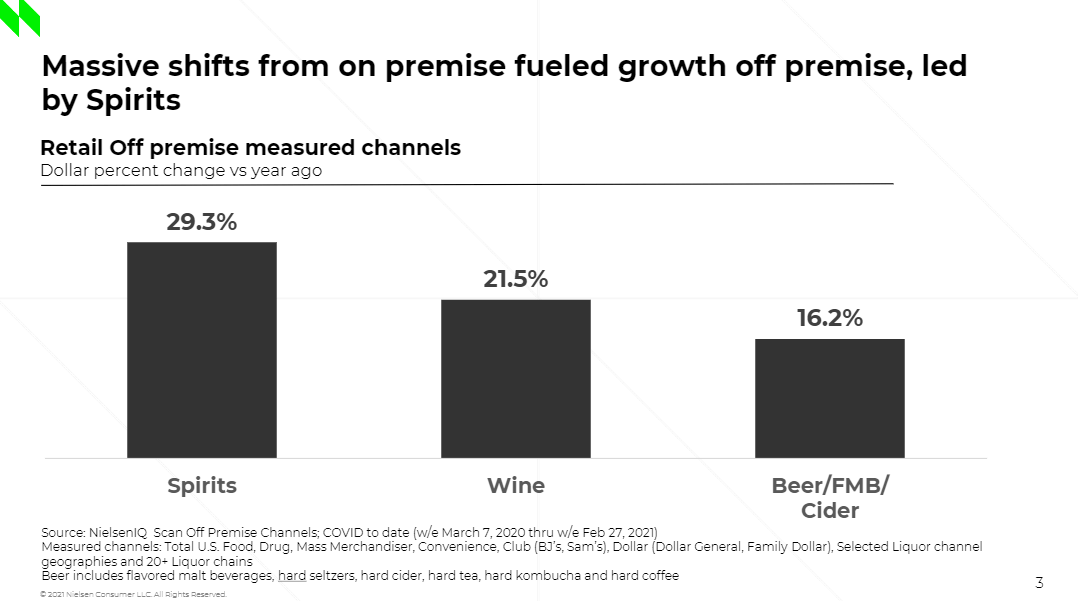
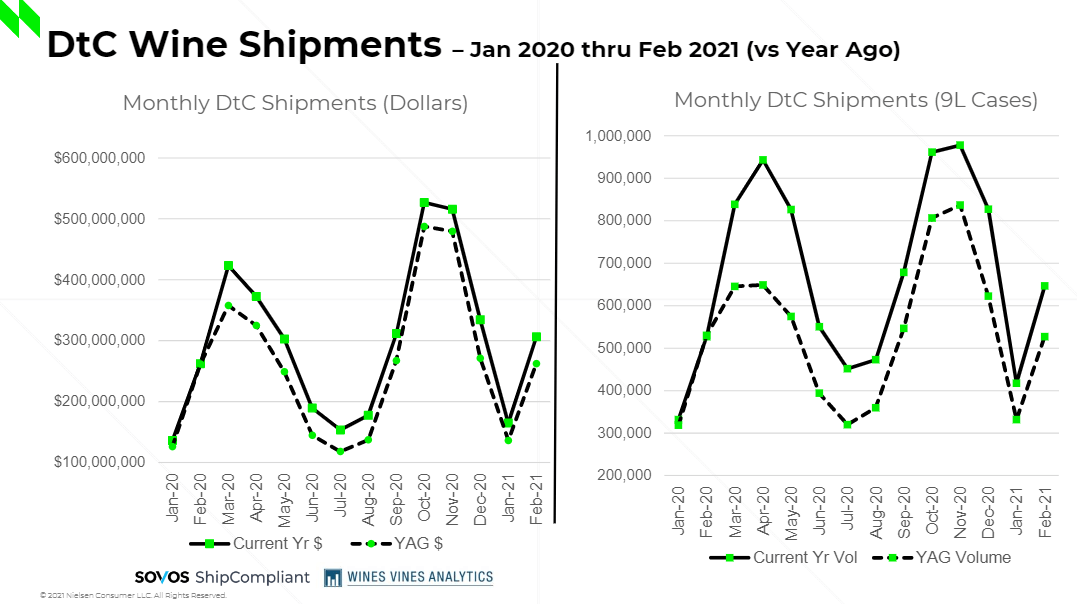
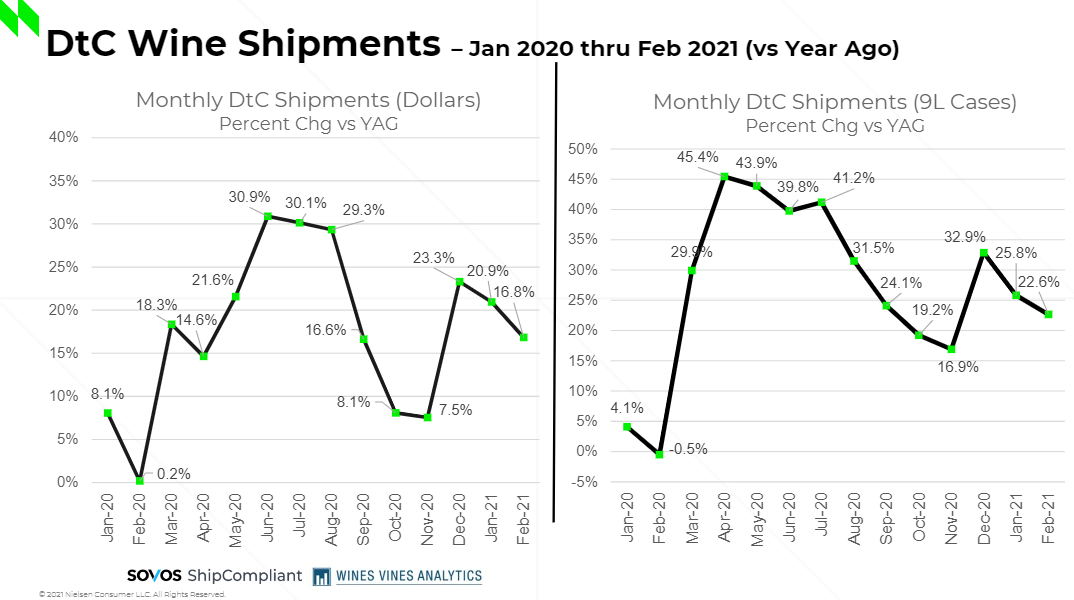
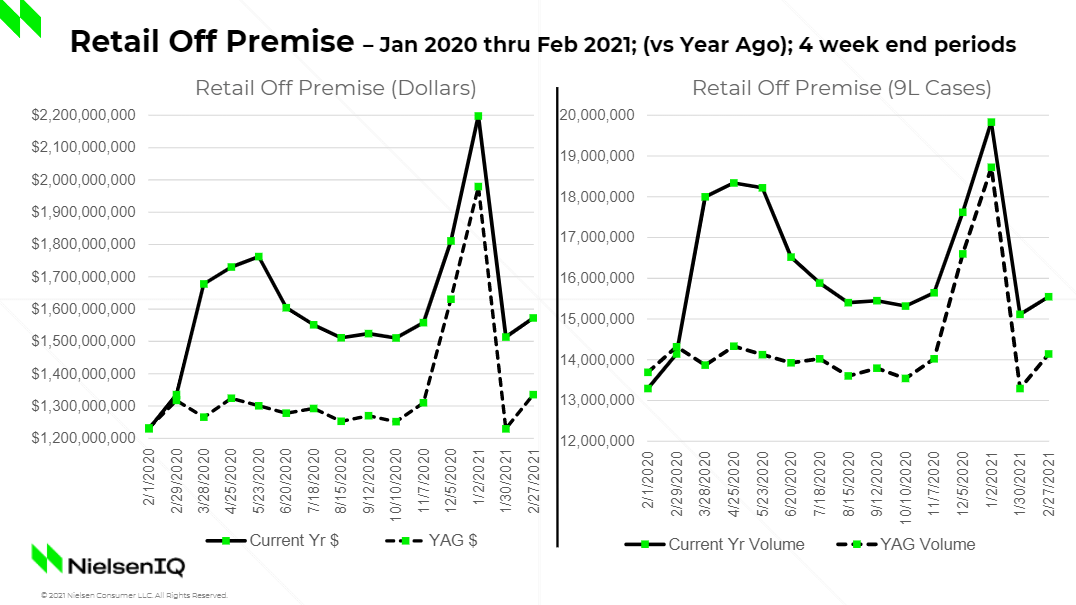
The wine market continues to be in flux as producers, retailers and consumers navigate the impacts of a global pandemic. Keeping a pulse on marketplace data has never been so important given these shifting dynamics.
Nielsen is collaborating with Wines Vines Analytics and Sovos ShipCompliant to provide a much more comprehensive view of the U.S. off-premise wine category than ever previously available, with a data product that enables both separate and combined views of retail off-premise sales and direct-to-consumer (DtC) shipments.
Here are some highlights from the most recent data, along with commentary from Nielsen consultant Danny Brager.
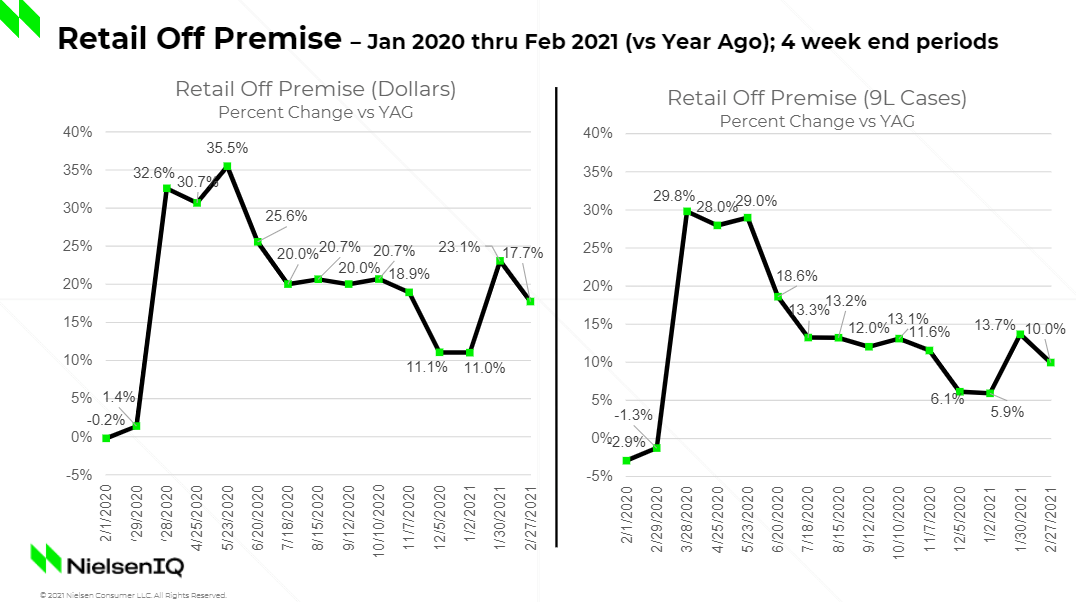
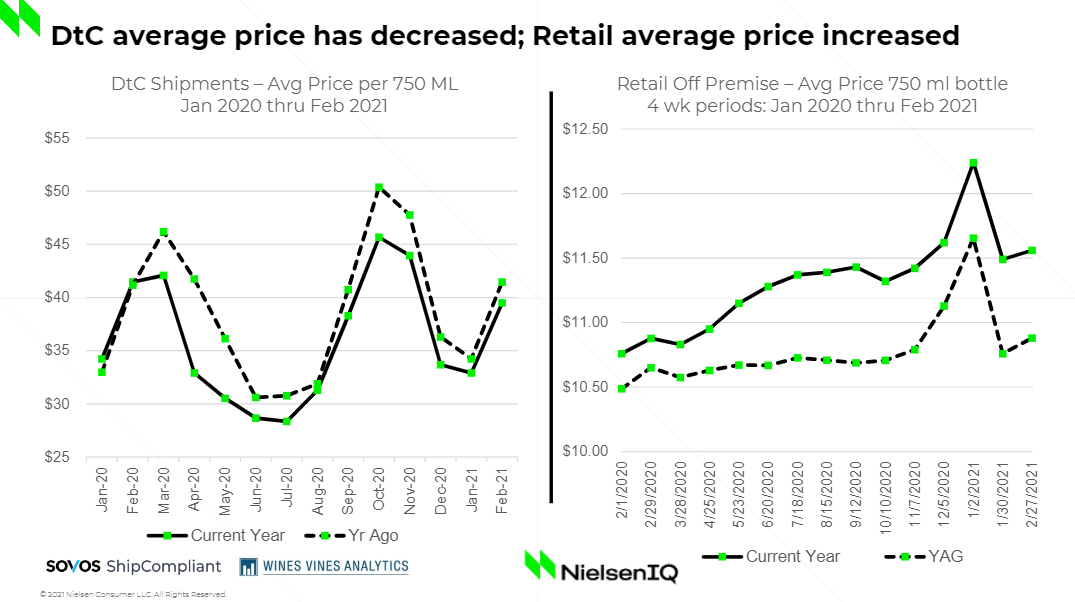
Interested in knowing more (e.g., by price tiers, varietals, origin, winery size, geography)? Contact Danny Brager at danny.brager@nielseniq.com.
Download the Direct-to-Consumer Wine Shipping Reporting for an in-depth look at the 2020 DtC wine shipping market.
On March 12, Kentucky Governor Andy Beshear signed HB 415 into effect, providing some very welcome updates to the state’s direct-to-consumer (DtC) alcohol shipping laws.
The biggest reform provided by the recently signed bill is the removal of a provision that previously prohibited DtC alcohol shippers from using third-party fulfillment houses to help with their shipping logistics needs. This change is a major shift for the state’s DtC alcohol shipping laws and should provide immediate relief to the many licensed DtC alcohol shippers, large and small, who rely on fulfillment houses to manage the complexities of readying packages with alcohol and bringing those packages to the designated carriers.
This change is also welcome in light of the ongoing debate about the value of fulfillment houses in the DtC alcohol shipping market and a bill proposed in Tennessee to prohibit their use.
The Kentucky Department of Alcoholic Beverage Control will be updating their regulations and application process to reflect the change in law, which removes the need for an applicant to designate addresses they own or lease as the locations from which shipments could be made.
The Kentucky bill also removed a requirement for licensed DtC shippers to register their brand/labels with the state before shipping those products.
In all, HB 415 revises and rewrites large portions of Kentucky’s DtC alcohol shipping laws, which were just enacted last year. The amendments and clarifications are beneficial to beverage alcohol suppliers and DtC shippers, and of course the Kentucky consumers they serve.
HB 415 became effective with the Governor’s signature.
Learn more about managing your DtC alcohol shipping compliance.
By Andrew Adams
Andrew Adams is the editor of the Wine Analytics Report and a regular contributor to Wine Business Monthly magazine. Adams grew up in the city of Sonoma, Calif., and graduated from the University of Oregon with a degree in journalism. In addition to working at daily newspapers for more than a decade, Adams worked for more than two years (three harvests) in the cellar and lab at a winery in Napa Valley.
The past year was a historic one for the winery direct-to-consumer channel, which is still relatively new and much smaller than both the retail off-premise and on-premise markets. Despite accounting for slightly more than 10% of total off-premise sales value, the DtC channel was a source of remarkable growth and consistent revenue during what proved to be one of the wine industry’s most challenging years. The following are a few recommendations on how winery staff can make the most of the 2021 Direct-to-Consumer Wine Shipping Report, the definitive examination of the channel produced annually by Sovos ShipCompliant and Wines Vines Analytics.
The report and our DtC data are not just based on Sovos ShipCompliant’s customers. While those transactions are at the heart of our statistical model, the Wines Vines Analytics database has such an accurate accounting of the more than 11,000 U.S. wineries that we are fully confident in our projection of the entire DtC market. That means when you compare your own internal DtC data to what is in the report, you’re accurately comparing how you did versus the entire market. The report provides comparative data for key winery regions, annual production, varietals and the top destination markets.
Year after year, the top varietals and wine types in DtC have been Cabernet Sauvignon followed by red blends and Pinot Noir. The past year saw significant growth of the “other” wine types, and while Cab remained No. 1 and shipment volume increased by more than 18%, the average bottle price per shipment fell by more than 13%. That indicates a flood of lower priced Cabernet wines had washed over the market as consumers purchased more everyday value wines or explored winery direct purchases and delivery for the first time. We’re still sifting through the data, but it appears — as one may expect — these first-time buyers were doing so at prices much lower than the channel’s average.
Digging into all varietals yields some interesting results. Sauvignon Blanc shipments were up 45% and Rosé enjoyed a 33% increase in shipment volume. The increases in shipments of these wines further demonstrates consumers were buying a greater variety of wines that were most likely intended for consumption occasions that have not traditionally been associated with DtC.
The states with the biggest DtC markets are also the leaders in on-premise and retail sales. This year’s report includes the year-over-year increase in shipment volume for all 50 states. Shipments to New Mexico, for example, were up more than 66% while Iowa saw a 47% surge and West Virginia was up 44.5%. The COVID-19 pandemic has been a national event and the increase in DtC shipments across the United States shows that consumers outside of “traditional” wine markets are buying wine direct and in volumes that are quite significant for those markets. Virtual tastings are expected to remain an important tool to engage with consumers. The data indicate a winemaker-hosted virtual tasting for a group of friends in Des Moines may be well worth the time and investment.
The past year showed that DtC is an integral part of a balanced sales strategy. Big margins from tasting room sales don’t account for much when the tasting room is closed indefinitely. DtC shipments are a way to serve consumer demand that other channels can’t or are unable to meet.
Our report provides the most objective and accurate picture of the DtC market that you can use to compare to data about other sectors of the industry. Understanding the total market doesn’t require as much time and investment as you may think, especially with free resources such as the annual report.
Download the Direct-to-Consumer Wine Shipping Report for an in-depth look at the 2020 DtC wine shipping market.
Recently, lawmakers in Tennessee introduced proposed legislation that would prohibit the use of fulfillment houses by direct-to-consumer (DtC) wine shippers for their sales to the state. If passed, this legislation could severely hamper the ability of DtC wine shippers to service the state, cutting off Tennessee consumers from accessing wineries of all sizes.
However impactful this legislation might be on the Tennessee market for DtC wine shipping (and keep in mind that it is far from certain it will pass; most proposed bills die before coming to a vote), the proposed law speaks to a broader question about fulfillment houses and how they fit into regulations around shipping wine DtC.
Tennessee regulators are far from alone in fearing fulfillment houses and seeking to restrict them, though this kind of outright ban is an extreme reaction. Much of this fear comes from misperceptions about what fulfillment houses are and what exactly they do in the context of DtC wine shipping. Better knowledge of who they are and what they do can lead to better rules and regulations that allow these invaluable services to operate in the DtC wine shipping market in a visible and compliant manner.
In a word, fulfillment houses are logistics centers. They are a service that wineries (and other alcohol suppliers) can use to store their products and can help with the process of bringing those products to purchasers when they are sold. They developed from storage warehouses, where suppliers could house their products before they were ready to be shipped.
Since many suppliers can struggle to find the room to house all of their product on their licensed premises, such storage facilities are invaluable and have been critical to supporting three-tier distributions, keeping alcohol in bond before it could be brought to a distributor.
As the DtC market developed, many fulfillment houses realized that they were well suited to help facilitate shipments to consumers. They were already storing the wines that licensed DtC shippers were now sending across the country, and with their logistical expertise, they were able to build out services to also package wines for their winery clients and hand off those packages to carriers to bring to consumers.
Since they are a business that holds and controls alcoholic beverages, even if just temporarily, they are required to be licensed by the state in which they are located. In California,where many fulfillment houses are based to service the California wine industry, the license they must hold is the Type 14 Public Warehouse license. As with all alcohol licenses, they must attest to their scruples and commitment to complying with alcohol regulations in order to remain in good standing.
Fulfillment houses provide a critical service to wineries engaging in DtC shipping. Wineries of all sizes face challenges when building out a widespread shipping model, which requires lots of infrastructure and human resources to manage, from storage to packaging to maintaining a loading dock for carriers to pick up those packages. A winery wants to focus on what it does best: producing a great product and marketing it to consumers. Even if they have the room, logistics, and human resources to handle their own shipping, they find utilizing the services of a fulfillment house well worth it (just as many DtC shippers rely on the support of software services to manage their compliance and tax reporting needs).
If fulfillment houses are not permitted to service DtC shipments to a state, then many DtC shippers will choose not to ship to that state, severely hampering the ability of consumers to access the products they want. While DtC shippers will lose business from that state, it is ultimately consumers who will suffer.
Some of the consternation surrounding fulfillment houses comes from not understanding what they are. They are often labeled a third-party provider, which would imply they could be grouped with online marketplaces or other third-party sellers. Since it is generally impermissible for third-party services to directly sell alcohol or otherwise be involved in DtC shipping of wine, some regulators may look at fulfillment houses and think that they are actually selling wine, that they are marketing to and getting money directly from consumers.
However, this is not the case. Fulfillment houses are merely logistical services; they do not “own” the wines they store, package, and help ship; they do not maintain marketplaces; and they do not make money from any individual sale of wine. They will only act on behalf of a licensed DtC wine shipper and then only to handle the logistics of getting a package of wine into the hands of a carrier. They serve to enable a licensed DtC wine shipper to manage and execute the shipment of wine sold by the licensed DtC wine shipper. They should not be confused with businesses that actually market and sell alcohol for DtC shipping, whether those be legitimate licensed DtC shippers or a third party marketplace that is operating in a legally dubious manner.
Part of this confusion likely stems from how an individual package of DtC shipped wine may be labeled. If the package is coming from a fulfillment house, it will likely use the fulfillment house’s shipping address as the return address on the label. It may appear from just looking at the package label that the fulfillment house was responsible for the shipment; a regulator would see such a label, not recognize the return address as belonging to any licensee, and believe that it is an illegal shipment coming from an unlicensed party even though the fulfillment house only shipped that package under the direction and authority of a licensed DtC shipper.
Fulfillment houses have long been seen as an easy target for regulators and parties that, for whatever reason, seek to hamper DtC shipping of alcohol. As such, if Tennessee does enact this new legislation to restrict fulfillment houses, it would hardly be alone.
Currently, fulfillment houses are also prohibited from servicing DtC shipments of alcohol to Oklahoma and Kentucky. Both states’ DtC laws require the product to be shipped only from the premises address listed on the DtC shipper’s license (notably, these are the latest two states to adopt laws permitting interstate DtC shipping of alcohol and their restrictions on fulfillment houses are more a matter of how the states interpreted their DtC laws as opposed to explicit bans, as Tennessee is working towards).
This has restricted the ability of many DtC shippers from entering those markets, and both states’ laws have been targeted for reform by advocates for DtC shipping of alcohol. In fact, at nearly the same moment as the proposed Tennessee legislation was introduced, a bill in Kentucky, HB 415, was put forward that would permit the use of fulfillment houses in DtC shipments to the state as state lawmakers there recognize the critical support that fulfillment houses bring to the DtC market.
Other states have implemented less draconian measures that seek to regulate fulfillment houses, but still allow them to operate. Both Virginia and North Dakota require fulfillment houses to become licensed in those states before they can facilitate DtC shipments there. Illinois recently began requiring DtC licensees to provide a list of their fulfillment houses when applying for a new or renewed license, and requires fulfillment houses to file a regular report on what shipments they’ve serviced to the state.
While state regulators may have some consternation about fulfillment houses, and question their activities in the DtC alcohol shipping market, there is a world of difference between regulating them and outright prohibiting them. Fulfillment houses, like most participants in the beverage alcohol industry, recognize the need for regulations and will follow their parameters. If they are not permitted to work in a state, they will not facilitate shipments there. But blanket bans will only hurt consumers as DtC shippers will stop operating in that state. Such bans will also do little to stop actual illegal shipments by unlicensed sellers and other businesses that are willing to operate outside of the law.
While requiring fulfillment houses to get licensed or otherwise be catalogued in the states they ship to, there is actually a fairly simple way for states to better monitor shipments of alcohol in their borders and where legal shipments of alcohol are coming from.
Many states require DtC shippers and carriers to provide regular reports, detailing the shipments they’ve made recently. These reports include lots of data about a shipment, including the name and address of the recipient, date of delivery, whether a signature was collected, and even the contents of the package (though this is only known and provided by the shipper, not the carrier).
While some data will be shared between a shipper’s and a carrier’s reports, states can often struggle to entirely match them up to show who exactly was responsible for each shipments a carrier reports. But for every shipment made, there does exist a single, unique data point that would be known, and could be reported, by both carriers and the DtC licensee: the shipment tracking number.
By requiring all DtC shipping reports to include the tracking number for each shipment (and also by adopting electronic spreadsheets for reports, which can be easily sorted and searched), states can readily monitor DtC shipments into their states and verify the licensee behind each shipment. In this way, they can remove the confusion that could arise when a fulfillment house’s address is reported as the source of a shipment; since a licensed DtC shipper would indicate they are responsible for the shipment with that tracking number, the state can be assured that it was a legitimate shipment by a licensed party that has properly complied with the state’s regulations and tax requirements.
Everyone in the beverage alcohol industry knows that it is heavily regulated, and fulfillment houses are no exception. However, there is a wide spectrum of options for states to regulate fulfillment houses, and measures like requiring the reporting of tracking numbers or for DtC licensees to identify their fulfillment houses are much more amenable than outright bans. Indeed, outright bans, like what Tennessee is proposing and what Kentucky is trying to do away with, will only hurt consumers as wineries and other licensed DtC shippers of alcohol will exit those markets when they find their critical partners in DtC shipping banned by law.
See how Sovos ShipCompliant can help you with your DtC shipping compliance.
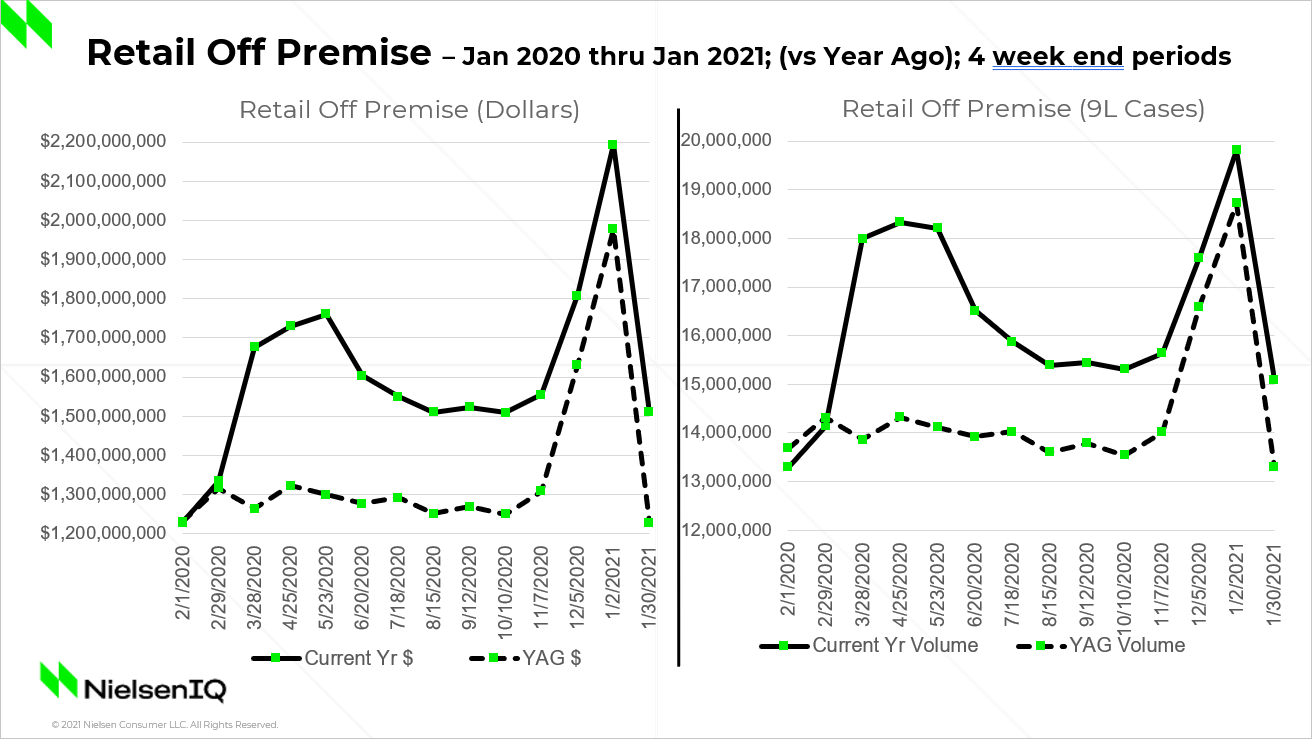
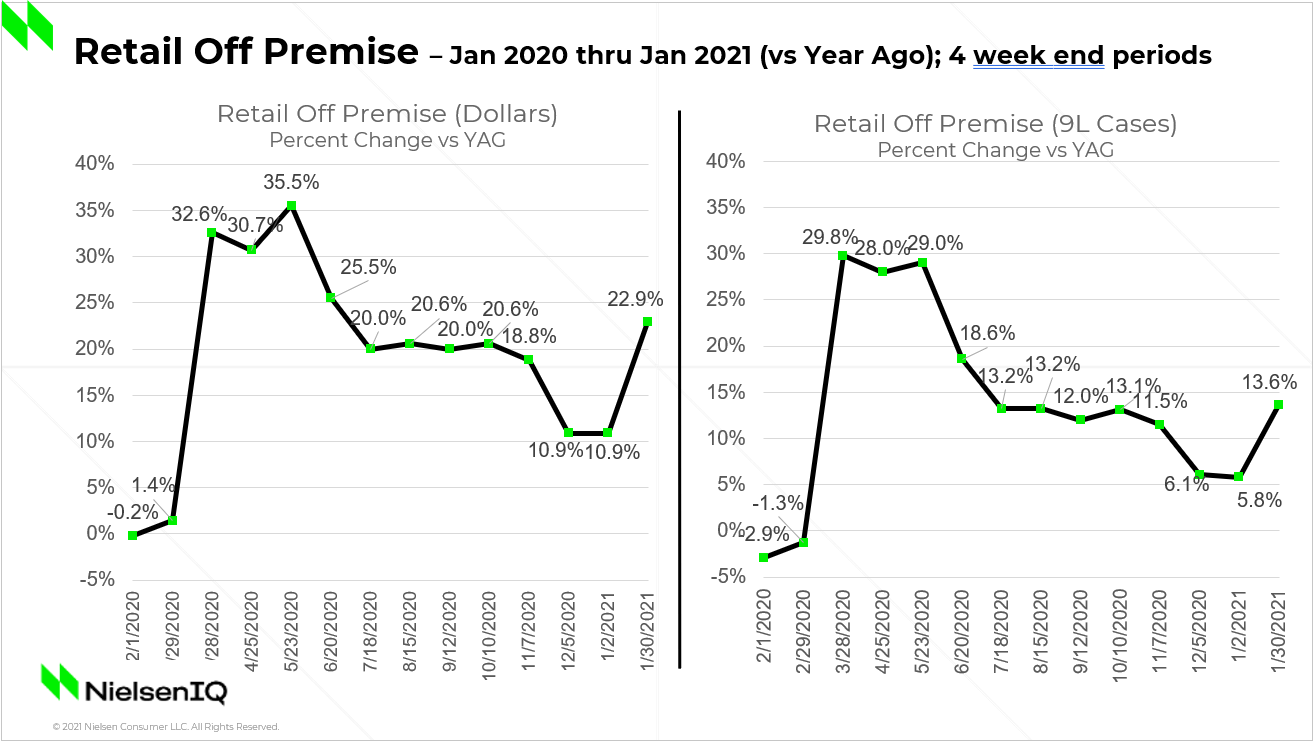
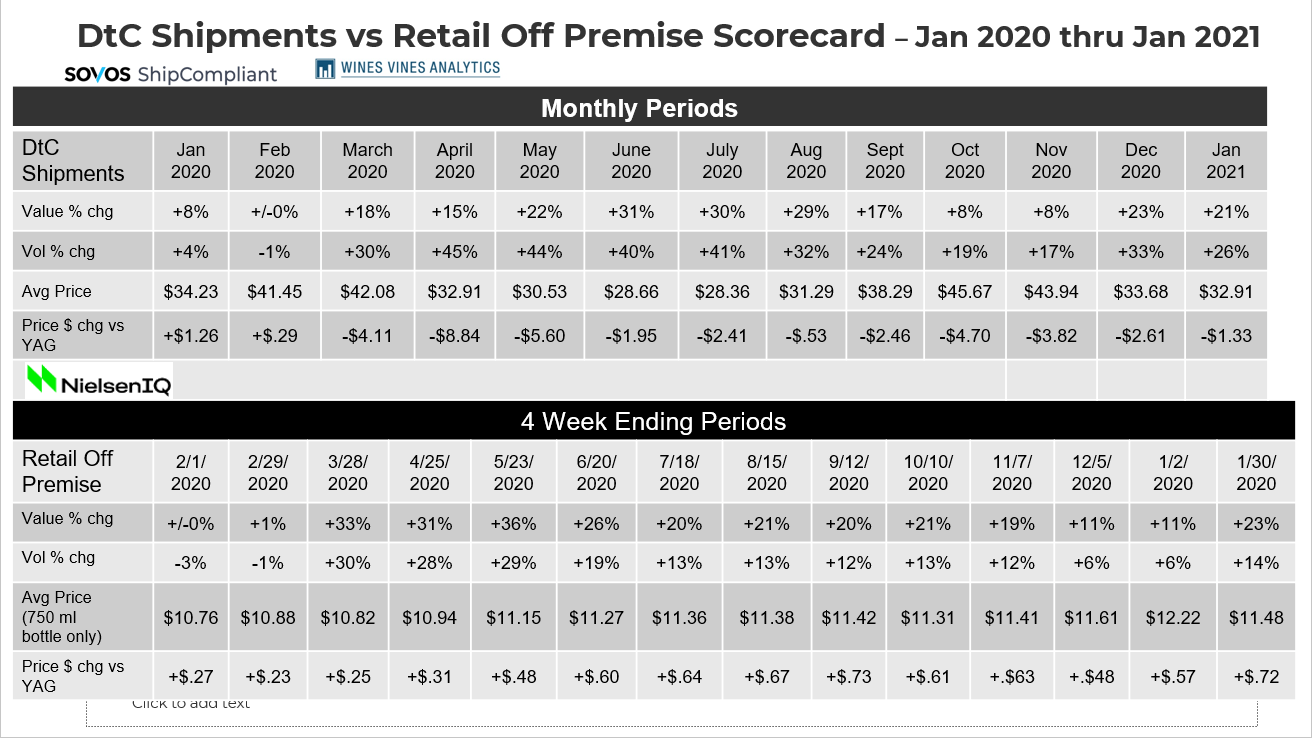
The wine market is in greater flux than ever as producers, retailers and consumers navigate the impacts of a global pandemic. Keeping a pulse on marketplace data has never been so important given these shifting dynamics.
Nielsen is collaborating with Wines Vines Analytics and Sovos ShipCompliant to provide a much more comprehensive view of the U.S. off-premise wine category than ever previously available, with a data product that enables both separate and combined views of retail off-premise sales and direct-to-consumer (DtC) shipments.
Here are some highlights from the most recent data, along with commentary from Nielsen consultant Danny Brager.
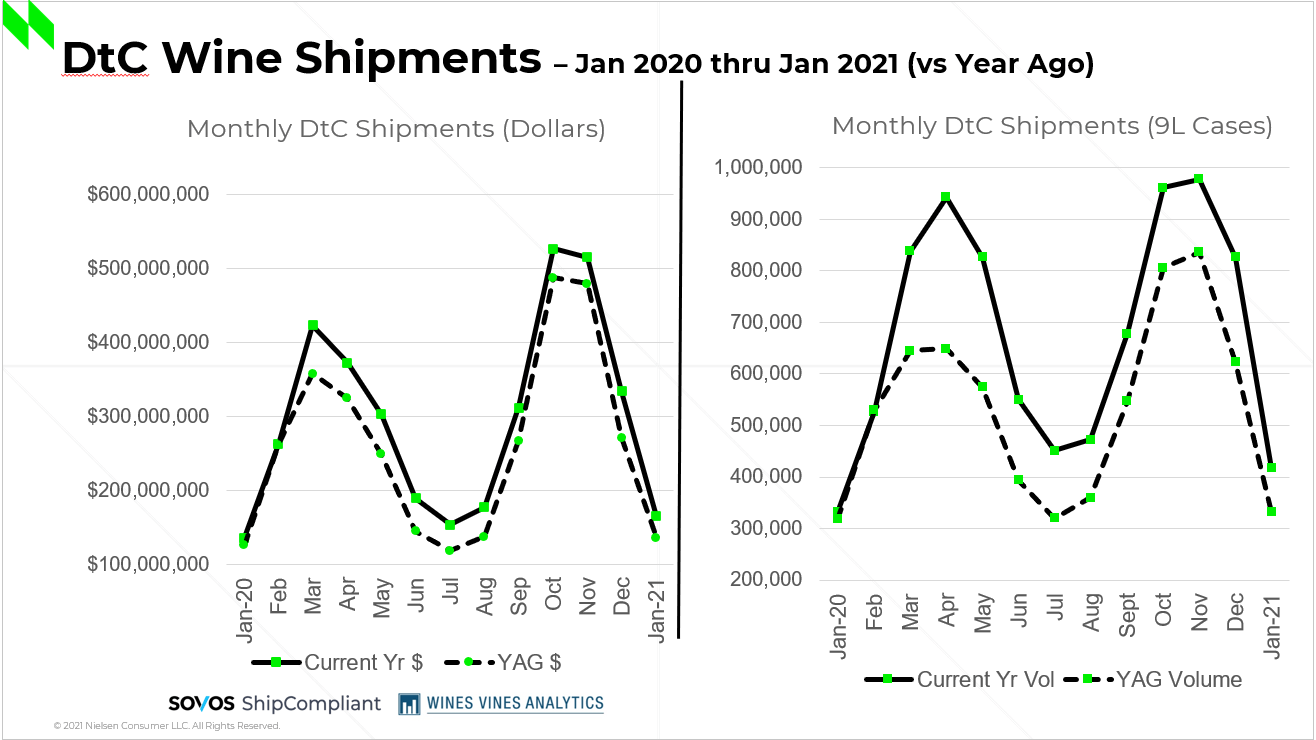
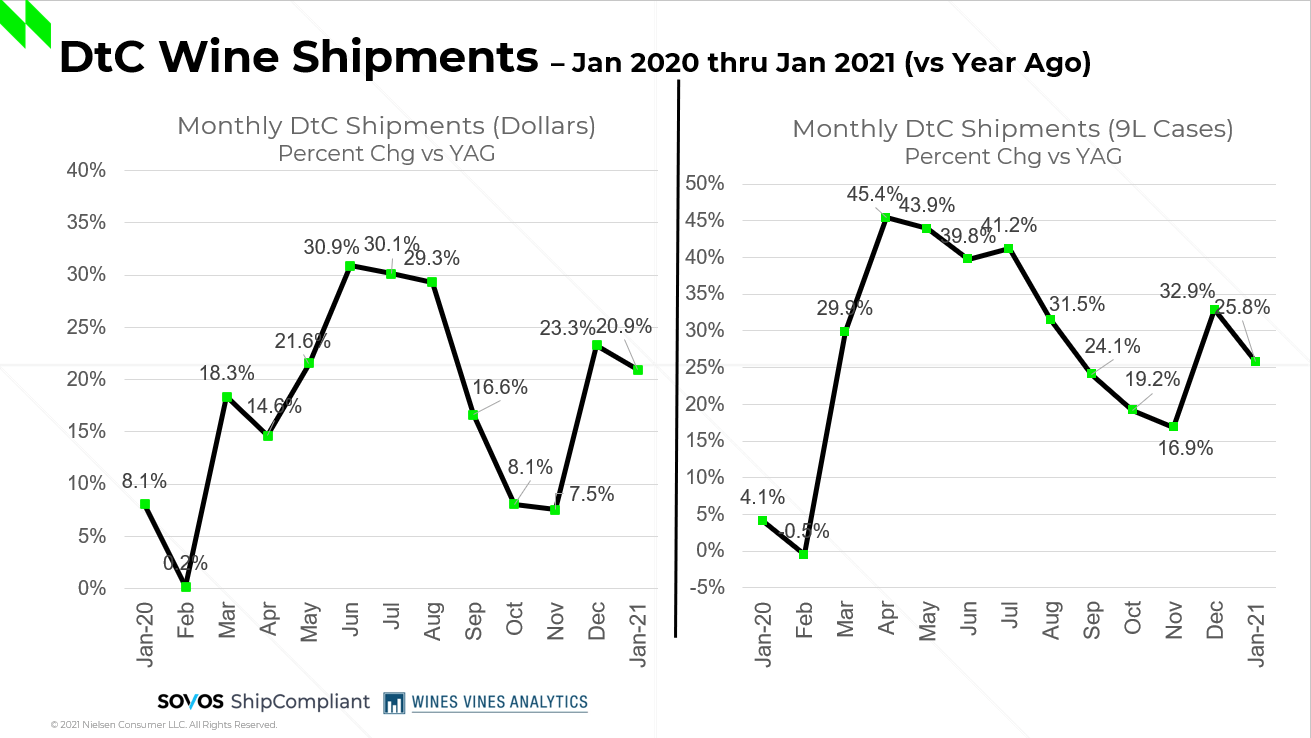
Interested in knowing more (e.g., by price tiers, varietals, origin, winery size, geography)? Contact Danny Brager at danny.brager@nielsen.com.
Download the Direct-to-Consumer Wine Shipping Reporting for an in-depth look at the 2020 DtC wine shipping market.
Consumer buying patterns have drastically changed over the past year, affecting the beverage alcohol industry in many ways. The COVID-19 pandemic has shifted what consumers are buying, where, and how often. Sovos ShipCompliant has examined data from our Product Registration Online (PRO) tool to see just how much consumers’ buying patterns have influenced producers’ new product registrations.
Below is a breakdown of the new product registration data via PRO from the last quarter of 2020 (October, November, December) for spirits, beer and wine.
The spirits category continued to have high growth, with gin in the spotlight. For spirits overall, the quarter saw a 15% increase in registrations over Q4 of 2019 but a 13% decrease from Q3 of 2020. Examining the data by types of spirit reveals some wildly different trends:
Beer registrations didn’t see the growth that spirits did. Flavored and specialty malts continued to grow with a 20% increase compared to Q4 of 2019 and a 50% increase in December alone. But ale, porter and stout categories were all down 18% from Q4 of 2019. So when combined, beer registrations were down 4% overall from Q4 of 2019.
Wine also experienced decline, with an overall decrease in registrations of 7% from Q4 of 2019. Specifically, Rosé was down 14%, table red was down 2% and table white was also down 2% from Q4 of 2019.
Though 2020 was a year like no other, the question is if the consumer trend toward spirits and away from wine and beer will continue in 2021.
Learn how PRO enables fast, easy electronic brand filings for beer, wine and spirits in participating states.
Join us for this two-day virtual event that gathers three-tier and direct-to-consumer industry members to look at both challenges and opportunities across channels. Topics include federal and state regulatory updates; data and trends across wine, spirits and beer; and import tariffs.
Buy your ticket today for this one-of-a-kind industry event. Click HERE
This January, Sovos ShipCompliant released the 2021 Direct-to-Consumer (DtC) Wine Shipping Report with our partner, Wines Vines Analytics. This report features exclusive data and insights on the state of the industry not tracked or reported on anywhere else. With wine shipments to consumers reaching a record $3.7 billion in 2020, there has never been a better time to understand the evolving trends of the DtC wine channel.
The Direct-to-Consumer Wine Shipping Report takes shipment data from over 1,100 U.S. wineries’ shipments to consumers each month, totaling more than 40 million shipments over the course of the year. As we gather information, each shipment is edited for submission for governmental tax and reporting requirements, and all elements are validated by standardized tables. The verified data is submitted to a proprietary model built on a database of about 11,000 wineries that is updated monthly by Wines Vines Analytics.
The DtC report is packed full of data, insights and forecasts regarding the wine industry. The report takes a deep dive into findings including by month, winery region, winery size, varietal, destination of shipments and price to produce the most thorough analysis. Here are some notable takeaways:.
Download your free copy of the 2021 Direct-to-Consumer Wine Shipping Report for additional insights and analysis of DtC channel trends.
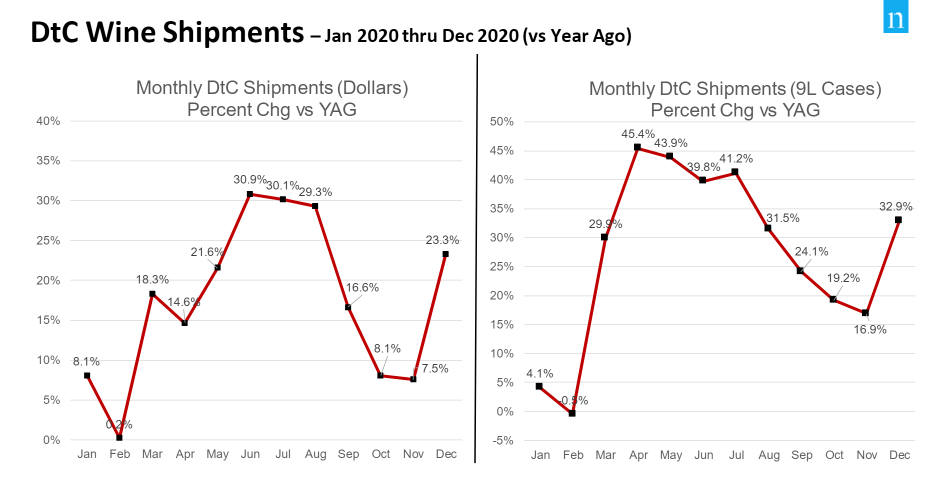
The wine market is in greater flux than ever as producers, retailers and consumers navigate the impacts of a global pandemic. Keeping a pulse on marketplace data has never been so important given these shifting dynamics.
Nielsen is collaborating with Wines Vines Analytics and Sovos ShipCompliant to provide a much more comprehensive view of the U.S. off-premise wine category than ever previously available, with a new data product that enables both separate and combined views of retail off-premise sales and direct-to-consumer (DtC) shipments.

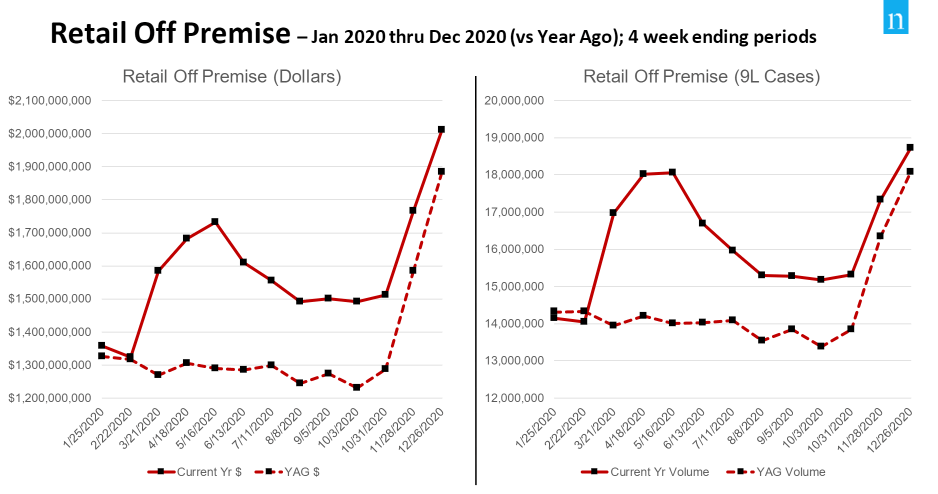

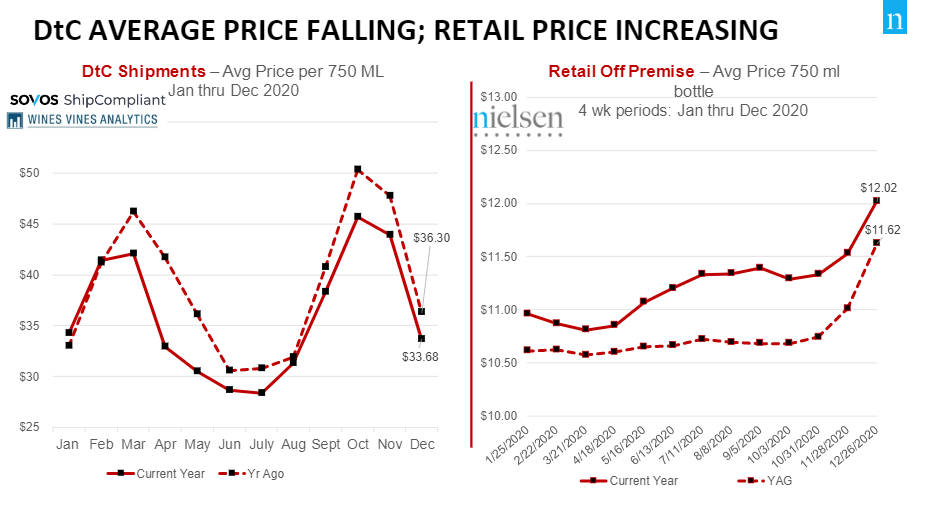

Interested in knowing more (e.g., by price tiers, varietals, origin, winery size, geography)? Contact Danny Brager at danny.brager@nielsen.com.
Download our annual Direct-to-Consumer Wine Shipping Reporting released on January 25 for an in-depth look at the 2020 DtC wine shipping market.
This month, Sovos ShipCompliant will release the annual Direct-to-Consumer (DtC) Wine Shipping Report with our partners Wines Vines Analytics, based on 2020 data. Here is what you need to know about this comprehensive report and some key findings from last year’s report.
The Direct-to-Consumer Wine Shipping Report is a one-of-a-kind industry snapshot, presenting data not tracked or reported anywhere else. Sovos ShipCompliant and Wines Vines Analytics have been collaborating for more than 10 years on the DtC channel’s exclusive shipping report, delivering detailed insights on wine shipments made from wineries to consumers in the United States.
The Wines Vines Analytics team created an algorithm that uses a database of nearly 10,000 U.S. wineries to extrapolate all DtC shipments from millions of anonymous transactions filtered through the Sovos ShipCompliant system in 2020. The model tracks sales by winery region, annual winery production, destination of shipments, wine type (varietal) and price points. The result is the most accurate projection of the American DtC wine shipping channel.
The 2020 report, covering 2019 data, shined a light on some new industry trends. With the COVID-19 pandemic having a huge impact on the wine industry and how consumers shop, will this year’s report be wildly different from previous years, or will trends only vary slightly? Here are some of the top takeaways from last year’s report on 2019 shipping:
We’ll have updates on these and other findings in the 2021 DtC report. In the meantime, you can take a look at how the DtC channel performed in 2019 by checking out last year’s 2020 Direct-to-Consumer Wine Shipping Report.
Sovos ShipCompliant General Manager Larry Cormier will be speaking at the Virtual Direct-to-Consumer Wine Symposium alongside Andrew Adams, editor at Wine Vines Analytics on Friday, January 22 at 11:40 AM PT and share what did and didn’t change in DtC wine shipping in 2020 as a result of COVID-19. Tune in to hear updated reporting on volume, value, shipment destination states, as well as outcomes by region, varietals and price tiers.
Subscribe to our blog to get the latest on this report and more.
Governor Jared Polis recently signed HB 20B-1004, establishing temporary COVID-related sales tax relief for on-premises liquor establishments, restaurants, and other qualifying food sellers, including mobile food trucks. Under this bill, qualifying food retailers are permitted to deduct up to $70,000 in sales per month from their state-level sales tax returns for the November and December, 2020, and January and February, 2021, reporting periods. This is permitted for up to five separate physical locations the qualifying retailer operates in the state. This allows the retailer to retain the sales tax money they collected from customers during these reporting periods. Notably, this retention of tax money applies only to the reporting of sales for the 2.9% state-level tax, and revenue related to any county, city, or special district taxes must still be reported in full and all such taxes must be remitted.
On December 22, Congress passed a new COVID relief measure, providing necessary relief and aid to the still reeling economy.
Included in the bill was the permanent extension of the Craft Beverage Modernization and Tax Reform Act (CBMTRA). This is extremely welcome to the beverage alcohol industry, as suppliers would have faced a huge hike in their federal excise taxes effective January 2021 if Congress had not acted.
The CBMTRA was first enacted in December 2017, providing steep cuts to federal excise taxes on alcohol, including specific allowances for certain product types like ciders, mead, and sparkling wines. A fuller account of what was originally included in CBMTRA, which have now been made permanent, is described in an earlier post on our blog.
This relief is extremely beneficial to the beverage alcohol industry, which has been severely impacted this year by the ongoing COVID crisis. And that the reduced tax rates have been made permanent means that beverage alcohol suppliers do not need to worry about this kind of down-to-the-wire legislating in future years. The CBMTRA has been extremely popular, receiving broad, by-partisan support for years, so it is very positive to see it finally be granted permanent status and have a resolution to the lobbying efforts of many industry organizations.
To learn more about beverage alcohol compliance for your business, get it touch with an expert.
The wine market is in greater flux than ever as producers, retailers and consumers navigate the impacts of a global pandemic. Keeping a pulse on marketplace data has never been so important given these shifting dynamics.
Nielsen is collaborating with Wines Vines Analytics and Sovos ShipCompliant to provide a much more comprehensive view of the U.S. off-premise wine category than ever previously available, with a new data product that enables both separate and combined views of retail off-premise sales and direct-to-consumer (DtC) shipments.
Here are some highlights from the most recent data, along with commentary from Nielsen consultant Danny Brager.


Interested in knowing more (e.g., by price tiers, varietals, origin, winery size, geography)? Contact Danny Brager at danny.brager@nielsen.com.
And, stay tuned for a detailed report of the DtC wine shipping market in 2020 via our annual Direct-to-Consumer Wine Shipping Report — the 2021 report (2020 look-back) will be released on January 25, 2021.
In April, 2020, Kentucky passed HB 415, which established new rules permitting the direct-to-consumer (DtC) shipping of alcoholic beverages. Early on December 14, 2020, the Kentucky legislature’s joint committee on Licensing, Occupations, and Administration Regulations voted to approve new regulations enforcing HB 415 making those laws effective and finally allowing DtC shipping to begin in the state.
The approval of these regulations allows the Kentucky Alcoholic Beverage Control to issue approved licenses to applicants for the new License to Direct Ship to Consumers. Once an applicant receives their approved license and completes any other required registration with the state’s Department of Revenue, they may begin selling and shipping alcoholic beverages directly to Kentucky residents.
Notably, Kentucky’s bill will allow all alcoholic beverages to be shipped to the states’ residents. However, only parties that hold a production license issued by their home state will be eligible for a License to Direct Ship to Consumers, meaning retailers are not permitted to ship DtC into Kentucky.
This new set of laws replaces previous statutes for DtC shipping to Kentucky, which for various reasons proved ineffective. The laws under HB 415 closely resemble other states’ DtC shipping laws and it is expected that the state will soon prove to be a valued new destination for DtC shippers.
Like all states that permit DtC shipping of alcohol, Kentucky imposes many rules on shippers. These include:
The addition of a new state to the map that permits DtC shipping is always a matter of good news for us at Sovos ShipCompliant and for our customers. When suppliers are permitted access to new markets and are allowed to fulfill consumers’ desire for variety and new products, and states are able to reap additional tax payments, it benefits all parties. We look forward to providing the necessary support for our users to manage their direct shipper compliance and tax needs in Kentucky.
See how Sovos ShipCompliant can help you stay compliant in your direct-to-consumer shipping operations.
