
Sovos is a proud partner of the Oregon Wine Symposium. As the premier educational event and trade show for the Northwest wine community, the Symposium covers the most relevant topics in viticulture, enology, and wine business. Presented by leading wine industry experts, the Symposium is a must-attend event for winery and vineyard owners, vineyard managers, winemakers, marketing and sales managers, and winery staff. Get your ticket now at https://www.oregonwinesymposium.com/2021/begin.
Illinois recently implemented new sales tax rules for businesses that have economic nexus in the state. These rules are broadly applicable to all remote sellers, and so if any direct-to-consumer (DtC) wine shipper meets the general economic nexus thresholds on their sales to the state, then they will need to comply with these new requirements. Like most states, Illinois has defined economic nexus as making either over $100,000 in gross receipts or 200 separate transactions within the previous 12 months. The state requires remote sellers to review their previous 12 months of sales on a quarterly basis, as once they reach either of these thresholds, they will need to register with the state for Retailer’s Occupational Tax effective in the first quarter.
Illinois has had economic nexus rules in place for a few years now, so really the major change is that going forward, remote sellers with economic nexus (including DtC wine shippers) will be required to collect and remit all local sales tax based on the effective rate at the destination address for their shipments, whereas before they could collect and remit at the 6.25% state tax rate alone. DtC shippers who do not meet either of the economic nexus thresholds will not see any changes to their tax liability in the state and can continue to collect and remit the state tax alone under their Use Tax Registration.
While Tennessee Wine and Spirits was being argued before the Supreme Court, a set of lawsuits were put on hold that were related to the question of DtC shipping by retailers and whether states could establish permissions for in-state retailers but not for out-of-state retailers, which would seem to discriminate against those out of state interests. Then, when the Supreme Court ruled in Tennessee Wine and Spirits that states could not enforce beverage alcohol laws that discriminated against out of state businesses without providing clear, demonstrable proof that such laws were narrowly tailored to upholding the principles of protecting the health and safety of their residents, we figured it meant those lawsuits were very likely to be settled in favor of the out-of-state retailers.
However, things have not really played out as expected. In one high-profile case, Lebamoff v. Whitmer, the 6th Circuit Court of Appeals ruled that Michigan’s seemingly discriminatory law was valid, despite the Tennessee Wine and Spirits ruling. This case has been appealed to the Supreme Court, and there have been signs that make it seem like the Court will hear it. If it does, that will preempt any complications if other appeals courts make a different ruling from the 6th Circuit in their own lawsuits (cases challenging similar laws in Illinois and Missouri are also pending and likely to go before appeals courts in the coming months).
It’s rather unclear how the Supreme Court might rule on the 6th Circuit’s Lebamoff case if it chooses to hear it. In Tennessee Wine and Spirits (and in Granholm before it), a majority of the Court did find discriminatory rules to be invalid and gave less credence to state claims that the 21st Amendment allowed them to regulate alcohol in any way they saw fit, even if it violated other parts of the Constitution (primarily the Dormant Commerce Clause). However, several Justices (Justice Gorsuch, in particular) seemed reluctant to permit what they called an “Amazon for alcohol,” and so they may try to find a way to allow states to prohibit interstate shipping of alcohol by retailers without contradicting their previous rulings invalidating discriminatory state laws on alcohol sales. How they will square that circle, though, and what impacts it might have on other aspects of DtC shipping by suppliers, is a very big unknown. We will be paying very close attention to whatever comes out of the Supreme Court in the coming months and recommend anyone else with an interest in this market to do the same.
During the COVID crisis, a number of temporary provisions were enacted. Many of these were related to providing emergency relief to businesses struggling in the moment, including delaying license expirations, delaying filing deadlines, and offering payroll support. But many states also extended greater permissions to beverage alcohol suppliers, distributors, and retailers in an effort to shore up their businesses during a very difficult time. A very common provision was permitting more deliveries and curbside pickups, and allowing on-premise retailers to sell alcohol to-go (generally requiring they accompany orders for food). Generally, these did not legalize these activities per se, but more the case that the state would not enforce restrictions on these activities that would normally apply.
But we have seen a few states move forward and make these temporary provisions permanent. Again, they are largely focused on granting more permissions to local businesses, primarily on-premise retailers who have been particularly harmed by the necessary COVID-related social distancing restrictions. For instance, Colorado passed legislation to extend its to-go sales of alcohol permission through at least July 2021, and there are efforts to make that permanent.
One area that we are hopeful for permanent change will be in regards to states’ DtC shipping laws and extending more permissions for breweries and distilleries to ship their products DtC. Currently, they face a rather small list of states (about 10 and six, respectively) compared to wineries (who can ship to 46 states). But there has been a tremendous surge in interest among consumers for increased DtC shipping, so it’s possible there will be a groundswell in the coming months and years to allow more DtC shipping of alcohol even after this time when social distancing is so important.
Learn how Sovos ShipCompliant can help you with your beverage alcohol compliance needs by getting get in touch with an expert today.
So, you’re thinking about direct-to-consumer (DtC) beer shipping. But first, what exactly do we mean when we talk about DtC beer shipping? Well, traditionally, alcohol is sold by a supplier to distributors who then sell it to retailers who then sell it to consumers. But with DtC or direct beer shipping, consumers place an order directly with the supplier that will then be shipped to that consumer’s residence.
According to the 21st Amendment, each state is enabled to regulate alcohol within their borders, including the sale and transportation of alcohol. Generally, beer may only be sold by licensed retailers or by local brewpubs and craft breweries, which requires the consumer to personally transport beer they buy on licensed premises.
However, breweries are permitted to ship directly to residents in Arkansas, Kentucky, Nebraska, Nevada, New Hampshire, North Dakota, Ohio, Oregon, Pennsylvania (retailers and wholesalers only), Vermont, Virginia and D.C. These states don’t make special provisions for beer specifically, but instead allow shipping of beer under similar rules that permit shipping of wine.
Using the direct wine shipping market as a guide to expanding direct beer shipping
In order to expand direct beer shipping options to more states, the wine shipping market is a good place to start. Currently 45 states allow wineries to receive and fulfill orders directly from their residents. States saw direct-to-consumer shipping as a positive, in that they could help foster their native wineries and vineyards by giving them wider access to the market, and that they wouldn’t need to rely on wholesalers picking up their products. Unfortunately for beer lovers, these actions—which have led to a $3+ billion industry in DtC wine shipping—largely did not include beer.
The production of wine is much more centralized, with the majority being made in California and the west coast. With less variety in where wine is produced, there are limited local options for consumers—creating a greater need for direct shipping.
The beer industry however, operates differently. Beer is largely dominated by big producers like Coors and Anheuser-Busch which are universally available, negating the widespread need for direct shipping. Since every state has its own small craft breweries, a beer drinker has more local options, reducing the need to look elsewhere and use direct-to-consumer shipping.
Then there is the cost of direct shipping. Beer has a much lower price point than wine. While a case of wine may cost hundreds of dollars, a case of beer is unlikely to be more than $30. So it may cost as much to ship the beer as the beer itself costs; adding ten or twenty dollars for shipping wine that costs $250 may seem much more justifiable.
Yes, you can ship beer DtC in the states that permit it. Direct beer shipping is in its infancy when compared to direct wine shipping, but there is plenty of opportunity for this market to grow. With recent temporarily lifted restrictions around alcohol shipping and purchasing in many states due to the COVID-19 pandemic, there may be increased momentum and demand for this option—bringing it forefront and possibly opening up more states to direct beer shipping in the future.
For more information see our state-by-state DtC beer shipping rules.
This year, Black Friday and Cyber Monday experienced the highest transaction and sales rates in their history. Black Friday saw an approximate 22% increase in sales, reaching $9 billion and Cyber Monday hit $10.8 billion in sales, up nearly 15% from last year, setting the record for the largest U.S. online shopping day ever. As e-commerce has become more and more ingrained in our daily lives, it’s no surprise that online activity for both Black Friday and Cyber Monday has increased.
Here at Sovos ShipCompliant, the data from Sovos’ global tax rate calculation engine and database, supports this trend—with transaction volumes reaching seven times higher than average.
Furthemore , on Cyber Monday, our tax determination engine experienced its highest volume ever, with about 46 million line items calculated, a 169% increase over 2019. In addition, 13 million transactions were counted, a 202% increase over 2019. On Black Friday, the number of line items calculated increased 211% compared to 2019, and the volume of transactions increased by 197% when compared to 2019.
Sovos’ global tax determination system continued to perform seamlessly and conduct calculations within milliseconds despite the larger-than-ever number of transactions. The response times met or exceeded performance expectations even with line item calculations reaching almost 37 million on Black Friday and 46 million on Cyber Monday.
For wineries and online wine retailers, October, November and December are traditionally busy months, with a spike in sales and direct-to-consumer shipping due to the holidays and gift-giving season. On Black Friday and Cyber Monday, the engine calculated about 343,000 line items for Sovos ShipCompliant clients—an indicator that consumers are continuing to purchase wine online.
Learn how Sovos ShipCompliant supports compliant DtC shipping with real-time tax determination and compliance checks, not just on Black Friday or Cyber Monday, but all year long.
Starting January 1, 2021, many direct-to-consumer (DtC) wine shippers will face an added sales tax burden on their shipments to Illinois. The Illinois Department of Revenue (DOR) published FY 2021-06, which explains the upcoming change.
Under the recent “Leveling the Playing Field for Illinois Retail Act,” the state will require all remote sellers with economic nexus in the state, including DtC wine shippers, to collect and remit state and local taxes at the rate effective at the destination address for their shipments. Affected remote sellers will be required to register with the state for Retailers Occupational Tax in order to properly remit these taxes.
Previously, Illinois permitted all retailers selling to Illinois residents from locations outside of the state to collect and remit only the state sales tax rate of 6.25% for all sales in the state. Going forward, though, all remote sellers with economic nexus will now need to apply destination-specific local sales tax rates.
Illinois defines economic nexus as making either over $100,000 in annual revenue in the state or 200 separate transactions to Illinois residents in one year. Any remote seller, including DtC wine shippers, that meets either of these thresholds will need to register for Retailers’ Occupational Tax and collect and remit based on destination-specific sales tax rates.
Notably, DtC wine shippers who do not meet the economic nexus thresholds will not see any change in their sales tax burden in the state. Such wine shippers may maintain their Use Tax registration and continue to collect and remit just the 6.25% state rate. This is a requirement imposed on them as holders of a Winery Shipper’s License in the state, as other remote sellers who do not have economic nexus in the state do not have any sales tax burden in the state.
This change does not in any way affect a DtC wine shipper’s Illinois Liquor Gallonage Tax (excise tax) burden.
The most important thing for a DtC wine shipper to do now is first recognize if they are affected by this change in policy. They should review their previous 12 months of sales into Illinois to see if they have either made over $100,000 in revenue in the state or made over 200 separate transactions to Illinois residents.
If they meet either of these thresholds, they will need to update their tax registration with the Illinois DOR. This can be done by logging into their MyTax Illinois account, clicking on “Register for New Tax Accounts” and selecting the “Retailer” option. The Illinois Central Registration Division can provide help where needed either at 217-785-3707 or REV.CentReg@illinois.gov.
Once this registration has been completed, starting January 1, 2021, the DtC wine shipper will need to ensure they are collecting sales tax from their sales to Illinois residents based on the tax rate effective at the Illinois resident’s address. Illinois is developing a Tax Rate Finder tool to help with this determination.
Sovos ShipCompliant users will also be able to adjust their tax preferences and reporting settings to comply with their new sales tax needs in Illinois. Further notices will be provided when this option is made available by the end of the year. Any tax returns due in January should still be reported under the DtC wine shipper’s Use Tax account and remit the 6.25% state rate. Only sales made after January 1, 2021 will need to apply destination-specific tax rates.
If you are a DtC wine shipper making sales under the economic nexus thresholds, then you should see no change in your tax burden. As long as you are registered with the Illinois DOR for Use tax and are current with your tax filings, you can continue to collect and remit the 6.25% state rate.
However, DtC wine shippers in this position must still remain vigilant for if and when they do meet the state’s economic nexus thresholds.
According to the DOR guidance, a remote seller should review their sales on a quarterly basis. By the last day of March, June, September, and December, they should review whether in the previous 12-month period they have ever exceeded $100,000 in revenue or made more than 200 separate transactions. If they have met either threshold, then they will need to collect and remit local sales tax based on the destination addresses beginning on the first day of the quarter immediately following the end of that 12-month review period.
Illinois’ new sales tax rules are just the latest in a bevy of adjustments states have made over the last couple years as they impose greater tax obligations on remote sellers and establish processes to make those obligations both easier to manage and more in line with in-state retailers’ tax burdens.
Earlier this year we saw changes to Louisiana sales tax rules and the imposition of the first city-managed sales tax burden on remote sellers by Chicago.
Even though DtC wine shippers have been managing these types of interstate sales tax obligations due to their unique regulatory relationships within states, it is critical that they remain aware and actively respond when states adjust their sales tax rules.
Learn how Sovos ShipCompliant can help you manage your tax and reporting obligations.
The wine market is in greater flux than ever as producers, retailers and consumers navigate the impacts of a global pandemic. Keeping a pulse on marketplace data has never been so important given these shifting dynamics.
Nielsen is collaborating with Wines Vines Analytics and Sovos ShipCompliant to provide a much more comprehensive view of the U.S. off-premise wine category than ever previously available, with a new data product that enables both separate and combined views of retail off-premise sales and direct-to-consumer (DtC) shipments.
Here are some highlights from the most recent data, along with commentary from Nielsen consultant Danny Brager.


Interested in knowing more (e.g., by price tiers, varietals, origin, winery size, geography)? Contact Danny Brager at danny.brager@nielsen.com.
A recent law change in West Virginia means that licensed direct-to-consumer (DtC) wine shippers are now able to reach more of the state’s residents.
In July, HB 4524 came into effect in West Virginia. Among the many state beverage alcohol provisions affected by this bill was the state’s “local option” rules. These rules allow local communities to directly determine whether to permit the sale of alcohol and in what capacity. In layman’s terms, that is, these rules permit a county or city in West Virginia to vote to be “dry” and prohibit the sale of alcohol, or “wet” and not impose local restrictions on the sale of alcohol.
When selling into West Virginia, DtC shippers have to abide by the rules of the state, including prohibiting sales to any community in the state that has elected to adopt a local option and prohibit all sales of alcohol, including by delivery.
Under HB 4524, the state amended its local option rules to open the entire state to sales of alcohol, unless a local community conducted another election that renewed their “dry” status.
Following the implementation of HB 4524, only two communities in West Virginia elected to remain “dry.” These are the town of Brandonville, in Preston County, and the entirety of Calhoun County. However, many counties and cities that had previously been “dry” now permit the sale of alcoholic beverages.
Along with our partners at Wine Institute, we have determined that this new permission to sell also applies to licensed DtC wine shippers, meaning they can now sell to many more residents of the Mountain State.
This should be good news for the people of West Virginia and for DtC wine shippers as many more people will be able to take advantage of the expanded offerings and safe delivery options that DtC wine shipping provides.
To learn more about state DtC shipping availability, see our state-by-state DtC wine shipping rules map.
Expanding into new states can be great for your business’ growth, but it comes with added intricacy. Because each state has the authority to regulate the production, sale, and distribution of alcohol within its borders, state reporting can get complicated for alcohol producers and retailers.
When states determine what information and forms are required for filing, there is no template or standard. Some states are straightforward and only require you to submit filings annually, while others can require multiple filings as frequently as monthly.
These filings can include a sales and use tax return, excise tax return, and shipper return. Keeping track of these filings for one state every month can be overwhelming—let alone for several. Within some state’s returns, they may require DOB of customers to be reported, the carrier that “fulfilled” the order, or even the tracking numbers associated with orders to be reported. Then when you add the step of reviewing which orders money has been collected for, or which orders ship on a monthly basis—things can get complicated quickly with each state shipped to.
When trying to manage state filing—whether it’s to 5 states or 45—there are varying approaches you can take:
No matter what approach you choose to manage state reporting, make sure you maintain transparency and control over your compliance process. State reporting doesn’t have to be overly complicated and stressful, but if mismanaged it can lead to some serious consequences—like audits, penalties and fines.
See how Sovos ShipCompliant can help you manage sales and use tax, excise tax, gallonage and shipment reporting with AutoFile.
By Tom Wark, Executive Director, National Association of Wine Retailers
No one who pays attention to the ongoing political and legal battles over direct-to-consumer (DtC) wine shipping will doubt that this is a contentious area of the law. Claims concerning retailer wine shipping emerge from every corner of the regulatory landscape including the wholesale tier, the retail tier and even from attorneys general and alcohol regulators. Sometimes these claims propagate myths that have the potential to become accepted as truths.
Here are five myths about retailer DtC shipping, debunked.
When the Supreme Court ruled in Granholm v Heald that a state may not discriminate against out-of-state wineries by banning shipments of wine while allowing instate wineries to ship wine to its residents, the Court did not distinguish between wineries and retailers. However, states, wholesalers, retailers and lawmakers said the Court did exactly this. They claimed in court cases, in the media, and in defending discriminatory laws that the Supreme Court’s Granholm ruling meant states could discriminate against out-of-state retailer shipping. In 2019, in the Supreme Court’s Tennessee Wine v Thomas ruling, explicitly declared that “there is no sound basis for this distinction….Granholm never said that its reading of history or its Commerce Clause analysis was limited to discrimination against products or producers.”
This justification for discriminating against out-of-state retailers is a pretext for protecting in-state interests. Though only a tiny percentage of wines sold by retailers, if any, is counterfeit, in-state retailers shipping wine can just as easily ship such wines. In the U.S. counterfeit wine is almost always a matter of very exclusive and very rare wines being counterfeited and these wines are very carefully and studiously screened for signs of fraud.
In states where wine shipments from out-of-state retailers are banned, consumers sometimes, nonetheless, buy wines from out-of-state retailers and arrange for their shipment. Consumers don’t make this effort because they are induced by retailers seeking to motivate consumers to break the law. Consumers seek out these non-resident retailers because they can’t find the wines they want at in-state retailers. This is due to the fact that the in-state wholesalers that provide and sell inventory to retailers in the state carry only a very tiny percent of the wines available in the entire U.S. marketplace.
In reality, consumers will always look first to local retailers for specific wines they want. By doing so, they reduce the wait and often very costly shipping charges. However, when consumers can’t find the wine they want locally, that’s when they look to out-of-state retailers. If the wine the consumer wants is not available locally, then it’s not a lost sale for local retailers since they were not selling it in the first place.
This particular myth is a claim that has been leveled at both wineries and retailers that seek the right to interstate wine shipping. The claim boils down to these shipments represent sales taken away from in-state businesses and with them the sales taxes that would have been collected. This simply isn’t true. The fact is, consumers will always buy a wine locally (and pay local sales taxes) if they can find that wine locally. Waiting for the wine is monotonous and shipping costs are expensive. It’s only when consumers can’t find a wine they want at a local outlet that they look outside the state. As mentioned above, if the wine isn’t available locally, then buying it out of state isn’t a lost sale and the sales tax can’t be lost on a non-sale. Moreover, if states are truly concerned with raising tax revenue they could easily create a license out-of-state retailers could obtain that would allow them to legally ship wine into the state under the condition that sales tax are remitted to the state—conditions out-of-state retailers have said they would gladly adhere to and that would likely bring millions of dollars in tax revenue to states.
Learn more about how retailers can compliantly ship direct-to-consumer.
The wine market is in greater flux than ever as producers, retailers and consumers navigate the impacts of a global pandemic. Keeping a pulse on marketplace data has never been so important given these shifting dynamics.
Nielsen is collaborating with Wines Vines Analytics and Sovos ShipCompliant to provide a much more comprehensive view of the U.S. off-premise wine category than ever previously available, with a new data product that enables both separate and combined views of retail off-premise sales and direct-to-consumer (DtC) shipments.
Here are some highlights from the most recent data, along with commentary from Nielsen consultant Danny Brager.


Interested in knowing more (e.g., by price tiers, varietals, origin, winery size, geography)? Contact Danny Brager at danny.brager@nielsen.com.
 Commerce7 General Manager Zach Kamphuis has been tracking performance of the direct-to-consumer wine channel during COVID-19. The data shows some unexpected findings about what changes are underway and accelerating during this upheaval. We asked Zach to share some insights into the DtC channel that Commerce7 is keeping an eye on.
Methodology notes: Commerce7 has collected the data described here from 400 of their winery clients over the year. The information is from only “live” clients and includes historical data for accuracy.
It will be interesting to see what our data shows at the end of the year. It’s hard to say for POS sales with COVID-19 and the fires in California, but I think that with the holidays coming up, web sales are going to continue to grow. I think we’re going to see a lot of web sales for both personal consumption as well as gifting for the rest of the year. Many consumers purchased wine online for the first time ever this year and for a lot of consumers, that new buying behavior is going to stick as a safer and more convenient option this holiday season. Wine has always been a great gifting option, but now with travel and vacations down this holiday season, I think we’re going to see a lot of consumers also buy wine online for personal consumption at home.

I think this was driven a lot from consumers who traditionally purchased wine in local retail locations, switching to purchasing directly online. They were likely already familiar with the brands they ordered online from, and were making their first online purchase as a safer and more convenient alternative to their traditional purchase method.

Yes, I think not only are we going to see more consumers shop for wine online, I think we’re also going to see more wineries invest in this channel.
The right online shopping experience is going to be a lot more convenient for consumers. Consumers who purchase wine online for the first time, if they’re given the right online shopping experience, they’re going to become repeat online shoppers.
Yes, it was notable that during the only week where wine club member cancellations outpaced club member acquisitions on our platform, one of the largest subscription services reported a +500% increase in sign-ups. This isn’t too surprising though considering that many wineries rely heavily on their tasting rooms to drive club sign-ups, and the major subscription services are digitally native companies.
When you look at the value that a traditional wine club offers to a consumer (outside of the wine of course) it’s all about exclusivity, perks, and tangible benefits. Access to exclusive wines, free tastings, access to member only events and dinners, etc. These are all great, but to a more casual drinker, a consumer not as engaged with the brand, or a consumer who doesn’t live nearby that can attend events and tastings, it might not be what they’re looking for. These value adds are a big contrast to the value that a wine subscription offers. With wine subscriptions, it’s all about convenience. Pick the wines you want, pick the quantity you want, pick the frequency of shipment you want, pick the specific ship date you want, cancel anytime, skip any package, etc. Wine subscriptions don’t offer any perks, exclusivity, or anything like that, but they double down on convenience, which is what I think many consumers are looking for today, and I think with the right marketing it will appeal to a broader audience.
Commerce7 is a certified Sovos ShipCompliant partner—one of the 60+ integrated partners that makes Sovos ShipCompliant a central hub of the direct-to-consumer and three-tier beverage alcohol ecosystem.
Consumer buying patterns have drastically changed this year, affecting the beverage alcohol industry in many ways. The pandemic has shifted what consumers are buying, where, and how often. To see how these changes have affected alcohol producers, Sovos ShipCompliant has examined data from our Product Registration Online (PRO) tool to see just how much consumers’ buying patterns have influenced producers’ new product registrations.
Some companies have grown during the pandemic, while others have seen negative impacts.Throughout the third quarter, of 2020 (July, August, September), the 10 companies with the highest registrations (out of 800+) are responsible for 54% of all registrations. And, over 500 companies only registered one label through our system during that same period.
Product registrations also varied depending on the month. Both April and July saw significant registrations over other months. This may be due to COVID-19 factors; in April many states eased up restrictions on business operations and alcohol sales, and in July socialization rates across the country increased significantly. It’s not surprising that outside factors had more of an influence on new product registrations this year than in 2019.
Following is a breakdown of the new product registration data from the past quarter—Q3—for spirits, beer and wine.
The spirits category had explosive growth. The past quarter saw a 58% increase in registrations from 2019 and a 31% increase over the previous quarter, Q2 (April, May, June). When broken down further:
Beer continues to decline in product registrations when compared to 2019. However, Q3 had an 11% increase over Q2 of this year. For flavored malts—which saw a large increase earlier this year—registrations were up 5% over 2019 but down 18% from the previous quarter, Q2.
Wine has experienced more tempered changes this quarter. Wine registrations are down from last year, but only by 5% and when compared to Q2 registrations, saw a 3% increase. Rosé in particular had a large decrease in registrations from Q2, down 22% but no change when compared to Q3 of 2019. Sparkling wine had a significant drop—a 33% decrease from Q3 of 2019 and a 4% decrease from the previous quarter.
This year has proven difficult to predict what trends and patterns will emerge. As we continue through fall and into winter, it will be interesting to see the data for spirits, wine and beer —including how seasonal and limited edition releases will affect registrations in the new quarter.
Learn how PRO enables fast, easy electronic brand filings for beer, wine and spirits in participating states.
Do you have questions about the rules, regulations, and compliance requirements of the beverage alcohol industry? This series, Ask Alex, is a perfect opportunity to get those pressing questions answered straight from one of the industry’s regulation and market experts, Alex Koral, Senior Regulation Counsel, Sovos ShipCompliant.
To take advantage of this opportunity and get your questions answered, submit questions to askshipcompliant@sovos.com and we’ll answer them here, in this blog series.
The Streamlined Sales Tax (SST) project is an agreement among 24 Member States that have determined to simplify sales tax administration by establishing uniform rules and procedures for sales tax registrations and filings. As part of this project, the SST Governing Board will work with select tax technology compliance companies to certify their tax determination and filing processes. When a tax filer uses one of these Certified Service Providers (CSP) for their tax filings in the SST Member States, the tax filer can have the SST Member States pay the CSP directly for their tax filings services.
However, under the previous agreements between the SST Governing Board and CSPs, this offer was only available to “volunteer sellers,” and tax filers that had a statutory requirement in a state to collect and remit sales tax were excluded from this benefit. Because DtC wine shippers are required to collect and remit state sales tax in all SST Member States they ship to, as a condition of getting their DtC shipping licenses, they were also excluded.
Under the latest agreement, signed on August 31 and coming into effect on January 1, 2021, this restriction has been removed. Therefore, going forward, DtC wine shippers who use a CSP for their tax calculations and filings in SST Member States can enjoy the full range of benefits that are offered under the SST Agreement.
A “Certified Service Provider” (CSP) is an agent certified under the Streamlined Sales and Use Tax Agreement to manage and support all of a seller’s sales and use tax requirements, other than the seller’s obligation to to remit use tax on purchases it makes where sales tax was not paid. As part of its offerings, a CSP must:
The SST Member States will periodically review a CSP to ensure that it provides accurate tax determinations and that its tax filing system is properly integrated with the states’ sales tax administrations. While this certification is available to any tax technology company that applies, only a select number have actually agreed to go through this certification process.
Sovos has been a participant in the SST Project since its inception in 2000, including being a CSP. Once the new Agreement becomes effective on January 1, 2021, qualifying DtC alcohol shippers will be able to enjoy the additional benefits when they use Sovos ShipCompliant to manage their tax filings in SST Member States.
For more information on the upcoming offerings for DtC shippers, read our recent FAQ blog post.
The wine market is in greater flux than ever as producers, retailers and consumers navigate the impacts of a global pandemic. Keeping a pulse on marketplace data has never been so important given these shifting dynamics.
Nielsen is collaborating with Wines Vines Analytics and Sovos ShipCompliant to provide a much more comprehensive view of the U.S. off-premise wine category than ever previously available, with a new data product that enables both separate and combined views of retail off-premise sales and direct-to-consumer (DtC) shipments.


 Interested in knowing more (e.g., by price tiers, varietals, origin, winery size, geography)? Contact Danny Brager at danny.brager@nielsen.com.
Love it or loathe it, social media can be an essential component of any business’ marketing strategy. Both organic and paid social media can be used to increase brand awareness and expand your customer base; in fact 52% of all online brand discovery still happens in public social feeds. This tool can be especially useful for small wineries, or wineries in the beginning stages. Social media is free, accessible and easy to use. If you want to be more targeted and specific, you can use paid social media to ensure your messaging is getting to your ideal audience. Here are some tips, tricks and data on organic and paid social media to help grow your winery’s brand awareness.
Social media platforms are a great way to make your brand visible to a variety of people your business might otherwise never be able to reach. When it comes to wineries, the platforms that tend to be the most fruitful are Instagram, Twitter, and Facebook. Here are some things to keep in mind with setting up your accounts:
When posting, it’s important to maintain a singular tone throughout. In the wine and beverage alcohol industries there is more room for a casual and playful tone of voice than what you’d expect in other industries, like banking or health care. Another thing to consider when starting up your social media is to decide if you will only share your company’s news and be self-promoting, or if you will also incorporate industry news and reshare other content that could benefit your followers. There are positives to both approaches, depending on your goals.
When reaching out to your audience and shaping your message on social media it’s important to consider the platform as well. For example, LinkedIn is the most formal and professional social media site, so using a friendly, casual tone to highlight a giveaway might not be the best strategy. Something along those lines might be better on Instagram or Facebook. LinkedIn is usually used least by wineries but Twitter, Facebook and Instagram are popular platforms for you to reach your consumer audience. These are more casual and informal sites that allow and promote sharing of almost any topic, using any method, to almost anyone.
When planning paid social media you should consider the same things, like brand imagery, type of content, and tone of voice. But, paid social posting is also different from organic. Paid social advertising can help you narrow in on your target audience so the “right” people are seeing your posts. Paid social ads and the fourth most common way people find new products, with 27% of internet users saying they find new products and brands through paid social ads. When it comes to the content of these paid posts, they should be consistent and similar to your regular organic posts on each platform. They should have a call to action, or CTA, with a link to bring the user to your website, promotion page, or anything else you are trying to drive traffic to.
When using paid social media you may want to start with the platform where you have the most followers or largest network. Before activating, have a clear goal and reason for the post—Do you want more followers? Do you want to increase sales by X%? Do you want people to sign up for your newsletter? Having a clear purpose for the post can help you shape your message and activation strategy.
Whether you’re a seasoned social media pro, or you’re just getting started, creating and executing a social media strategy for your business can have a huge positive impact. Creating specific and measurable goals in the beginning can help you stay on track and prioritize your posting. Harness the power of organic and paid social media, and see your brand awareness and customer base grow.
See how Sovos ShipCompliant can help your winery’s compliance today.
Under the latest Streamlined Sales Tax™ Agreement, direct-to-consumer shippers of alcoholic beverages can soon get increased support, including compensation and audit protections, for using approved sales tax technology services like Sovos ShipCompliant.
This should prove to be extremely welcome news for the DtC shipping market as managing sales tax obligations is consistently one of the biggest headaches for DtC shippers.
Unlike most other businesses, DtC shippers are legally required to collect and remit sales tax in every state they sell in—even if they have only $1 worth of sales in a state. This means DtC shippers must manage the collection and remittance of sales tax across thousands of jurisdictions and dozens of different forms.
This creates a significant compliance burden for a DtC shipper, even one that utilizes a service like Sovos ShipCompliant to help manage their sales tax obligations, especially if that shipper has been selected by the state for a sales tax audit.
Relief for this burden is on the way in the latest contract between the Streamlined Sales Tax (SST) Governing Board and its Certified Service Providers™, approved by the SST Member States on August 31, 2020. Once it takes effect, DtC shippers will be able to enjoy the benefits of using an SST Certified Service Provider like Sovos ShipCompliant, including state-compensation and sales tax audit protection.
The Streamlined Sales Tax (SST) Project was formed in the late 1990s to help simplify sales tax collection. As internet and other cross-state border sales became more prevalent, it grew apparent that a sales tax system built off of a model designed in the 1930s would not work for 21st century commerce.
From this idea came the SST Agreement, which is a cooperative framework wherein member states voluntarily agreed to clarify, simplify and modernize their sales tax laws, rules and regulations. The goal is to provide clear rules across many states so that businesses can more easily manage sales tax obligations. By establishing uniform product definitions and best practices for simplified sales tax administration, SST works to iron out the complications that a business with a national presence will face.
Currently, there are 23 Member States, and one Associate Member.
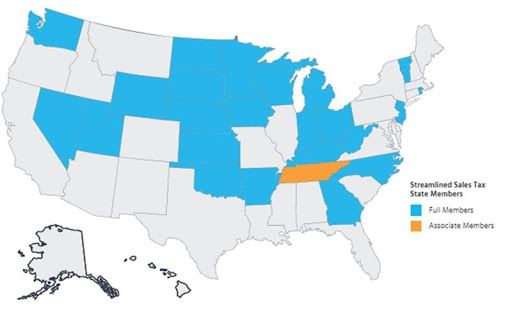
The primary benefit of SST is that it reduces the complication that comes with managing widely varying laws across the states (a benefit that DtC alcoholic beverage shippers should immediately recognize as beneficial). By simplifying a state’s sales tax administration and establishing uniform laws, definitions, and practices, SST can vastly reduce the amount of rules and regulations that a business needs to keep in mind as it has a sales tax obligation in many states at once.
But more than that, qualifying businesses can actually receive two additional highly material benefits, those being reduced cost and audit protection. However, in order to receive this benefit a seller must use a Certified Service Provider (CSP) to manage their sales tax collection and reporting.
CSPs are sales tax technology providers who are certified by the SST Governing Board as trusted providers of comprehensive sales tax compliance support. While any tax technology company could become certified, only companies like Sovos, which agree to undergo a regular, rigorous review of their technology and tax content, have been so certified.
When a seller uses a CSP to calculate and remit their sales tax into any SST Member state, the CSP services can actually be paid for by the state. Further, the seller is afforded significant audit protection.
More information on SST and the benefits that can come from using a CSP can be found here.
Previously, the compensation and audit protection afforded to sellers using CSPs was made available only to “volunteer sellers,” which required them to not have any statutory requirement to register for and collect sales tax in a Member state. Since DtC shippers are almost always required to become a sales tax collector as a condition of getting their DtC license, this meant they were ineligible to take advantage of the CSP compensation and audit protection benefits that came from the SST Agreement.
While DtC shippers who used CSPs, like Sovos ShipCompliant, certainly benefited from using a provider whose technology and tax content were certified as accurate by SST Member states, they had been left behind other businesses.
However, the latest SST Contract has been specifically amended to address this gap. Going forward, DtC shippers will be fully eligible for all benefits under the SST Agreement, in particular getting audit protection in Member States and being able to receive state compensation for using a CSP like Sovos ShipCompliant.
The new contract allowing DtC shippers the full benefits of SST participation becomes effective starting January 1, 2021.
As a CSP, Sovos ShipCompliant is delighted that our valued DtC shipping clients will soon be able to enjoy the full range of benefits afforded by SST, including the state compensation for using our service.