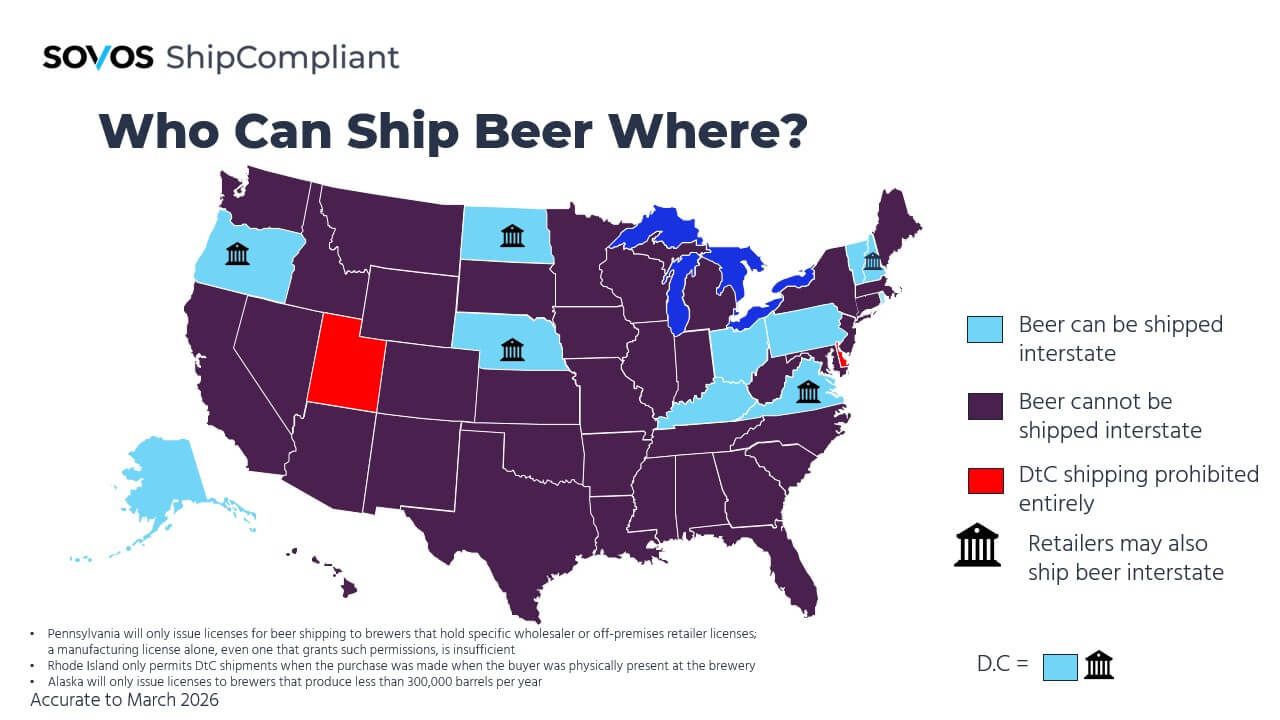
For direct-to-consumer (DtC) spirits shipping, the story of the past five years is less about what has changed than about what hasn’t: consumer demand. The fifth annual Direct-to-Consumer Spirits Shipping Report, produced by Sovos ShipCompliant with The Harris Poll and the American Craft Spirits Association (ACSA), shows regular craft spirits drinkers asking for the same thing year after year, and the findings give distillers plenty to work with. Here’s what stands out.
Every year since 2022, we’ve asked regular craft spirits drinkers the same questions about DtC shipping. Every year, they’ve given essentially the same answers. In meaningful ways, that consistency is the finding, and this year’s report gives distillers a solid basis for planning around it.
Support for expanded DtC spirits shipping among regular craft spirits drinkers has stayed in a 79%-82% range for five years (81% in 2026). Among all Americans 21+, it has edged up from 64% to a five-year high of 68%.
Because year-to-year changes of a point or two fall within the survey’s margin of error, the five-year range gives a more dependable picture than any single year. Over that period, support among regular craft spirits drinkers has stayed between 79% and 82%, which gives distilleries considering a DtC program a consistent preference to plan around.
Seventy-six percent of regular craft spirits drinkers have found a spirit while traveling that they wished they could buy at home, and 81% say they’d be more likely to try new brands if those could ship to them. That interest extends across the country, ranging from 72% in the Midwest to 84% in both the Northeast and South.
The research shows that consumers aren’t asking for DtC because it’s easier than the visiting a retail oulet; they’re asking because the store doesn’t carry what they found on the road. That makes DtC less a substitute for retail than an extension of the tasting room, which is why the ACSA ties it to distillery tourism: visitors can keep buying after they go home.
Among regular craft spirits drinkers likely to buy via DtC, 81% would buy at least monthly, and 19% weekly or more. They’d spend roughly $119 a month, and 22% would spend $200 or more (up from 17% in 2022).
The loyalty numbers are just as strong, as they have been for years. If a distillery offered DtC shipping:
The average-spend figure is an upper bound for a segment, so it should be treated as potential, not a forecast. Still, frequency and loyalty point to recurring revenue that spirits clubs and subscriptions can provide.
Perhaps the most useful stat for anyone in the room with a distributor is this: 94% of likely DtC buyers say they’d look for a brand at retail after enjoying it via DtC, and 49% say they’d be very likely to. That’s up from 92% in both 2024 and 2025.
That makes DtC a discovery engine. A customer in a state where you have no distribution can try your brand, fall in love with it, and then ask a local retailer to stock it. For distillers who struggle to find distribution, it’s a way to build proof of demand before the wholesale conversation. The ACSA’s perspective in the report says it plainly: DtC doesn’t replace wholesalers or retailers, but it gives craft distillers a complementary route to market when traditional distribution is unavailable or impractical.
California won’t be the only state in play. Lobbying in Missouri, Hawaii, South Dakota, and Iowa gained traction in 2026, and exploratory efforts in Colorado point to a more favorable climate. Washington’s in-state-only DtC spirits law is also being challenged in court, since in-state-only shipping likely violates the Granholm principle.
There’s also precedent on distillers’ side. Wine DtC has operated for more than 20 years since Granholm, expanded to almost every state and become a $3+ billion annual market, and the concerns raised against it haven’t materialized. Legislators considering DtC spirits have a track record to point to.
California went from law to 43 licensed distilleries in six months. See how ShipCompliant helps distilleries manage licensing, tax and reporting, so you’re ready to ship when the next state opens.
[Request a Demo →]
For DtC shippers, the compliance rules that matter most are the familiar ones: licensing, age checks, remitting taxes, putting a warning on the package.
The issue of shipping to dry territories in states, however, doesn’t come up nearly as often. While all DtC rules are important and must be followed, the reason why shipping to dry regions is not as top of mind is because only a handful of states apply wet/dry restrictions to DtC shipments at all. However, that still leaves several places where DtC shippers do need to be concerned about dry regions.
Paramount in U.S. beverage alcohol law is the idea of local control of alcohol sales. Coming out of Prohibition, the greatest bogeyman was the “foreign” (i.e., out-of-state) supplier who, heedless of local virtues, would come in and promote overconsumption. This fear is the heart of the three-tier system, which was originally intended to force a separation between the big-bad suppliers and the poor, readily-influenced retailers.
Local option laws, which grant certain communities (counties, cities, townships, etc.) the power to vote on what kind of alcohol sales can occur within their jurisdictions, are a key part of this principle and, indeed, have been active even before Prohibition began.
These rules can vary in their severity, with many allowing on-premises sales but not off-premises sales (or vice versa) or prohibiting only sales of spirits. Indeed, while “dry” counties (which prohibit most all forms of alcohol sales) get most of the attention, by far most counties with local option rules in place are actually “moist,” meaning that there are lots of exceptions to the rules.
Currently, most of the states with local option rules are in either the South or the Northeast (wet counties with dry townships are particularly prevalent in Ohio, Pennsylvania and New England—most fully dry counties are found in the Bible Belt). However, to the benefit of DtC shippers, almost all of these states exclude DtC shipments from local option restrictions, giving them free access across the state.
The exceptions to this general rule are Alaska, Arkansas, Florida, Kentucky, West Virginia, and Vermont.
Of these, Florida, West Virginia, and Vermont are relatively painless to manage as only two counties (Lafayette and Liberty, Florida) and three towns (Baltimore and Athens, Vermont; and Brandonville, West Virginia) are implicated, which account for a total population of less than 20,000 people.
However, the other three states present more of a challenge for DtC shippers to manage.
Alaska as a state has a rough history with alcohol consumption, particularly among the native population. As such, there are roughly 75 dry communities where all sales and importation of alcohol are prohibited. In addition, there are many more communities that rely on USPS for last-mile delivery; but because USPS is prohibited under federal law from carrying packages with alcohol, those communities also cannot receive DtC shipments. To its credit, Alaska’s ABC publishes a regular list of communities with local option rules and lists of ZIP codes where common carriers are approved to deliver, which makes it at least possible to manage.
Arkansas is far more complicated than Alaska, as the state maintains both the largest list of dry counties in the country (29) but also another 24 “mixed” counties that contain both wet and dry communities. While it is easy enough for a DtC shipper to block shipments to all of the completely dry counties, the mixed counties present a special challenge as the lines between the wet and dry regions are based along “townships,” which are broadly based on voting precincts but not any other geographic or address-based boundary, such as city or ZIP. While Arkansas does maintain a wet/dry map through its GIS office, determining whether a given address falls inside or outside of the wet/dry borders often comes down to eyeballing it. DtC wine shippers (only wine can be shipped to Arkansas consumers) need to take extra care then when shipping to mixed counties in the state.
Kentucky, like Arkansas, has an odd mix of dry, wet, and “moist” counties, and also like Arkansas, its mixed county dry/wet lines are based on election precincts rather than city or ZIP boundaries, which are even harder to determine than in Arkansas. However, Kentucky does have two key tools for DtC shippers to rely on. For one, the state ABC maintains an online address search tool for DtC shippers to use (though it does declaim it’s accuracy somewhat). Further, Kentucky’s law puts the liability for a dry-area delivery on the consumer rather than the shipper or carrier, provided the shipper made a good-faith effort at the time of purchase by having the consumer affirm they don’t live in a dry area. This is more forgiving than in Arkansas or Alaska, but it still means building that attestation step into your checkout process rather than skipping it.
The common thread across all three states is that the boundaries regulators use for wet/dry determinations don’t always line up with the boundaries everyone else uses. Addresses are built around ZIP codes and city lines. Dry-area designations are built around townships, precincts, or county votes that can shift with a single local election. That mismatch is the real challenge, more than the restriction itself.
The practical answer is fairly simple, even if the execution takes some care: don’t ship into a dry location. But to make sure that can happen reliably, you need a way to check whether an address falls in one. That might mean cross-referencing Arkansas’s GIS map, watching for updates to Alaska’s published ZIP list, or building a customer attestation step for Kentucky orders where no authoritative list exists at all. Sovos ShipCompliant keeps current dry-community guidance built into our DtC state rules pages for wine, beer, and spirits, which is a good starting point any time you’re setting up shipments to these three states or reviewing an existing program there.
It’s a narrow issue in the scope of DtC compliance overall, affecting only three states out of the many that now allow direct shipping. But narrow doesn’t mean low-stakes. A shipment that lands in a dry county can mean real legal exposure, and “the customer said it was alright” isn’t much of a defense (except in Kentucky). Knowing where these lines sit, and relying on available tools to check addresses, is a small effort that avoids a much bigger headache down the road.
A dry county (or dry township, precinct, or city, depending on the state) is a jurisdiction that has voted under local option laws to prohibit alcohol sales within its borders. While there are many states that have dry jurisdictions, most of them have carved out DtC shipments, allowing them to go to dry regions. But in Alaska, Arkansas, Florida, Kentucky, Vermont, and West Virginia, dry-area restrictions do apply to DtC shipments, prohibiting shipments to those parts of those states.
Alaska, Arkansas, and Kentucky are the three states where dry-area restrictions create real day-to-day compliance work. Florida, Vermont, and West Virginia also restrict DtC shipments into a small number of dry counties or towns, but the affected population in each is under 20,000 people, making those far easier to manage.
No. In these states, if a customer’s address falls within a jurisdiction that prohibits alcohol sales under local option law, a DtC shipment can’t legally be delivered there, even if the producer holds a valid shipping license for the rest of the state.
Arkansas has 29 fully dry counties along with 24 “mixed” counties that contain both wet and dry areas. In the mixed counties, the wet/dry line is drawn by township rather than by city or ZIP code, so a shipper can’t determine an address’s status using ordinary geographic references. Arkansas maintains a wet/dry map through its GIS office, but matching a specific address to that map often takes manual review. Note also that only wine can currently be shipped DtC to Arkansas consumers.
Yes. Kentucky’s ABC maintains an online address lookup tool that DtC shippers can use to check a given address, though the state notes the tool’s results aren’t guaranteed to be fully accurate. Kentucky’s dry, wet, and “moist” boundaries follow election precincts, which don’t align with city or ZIP boundaries, so the lookup tool is a meaningfully useful resource here.
In Kentucky, liability for a dry-area delivery falls on the consumer rather than the shipper or carrier, as long as the shipper made a good-faith effort at the time of sale by having the consumer affirm they don’t live in a dry area. That’s a more forgiving standard than Arkansas or Alaska apply, but it still depends on the shipper actually building that attestation step into checkout.
They apply across product types in the states where they exist. Alaska’s and Kentucky’s dry-community rules cover wine, beer, and spirits alike. Arkansas currently limits DtC shipping to wine only, so its dry-county restrictions are, for now, a wine-specific concern.
Direct-to-consumer (DtC) alcohol shipping is a cornerstone of growth for wineries, breweries, and distilleries looking to connect directly with consumers across state lines. However, the landscape of DtC shipping is intricate, governed by a patchwork of state laws and regulations that demand strict compliance. And as much or more than ever, states are paying attention to compliance with their stipulated rules.
In this July 2026 webinar, Alex Koral, Regulatory General Counsel at Sovos ShipCompliant, shared essential information about DtC alcohol shipping compliance fundamentals, enforcement trends, and best practices for staying compliant.
As Alex pointed out at the outset, navigating DtC alcohol shipping is fundamentally about compliance. State governments maintain tight control over alcohol sales and distribution, demanding that shippers strictly adhere to the rules of each destination state. Failure to comply exposes businesses to enforcement actions, fines, and even the loss of shipping privileges.
The message is simple if not easy: “The name of this game really is compliance. It’s abiding by the rules. It is avoiding enforcement actions.”
[video_embed url=”https://fast.wistia.net/embed/iframe/usekxf2vnr”]
Alex emphasized that DtC shipping regulations can vary widely in their details and applications. He provided an overview of accessible markets for alcohol shippers, noting the wider availability for shipping wine than for spirits and beer. What stands out most from the map, though, is that only two states, Utah and Delaware, currently have no allowance for any DtC shipping of alcohol.
Although Delaware recently passed a DtC law, Alex described it as extremely unfriendly to shippers and advised businesses to avoid using it until necessary adjustments are made: “Delaware…did pass a direct consumer shipping law last year. However…we are probably going to suggest that people really don’t avail themselves of the Delaware law at least until it’s been fixed.”
For the states that do allow DtC shipping, it comes down to following the rules, including: proper licensing; age verification; adhering to volume limits; appropriate tax determination, collection, and remittance; and filing other state reporting where required.
Alex stressed that DtC shippers must recognize and abide by destination-state rules: “It is always based on the destination state…you always have to abide by the rules of the state where the consumer lives.”
States are leveraging advanced tools and cross-referencing techniques to enforce DtC shipping regulations. Many states have moved to electronic reporting, enabling faster and more comprehensive review of shipping activity.
One of the key concerns that states are monitoring through these reports is volume limits. Many states restrict the amount of alcohol that a shipper can sell to an individual consumer or household, often permitting only one case per month or twelve cases per year. Shippers need to avoid hitting one of these limits by continually monitoring their shipments and proactively delaying any that would exceed a limit.
Alex emphasized the need to actively communicate with consumers about these volume limits, especially so they are not surprised when an order does need to be delayed. Consumers that frequently meet or attempt to exceed their volume limit need particular attention so that they can help the winery avoid facing penalties. “You need to let them know that what they’re doing…is likely to get you in trouble. If it does get you in sufficient trouble, that means you are shut down in that state.”
Alex noted that Kansas, in particular, has taken an aggressive approach in issuing enforcement actions for violations related to shipping limits and address manipulation.
Preventing sales to minors remains a cornerstone of all alcohol sales, and states are actively working to detect violations in the DtC market. Sellers are responsible for verifying the age of purchasers and ensuring that alcohol deliveries are signed for by recipients over the age of 21.
[video_embed url=”https://fast.wistia.net/embed/iframe/o966q8se5h”]
Alex highlighted several best practices for age verification:
“An adult over the age of 21 with a signature is the only party who can both make the purchase and then receive a package at the end of the day.”
Alex shared a cautionary note about certain states, such as Massachusetts, which enforce strict protocols to prevent underage alcohol sales.
[video_embed url=”https://fast.wistia.net/embed/iframe/9qa60drch2″]
Many states now require fulfillment houses to carry specific licenses or be registered as ship-from addresses. Notably, Oklahoma entirely prohibits the use of third-party fulfillment houses for DtC shipments.
Alex advised businesses to maintain clear and direct communication with their fulfillment house and carrier partners for alignment on regulatory requirements.
Tax compliance is another critical area of focus that varies across states. Alex explained that excise taxes must generally be paid to the destination state, not the origin state, and that sales taxes are also generally required regardless of sales volume.
Emerging fees, such as retail delivery fees (e.g., in Colorado and Minnesota) and recycling fees (bottle bills) are key considerations for maintaining compliance and avoiding penalties.
Alex advised caution in evaluating or partnering with marketplaces or other third-party sellers that claim to handle compliance “for everyone” or promise dubious shipping abilities, such as shipping into Utah. Sellers must ensure that all marketplace vendors hold proper licenses and comply with state-specific regulations. Keep in mind that apparent workarounds may not be seen as valid by the states and, at a minimum, “Make sure you’re doing your due diligence…asking tough questions.”
[video_embed url=”https://fast.wistia.net/embed/iframe/di91kj83cx”]
Watch the webinar recording for the complete picture on DtC shipping compliance essentials and state enforcement trends. And remember that proactive compliance is always the wisest bet for your business. Key strategies include:
Compliance isn’t just about avoiding fines; it’s about safeguarding the future of this thriving market. By embracing best practices, shippers can expand operations while ensuring their obligations are met.
As direct-to-consumer (DtC) shipping of spirits has become more prevalent, it is natural that certain incorrect ideas about how it can be done will crop up. After all, even outlandish ideas, such as that D.C. retailers are exempt from shipping restrictions, continue to propagate.
One common misconception is that most states operate under what are called “reciprocity” laws, meaning that they will only grant shipping licenses to distilleries that operate in states that themselves permit DtC shipping—essentially an “I’ll scratch your back if you scratch mine” requirement.
It is understandable why this belief has spread. There is the inherent “fairness” of reciprocity, that a state shouldn’t just give DtC shipping rights to out-of-state distilleries without getting something back for its own distillers.
There is also a history of states having reciprocity rules for wine and spirits DtC shipping on their books, with one notably maintaining it to this day. There are even several states that have (with greater and lesser, though never complete, legitimacy) said that their local prohibition on DtC shipping of spirits extends to shipments made by their distilleries into other jurisdictions.
However, the idea that reciprocity is widespread—or even that it is a lawful DtC shipping provision that doesn’t violate the Dormant Commerce Clause—is incorrect. Distillers and others scared away by the claim of reciprocity restrictions would do well to reconsider what they are being told. They might have many more markets to access than they might believe.
As of now, the states with clear, statutory authority allowing spirits to be shipped in and into their borders are:
That’s a shorter list than wine enjoys, but it’s also a longer list than a lot of distillers seem to believe. As always with the direct-to-consumer shipping of alcohol, each state sets its own regulatory framework, and so we should note a few points on some of these states:
Rhode Island only permits shipping when the sale occurred on the distillery’s licensed premises. If a customer visits your tasting room, buys a bottle, and asks you to ship it home, that is allowable. An online order placed from a laptop in Providence is not.
Vermont limits DtC shipments of spirits solely to ready-to-drink cocktails, defined as a spiritous product with an ABV of12% or less and packaged in containers no larger than 24 fluid ounces. A cask-strength whiskey doesn’t fit that definition, no matter how well it travels.
Arizona, Alaska, and California cap eligibility by production volume, issuing licenses only to distilleries that produce less than 20,000 gallons, 50,000 proof gallons, and 150,000 gallons per year, respectively.
D.C. stands out for what it doesn’t require. Shippers into the District don’t need to obtain a license before shipping, and there’s no D.C. tax obligation on those shipments either. Compared to the compliance lift elsewhere, it’s a comparatively light touch.
And then there’s New York.
New York is currently the only state in the country with a reciprocity law on its books for DtC shippers. Under its law, New York will only issue a shipping license to an out-of-state distillery if that distillery’s home state would, in turn, license a New York distillery to ship to its residents.
This rule is a holdover from New York’s wine shipping statute, where it is still active. However, the wine industry opted early on to not challenge the reciprocity clause, choosing to instead focus on expanding DtC shipping availability in more states and thereby mooting the restrictions (if everywhere allows shipping, then there’s no one to ban).
Spirits are a different story. As seen above, the list of reciprocal states is short, which means the practical effect of New York’s rule falls almost entirely on New York consumers rather than on distilleries elsewhere. A distillery in a state like Tennessee, which doesn’t yet allow interstate DtC spirits shipping, won’t qualify for a New York shipping license, no matter how much demand exists for its product among New York customers. Meanwhile, a distillery in Kentucky, sitting right next door, would qualify without issue.
This creates a fairness question that we hope will receive greater attention as more states weigh their own DtC spirits laws.
As stated, some state agencies have warned their distilleries against shipping anywhere on the grounds that shipping of spirits is illegal within their borders. This, however, is an extremely dubious claim and is not supported by any statute or regulation. Indeed, most states authorize their manufacturers to freely export, as long as they do so in compliance with the rules of the states they export to. And if Kentucky allows its consumers to purchase spirits from Colorado distilleries, it is hard to see the legal or even moral justification for Colorado prohibiting that sale.
The one exception is Florida, which does maintain a blanket prohibition on craft distilleries engaging in DtC shipping, under Florida Statute 565.03(f)(3). Notably, this provision only applies to Florida craft distilleries (producing up to 75,000 gallons per year), but not larger format distilleries. And, again, the broader constitutionality of that provision as it applies to shipments from Florida into other states, is dubious. Certainly Florida can prohibit DtC shipping in its borders, but what right does it have to block them elsewhere?
Nevertheless, the only distilleries in the country that are operating under a clearly written and defined statute that prohibits them from shipping based on where they are located are Florida craft distilleries and distilleries trying to ship from non-DtC states into New York.
None of this changes the fact that the list of DtC-friendly states for spirits is still relatively short compared to wine. But the misconception that your own state’s laws may limit your eligibility to ship elsewhere has probably kept some distillers from exploring markets that are genuinely open to them.
If your state doesn’t currently permit inbound DtC spirits shipping, that’s a separate issue from whether you can ship out. The one exception applies to Florida craft distilleries. And if New York is on your list of target markets, check your home state’s own inbound spirits shipping status before assuming you’re eligible.
As more states consider spirits DtC legislation, this list will keep shifting, so it’s worth revisiting periodically rather than treating today’s rules as permanent.
No. Reciprocity — where a state only grants shipping licenses to distilleries based in states that return the favor — is widely assumed to be a common requirement, but it isn’t. New York is currently the only state with a reciprocity law on the books for DtC spirits shipping. Every other state that permits DtC spirits shipping evaluates eligibility based on its own rules, not on what the distillery’s home state allows.
As of now, the states with clear statutory authority allowing spirits to be shipped in and into their borders are Alaska, Arizona, Kentucky, Nebraska, New Hampshire, New York, North Dakota, Rhode Island, Vermont, and the District of Columbia. Each state sets its own conditions, so eligibility can depend on factors like production volume, sale location, or product type.
Can my distillery ship spirits directly to consumers in New York?
Possibly, but only if your distillery is based in New York or in a state that itself allows New York distilleries to ship to its residents. This is New York’s reciprocity requirement, and it’s the one state where a distillery’s home-state laws directly affect its ability to ship into another state.
What is New York’s reciprocity rule for spirits shipping?
Under New York law, the state will only issue a DtC shipping license to an out-of-state distillery if that distillery’s home state would, in turn, license a New York distillery to ship to its residents. The rule carries over from New York’s wine shipping statute, but it carries more weight for spirits because far fewer states currently allow reciprocal spirits shipping compared to wine.
Are there production volume limits on DtC spirits shipping?
Yes, in some states. Arizona limits eligibility to distilleries producing fewer than 20,000 gallons annually, Alaska caps it at 50,000 proof gallons, and California sets its limit at 150,000 gallons. Distilleries above these thresholds may not qualify for DtC shipping privileges in those states even if their product otherwise meets requirements.
Can distilleries in Florida ship spirits directly to consumers in other states?
Florida craft distilleries producing up to 75,000 gallons annually are prohibited from DtC shipping under Florida Statute 565.03(f)(3), making Florida one of the only states with a clearly defined statute blocking its own distilleries from shipping based on their location. The provision doesn’t apply to larger-format distilleries, and its legal reach over shipments crossing into other states remains an open question.
Does Washington, D.C. require distilleries to get licensed before shipping spirits there?
No. D.C. is notable for not requiring shippers to obtain a license before shipping DtC spirits, and it doesn’t require payment of D.C. taxes on those shipments either, making it one of the lighter-touch markets on the current list. However, D.C. entities must still abide by the rules of other states when shipping out of the district.
Direct-to-consumer (DtC) shipping has become an essential channel for wineries and other alcohol suppliers, developing over the last 20 years into the modern market that we all love and enjoy. Currently, every state except for Utah and Delaware permit some sort of DtC shipping.
Underlying the DtC shipping market is an extensive system of laws and regulations established and enforced by each individual state, which must be abided by when shipping into those states.
While most shippers do recognize these laws and take active steps to ensure that they remain in compliance with each individual state’s rules, there are still an unfortunate number of parties that, perhaps left out by the laws as written or priced out by complex regulations, seek out and use “alternative” DtC shipping systems that promise ways to work around the state rules that everyone else complies with.
The fundamental issue with these “alternatives” is that they do not actually provide what they promise. That is, instead of giving alcohol producers, importers, and sellers free and easy access to the different states’ markets, they rely on gimmicks and tricks that are just as unlawful as any other violation of a DtC shipping law.
Part of the problem seems to be that some people look at DtC shipping regulations, like licensure and tax payments, as a problematic annoyance, which only apply when certain parties (e.g., wineries) are shipping. Because they have written their sales contracts in the right way or they simply don’t think the laws apply, though, they can ship whatever and wherever they want.
This is a fundamental misperception of what DtC shipping is and represents within the broader alcohol market. Rather, whether states employ the three-tier system or the control model, they all strictly limit the situations in which alcohol can be made, distributed, transported, and sold within their borders. Generally, alcohol can only be transported by select parties in select situations—shipments from suppliers to distributor warehouses, or from distributors to retailers.
If states do allow alcohol to be transported from a licensee to a consumer, it must occur only in certain, explicitly determined circumstances, including DtC shipping. Indeed, DtC shipping laws are not a burden only for wineries, limiting how they can ship their goods. They are the exception to the typical rule that no one can ship; and if you cannot follow those rules, that means you cannot ship, no matter what your contract says.
So, what are the main ways that people try to avoid DtC shipping laws through contract shenanigans?
There are certain wine shippers out there who, after having properly acquired their own licenses to ship into different states, have offered the use of those licenses to other wineries. In this model, the secondary winery will still own and market their own wines to consumers, selling from their tasting room or an online store, but, for compliance purposes, the first winery will assume ownership and responsibility for the shipment.
In the eyes of the parties involved, they are complying with state laws, in that there is a licensee supervising the order, they are conducting age checks to prevent sales to minors, they are paying taxes, and they are working with compliant carriers, so what’s the harm?
The problem is that it entirely subverts the importance of licensing, namely that the state has an opportunity to review and vet the parties selling within their jurisdiction and that there is a singular, identifiable, approved party selling their own products. While, yes, it is good that age checks are being done and taxes are being paid, it is just as nonsensical to say that I can ship under someone else’s license as saying that I can open a bar in my garage because my friend has a bar license. Indeed, if this were true then theoretically only one winery in the country needs to have a shipping license and they could handle compliance for everyone.
But no state will sign on to this theory and several have taken steps to shut down this sort of activity.
Another sales model we see all too frequently relies on careful working in the seller’s terms and conditions to somehow avoid DtC shipping laws. In this model, the seller (often a licensed, off-premise retailer that can make legitimate alcohol sales) constructs their sales contracts to state that all sales are finalized at the seller’s premises with the consumer taking ownership of the goods at that moment, as if they had purchased it in-person. The seller then, acting merely as the agent of the consumer, will ship to the consumer wherever they live. The goal is to characterize the transaction as a local sale followed by consumer-directed transportation, rather than a DtC shipment into another state, somehow relieving the seller of all responsibility for the shipment.
Contract terms cannot alter the regulatory reality for two important reasons.
First, consumers are generally not authorized to ship alcohol to themselves through common carriers—only authorized, licensed parties can instigate a DtC shipment. As such, if the consumer cannot lawfully ship the package themselves, they cannot avoid the law by having another party ship on their behalf. At best, this model is setting up the consumer to break the law.
Second, state DtC laws specifically say that shipments of alcohol going to the end consumers are deemed to have occurred in the destination state. A private agreement cannot sidestep what the state law says, which obviates the entire basis for this sales model. Further, if the seller markets to out-of-state consumers, accepts the order, processes payment, prepares the package, tenders it to a carrier, and causes alcohol to be delivered across state lines, regulators will not view them as an innocent party in the transaction, again, no matter what the contract says.
The rumor has spread through back alleys of the alcohol industry that, somehow, retailers located in the District of Columbia are exempt from state DtC laws, and so can ship everywhere on behalf of anyone.
Perhaps this comes from extremely liberal importation permissions that D.C. grants its retailers, allowing them to buy directly from producers around the country. Or, perhaps people have a misapprehension of what it means to operate in the District, thinking that, if they are only subject to federal laws, they are not subject to state shipping laws.
Whatever the reason, this theory has unfortunately lingered, despite past enforcement actions.
Above all, even if D.C. retailers have certain local privileges, those privileges do not erase the authority of the destination state in controlling shipments. When alcohol is shipped to a consumer in another state, it is always the destination state’s rules that matter; operating out of a federal district does not change that.
DtC shipping compliance can be complicated and expensive, and it makes sense why an organization would look for ways to avoid that burden. But DtC shipping of alcohol needs to be recognized as a unique sales model that does not exist outside of the specific parameters established by the different states. The only way to legally ship to a given state is within the four squares of its law and failing to do so not only risks enforcement action, like fines and penalties, but potentially the loss of one’s production or retail license, which is the end of one’s presence in the beverage alcohol industry. If a state’s DtC rules exclude your business or are overly burdensome to the extent you don’t think you can comply with them, the proper course of action to work to change the laws, not seek out “alternatives” that rely on increasingly outlandish shenanigans that ignore the existing, compliant sales model.
No. Shipping alcohol under another business’s license — sometimes called “license sharing” or “license lending” — is unlawful. State licensing exists specifically so regulators can review and approve each individual seller operating in their jurisdiction. Allowing one licensee to cover shipments on behalf of unlicensed parties would effectively eliminate the purpose of licensing altogether. States have actively enforced against this practice.
No. Some sellers attempt to structure their sales contracts so that title (ownership) of the product passes to the buyer at the point of sale, then characterize the shipment as the consumer transporting their own goods. This approach does not hold up legally for two reasons: first, consumers are generally not authorized to ship alcohol to themselves via common carriers; second, state DtC laws explicitly deem shipments to end consumers to have occurred in the destination state, regardless of how a private contract characterizes the transaction. Regulators look at the practical reality of a transaction, not just its contractual framing.
No. Despite a persistent industry rumor, D.C. retailers are not exempt from destination state DtC shipping laws. While D.C. does grant its retailers broad importation privileges locally, those privileges do not override another state’s authority to regulate alcohol shipments entering its borders. When alcohol is shipped to a consumer in any U.S. state, it is the destination state’s rules that govern the transaction — regardless of where the shipper is located or what kind of jurisdiction they operate in.
Shipping alcohol outside of a state’s legally prescribed DtC framework can result in serious consequences, including regulatory fines and penalties, cease-and-desist orders, and — most severely — revocation of other alcohol-related licenses the shipper might have, which would mean the end of that business’s ability to participate in the beverage alcohol market entirely.
DtC shipping is not a standard retail transaction — it is a legally created exception to the standard three-tier system and laws that restrict shipments only between licensees. States regulate it strictly to maintain control over who is selling alcohol within their borders, ensure age verification at the point of delivery, collect applicable taxes, and protect public health and safety. Any method of shipping that bypasses these controls — however it is structured — runs counter to the purpose of the entire regulatory framework.
The complexity of Extended Producer Responsibility (EPR) regulations demands attention from businesses across industries — but particularly for beverage alcohol producers, importers, and other sellers. In a July 2026 webinar hosted by Sovos ShipCompliant, guest speaker Andrea Nappi Conforme, President, National Association of Beverage Importers (NABI), delved into the nuances of EPR requirements to help companies navigate this emerging regulatory framework.
With the rise of ecommerce, states have had to deal with increasing amounts of packaging and other waste materials, overburdening their existing waste management systems. The intent of EPR laws is to address this strain by increasing state funding for waste management through new fees imposed on sales made by producers in select states.
However, the newness and complexity of EPR have left many businesses scrambling to comply. Here’s an overview of the essentials beverage alcohol companies should know.
At its core, EPR regulations aim to relieve municipalities from some of the financial burden they face dealing with packaging and other waste materials—cardboard boxes, inserts, bottle caps, and more—by levying added revenue from producers. As Andrea described the impetus behind these laws:
“With the increase in ecommerce…states have been inundated with cardboard and other packing materials… EPR statutes are developed so they can share the costs with those responsible for shipping.”
As of July 2026, seven states have passed EPR legislation: California, Colorado, Maine, Maryland, Minnesota, Oregon, and Washington. Businesses operating in these states, whether as a local manufacturer or as a remote seller or supplier, will need to assess their responsibilities immediately.
Andrea noted a political bent among the states that have adopted EPR rules, suggesting that producers operating in other blue states should pay close attention to future legislation.
Of course, one of the first questions a business needs to ask about EPR is, “Am I responsible? Am I a ‘producer’?”
Critically, though, each state has its own definition of “producers,” separate from how their beverage alcohol-related statutes define the term. This means that whether a business is responsible for a given EPR law cannot be assumed and must be assessed in each state individually.
Under the different state definitions, producers could be manufacturers, brand owners, first sellers in the state, or importers. Most states also include exemptions based on revenue or tonnage thresholds, but as Andrea explained, “There isn’t one magic number, because each state has set this threshold at a different level.”
There are further exemptions for business-to-business sales, but they are also not always intuitive:
“You think, okay. Well, great. I only ship to distributors. I’m shipping to a business. Therefore, I’m exempt. Right? That’s not necessarily true.”
Understanding these state-by-state distinctions is essential for compliance.
Once a state has enacted EPR legislation, state agencies step in to flesh out the details through rulemaking, including determining how subject producers will register with the state and pay their fees. To handle this, states designate a third-party organization to manage the registrations and fees, known either as a Producer Responsibility Organization (PRO) or a Stewardship Organization (SO).
In effect, almost every state with EPR has settled on Circular Action Alliance (CAA), a non-profit organization setup by major packaging waste producers, as their PRO/SO. As Andrea noted:
“Circular Action Alliance is the one…to whom you will be reporting. They manage program registration forms, but producer fees depend on the amount of packaging material shipped into a state.”
Reporting requirements for EPR programs are stringent—often pushing companies to provide granular breakdowns of packaging materials. Andrea elaborated:
“Even the adhesive on the label, if it is made of certain materials, would be included…. It’s going to be a headache, certainly, and requires research.”
For compliance success, Andrea recommended:
Noncompliance is not a risk businesses can afford to overlook. Andrea warned about steep penalties:
“Oregon fines can reach $25,000 per day, Colorado $10,000 per day, California $50,000 per day…. States also have the ability to halt sales.”
While enforcement hasn’t yet begun in earnest, businesses should take proactive steps to avoid future issues.
The conversation also touched on pending legislation in states like Connecticut, Hawaii, Illinois, Massachusetts, and Rhode Island. Andrea noted these regulations were rapidly evolving, meaning businesses need to remain vigilant:
“There’s just a lot happening…companies are trying to get their heads around this.”
Ongoing litigation in Oregon, California, and Colorado may also impact enforcement in the years ahead.
Andrea emphasized the importance of preparation and action for those selling into the seven EPR states: clear understanding of state-by-state laws, maintaining updated records, and keeping tabs on evolving regulations. “Start with grouping your brands and creating a spreadsheet for clearer analysis…[though] it won’t be a simple process.”
To help members of the beverage alcohol industry, NABI offers (for sale) a plain-English guide that breaks down state EPR obligations and other resources are discussed in the webinar recording.
Extended Producer Responsibility marks a seismic shift in the way recycling and packaging waste are managed. Businesses operating in EPR-affected states must act fast to assess their obligations, register with organizations like CAA, and prepare for reporting deadlines. As Andrea put it, compliance may be arduous, but it’s not optional: “It is something that should be top of mind.”
Direct-to-consumer (DtC) shipping of alcohol by retailers has been a persistent issue in recent years, commanding the attention of numerous courts (and blogs) as they seek to determine how exactly this market should work.
The question has never been whether retailers should be allowed to avail themselves of DtC shipping services (that is, to use third-party carriers like FedEx and UPS to fulfill remote orders). Rather, it has always been a matter of which retailers are eligible for this permission: only instate retailers, or do states also need to make it available to out-of-state retailers?
While about a dozen states do permit shipping by out-of-state retailers, many more have adopted rules that allow shipping only by in-state retailers, leading to the series of lawsuits seeking to make retailer shipping available nationally.
So far, proponents of national DtC shipping by retailers have not had much success in court, with almost every case being ruled in favor of the state and allowing their instate-only shipping laws to stay in effect. However, a recent update in one case has the potential to bring resolution to the entire issue—or make everything much more confusing.
In the seminal 2005 case, Granholm v. Heald, the Supreme Court ruled that New York and Michigan laws that permitted DtC shipping only by instate wineries was unconstitutional under the Commerce Clause, as they improperly and discriminatorily gave a benefit to instate businesses that was denied to similar out-of-state businesses. Going forward, if a state was to allow consumers to receive direct shipments from wineries, the state then must provide wineries from across the country equal access to that market. Concerns that states had as to the safety of the DtC market could be relieved through licensing, age verification, tax payment, and reporting requirements on shippers. From this ruling (and decades of lobbying in different states) emerged the modern DtC wine shipping market that we all know and enjoy.
However, since Granholm centered around shipping by wine producers, it has been an open question whether its principles apply to other parties. While brewers and distillers have been able to claim equal treatment based on their general similarity to vintners, retailers, as members of a different tier and generally not federally regulated, have struggled to make their claim.
Not that they haven’t tried. Litigation on this issue has been raging for years across numerous states and going up and down the appellate process. The Supreme Court has been petitioned to review retailer DtC shipping cases at least twice, though so far without success.
Largely, these cases have been ruled in favor of the states, though the rulings themselves have often lacked a measure of legal scrutiny that they would seem to merit. Many courts ruled for the states on procedural grounds, that the plaintiff retailers lacked standing (due to a lack of perceived harm) or failed to state a proper course of relief (that is, they asked the court to do things it could not do, such as draft new statutory law). Others have determined that there is no discrimination as the out-of-state retailer could simply open a new storefront in-state and thereby get access to the DtC market—even though this kind of reasoning has been definitively deemed improper in Commerce Clause litigation.
Even where courts have found the plaintiffs have standing and even when they have determined there is discriminatory effect, most have still ruled for the states on the grounds that the discriminatory shipping laws are necessary to preserve their three-tier systems. This is despite the facts that 1) courts rarely press states on their evidentiary claims as to the sanctity of their three-tier systems and 2) shipments by retailers will have gone through a three-tier system (if not the one for the state at issue).
As such, discriminatory retailer shipping laws, which mean that consumers are not granted access to wines not sold in their state, have remained pervasive.
In the last two months, there have been three major actions related to retailer DtC shipping that seem to be forcing a decision point on the whole issue.
The first was the ruling by the Sixth Circuit Court of Appeals that Ohio’s instate-only retailer DtC shipping law is, in fact, unconstitutionally discriminatory and not justified under the evidence provided by the state as closely tied and necessary to maintaining its primary 21st Amendment interests, namely public health and safety. As such, the court ordered further review for Ohio to correct its law to remove the discriminatory effect by enabling access to DtC shipping for out-of-state retailers (or denying shipping permission to all retailers).
The second was the rejection by the Supreme Court of two separate appeals from the Seventh and Ninth Circuit courts made by retailer plaintiffs after those courts had ruled in favor of seemingly discriminatory instate retailer-only shipping laws in Indiana and Arizona. While it is not a definitive ruling, when the Supreme Court rejects an appeal, it does mean that the lower court opinion is at least tacitly upheld.
The third was a real surprise, coming again from the Sixth Circuit court case. Rather than simply delay the unfavorable ruling by requesting an en banc hearing by the full circuit court or appealing the rulings by future district courts on how it would need to amend its laws, Ohio itself filed an appeal directly to the Supreme Court to review the Sixth Circuit court’s ruling.
What is most surprising about this decision is how both uncertain and decisive a ruling by the Supreme Court could be.
If the Court takes the case and decides that the Sixth Circuit was in error and that Ohio is justified in its seemingly discriminatory law, then the state’s gamble will have paid off.
However, if the Court takes the case and upholds the Sixth Circuit’s ruling, then the state will have scored a huge own goal, especially given how loath the Supreme Court has been to pick up these cases. And there is reason to believe that the Court just might rule in favor of interstate retailer shipping given how they ruled in 2019’s Tennessee Wine & Spirits Retailers Ass’n v. Thomas.
But the biggest unknown will be if the Court doesn’t take the case. This will mean that the Sixth Circuit’s ruling will stay in effect and that, at least within the states covered by the Sixth Circuit (Michigan, Ohio, Kentucky, and Tennessee), interstate DtC shipping by retailers will be the law, while in other circuit court jurisdictions like the Seventh and Ninth, discriminatory instate-only retailer shipping laws will be permitted. This situation—a circuit split—is anathema to the federal system in the U.S. as it creates different standards for different parts of the country, making the Court’s rejection of the appeal less likely.
Perhaps Ohio is banking on the Court’s rejection of the Seventh and Ninth Circuit appeals as signaling a mindset that instate-only retailer shipping is legitimate. Or perhaps the state misjudged the Court’s reasons. Either way, proponents and detractors of interstate retailer DtC shipping are eagerly awaiting a decision by the Court in the fall on whether to take the case and potentially settle this matter once and for all.
Three recent developments are moving the issue toward a potential resolution. The Sixth Circuit Court of Appeals ruled Ohio’s instate-only retailer shipping law unconstitutionally discriminatory. Separately, the Supreme Court declined to review appeals from the Seventh and Ninth Circuits, leaving instate-only laws in Indiana and Arizona standing. Ohio then made a notable move, appealing the Sixth Circuit ruling directly to the Supreme Court rather than pursuing standard procedural options. The Court is expected to announce whether it will take the case this fall.
The central question is whether states that permit retailer DtC shipping must extend that permission equally to out-of-state retailers. The 2005 Granholm v. Heald ruling established that states cannot favor instate wineries over out-of-state ones — but courts have long debated whether that principle extends to retailers, who occupy a different tier of the distribution system. Out-of-state retailers have challenged instate-only shipping laws as discriminatory under the Commerce Clause. Courts have largely sided with the states, though often on procedural grounds rather than substantive legal analysis.
A Supreme Court decision on whether to hear Ohio’s appeal is expected this fall. A refusal would leave the Sixth Circuit ruling in place, making interstate retailer DtC shipping the standard across Michigan, Ohio, Kentucky, and Tennessee — while instate-only laws remain valid in states under the Seventh and Ninth Circuits. That kind of inconsistency across federal jurisdictions, known as a circuit split, historically draws Supreme Court intervention. Taking the case would open the door to a nationwide resolution for the first time.
Proponents of retailer direct-to-consumer (DtC) wine shipping won a significant victory last Friday when the Sixth Circuit held that an Ohio law allowing DtC shipping only by in-state retailers is unconstitutionally discriminatory.
The decision is the latest development in the long-running litigation over Ohio’s law, along with a series of challenges to in-state-only retailer DtC wine shipping laws nationwide, but it is the clearest victory for the plaintiffs to date.
The ruling does not resolve the broader issue of retailer DtC wine shipping. Even the Ohio law’s fate remains uncertain as the Sixth Circuit remanded the case back to the lower court to determine the appropriate remedy. It is also likely that the state will seek en banc, or a review by the full court.
Still, the opinion is notable if nothing else than for the rigor of its analysis. In recent years, courts addressing similar laws have often upheld them on limited reasoning, concluding perfunctorily that either the laws were simply not discriminatory or that their discriminatory effect was excused by the states’ broad 21st Amendment regulatory authority.
The Sixth Circuit, by contrast, dutifully applied the Supreme Court’s framework for reviewing alcohol laws, as established in 2019’s Tennessee Wine and Spirits, and scrutinized the limited evidence offered by the state. Whether the ruling survives en banc review, how the lower court fashions relief on remand, or whether the Supreme Court will moot the whole issue by picking up a related case from the Ninthth Circuit, the decision reflects a more exacting review of state justifications. the decision reflects a more exacting review of state justifications.
The dispute over retailer DtC wine shipping has persisted since the Supreme Court’s 2005 Granholm v. Heald decision, which held that state authority under the 21st Amendment is limited when it conflicts with other constitutional provisions, including the Dormant Commerce Clause. As a result, states that permit in-state DtC wine shipping must extend comparable access to similarly situated out-of-state parties, a framework that has led to today’s regulated DtC winery shipping market.
The unresolved question was whether retailers are enough like wineries that the Granholm ruling would apply to them too. Ohio’s law has been challenged in some form since 2020, moving repeatedly through district and appellate courts.
During that period, different courts around the country have often, though not uniformly, upheld similar state laws. Most of those rulings read perfunctorily, with the courts latching onto facile claims to rule in favor of the states, such as a lack of standing by the plaintiffs, or that the challenged laws are not discriminatory, or that any discriminatory effect they have is justified because the three-tier system is “unquestionably legitimate.”
The most notable aspect of the decision is the court’s adherence to the Supreme Court’s established framework for reviewing alcohol laws and its more skeptical assessment of the state’s evidentiary claims.
In Tennessee Wine and Spirits, the Supreme Court invalidated a state residency requirement for retailer licensees and articulated a two-part test for reviewing discriminatory alcohol laws: 1) can the law can be justified as a health and safety measure within the state’s 21st Amendment authority, and 2) is the law’s predominant effect to protect public health and safety or local economic interests? That is, alcohol laws that otherwise violate constitutional principles, such as open interstate commerce, can only stand if they are tailored to support the state’s public health and safety concerns.
Many courts, including the lower court in this case, gave that test little more than cursory treatment. The Sixth Circuit, however, engaged with the analysis directly.
First, the court declined to assume that because the three-tier system is “unquestionably legitimate,” any provision that seemingly contravenes it must be invalid. It noted that Ohio already permits several departures from the three-tier model, including DtC shipping and self-distribution by out-of-state wineries, undermining the claim that barring out-of-state retailers from shipping is an essential feature of the three-tier system.
Next, the court found much of Ohio’s evidence supporting in-state enforcement powers unpersuasive or irrelevant. Rather than accepting the state’s assertions at face value, it emphasized that the state identified only one instance in which in-state enforcement was necessary. That example involved a slew of illegal activity, including bootlegging, and so was largely inapplicable to the question of regulating shipments from licensed retailers.
The court also recognized, as the Supreme Court did in Granholm, that states have multiple tools to regulate out-of-state retailers on equal terms with in-state retailers. On that basis, it concluded that the state failed the second part of the test because less discriminatory alternatives are available.
As noted, the practical implications of the ruling remain uncertain. The en banc court could reverse; and the lower court could, on remand, remove the discriminatory effect by eliminating in-state retailer shipping privileges rather than extending them to out-of-state retailers. Alternatively, the legislature could step in and amend the law to be non-discriminatory, or the Supreme Court could resolve the issue nationally by taking up the Ninth Circuit case in the fall. However, if nothing else, the Sixth Circuit’s ruling will hopefully influence future courts—and potentially the Supreme Court—to examine these laws more closely.
The direct-to-consumer (DtC) wine shipping market brings wine lovers and wineries closer together, no matter where they live. For nearly two decades, since the 2005 Granholm v Heald Supreme Court ruling, DtC shipping of wine grew at a remarkable rate, climbing to over $4 billion in sales by 2020.
The last few years, however, have seen a notable shift as shown in the latest Direct-to-Consumer Wine Shipping Report, produced by Sovos ShipCompliant and WineBusiness Analytics, with steep declines in both volume and value.
These declines have raised alarms, with many in the industry wondering when and how things might improve. The report points out several factors at issue, including general economic anxieties, health concerns, and increased competition. Indeed, all of these need to be recognized and addressed by not only DtC shippers but the wine industry at large. But, as ever, we cannot overlook the importance of amenable rules and regulations in enabling this important market.
At the turn of the decade, the DtC wine shipping market was riding high. After years of continual growth, annual channel value was cresting the $4 billion mark, clearly demonstrating the importance of DtC shipping to wineries and consumers alike. However, even then, there were signs that the growth was perhaps starting to slow, with the 2020 Direct-to-Consumer Wine Shipping Report (with 2019 data) reporting one of the lower growth percentages we had seen so far.
Of course, then the next two years—the pandemic years—disrupted everything and drove consumers to much more actively engage with the DtC shipping market, leading to extreme surges in both volume and value shipped in 2020 and 2021.
As such, some of the declines the market has seen the last few years represent a “coming to Earth,” as markets and consumers reverted to their normal buying patterns. But by now, the excess of pandemic years has passed and the DtC wine shipping market has continued to decline, returning in 2025 to 2018 rates of volume and value.
Certainly, those rates still represent thousands of cases of wine shipped and billions in revenue, but the rate of decline, whose bottoming out is hard to forecast, has caused a panic.
As noted, there are many reasons that consumers have moved away from DtC wine shipping, most of them applicable to the broader wine market—indeed, the numbers for DtC wine shipping largely reflect those in the three-tier market as well).
Economic anxiety pervades society, leading many would-be consumers to move away from an indisputable luxury good like wine. This has a particular effect on DtC wine shipping, as the market has long focused on higher-end wines and requires consumers to pay the additional shipping costs.
There is also a reported trend towards “healthfulness” in society, which scorns “harms” like alcohol and encourages would-be consumers to consider alternatives, such as low- or non-alcoholic beverages. Again, this trend is not unique to DtC wine shipping, but it certainly has an impact on the market.
One factor that has affected DtC wine shipments in particular has been the marked decline in tasting room visitations, especially in California. Unlike other means of alcohol retailing, DtC wine shipping relies on an active and ongoing connection between the winery and the consumer, to foster the type of relationship that would bring a consumer to seek out that winery’s good and become a wine club member, receiving repeated shipments.
Tourism and visitations have long been a leading generator of such goodwill and consumer engagement. However, tasting rooms visits also declined in 2025, continuing a grim trend for the wine industry. Again, there are many reasons for this, including the general economic anxiety that would lead a consumer to consider a cheaper alternative to a bottle of wine.
But the importance of tasting rooms for wineries, especially the smaller size ones that also rely on DtC shipping, cannot be overstressed. The industry must get together to figure out how to reverse this trend. Whether it is through reduced pricing, better marketing, or banding together to offer tour packages for consumers, the wine industry is called to make sure that consumers, new and old, are welcomed back when they are ready to return.
For the first many years of DtC wine shipping, the industry could rely on a surge in sales whenever a new state changed their laws to join the market. 2017 stands out as a banner year, when Pennsylvania finally enabled DtC wine shipping and the market grew by nearly 17%.
There was some hope that 2025 would see similar spurts of growth, as two states—Arkansas and Mississippi—amended their laws to establish new markets (Arkansas previously allowed DtC shipping only after an on-site purchase; since September, the state has permitted online sales). However, any such hopes were limited by the rollout of the new laws, which were both late enough in the year and confusing enough that not many wineries chose to expand their sales in those states (it is likely, though, that Arkansas’ 2% decline in volume would have been much greater without the law change).
Indeed, the liberalization of laws in Arkansas and Mississippi, if still limited, is in clear contrast to what happened in Maine, which implemented a janky and ill-considered new law requiring DtC wine shippers to manage the state’s bottle bill rules on their shipments to the state (the legitimacy of requiring DtC wine shippers to abide by bottle bills is not at issue, rather the way that Maine operates its bottle bill is nearly impossible for out-of-state businesses to work with). The bottle bill rule came into effect for DtC shippers on July 1 and subsequently Maine saw the greatest decline in shipments for any state in 2025.
DtC’s legislative success in the past is now a bit of a foil, as there are almost no more states to open up—only Utah and Delaware remain closed (Delaware passed a DtC shipping bill in 2025, however, it is so full of problematic provisions that leading advocacy groups have told wineries not to engage with it in its current form).
As such, growth in the DtC wine shipping market, when it returns, will have to come from the existing populations of current and potential consumers, not from suddenly having millions more people to sell to. The issues causing the declines are multifaceted and not limited to DtC shipping. But they are serious and require a clear and committed industry response, to ensure that the tremendous successes of the last 20 years don’t go away.
For reasons including economic anxiety, health concerns, and rival products, consumers have been turning away from wine in recent years — resulting in declining wine sales for both DtC shipments and other channels.
Arkansas removed a requirement that purchases be made at the winery tasting room prior to shipping. Mississippi adopted a wholly new DtC law, broadly in line with the model shipping bill active in most states. Delaware passed a statute that, while permitting DtC shipments, contains numerous flaws.
As of 2026, DtC wine shipping has seen notable declines in both volume and value since their peaks during the COVID pandemic; however, availability of DtC shipping has expanded, resulting in more options for interested consumers.
As a strictly controlled market, DtC wine shipping is directly tied to the regulatory environments in which it operates. DtC shipping thrives in states with rules that are accessible, understandable, and manageable. This enables wine shippers to thrive, compared to states that impose onerous requirements, such as prohibiting concurrent wholesale sales or the use of third-party logistical services.
While it appears that DtC wine shipping’s recent struggles will continue for the immediate future, the opportunities and benefits that the DtC channel offers mean that, as popular interest in wine rekindles and consumers feel more fiscally comfortable, the market can stabilize and even return to growth.
The story of direct-to-consumer beer shipping in 2026 reveals a familiar but contradictory reality: consumer demand and spending intent remain strong, yet regulatory progress continues to lag behind.
The 2026 Direct-to-Consumer Beer Shipping Report highlights a widening gap between what consumers want and what current regulations allow. For breweries, retailers, and policymakers alike, this gap represents both a major challenge and opportunity.
This year’s report reinforced that demand is certainly not the issue. In fact, 81% of regular craft beer drinkers and 63% of Americans age 21+ support the expansion of DtC beer shipping laws. Just as importantly, demand has proven to be remarkably stable over time.
Over the past several years, roughly four in five regular craft beer drinkers have consistently expressed interest in DtC-shipped beer purchasing. This consistency removes uncertainty for breweries and policymakers alike: the appetite for DtC beer shipping is not a trend, it’s an expectation.
Another constant is that most of the country remains closed off to interstate DtC beer shipping. As of 2026, only 11 states plus Washington, D.C. allow it, compared to 48 states plus D.C. for wine. Even with legislative efforts in states like Texas and Illinois, progress has stalled. The result is a highly fragmented regulatory landscape that limits access, restricts growth, and creates unnecessary complexity for breweries attempting to scale.
If the first half of the DtC beer shipping trends are defined by limitations, the second half is defined by opportunity. The data shows that when access expands, the benefits are felt across the entire ecosystem—from breweries unlocking new revenue streams to consumers gaining access to the products they already want to buy.
Recurring revenue is one of the most compelling and obvious advantages of DtC, and the potential is clear. Sixty-nine percent of regular craft beer drinkers would subscribe to a DtC beer club. Relatedly, 77% of beer drinkers agree they would purchase more craft beer if direct shipping were available. This mirrors the success seen in the wine industry, where subscription models have driven long-term customer loyalty and predictable revenue streams, to the tune of a $3.7 billion channel.
Just as importantly, DtC offers a critical path to market for small and independent brewers. As noted by the Brewers Association, many breweries struggle to access traditional distribution, especially for niche, seasonal, or limited-release products. In this environment, DtC shipping becomes not just a growth channel, but a lifeline.
Beyond revenue, the brand impact is equally significant. Of the regular beer drinkers surveyed, 86% say they would view a brewery more positively while another 85% would be more likely to recommend to others if DtC were available.
Breweries aren’t the only ones feeling the friction. Consumers are encountering it firsthand, as 75% of craft beer drinkers have discovered a beer while traveling that they couldn’t buy back home. Consumers are ready to buy, but the system prevents them from doing so—and it’s a missed opportunity for breweries to convert interest into sales.
One of the most persistent misconceptions about DtC beer shipping is that it threatens the three-tier system. However, 91% of consumers who are likely to buy beer via DtC shipping say they would look for those brands in retail afterward.
Consumers try new beers through direct shipping, then seek them out in bars, restaurants, and stores. Rather than disrupting the ecosystem, DtC strengthens it, acting as a demand-generation engine that benefits producers, distributors, and retailers alike.
The takeaway from the 2026 DtC beer report is clear: the industry is facing an access problem rather than a demand problem. Consumers are ready, breweries are ready, and the broader ecosystem stands to benefit. What’s missing is regulatory alignment.
Until laws evolve, breweries will continue to face constrained growth, and consumers will remain limited in how they discover and purchase craft beer. But the consistency of this data year over year sends a strong signal: change is not a matter of if, but when.
The insights above only scratch the surface. The full report dives deeper into consumer behavior, regulatory trends, and what’s next for breweries navigating this evolving landscape. Download the 2026 Direct-to-Consumer Beer Shipping Report to explore the data, uncover new opportunities, and prepare for what’s ahead.
By Andrew Adams, Editor, WineBusiness Analytics
The pandemic surge in DtC wine shipments temporarily obscured a structural change that is now hard to ignore. The story is told in a chart from this year’s annual report on winery direct-to-consumer (DtC) shipments depicting the change in value and volume of shipments of wines priced more than $100 and less than $40.

These two price tiers at opposite ends of the wine price spectrum illustrate one of the defining characteristics of the post-pandemic DtC shipment market. Total value of wines priced more than $100 grew 5% year-over-year, and volume declined by just 2%, which is significantly better than the overall channel. Meanwhile wines priced less than $40 did worse, declining 18% by value and 21% by volume.
It’s clear now that this change is not the result of premiumization, which had been defined in the previous decade as wine drinkers buying the same amount of wine but at higher prices. What’s happened among DtC shipments is, instead, referred to in the annual report as “mix shift” — shipments of the most expensive wines now account for a larger share of the total market as fewer bottles of more affordable wines are shipped DtC.
The surge in total shipment volume seen in 2021 and 2022 obscured this trend, which appears to have been in play even then.
In 2020, shipments of wines priced more than $50 accounted for 52% of total shipment value of $3.7 billion. Last year, total shipment value also came to $3.7 billion but wines with an average price of more than $50 accounted for 71% of total value. Among shipments by Napa County wineries the share has increased from 75% to 88% and for wineries located in states east of the Rocky Mountains, or “Rest of U.S.”, the share has increased from 11% to 20%.
Since 2020, total shipment value of all wines with an average price of more than $50 grew 36% at an average annual rate of 5% across all major winery regions.
Wineries in all regions and of all sizes and price points relied on the DtC channel to offset losses from the on-premise market and other disruptions during the COVID-19 pandemic. Just as recent years have seen an increase in the share of higher-priced bottles, 2021 and 2022 saw a dramatic increase in more affordable prices that pushed total volume to unprecedented levels that have not been matched.
As the pandemic came to an end, shipments of more affordable wines rapidly began to decline. Many wineries increased their prices to stay ahead or integrate increased costs for packaging materials and shipping, and for the all-important appearance of free (included) shipping through a seamless, simplified online checkout process to prevent shopping carts from being abandoned.
As winery prices rose, consumers have also pulled back on their spending because of a host of reasons that have led to a downturn in wine sales and nearly all other beverage alcohol products.
The increase in shipments of higher-priced wines has helped keep total DtC shipment value outpacing volume, but even that trend is slowing. Compared to 2024, shipment value of wines priced more than $50 slipped 1%, while the total volume of such wines declined 7%.
In 2025, the total shipment volume of wines with an average price of more than $50 accounted for roughly 37% of total channel volume and that’s about the same as in 2024. Total channel volume last year, however, declined by nearly 1 million cases, meaning some of that value “growth” really was from the same amount of wine accounting for a larger share of a shrinking market.
Taken together, we see a DtC channel increasingly shaped by price pressure, changing consumer behavior, and the unwinding of pandemic-era distortions. Winery DtC shipments started 2026 off on a weak note, declining nearly 28% by volume in January. The start of the year has always been a slow period for shipments, but the size of the decline is a strong indication the trends of the previous year have continued into this one.
Key Highlights:
For the direct-to-consumer (DtC) alcohol shipping market, 2025 ended up being rather active in terms of new and amended laws. As the 2026 legislative calendar comes into focus, however, there remains much more for states to do, either to remove ongoing barriers or to establish new DtC shipping privileges where they are currently not available. As a result, DtC alcohol shipping laws are expected to remain a major focus for regulators, producers, and consumers alike.
Making laws is a complicated process, and so it is not uncommon for state legislatures to need to pass follow-up bills to correct issues (both foreseeable and surprising) that resulted from past law changes. This dynamic has become especially apparent as states continue to refine and revisit DtC alcohol shipping laws enacted in recent sessions.
In 2025, both Mississippi and Delaware passed new DtC wine shipping laws, creating entirely new markets to service their wine-loving residents (Mississippi opened last July; Delaware is set to make its law effective some time in 2026). However, both bills included provisions that restrain the ability of wineries to fully engage in their state markets and that ultimately work to limit consumer choice.
The central issue with both states’ new DtC wine shipping laws is that they restrict wineries from both DtC shipping their products and selling them at wholesale in the state.
In Mississippi, this comes down to prohibiting a DtC shipper from shipping wines that have been listed for sale through the Mississippi Alcohol Beverage Control Board. While this is far from a complete ban, it does present a challenge for wineries to track which of their wines are sold in which channel—and, of course, it severely limits the ability of a winery with an active DtC shipping program from expanding their wholesale presence in the state.
Delaware presents a far greater problem. At present its law bans any winery that has, or is part of a larger organization that has, a relationship with a Delaware distributor from even applying for a DtC license. Indeed, there are many problems with the bill that passed in Delaware last year, including its exorbitant license fee and very limited shipping volume caps, so it is no wonder that a fix bill is a key priority for advocates of DtC wine shipping.
While there was significant effort in 2025 to finally filling the DtC wine shipping map, there are still several states with long-lasting restrictive laws that come up regularly as a target for change.
New Jersey is the last state to maintain a production cap on DtC wine shippers, banning wineries that produce more than 250,000 gallons a year. While, as the latest Sovos ShipCompliant/WineBusiness Analytics Direct-to-Consumer Wine Shipping Report shows, it is small, very small and limited production wineries that make up the majority of DtC wine shippers, the industry has unified against production caps, finding them both a threat to potential growth by a winery and a provision that only creates unnecessary division within businesses that otherwise should work together to improve their collective positions. As such, you should expect New Jersey to be a focus of legislative change, to remove this last barrier.
Similarly, with Arkansas adopting a proper DtC shipping law last year, Rhode Island is now the last state to require that DtC wine shipments happen only after the consumer has made an onsite purchase from the winery, effectively blocking online, phone, and club sales. The other 48 states, plus D.C., that do allow wineries to make and fulfill remote sales to their residents show how needless and problematic Rhode Island’s ongoing restriction is.
And indeed, 2026 could be the year to remove a lot of “final restrictions,” as Utah is now the only state with no allowance for any kind of DtC wine shipping (though, of course, even with its new law, Delaware retains its “do not ship” warning from Wine Institute). Utah legislators are not unaware of the broad public interest behind DtC wine shipping, as they have made motions in recent years to open their state by creating (ultimately extremely restrictive) special order options. While it is very unlikely that Utah will pass a proper DtC shipping law in 2026, we cannot entirely say it would be impossible—and nothing will change there if we don’t first think it could, so here’s hoping.
While wine shipping naturally gets lots of attention, both the spirits and beer industries are increasing their efforts to enable their own DtC shipping privileges.
Indeed, there was a huge update in 2026 when California finally passed a proper spirits shipping law that created a new license available to distilleries in all states. Of course, there are still a few noticeable issues with the California bill that require a subsequent fix. For one, the law is set to expire on December 31, 2026, which means that California consumers currently have less than a year to enjoy this market. The law also includes a bizarre daily shipping limit (which allows a distillery to ship a large total amount per year, as long as they make constant shipments) and a production cap (which have so far been unfortunately common with DtC spirits shipping laws). So, while it is fully expected that the law will be extended (if not made permanent), it would be a truly positive sign for the state to correct everything.
Nevertheless, the passage of the California DtC spirits law was tremendous news and something that every other state should pay attention to. Indeed, DtC spirits shipping remains extremely popular among both consumers and the general public and so it is heartening to hear that several states—Iowa, Colorado, Missouri—are likely to introduce legislation to make that available to their residents.
And, of course, there remains ample availability to expand DtC beer shipping in 2026 as well.
Despite recent market challenges, DtC shipping remains popular and something that consumers will continue to seek out when looking for their favorite wines, ciders, spirits, and beer. And so state legislators should do what they can to enable consumer choice by removing these unnecessary barriers.
Wine can be shipped DtC in 49 states and D.C., while beer shipping is permitted in 11 states plus D.C., and spirits can be shipped to 10 states plus D.C.
Common requirements and restrictions include licensing, volume limits, distributor relationship prohibitions, and brand registration.
Producers should monitor legislative sessions for fix bills, expansion efforts beyond wine, and states revisiting outdated restrictions. As consumer demand remains strong, momentum is likely to continue building around modernizing DtC alcohol shipping laws.
Arkansas, Mississippi, and Delaware passed new laws, while Maine added container redemption requirements, and California updated distilled spirits shipping rules.
The beverage alcohol industry operates under complex rules, which vary by state. While importers are part of the “supplier” tier—similar to wineries, distilleries, and breweries—they are treated differently under federal and state regulations. This distinction is especially notable when it comes to direct-to-consumer (DtC) wine shipping.
Currently, 48 states plus D.C. permit some measure of DtC wine shipping, but most restrict licenses to businesses that hold both:
Some 13 states allow retailer licensees to ship wine DtC, six allow beer shipping, and four allow spirits shipping. So, can importers ship DtC under these laws? In most cases, the answer is no, unless they hold additional domestic production or retail licenses.
Importers must comply with federal requirements, including holding a TTB-issued Basic Importer’s Permit. However, federal law does not have any bearing on DtC shipping permissions, which are governed solely by the state into which alcohol is being shipped. TTB rules for dtc shipping set the federal baseline, but state laws ultimately determine whether importers can participate in DtC sales. So, while importers may be positioned similarly to wineries under federal law, unless they meet the specific requirements of the different states, they cannot ship their imported products DtC.
Only Mississippi and Wyoming explicitly allow importers to apply for DtC licenses in their laws. Most other states limit DtC shipping licenses to domestic wine manufacturers with a state license that grants production permissions (such as the California Type 02 Winemaker license). Some states will issue DtC licenses to retailers, though such permissions are very limited and vary by state. Since importers generally lack producer or retailer licenses, they are often unable to obtain DtC licenses.
DtC eligibility for alcohol importers is typically limited by state laws that prioritize domestic producers and retailers. Importer direct-to-consumer laws are often more restrictive than those for domestic producers, limiting the ability of importers to participate in DtC shipping. Note, however, that domestic producers with an Importer’s license can obtain DtC licenses, though they may face restrictions on shipping the wines they import.
To enter the DtC shipping market, importers have two potential paths:
Importers may try to obtain additional licenses, but this approach is risky. Many states prohibit cross-tier ownership, and retail licenses may require physical stores and walk-in inventory. Violating trade practice laws can result in severe penalties, so understanding the limits on which licenses an importer is eligible for is essential.
Importers, including domestic wineries that also operate as importers, who manage to ship DtC will need to comply with each states’ individual laws. Of critical importance to importers, many states prohibit DtC shippers from shipping wines that they do not personally produce or own, which could severely limit the shipping of imported wines. But failure to follow any DtC shipping law can bring real trouble, including the possibility of fines and license revocation. Navigating DtC compliance is critical to avoid legal liability and loss of market access.
Rather than pursuing risky or non-compliant strategies, importers are better served by partnering with licensed producers, ensuring full compliance with all trade practice laws, and leveraging technology to manage the complex regulatory requirements of the DtC shipping landscape. Staying up to date with dtc shipping regulations is essential for importers to avoid penalties and ensure legal compliance.
Sovos ShipCompliant supports importers by providing tools that automate compliance checks, manage licenses and reporting, and ultimately reduce risk for businesses navigating the intricate DtC shipping laws. These solutions help importers stay up to date with DtC shipping regulations and licensing requirements for DtC shipping.
Until laws change, importers face significant barriers to DtC shipping. While options exist, they are limited and often risky. Compliance remains critical for any importer considering DtC strategies.
Only by following the laws of the states they want to ship into, which do often prohibit importers from shipping at all.
Generally no, unless they also qualify as a producer or retailer under state law.
They do not meet state requirements for producer or retailer status. Most DtC laws are designed to support domestic producers, which has meant that importers (and foreign producers) are largely ineligible for DtC shipping licenses.
A couple of states will directly license importers. Otherwise, an importer will need to hold additional production or retail licenses to ship DtC.
DtC shipping done illegally can result in fines, license revocation, and legal penalties.
Sovos ShipCompliant helps importers manage license management and automate reporting.
As 2025 winds to a close, we at Sovos ShipCompliant look back at all that happened and changed for the dynamic industry we serve. Indeed, 2025 proved to be an eventful year for the direct-to-consumer (DtC) shipping market and the beverage alcohol industry writ large.
Beyond these more proximate developments, 2025 also saw the twentieth anniversary of both the Granholm v. Heald Supreme Court ruling, which ushered in the modern direct-to-consumer (DtC) wine shipping market, along with the founding of Sovos ShipCompliant.
Twenty years can be a long time for market, and it has been our absolute privilege to work alongside so many fantastic wineries and the other support services, like fulfillment houses, POS, and ecommerce platforms, and our other integrated partners, that have helped to grow the DtC wine shipping into a multibillion-dollar annual market.
There was nothing guaranteed about this success in 2005 and so we also honor the many incredible people who have built Sovos ShipCompliant along with all those who made the DtC shipping market into what it is, from organizations like Wine Institute and Free the Grapes!, to the consumers who were moved to lobby their representatives, and of course, the amazing winemakers and suppliers that strive daily to make the world a little better by providing consumers with fantastic wines to enjoy with family and friends.
Still, time marches on, bringing new and changed concerns to manage, and the beverage alcohol industry is not immune. So, while we can reflect on all we have accomplished over the last 20 years, this moment is also a time to review all that happened for DtC wine in 2025.
The biggest news from 2025 was the enactment of three separate state laws enabling new DtC wine shipping permissions.
Over the year, Arkansas, Mississippi, and Delaware all passed laws designed to provide their residents with greater access to the national wine market. With these new laws in place, that leaves Utah as the only state without any form of DtC shipping rules on its books (and Rhode Island as the only state that requires an onsite sale prior to shipping).
Of course, just because DtC shipping laws are in place in these states doesn’t mean there aren’t restrictions and limitations—some of them severe—on wineries servicing consumers there.
Arkansas prohibits DtC shipping into any dry region of the state, which, with 53 dry or mixed counties, restricts much of the state.
Mississippi doesn’t permit DtC shipping of any wines that are listed for distribution through the state control system, effectively blocking wineries from engaging in concurrent DtC and wholesale sales in the state.
Delaware’s new law includes the most onerous restrictions, including:
Indeed, in its current form, Delaware’s law is so restrictive that it is not recommended for any winery to pursue shipping there when the law takes effect in 2026.
Maine extended its container redemption program to DtC shipped wines, effective on July 1. This new requirement has proved to be an extreme burden on wineries as many have found it nearly impossible to comply with the registration requirements.
While there are perfectly legitimate reasons for states to look at extending their bottle bill requirements to remote shippers, the states must make these programs accessible and readily manageable for everyone.
Wine was not the only product type affected by state law changes this year, as California (finally!) enacted a Granholm-compliant DtC shipping law for distilled spirits.
The state had been operating for several years under a “temporary” law that permitted California-based distilleries only to DtC ship, for which it was at great risk of litigation. As such, the new law, which makes DtC shipping available to all U.S. distilleries equivalent in size to California craft distilleries (150,000-gallon annual production cap), is extremely welcome. Less welcome, though, is the one-year term for the new law, which will need to be renewed by the state to extend past December 31, 2026.
2025 was also a rather complicated year at the federal level, due to:
Looking at the overall beverage alcohol market, things were still challenging in 2025 with many analysts noting broad declines in consumption across all product types and consumer groups. Even more voguish products, like RTD cocktails and seltzers, have been performing less robustly than they had recently.
For the DtC wine shipping market, 2025 has generally seen declines in shipping volume and value continuing at a similar rate as the last two years. While some of this might still be attributed to a return to normal from the heady years of the pandemic shutdown, it is undeniable that the DtC wine shipping is facing an extended downturn. Even if the decline in shipments parallels the broader struggles of the wine and alcohol markets, it is little comfort to wineries looking for a return to growth. There are some signs that the 2025 holiday shipping season may be surprisingly robust, which may signal things could level out in 2026, though no one is holding their breath.
Over the last 20 years, we at Sovos ShipCompliant have had the privilege of becoming a key member of the DtC wine shipping market and the beverage alcohol industry writ large. Through the years, we have seen a great deal of change, largely for the better, with greater access and availability to the tremendous number of delicious beverages produced and sold in this country. As we look back at all of the good we have seen and been part of, we will raise our glasses to many more years of supporting this exciting market.
Arkansas, Mississippi, and Delaware passed new laws, while Maine added container redemption requirements, and California updated distilled spirits shipping rules.
All states except Utah permit some form of DtC wine shipping; Rhode Island requires onsite purchase before shipping.
Tariffs were imposed and removed multiple times, creating uncertainty and operational challenges.
Signs suggest stabilization of the DtC wine market, but growth will depend on consumer demand.