Kansas Governor Laura Kelly signed HB 2137 into law on May 19, 2021, making several critical changes relating to the DtC shipping of wine impacting fulfillment houses and DtC Sellers. These changes are immediately effective.
Kansas requires both in-state and out-of-state fulfillment houses to register and received a Fulfillment House License. Each location of the fulfillment house needs to be separately licensed.
Fulfillment house licensees must file a monthly report of their shipments electronically by the 15th of the month following shipments.
The timing for remitting gallonage tax returns has changed from annually to quarterly
Both the gallonage tax and sales reports must now be filed electronically.
For more information on these important changes, please review this blog:
Wineries that use FedEx or UPS to print shipping labels for beverage alcohol packages can integrate with ShipCompliant to streamline the fulfillment process. This means:
Follow the above instructions to enter a daily order number into your fulfillment software. Then, scan your invoice to pull the shipment information into UPS or FedEx from ShipCompliant. The tracking number will sync back to your ShipCompliant account automatically. ShipCompliant receives the tracking numbers and will ping the carriers daily for tracking updates until the package has been delivered. We ping carriers multiple times per day to increase visibility to end customers.
If a customer does not have the integration, ShipCompliant still provides either FedEx- or UPS-specific files that can be accepted into their systems. This way, customers can generate FedEx or UPS labels for club or daily orders. Additionally, the tracking is imported back into our system for compliance and delivery insights and tools.
Create a batch in ShipCompliant for the club orders you want to process, making sure all packages in the batch are the same weight. Then, enter the batch number into UPS or FedEx. Once this is done, all of the shipping information for every package will pull in and your labels will be print-ready. Tracking numbers then sync back into ShipCompliant automatically.
There is a charge from UPS associated with setting up the UPS integration. This charge will vary and it is best for customers to connect with their rep to discuss pricing. Reach out to ShipCompliant Support for more details on either FedEx or UPS. Not a ShipCompliant client yet? Schedule a demo to get started.
Ready to take your DtC shipping to the next level? Find out what delivery management software can do for you.
The demand among retailers and consumers for interstate direct-to-consumer (DtC) wine shipping is growing, further bolstered in the wake of the COVID-19 pandemic. Retailer DtC shipping is allowed in just 12 states and the District of Columbia, but retailers still saw significant increases in online orders and DtC shipping in the past year. But what exactly are the rules around retailer DtC shipping? What can we expect for the short- and long-term?
Sovos ShipCompliant’s Alex Koral, Senior Regulatory Counsel, sat down with Tom Wark, Executive Director at the National Association of Wine Retailers (NAWR), in a recent webinar to discuss The State of Retailer DtC Shipping: Where We Are and What’s Ahead.
Together they explored how the retailer DtC shipping market can move forward holistically, in a healthy and safe manner, like that established by the $3.7 billion winery DtC channel. This is an important time for the DtC market and for retailer shipping. Understanding the details for retailer DtC shipping can help the bev alc industry continue to evolve in a way that benefits all parties involved.
Check out the full on-demand webinar, and read the below recap for quick highlights.
Generally, DtC shipping rules require shippers to adhere to the following:
There are also key differences between shipping and delivery. For example, if a customer uses the Drizly app — which is really about local delivery of a product brought to market through the three-tier system – they only have access to products brought into the state by wholesalers. That leaves a broad array of not-widely distributed products, particularly imported wines, out of their grasp. Even through arrangements like special order purchases from a local retailer, these wines are generally unavailable, or at best require lots of time, cost, and personal effort for the consumer to access them.
It’s also important to understand the difference between sales and shipping. It is illegal for an out-of-state retailer to ship into Texas, but it is not illegal to sell to an individual from Texas. The issue is about how the product can legally enter the state. A Texan could travel and purchase limited amounts of wine outside of the state that they personally carry back in their trunk or checked luggage, but they cannot have that same wine shipped to their home. Instead, the importation of wine, even a single box brought by a common carrier, almost always requires the responsible party to hold a beverage alcohol license and remit taxes.
Wark confirmed that the most common comment that NAWR members get from customers is, “What do you mean you can’t ship to me?” While the majority of states allow wineries to ship DtC, retailers (and consequently their customers) have fewer options.
Currently 12 states, plus Washington D.C., allow wine shipments from out-of-state sellers. Comparatively, wineries can ship to nearly every state, with the exception of Delaware, Mississippi, and Utah.
Wark noted that the most commonly heard arguments against interstate retailer shipping include the following:
However, such arguments are not always accurate. For example, there are not 400,000 retailers that would be shipping wine, according to Wark. Of the approximately 1,200 retailers listed on wine-searcher.com, 500 are currently active in shipping interstate. Even if more retailers enter the market, the total number would be low, limited more to specialty retailers who are willing to undertake the cost and effort to establish a DtC market. But the larger number, the total number of retailers in the entire country, is what often gets cited.
Retailers that oppose DtC shipping sometimes claim that allowing it would not be fair because retailers that ship wine DtC do not have to live under the same rules, specifically with regard to paying taxes and adhering to specific laws or regulations. Wark noted that this argument is attenuated at best, as DtC shippers are required to abide by local restrictions, including licensing and tax remittances. Every retailer must also already both follow the rules of their home state and purchase all the wines they resell through their home state’s three-tier system. Additionally, retailers shipping DtC cannot take advantage of the on-the-ground benefits that are enjoyed locally by retail shops, such as having police or fire protection.
While it is impossible to fully predict what will happen down the road for retailer DtC wine shipping, Wark remained optimistic. If just seven more states were to make law changes to allow for retailer DtC shipping, a significantly greater population of the U.S. could be served. Specifically, 29% of the U.S. population may receive shipments from retailers today. But if Illinois, Michigan, Ohio, Pennsylvania, New Jersey, New York, and Texas opened up, more than 60% of the population could be served.
That is one of the ultimate goals of NAWR, Wark said. Giving consumers more options and a greater awareness of the market will help them try more things and, ultimately, make more purchases. With retailer DtC bills currently pending in Illinois, Rhode Island and New York, it might not be too lofty of a goal after all.
Learn more about managing your DtC alcohol shipping compliance.
On May 18, 2021, congressional bi-partisan co-sponsors introduced the USPS Shipping Equity Act, a bill that would allow the Postal Service to ship beverage alcohol directly to consumers over the age of 21. If passed, the bill would lift a Prohibition-era ban that currently prevents the USPS from shipping wine and other alcohol directly to consumers.
This is not the first time such a bill has been introduced. In fact, it marks U.S. Rep. Jackie Speier (D-CA)’s fourth attempt to introduce such a bill in Congress. However, this bill is a bipartisan one, and an equivalent bill has been introduced in the U.S. Senate as well.
The DtC wine market has been growing for years, becoming a multi-billion-dollar industry, with craft brewers and spirits producers also seeing a steady increase in demand. The DtC wine channel grew by an unprecedented 27% in 2020 over 2019, and as the COVID-19 pandemic pushed many people to increase their use of e-commerce across the board, sales and shipping are top-of-mind for producers and consumers alike.
At first glance, the proposed law has multiple benefits for licensed alcohol producers. As the DtC alcohol market grows and volume increases, expanded availability and shipping options will be favorable to shippers. The USPS Shipping Equity Act would expand service to places that only the Postal Service serves, like remote and rural areas. It will also give producers more options for shipping alcohol, which could reduce costs and help them meet demand.
It is important to note that even with this new law in place, USPS and alcohol shippers would still have to comply with local and state laws that are in force from before sale through the point of delivery. For example, almost every state requires a shipper to hold a state-issued license before shipping there and levies significant tax obligations on the shippers as well.
Further, many states impose additional licensing and reporting burdens on common carriers involved in direct-to-consumer shipping, leading to questions about how a state would regulate a federal agency like USPS. The proposed bill gives USPS two years to create a system that will put the law into motion.
The idea of expanded services supporting the alcohol shipping market is beneficial for producers, but it remains unclear how state regulators may respond to USPS’s presence in the market and how USPS compliance with state regulations would play out. For the time being, this bill remains a useful piece of legislation that will be interesting to follow as it makes its way through Congress.
Learn more about managing your DtC alcohol shipping compliance.
Kansas Governor Laura Kelly signed HB 2137 into law on May 19, 2021, establishing new regulations affecting the direct-to-consumer (DtC) wine shipments in the state. These regulations became effective immediately.
HB 2137 includes provisions that now require both in-state and out-of-state fulfillment houses to register and received a Fulfillment House License, which allows the licensee to handle all logistics on behalf of a special order shipping license holder, including packaging, warehousing, order fulfillment, and shipping services. The license fee is $50 for a two-year term in addition to the application fee and modernization fee. Each location of the fulfillment house needs to be licensed and pay the fees. We recommend starting the application process immediately.
The application process is as follows:
Additionally, HB 2137 contains a provision that has changed the timing of collecting and remitting gallonage tax from annually to quarterly. Quarter 1 gallonage taxes should be remitted by the 15th of this month.
Lastly, electronic reporting is now mandatory in Kansas. Special order wine shippers can no longer print and mail in their gallonage tax return and sales report as they have done in the past.
As always, Sovos ShipComplaint will continue to monitor for any further changes brought about by HB 2137.
Learn more about managing your DtC alcohol shipping compliance.
Last month, Sovos ShipCompliant hosted its 16th annual Wine Summit. The virtual event featured sessions and keynotes devoted to regulatory updates, education and how the industry has continued to make adjustments in the wake of the pandemic. We gathered some Summit highlights and fast facts from a few sessions.
Larry Cormier, VP, GM Sovos ShipCompliant, shared updates and perspective from a challenging year that was also filled with growth. Even with the COVID-19 pandemic, the direct-to-consumer (DtC) wine shipping market saw record spikes, proving to be “a silver lining in the pandemic cloud.”
Steve Gross, VP State Relations, Wine Institute, presented his 16th annual Wine Summit address, detailing how the Wine Institute works to expand DtC shipping options in new states, improve existing statutes and protect existing shipping privileges.
Kentucky ABC’s General Counsel Joshua Newton discussed Kentucky’s recent DtC alcohol shipping program with Alex Koral, Senior Regulatory Counsel, Sovos ShipCompliant. Newton explained that while Kentucky had had a DtC permission for many years, it was not largely adopted. However, when HB 415 passed in 2020, the Kentucky Alcoholic Beverage Control began to issue approved licenses to applicants for the new License to Direct Ship to Consumers.
In a separate panel, Matthew Botting, General Counsel, California Alcoholic Beverage Control (ABC), spoke with Sovos ShipCompliant’s Alex Koral about California regulatory updates. The COVID-19 pandemic greatly impacted how California approached the sale and delivery of alcohol.
Bahaneh Hobel, Partner, Dickenson Peatman & Fogarty and Teri Quimby, former Commissioner at the Michigan Liquor Control Commission presented a session titled, “The Shifting Beverage Alcohol Regulatory Landscape.” The two discussed changing regulatory requirements, potential licensing issues and compliance concerns in the bev alc industry.
Will Blackmon, Founder, The Wine MVP, explained how his background in professional sports helped him create and develop an educational service for everyone from wine aficionados to wine novices who simply want to learn more.
On-demand access to the event’s recordings and slides will be available soon. And mark your calendar for the 2022 Sovos ShipCompliant Wine Summit, April 13-14 at the Napa Valley Marriott. We look forward to seeing you there!
Learn more about managing your DtC alcohol shipping compliance.
Sovos ShipCompliant recently announced new Product Registration Online (PRO) renewal enhancements that will help suppliers and states ensure even more efficient workflows. With these changes, PRO users enjoy fast, easy electronic brand and label registrations for beer, wine, spirits and no-COLA products in participating states. Oklahoma was the pilot state for these enhancements, with their mid-April renewal period launch. We’ve received excellent feedback regarding the efficiency and time saving associated, and plan to expand this functionality to the remaining PRO renewal states as well.
Manual workflows are difficult to maintain, especially as organizations expand and work to adapt to customer needs. The COVID-19 pandemic certainly exacerbated this issue, and pushed many states, suppliers and distributors to make changes to daily operations.
PRO renewals happen at different points in the year, with each state having various rules, regulations and fees. To address this variability, we created a standardized workflow, but one that could be customized and applied to each state that we serve. Users now have the ability to export and reimport eligible renewals for all licensees that are renewing as part of a workflow that condenses all steps into an intuitive touchpoint.
Sovos ShipCompliant worked to provide an exportable template that gives all renewals at the outset. Customers can indicate on a spreadsheet which product registrations should be renewed or not and can then reimport it. Additionally, the export feature shows expanded, detailed information regarding the registration renewals in question to assist with reconciliation. There is now a simple, efficient process for PRO renewals that can help users continue to move forward.
There are a few brand registration challenges that we have solved through the PRO renewal enhancements. First, the new export option enables sharing of eligible renewals to obtain feedback from suppliers. Distributors can export all renewals, break the spreadsheet apart and then send it to suppliers to receive necessary feedback on which registrations they should be renewing. Additionally, distributors can reimport all selections into the system, rather than going through one by one to manually select or deselect eligible renewals.
Second, users can now select their renewals in manageable sections. The bulk selection option is magnitudes faster than the manual selection option, and can be done incrementally outside of the workflow.
Finally, having the additional ability to identify renewal data enables easy fee reconciliation for licensees.
Another way that these PRO upgrades improve user efficiency is cutting down on clicks and time for pages to load. Imagine that a user has 3,500 products that are eligible for renewal. Previously, they had to go through one page at a time and make their selection. The new brand registration capabilities are immensely more efficient.
While these PRO renewal enhancements were initially triggered through distributor feedback in Oklahoma, they will add value for all states that currently use PRO renewal. Feedback from customers remains a key part of our product development process and commitment to our users’ success.
Learn more about how PRO helps suppliers and states enjoy efficient brand registration processes.
Oregon Governor Kate Brown signed SB 406 into law on May 21, 2021, more than doubling the amount DtC winer Shippers with permits may ship to an Oregon resident per month.
Going forward, licensed direct-to-consumer (DtC) shippers of beverage alcohol may ship up to five (5) cases of wine per Oregon resident per month, with a case not to exceed nine liters of wine. The previous limit was only two nine-liter cases. However, that applied to all shipments of any alcohol, Oregon being one of the few states that currently permits DtC shipping of malt beverages along with wine and cider.
SB 206 establishes separate per-customer volume limits for different classes of beverage alcohol. While a Direct Shipper Permittee will be able to ship up to five cases of wine per resident per month, they will also be restricted to shipping no more than two nine-liter cases of malt beverages or cider per resident per month (cider defined as an apple or pear-based beverage alcohol with an ABV not greater than 8.5%).
Oregon is one of the leading destination states for DtC shipments of wine, so it is heartening to see that Oregon residents will be able to receive more of their favorite wine at a time, though the different treatment of other types of alcoholic beverages is notable.
The volume limit in Oregon parallels a similar change passed earlier this year in Wyoming, where licensed DtC wine shippers are set to be able to ship up to 108 liters (12 nine-liter cases) of wine per resident in a given 12-month period, up from only 36 liters.
Wyoming’s increased volume permission is set to become effective on July 1, 2021 (applying them to shipments made after that date). Oregon’s increased volume permission became effective when it was signed.
Learn more about managing your DtC alcohol shipping compliance.
As the global pandemic slowly eases, wine producers, retailers and consumers continue to be impacted by fluctuations in wine direct-to-consumer (DtC) shipments. Watching marketplace data is critical to understanding how the industry can keep up with change and account for evolving market needs.
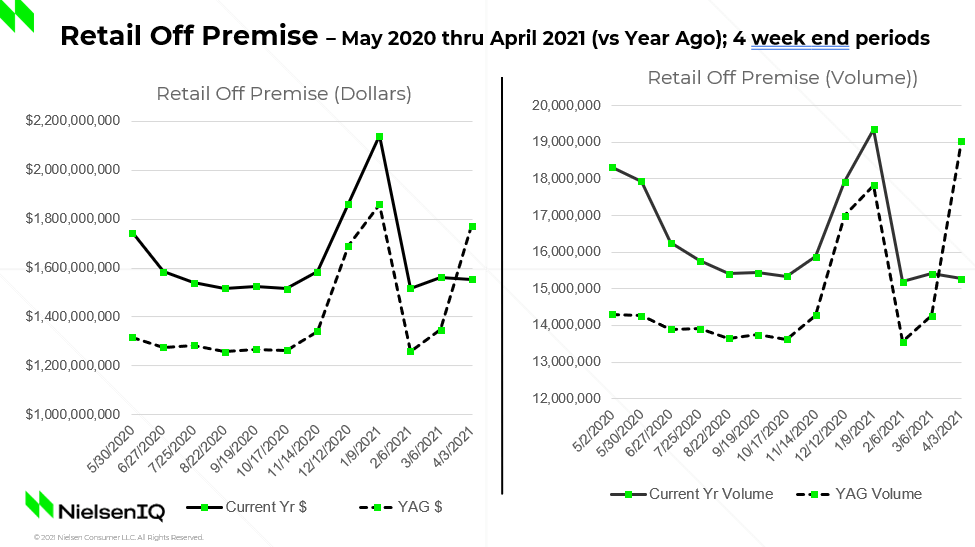
Nielsen is collaborating with Wines Vines Analytics and Sovos ShipCompliant to provide a much more comprehensive view of the U.S. off-premise wine category than ever previously available, with a data product that enables both separate and combined views of retail off-premise sales and DtC shipments.
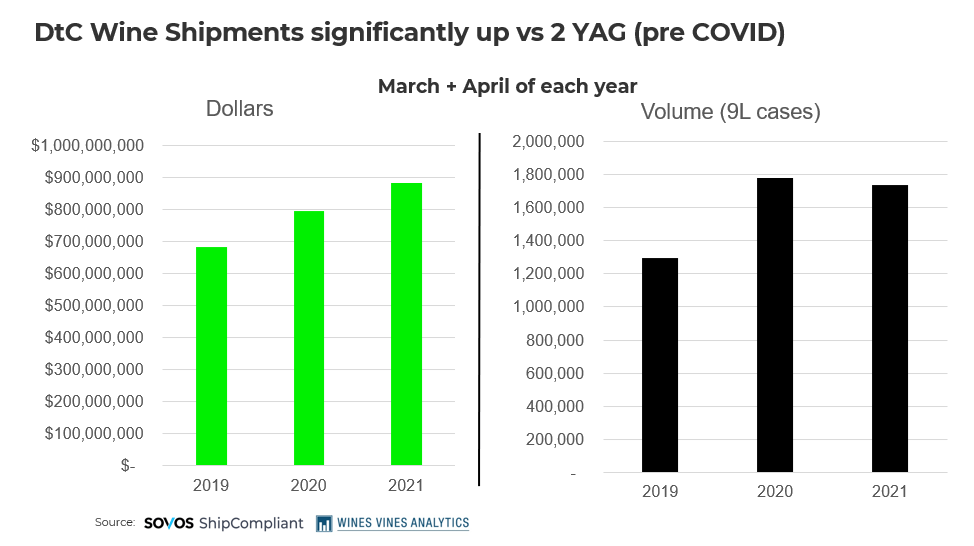
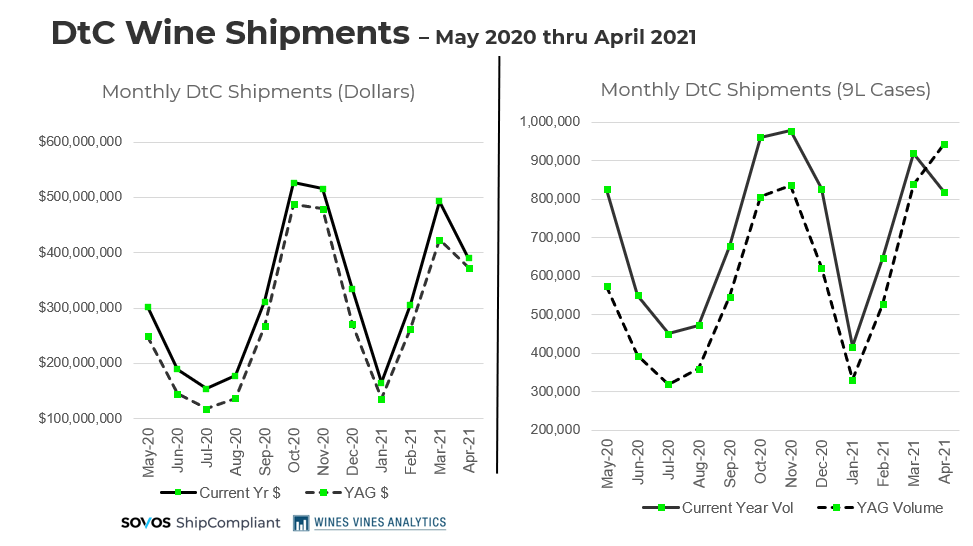
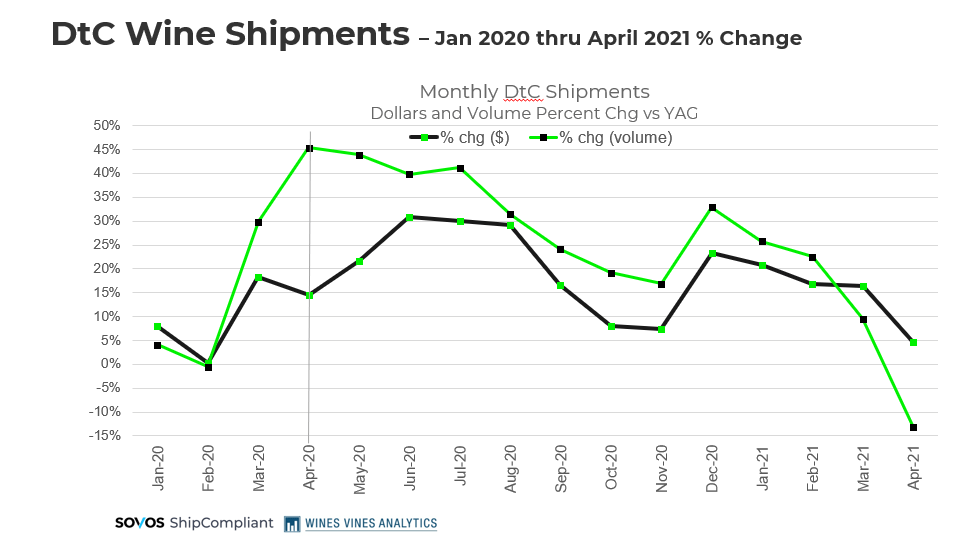
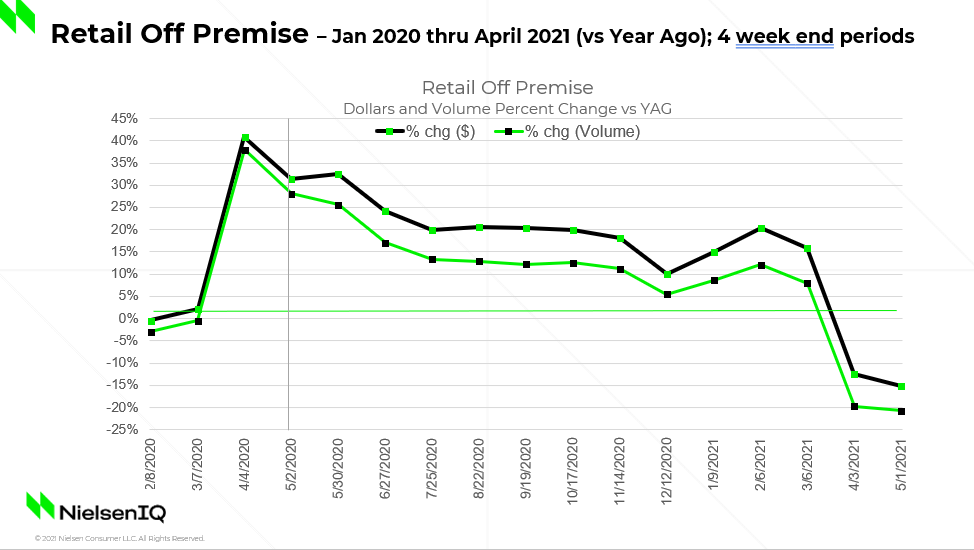
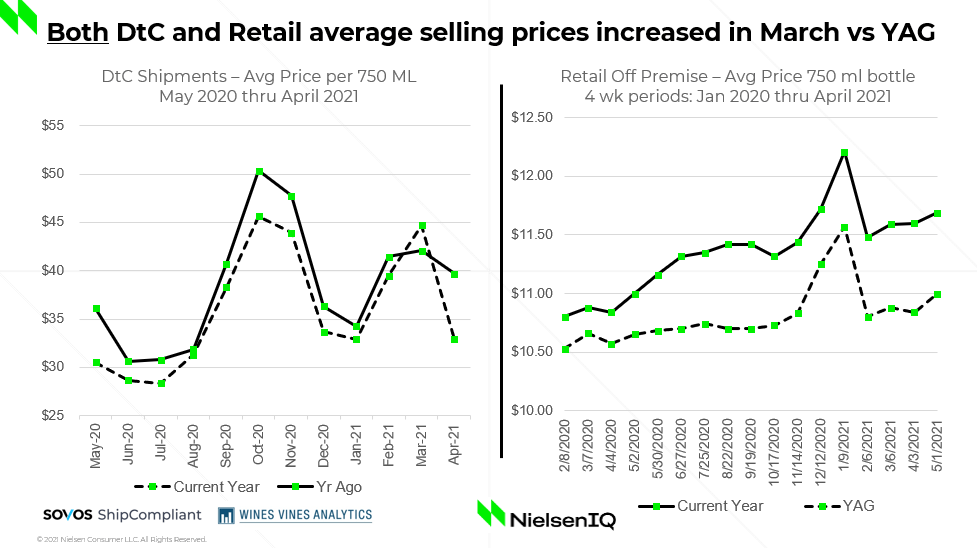
Now that we are comparing to COVID-impacted periods of one year ago, and on-site tasting room business are slowly starting to return, volume growth in April 2021 fell double digits versus year ago. However, dollar growth was still positive and for the second month in a row it exceeded volume changes.
Here are some highlights from the most recent data, along with commentary from Nielsen consultant Danny Brager.
Interested in knowing more (e.g., by price tiers, varietals, origin, winery size, geography)? Contact Danny Brager at danny.brager@nielseniq.com.
Download the Direct-to-Consumer Wine Shipping Reporting for an in-depth look at the 2020 DtC wine shipping market.
Alabama Governor Kay Ivey signed HB 437 into law on May 13, 2021, making Alabama the latest state to legalize direct-to-consumer (DtC) wine shipping. With this step, only Delaware, Mississippi and Utah continue to prohibit this popular and valuable means of selling wine.
Alabama’s new DtC law will not become effective until August 1, 2021. Before then, wineries looking to engage the Alabama market can familiarize themselves with the regulations and requirements that are in place.
As set out in HB 437, DtC wine shippers must comply with the following conditions:
Violating any of these requirements can bring severe monetary penalties, particularly for repeat offenders.
In addition to these regulations on the Direct Wine Shipper Licensee, HB 437 establishes several requirements for common carriers and fulfillment centers, which may be involved in facilitating DtC wine shipments. As in other states, common carriers will be required to collect a signature from someone aged 21 or older at the time of delivery and maintain a record of those signatures for up to three years. Common carriers will also be required to file a quarterly report detailing each shipment of wine they facilitated. Direct Wine Shipper Licensees should then only work with carriers who do abide by these requirements.
Fulfillment centers, defined in HB 437 as entities that operate as bailment warehouses and logistics servicers for licensed Direct Wine Shipper Licensees, are also subject to a number of provisions that largely resemble rules recently imposed by Tennessee.
These rules on fulfillment centers include a licensing requirement ($500 per year) and identifying each location from which the fulfillment center might ship products into Alabama (an additional $100 fee per location). Fulfillment centers must also file a quarterly report detailing each shipment they facilitated. And they must agree to work only with compliant carriers and only ship on behalf of wineries that have active Direct Wine Shipper Licenses issued by the ABCB. Fulfillment centers will similarly face severe penalties and fines if they fail to comply with these requirements.
Notably, HB 437 explicitly states that entities involved in DtC shipping of wine, including Direct Wine Shipper Licensees and fulfillment centers, may not avoid liability for any violations by contracting with a third party to handle their DtC shipping obligations. This does not mean that DtC wine shippers cannot avail themselves of a service that helps them manage their own compliance needs (such as Sovos ShipCompliant). Instead, it more emphasizes the need for wineries to assume personal responsibility for their DtC markets and not rely on third party entities that claim to enable legal, compliant sales under their licenses.
It is always good news when a state opens up to permit DtC shipping and Alabama is a particular prize after the many years of effort it has taken to pass HB 437. DtC shipping of wine continues to be a safe and effective means for wine consumers to access thousands of wine labels that may not be widely available in their states and for those winemakers to engage with a national market. With only a few holdout states remaining, we anxiously await the day when all Americans can benefit from the DtC wine shipping market.
Learn more about managing your DtC alcohol shipping compliance.
On May 6, 2021, Tennessee Governor Bill Lee signed HB 742 into law, establishing a slew of new provisions affecting the direct-to-consumer (DtC) shipping of wine in the state. These provisions, however, will not become effective until January 1, 2022.
While the bill does impose several new restrictions and requirements on businesses involved in DtC wine shipping in the state, particularly fulfillment houses, the most harrowing elements of the bill as originally drafted were removed.
As originally drafted, HB 742 was focused solely on prohibiting DtC wine shippers from using fulfillment houses when making shipments to Tennessee residents. Such a restriction would have severely impacted the ability of wineries to fulfill orders to consumers in the state. As such, it is extremely welcome that an outright ban was not part of the final bill signed into law.
However, the amendments that did happen to HB 742 through its passage included several additional provisions that will apply to both licensed DtC shippers and the fulfillment houses they utilize. These additional provisions include:
State regulators are increasingly concerned about perceptions of illegal DtC wine shipments, and they see fulfillment houses as an unregulated part of the DtC wine shipping market upon which they can impose new regulations. This view does overlook the fact that fulfillment houses are required to hold licenses in the state where they are located in order to store and hold wine on behalf of wineries (so they are actually not “unregulated” entities), and that they only make shipments under the explicit direction of wineries and make no sales themselves. Fulfillment houses by and large respect the central role they provide in enabling the legal DtC wine shipping market and already do much to ensure they only fulfill shipments on behalf of parties licensed to make those shipments.
Nevertheless, because of the critical role that fulfillment houses play in the DtC wine shipping market, they are apt to abide by the regulations that a state may impose on them, especially as directly challenging them would likely be a long and difficult fight, where compliance might just be the easier path. It is likely, though, that following Tennessee’s success in passing these provisions, other states will look to establish their own requirements on fulfillment houses.
All of these provisions will not become effective until January 1, 2022, so there will be plenty of time to further parse what is provided for in HB 742 and prepare to comply with the new restrictions and requirements.
Learn more about managing your DtC alcohol shipping compliance.
Kansas became the latest state to adopt effective economic nexus rules after the state legislature overrode a Governor’s veto to pass SB 50. The new law becomes effective on July 1, 2021, to apply to sales made after that date.
Under the new economic nexus law, remote sellers will face sales tax liability on their sales to Kansas residents if they make over $100,000 in total annual gross revenue in the state. Kansas state sales tax rate is 6.5%, which can be supplemented by local rates depending on where sales are made to.
On its face, the new Kansas economic nexus law is more notable for the contentious and Byzantine route it took to pass (including an attempt last year, which the Attorney General determined was unenforceable and the veto by Governor Laura Kelly in April). However, for direct-to-consumer (DtC) shippers of wine, there are additional considerations that attenuate the overall impact of this new general sales tax law.
Notably, Kansas is one of the few states that does not condition DtC wine shippers to accept a sales tax burden in the state as a condition of getting a DtC shipping license. As such, a DtC wine shipper’s sales tax burden in the state would only exist depending on generally applicable rules, such as the new economic nexus law.
There is a very good reason that this provision was left out of Kansas’ DtC wine shipping laws: sales of alcohol in Kansas are not subject to Kansas sales tax. Instead, the state imposes what is called the Beverage Occupational Tax of 8% on off-premises sales of alcohol (a 10% “Liquor Drink Tax” is applied to on-premises sales of alcohol).
The 8% Beverage Occupational Tax is imposed on DtC wine shippers, which they have been collecting and remitting to the state for many years providing millions of dollars to the state’s coffers.
However, under the new economic nexus laws, certain DtC wine shippers may now face an additional tax burden.
As written, the $100,000 annual sales threshold applies to total cumulative gross receipts made by a remote seller from sales to Kansas customers. While this threshold would exclude non-taxable sales for resale (e.g., sales made by wineries to Kansas wholesalers for three-tier distribution in the state), there does not appear to be any exclusion for sales that are exempt from sales tax but are otherwise taxable, such as DtC shipped wine.
Under the law as written, a DtC wine shipper would thus face a sales tax burden once they sell over $100,000 in wine into Kansas in a year. A DtC wine shipper reaching that threshold would be required to register with the Kansas Department of Revenue and file regular sales tax returns reporting their sales into the state. While they would be able to fully exempt their wine sales from their sales tax returns (providing that they are regularly filing and remitting their Beverage Occupational Taxes), they would still be required to file a return reporting their retail sales, and collect and remit sales tax on non-wine purchases made by Kansas customers.
It is this last point that makes the new Kansas economic nexus law peculiar for DtC wine shippers. While DtC wine shippers do often sell non-wine products, such as glasses or corkscrews, the overwhelming bulk of their sales are of wine. Under the new rules, a successful DtC wine shipper could be required to regularly file a sales tax return with Kansas even though a large majority of their sales will be completely deducted from that return. Nevertheless, such are the vagaries of sales tax law, wherein subtle nuances can have broad impacts.
It must be noted that the Kansas Department of Revenue has yet to provide specific guidance on its new economic nexus law. It may turn out that they will exclude retail sales that are not subject to Kansas sales tax (like DtC shipped wine) from their economic nexus threshold. However, in the absence of specific guidance to that point, DtC wine shippers who are making over $100,000 in total sales to Kansas consumers should at least anticipate that they will need to register for Kansas sales tax in the coming months.
With the passage of SB 50 and a similar measure in Florida last month, Missouri remains the only state that does not currently have economic nexus laws in effect. Missouri is also one of the few states that does not require DtC wine shippers to assume a sales tax liability. As such, we are paying close attention to that state’s legislature as it works to establish its own economic nexus laws.
Learn more about managing your DtC alcohol shipping compliance.
 By Marc Sorini
Marc Sorini is General Counsel for the Brewers Association. Prior to joining the BA, he represented small and independent craft brewers for over two decades as a partner with McDermott Will & Emery law firm, representing the BA and its predecessor organization, the Brewers Association of America (BAA). Sorini’s accolades include Go-To Thought Leader by The National Law Review, Lawyer of the Year for food and beverage law by The Best Lawyers in America, and MVP of the Year by Law360, among many others.
The Brewers Association’s recent DtC beer shipping report in partnership with Sovos ShipCompliant trains a spotlight on direct-to-consumer shipping, one that’s drawing increasing interest from craft beer drinkers and craft brewers alike. It’s just one of the areas where the Brewers Association sees opportunities for positive evolution of the laws governing the distribution of beer.
Beer in this country has experienced a renaissance in the past two decades, driven by consumers’ search for differentiated, quality products and a desire to patronize small, often local, businesses. Until the COVID-19 pandemic disrupted society, beer consumers often found choice by “voting with their feet” to visit breweries, taprooms and other venues where craft beer thrived. The pandemic made it much harder for consumers to venture outside their home to enjoy new beer experiences, so it is time to bring new beer experiences to the consumer.
It is no secret that the pandemic brought significant, and likely long-lasting, changes to business and government alike. In our industry, gubernatorial Executive Orders transformed overnight regulatory structures that had been in place for decades. As society looks out hopefully towards the end of the pandemic, the need to satisfy beer-lovers’ needs in new yet responsible ways has lawmakers, regulators and the public re-thinking long held notions about alcohol control.
One notable change has been the convergence of on- and off-premise retail rights in the COVID (and likely post-COVID) era. Until very recently a restaurant, a bar or a brewpub were strictly limited to on-premise sales. Today many of those businesses are bringing meals with drinks to the consumer.
DtC Shipping Extends Brewers’ Reach
To reach consumers further from their brewery locations, more and more brewers are “shipping.” By shipping we mean delivery through a common carrier, thereby extending the brewery’s reach to consumers far away. You now see the interest of brewers and distillers in doing what wineries have been doing successfully and responsibly for 15 years.
Other direct-to-consumer models that rely on local retailers only give consumers a very small subset of products available because most are not widely distributed and therefore not available for delivery from a local retail outlet. While the three-tier system does a great job for larger brands, for little brands, reaching faraway consumers through local retailers is simply not practical. Giving some sort of direct outlet to consumers is going to be an important thing for craft brewers going forward.
As the click-and-delivery economy continues to grow, restricting beer delivery will prove increasingly limiting for small brewers trying to reach the consumer looking for a niche product. Limiting delivery will favor the large, dominant brands. It’s not very hard to find an IPA that’s made by a subsidiary of one of the two big brewers anyplace in the country. But for over 99% of the Brewers Association’s members, such wide distribution is not the reality. The bottom-line is that if the consumer can only select what’s available at the local retailer, selection will be limited and small brewers will be largely left out of the delivery revolution, which is a definite concern of ours.
We see local delivery and more far-flung shipping as complementary to each other, much as they are in the wine industry today. We also recognize that delivery and shipping must be done right. It must be done responsibly. Fortunately, proven models to ship alcohol beverages responsibly already exist. The wine industry has been using and proving these methods for several decades.
Back to the Future
One distribution development we continue to see progress on is what I call distribution for small brewers going “back to the future.” If you look at the market of the 1930s, you had small brewers (the so-called “old regionals”) often relying on direct-to-retail self-distribution. That was a normal distribution model for smaller brewers back in the 1930s and 1940s. As the marketplace evolved, that practice declined and, in some places, became something that couldn’t legally be done. That might have made sense in an era of only giant brewers, but now that we have many small brewers again, it’s time to go back to the future. The three-tier system does great for a brand of scale, and a small brand that grows to a certain scale can successfully enter that system. But while a brand is growing, having an alternative outlet is important. We’re seeing progress on self-distribution in a number of states.
The math is simple: the brands of over 8,000 breweries will not fit within traditional distribution channels, which usually consist today of just a few wholesalers serving a given territory. Having 98% of the volume pass through traditional distribution channels works and that’s perfectly fine. But if a 2,000 barrel-per-year brewery wants to sell to the five restaurants within a half mile of it, the regulatory structure should have the flexibility to allow that. In sum, smart complements to the three-tier system exist to help the smallest brewers thrive, and the Brewers Association is working with state guilds to promote those complements.
An Independent Middle Tier
We recognize that an independent middle tier is critical to the success of small brands. We do not want a market where the distribution system is controlled by a couple of large suppliers, or a market where distribution is largely handled in-house by a couple of giant retailers. You see that in other countries, and it’s not great for small brands. Similarly, we recognize that the Brewers Association’s largest members would not have the success that they’ve enjoyed if they had to buy their own trucks and self-distribute across the United States. That level of capital investment would have been impossible. So, we see real benefits from an independent middle tier, but we also think the system needs to have more flexibility. If you are a tiny brand, you want the ability to grow your brand through local self-distribution, and if you succeed you will graduate up into a three-tier distribution model later on.
The Brewers Association also believes that franchise laws need significant reform. In wine and spirits, fewer large markets give wholesalers franchise protection, but in beer distribution such laws are almost universal. Those laws were designed for an era (the 1970s and 1980s) when you had mostly giant brewers distributing through small mom-and-pop wholesalers. Today the dynamics are completely different, and you have giant multi-million case wholesalers dealing with small mom-and-pop brewers. In that context, franchise laws just don’t make sense.
In short, the Brewers Association believes in sensible systemic changes that can help small businesses thrive, deliver value and selection to consumers, and will not crash the three-tier system. Reasonable evolution ultimately will make the entire system stronger and better for all.
Both beer and spirits new product registrations continue to see positive growth in Q1 2021
The past year has seen drastic changes in consumer buying patterns, with variation in what is being purchased, where and how often, impacting the beverage alcohol industry in many ways. Sovos ShipCompliant reviewed data from our Product Registration Online (PRO) tool to gauge how market conditions and consumer buying patterns influenced producers’ new product registrations.
The following is a breakdown of the new product registration data via PRO from Q1 of 2021 (January, February, March) for spirits, beer and wine.
This was a big quarter for wine, including a large increase in the amount of dessert wine new product registrations.
Q1 of 2020 was booming for the beer category (Q1 2020 was up 63% over Q4 2019). Though in Q2 when the effects of the pandemic appeared, new product registrations in the channel decreased 45%. As seen in the Q1 2021 new product registrations data, numbers are still far from reaching pre-pandemic levels.
While the overall beer new product registration numbers are down 40% over Q1 2020, they are up 2% from Q4. Specifically, beer numbers decreased 8% over last quarter while malt (seltzers, etc.) new product registration numbers are up 11% over last quarter.
The spirits category continues to expand in the pandemic, seeing new product registration growth in each quarter over the corresponding 2020/2019 quarter. Overall, there was a 46% increase over Q1 2020, with growth of 26% over Q4.
Rum, gin and tequila had new product registration increases of 99%, 90% and 66%, respectively, over Q1 2020. On the lower end, but still seeing new product registration growth, whiskey was up 14% and vodka up 11% over Q1 2020.
While last year was one of great change for the beverage alcohol industry, it seems that 2021 is also off to an incredible start.
Learn how PRO enables fast, easy electronic brand filings for beer, wine and spirits in participating states.
Direct-to-consumer (DtC) shipping has increased in popularity over the years, and has been very successful in the wine industry. Unfortunately for retailers shipping DtC, they have not been able to enjoy the same level of success due to a much more limited map. But as DtC shipping continues to grow in popularity retailers are trying to take more advantage of this channel and reach new customers, despite some of the added regulatory rules to comply with. Below are five facts for retailers exploring out-of-state DtC alcohol shipping.
Want more in-depth information about retailers shipping DtC? Read our free white paper, How and Where Retailers Can Ship Alcohol DtC.
Last year, wine shipments to consumers reached a record $3.7 billion, with a 27% year-over-year increase in direct-to-consumer (DtC) shipment volume. With no indication of slowing down, wineries must ensure that they utilize the right tools to protect their bottom line, collect the right tax rates and ensure compliance on every transaction. Implementing real-time software for DtC wine shipping needs can accomplish each of these goals.
Understand the penalty risk
Real-time software helps wineries avoid potential penalties before they happen. For example, a winery can know ahead of time if it is not properly licensed in a state or does not have the proper label registrations to sell compliantly. Additionally, businesses can rest assured that they are compliant with all state, county and city regulations.
Correct tax collection
Sales tax varies from one state to the next, which is why wineries need to ensure they correctly collect tax, regardless of their customers’ locations. Maybe a medium-sized winery in California gets three orders for its limited release Cabernet Sauvignon: one each in Minnesota, Florida and New Mexico. If the winery attempts to collect sales tax for each order using the Florida tax rate of 6%, it will overcharge the New Mexico customer but undercharge the Minnesota customer. These point of purchase miscalculations will require wineries to make up the difference from undercharging and to return any overages. Neither situation inspires confidence nor helps build long-term relationships with customers.
Wineries must collect the appropriate sales tax for each jurisdiction at the time of purchase to avoid creating a tax gap. Otherwise wineries face potential legal action from both states and consumers.
Avoid compliance concerns
Real-time compliance checks are also crucial. For example, different states will have varying requirements when it comes to limits on the permitted alcohol by volume (ABV) per shipment, the size of the order and packaging, the amount an individual can receive DtC in a time period (CAVL) and specific shipping label requirements.
If a state agency completes a wine purchase with an underage or invalid license, the agency knows that particular DtC wine shipper is illegally selling wine and not following the state’s established rules and regulations. Real-time compliance checks can help ensure that your business is protected if it is part of a sting operation or is selected for an audit.
The DtC wine channel continues to grow each year, giving wineries great opportunities to expand their DtC operations compliantly and increase business sales. Real-time software for compliance and sales tax determination helps reduce risk and keeps customers happy. Incorrect tax reporting could lead to increased oversight of DtC wine shipments, fines, penalties or even a loss of licensure. Wineries should invest in real-time software and not leave tax and compliance to chance.
See how Sovos ShipCompliant can help you with your DtC shipping compliance.
Florida Governor Ron DeSantis signed SB 50 into law on April 19, which makes Florida the latest state to adopt economic nexus rules to impose a sales tax liability on remote sellers, including direct-to-consumer (DtC) shippers of wine.
Unlike most other states, Florida does not currently require DtC wine shippers to assume a sales tax obligation in the state to make sales. Previously, DtC wine shippers were only liable for Florida sales tax if they had physical presence nexus in the state. Under the new economic nexus rules, however, many more DtC wine shippers will now be required to collect and remit Florida sales tax.
Under SB 50, the economic nexus threshold in Florida is established at $100,000 in annual, taxable sales in the state. Since the threshold applies only to taxable sales made by remote sellers, this would exclude sales to Florida wholesalers (as those are non-taxable sales for resale). As such, DtC wine shippers should only assess their direct sales to Florida consumers when they determine they have economic nexus.
SB 50 is set to become effective on July 1, 2021, so DtC wine shippers have until that date to prepare for collecting and remitting Florida sales tax if they meet the annual sales threshold (looking back at the previous year’s sales).
Economic nexus rules have swept across the U.S. since the Supreme Court ruled in the 2018 South Dakota v. Wayfair case that states could establish sales tax obligations on remote sellers if the requirements and conditions were not too onerous. Similar law changes in California, Colorado, Minnesota, Iowa, D.C., Wyoming, and Louisiana establishing new sales tax rules for remote sellers have previously affected DtC wine shippers. Florida is just the latest state, and one of the last, to adopt economic nexus rules.
Florida’s state sales tax rate is at 6%, though local communities can impose an additional amount of up to 2%.
DtC wine shippers with economic nexus in Florida should prepare to collect and remit the state’s sales tax by the effective date of July 1. This will require registering an account with the Florida Department of Revenue (DOR) to file those taxes. Sovos ShipCompliant users currently can find support for collecting and filing Florida sales tax in their accounts. However, they should not adjust those settings until they have an active sales tax account with the Florida DOR.
Learn more about managing your DtC alcohol shipping compliance.