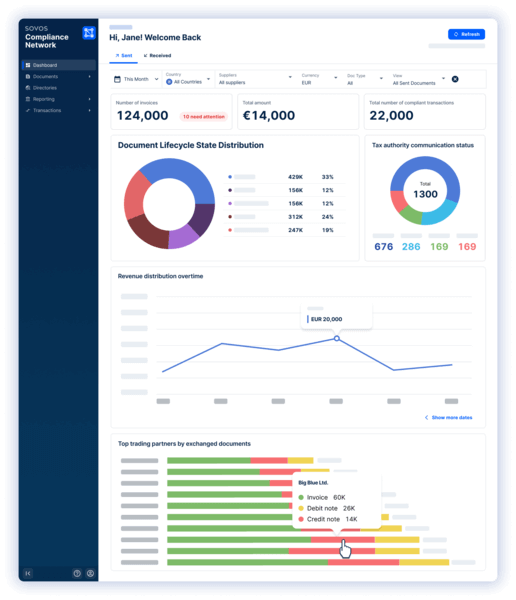
Compliance Network: E-Invoicing, E-Receipts and E-Archiving
Transact worldwide with confidence.
“Compliance is now inside the transaction, elevating its importance and driving businesses to look beyond just meeting a minimum threshold. Now, the goal is a global view of compliance with a single source of data that allows them to generate actionable business intelligence”
Kevin Permenter, Research Director
IDC
Get in touch: find out more about Compliance Network with our team of experts.
Global Compliance for Continuous Transaction Controls
Sovos Compliance Network is complete, continuous and connected. We process over 6 billion compliant invoices per year through our Compliance Network, more than 60 times other industry providers.
A core component of our Indirect Tax Suite, Sovos Compliance Network helps you:
Effortlessly map indirect tax compliance requirements with suppliers, buyers and consumers
Ensure your transactional documents adhere to the latest local regulations
Connect seamlessly with the right government agencies and certified platforms
Distribute invoices to trading partners where required
Build the Sovos Compliance Network into every transaction
The solution provides:
B2B & B2G Transaction Compliance
The world’s first complete solution for e-invoicing compliance, including clearance, CTC and global post-audit models.
Prove integrity and authenticity with universal, compliant archiving, including compliance maps, preservation sets, timestamps and signing and validation services.
Tax authorities across Eastern Europe continue to move ahead with SAF-T adoption, with upcoming changes impacting VAT compliance requirements for businesses operating in the region.
In this exclusive webinar, you’ll get in-depth insights on:
– Romania’s SAF-T expansion: The tax authorities will expand the scope of businesses impacted by this requirement to non-established companies from January 2025
– Bulgaria’s SAF-T Introduction (2025): Learn about Bulgaria’s planned adoption of the SAF-T framework and what it means for businesses operating in the region
– Poland’s Extended SAF-T Reporting: Discover how Poland is expanding its SAF-T filing requirements and how this may affect VAT compliance and audits
Join our expert, Clementine Mayor, VAT Consultant as she unpacks the latest developments in VAT reporting across Eastern Europe. Don’t miss this opportunity to understand how these changes will shape the future of VAT audits and prepare your business for compliance.
Italy: IPT Treatment on Used Vehicle Warranty Services
On 21 May 2024, the Italian tax authority published a ruling (No. 110/2024) on the IPT treatment of warranty services provided in relation to the sale of used vehicles.
The ruling dealt with a scenario in which a company (the ‘Applicant’) provided warranty services to dealers within the same company group, with the latter offering these warranties to the purchasers of the vehicles. The Applicant also separately entered into insurance contracts with an insurance company to obtain coverage for the costs it incurred in repairing the vehicles sold when required under the terms of the warranty.
The insurance contract concluded between the Applicant and the insurance company would only be subject to IPT in Italy if the policyholder’s relevant establishment was located in Italy, in line with the location of risk rules.
More significantly, however, the ruling also addressed the warranty services provided by the Applicant to the dealers. For these, the ruling assessed that guarantees such as these do not satisfy the requirements of an insurance contract with an insurance company as the contracting party. The VAT treatment of this arrangement was outside the scope of the ruling, but it was conclusive in outlining that IPT does not apply to such an arrangement.
Comparing this ruling to the position in Germany highlights the possibility of a lack of harmonisation in this area without an EU-wide position.
Read our blog on general matters of IPT in Italy for additional information.
Germany: The Application of IPT rather than VAT to Guarantee Commitments
Following the publication of various circulars by the Federal Ministry of Finance in Germany in 2021, rules on the taxation of guarantee commitments were made effective 1 January 2023. This blog explains how this affects insurers and other suppliers.
Scope of the rules for guarantee commitments
The Ministry of Finance published its initial circular in May 2021. This was in response to a Federal Fiscal Court judgment. It concerned a seller of motor vehicles providing a guarantee to buyers beyond the vehicle’s warranty.
In these circumstances, the circular confirmed that the guarantee is not an ancillary service to vehicle delivery but is deemed to be an insurance benefit. As such, it would attract IPT instead of VAT – unless the guarantee is considered a full maintenance contract.
The circular did not prompt immediate concern within the insurance sector. Markets outside the motor vehicle industry weren’t concerned either. The presumption was that it was limited to the specific context of the motor vehicle industry.
Matters changed the following month. The Ministry of Finance clarified that the tax principles it outlined in fact applied to all industries. As a result, the scope of these rules became potentially limitless in Germany. All guarantees provided as additional products to goods or services sold are now within the scope of the application of IPT.
The clarification could impact industries like those organisations selling electrical items and household appliances.
Effect on insurers and other suppliers
The effect on traditional insurance companies should be relatively limited as they do not usually provide guarantees as part of the sales of goods and services. There could arguably be a significant impact on other suppliers that do provide such guarantees.
First and foremost, there is a potential increase in the cost of providing the guarantees caused by the application of IPT. Unlike input VAT, a supplier cannot deduct IPT from its taxable income – it must either increase prices to compensate or accept a less favourable profit margin.
Any companies that purchase the guarantees cannot reclaim the IPT either, as they can do with VAT. The standard IPT rate of 19% in Germany is high compared to most European countries. This exacerbates these issues.
There are also practical considerations to bear in mind for suppliers obliged to settle IPT with the tax authority. They are presumably required to be registered for IPT purposes like insurers, although the Ministry of Finance has not formally confirmed this.
Perhaps more difficult is the issue of licensing. The Ministry of Finance circulars focus on taxation, leaving it unclear whether other suppliers are now required to obtain a license to write insurance under German regulatory law.
Looking for more information on general IPT matters in Germany? Our German IPT page can help.
Determining and calculating IPT liabilities in various regions can be challenging.
Sovos IPT Determination is a compliance software designed to streamline Insurance Premium Tax (IPT) calculations and ensure accurate tax reporting.
In this webinar, Ramesh Sudhan, Sovos’ Director of Product and Research & Development, will guide you step-by-step through several typical processes supported by the solution.
The Government of the Republic of Slovenia has released a draft proposal to implement mandatory e-invoicing and e-reporting for B2B and B2C transactions. This implementation would mark a significant shift in the country’s e-invoicing landscape.
Should the proposal be approved, taxpayers will be subject to a two-fold obligation: they must issue and exchange B2B invoices electronically and report B2B and B2C transactional data to the tax authority. Although clearance will not be required in the e-invoice issuance process, transactional data must be reported to the tax authority in near real-time, which shows that Slovenia is aligning with the global trend of governments implementing Continuous Transaction Controls (CTC).
Taxpayers under scope are all business entities registered in Slovenia’s Business Register (PRS), including companies, self-employed entities and associations. To register in the PRS, business entities must have a registered office or address in the territory of the Republic of Slovenia.
This new system also introduces a decentralised reporting and exchange model facilitated by registered service providers, called e-route providers. These are similar to the network exchange requirements in France and those planned for Spain.
The proposed mandatory e-invoicing and CTC e-reporting will be introduced from 1 June 2026.
E-invoicing requirements
The e-invoicing mandate would require taxpayers to issue, send and receive e-invoices and other e-documents for B2B domestic transactions.
Under the Slovenian proposal, e-invoices refer to an invoice or similar accounting document that records business transactions, regardless of what they are called. This includes credit notes, debit notes, advance invoices, payment requests, etc.
There are multiple supported formats for the exchange of e-invoices:
e-SLOG standard, developed by the Chamber of Commerce of Slovenia, which is compatible with EN16931 and already in use in the B2G sector
European standard EN 16931 for e-invoices, as per Directive 2014/55/EU
Other internationally recognised standards agreed mutually by the parties
The proposal allows three methods for e-invoice issuance and exchange:
E-route providers, which are registered service providers facilitating the issuance and exchange of e-invoices and e-documents.
Direct exchange between the issuer and recipient’s information systems (excluding e-mail transmission)
The authority’s free application for taxpayers with a smaller business volume
In cases where the issuer and recipient use e-invoice different standards, if using e-route providers, the recipient’s provider must convert the e-invoice to the syntax accepted by the recipient.
Regarding B2C transactions, consumers will have the option to receive either e-invoices or paper invoices. This must be agreed upon by the parties. If an e-invoice is issued, suppliers will be obliged to provide a visualised content version (e.g., PDF).
CTC e-reporting requirements
The proposal states that taxpayers must electronically report B2B and B2C transactional data, including cross-border transactions, to the Financial Administration of the Republic of Slovenia (FURS) within eight days of invoice issuance or receipt. Reporting must be done exclusively in the e-SLOG standard.
The reporting requirement extends to B2C and cross-border transactions, regardless of whether an invoice was issued electronically. This ensures that transactions such as these, for which e-invoicing is not mandatory, are reported to the FURS allowing it a comprehensive collection of taxpayers’ transactional data.
The selected method for e-invoice exchange will impact the e-reporting of transactional data. If the parties use e-route providers, both the issuer’s and recipient’s providers must send the e-invoice to FURS. For direct exchanges, both parties must separately report their transactions to FURS.
E-route provider requirements
The draft establishes obligations and certain technical requirements applicable to e-route providers. According to the Slovenian government, the requirements to become an e-route provider are comparable to those in France but without the need for certification
However, the public authorities will maintain a list of registered e-route service providers who must fulfil certain requirements, some of which are already listed in the draft law. The proposal does not state explicit local registration/establishment rules for e-route providers. The government will publish further regulations detailing the application process and other applicable requirements.
Next steps
The government must take certain crucial steps before enforcing the mandate. The Parliament must officially approve the draft law before the requirements are confirmed.
Moreover, publication of the technical specifications and further regulations are awaited, including details of the data reporting methods to the tax authority. Slovenia will need to apply for a derogation from the VAT Directive with the EU Commission to enforce mandatory B2B e-invoicing before the adoption of ViDA (VAT in the Digital Age).
For businesses operating in Slovenia, this will mean impactful changes to their outbound and inbound processes by 1 June 2026. This includes the acquisition of software or update of their systems to issue, send and receive e-invoices, adapting to the allowed e-invoicing formats and connecting to the FURS or availing the services of e-route providers to electronically report their data.
Have questions about how these changes could affect your operations? Ask our team of experts.
VAT Compliance in Germany: An Overview for Businesses
Tax compliance in Germany is fragmentary by nature and requires resources to ensure compliance. Consider that compliance for many German taxpayers requires meeting several mandates, and the fact that such regulations are updated often, and you understand the challenge taxpayers have to undertake. From VAT to IPT, multiple moving parts demand precious time and resources.
This page is your overview of all tax compliance obligations across Germany. To keep up with evolving requirements, be sure to bookmark and revisit frequently.
Germany VAT compliance can be resource-heavy to stay on top of due to the many requirements imposed on taxpayers. These include:
Periodic VAT return
Monthly 10th day of the month following the end of the tax period
Quarterly 10th day of the month following the end of the tax period
Annual VAT Return
Annual 31st May of the year following the reporting year
EU Sales and Purchases List
Monthly 25th day of the month following the end of the tax period (for goods once sales pass EUR 100,000 annually)
Quarterly
25th day of the month following the end of the tax period (for services and goods when sales are under EUR 100,000 annually)
Intrastat
Monthly 10th day of the month following the relevant month
VAT rates
19%
7%
0% and Exempt
Intrastat thresholds
Arrivals: EUR 800,000 Dispatches: EUR 500,000
VAT Rules in Germany
Germany e-invoicing
E-invoicing is on its way for all taxpayers in Germany, but complete coverage is not here just yet.
Electronic invoicing is currently divided by transaction type. While there are national and federal requirements for B2G transactions, electronic B2B invoices are still not mandated.
Taxpayers may find Germany’s e-invoicing scheme complicated due to its fragmented status, and the fact that more updates are coming. Our dedicated Germany e-invoicing page can help you to meet your compliance obligations.
Requirements to register for VAT in Germany
Companies established within the EU but outside of Germany typically do not have to register for VAT in the country. However, there are exceptions which would require a foreign business to have to register for VAT – including:
Buying and selling domestically without the goods leaving the country
Holding products in a German warehouse and selling to German customers
Importing into and selling goods in Germany from another EU Member State
Intra-community supplies (moving goods between Germany and other EU Member States)
Organising live events in Germany – whether for art, education or a conference
Selling via an electronic marketplace in Germany
More exceptions and other nuanced situations may require VAT registration in Germany. Contact us for more information.
IPT in Germany
Insurance Premium Tax (IPT) is another tax obligation in Germany to consider.
IPT in Germany is complex, providing numerous elements for insurers, brokers and other applicable parties to track – from rates to law changes. Just a handful of years ago, Germany underwent sweeping Insurance Tax Act reforms that caused uncertainty in the insurance market.
Put simply, Insurance Premium Tax is made up of five key elements. Together, the following determine the tax:
Import VAT, known as Einfuhrumsatzsteuer in Germany, is a unique form of VAT that foreign taxpayers must know. It is charged by the country’s customs authorities when goods are imported into Germany from countries outside the EU.
Companies established outside of EU Member States must pay import VAT in Germany, including when using ports in Bremen and Hamburg. However, foreign taxpayers oftentimes can apply for reimbursement of import VAT they have paid if they register in Germany.
Invoicing requirements in Germany
German VAT invoices have strict requirements to be legally valid. Required invoice contents include:
Issuance date
Unique invoice number
VAT identification number for the supplier
VAT rate(s), VAT amount(s), and total gross amount
Supplier and buyer full addresses
Description of the goods or services (plus quantities if supplying goods)
Total value of the invoice
Details in case of zero VAT, reverse charging, intra-community supply, etc
Registration for OSS in Germany
Cross-border trade in the EU for B2C transactions was simplified with the implementation of the One Stop Shop (OSS) scheme as part of the 2021 EU E-Commerce VAT Package.
To register for OSS in Germany, taxpayers must use the ELSTER.de portal. However, this requires an ELSTER certification, which is given to companies that have registered, paid VAT or submitted a tax return in Germany.
Devised to simplify EU VAT compliance, the VAT Import One Stop Shop (IOSS) consolidates your intra-EU activities into a single VAT return.
Businesses or their local representatives must submit an electronic application to the BZSt to register for IOSS in Germany. Taxpayers who pay VAT must also specify their VAT registration number.
Intrastat is an obligation for particular companies that trade internationally in the European Union. Specifically, it relates to the movement of goods across EU Member States.
Despite their being similar enforcements across the EU, Member States have chosen to implement Intrastat rules differently and they each have their own Intrastat threshold that triggers reporting. In Germany, there is a declaration threshold of EUR 800,000 for arrivals and EUR 500,000 for dispatches in 2024.
Germany issues VAT refunds monthly or quarterly, depending on the business’ filing frequency. The tax authorities transfer the refund to the bank account the business provided when it registered.
The standard VAT rate in Germany is 19%, applying to most goods and services. There’s a reduced rate of 7% for the likes of books, cultural services, medical and dental care.
The VAT registration threshold for taxpayers in Germany is EUR 10,000, providing they haven’t opted to pay VAT in Germany through the EU’s One Stop Shop scheme.
In Germany, VAT is due when the tax point occurs. It can be paid from the day after the end of the reporting period to the due date of the VAT return being paid.
Germany does not require companies outside the EU to appoint a fiscal representative for tax purposes. Businesses can choose whether to appoint a local representative or register directly with the appropriate tax office in Germany.
In Germany, the tax point determines when VAT is due. For goods, it is typically the time of delivery. For services, it is when the service is completed.
The tax office automatically sends a tax ID number to newly registered German addresses within three weeks of registration. It will come via mail; a duplicate can be obtained from the Finanzamt.
The delivery threshold in Germany is EUR 10,000. If a Germany-based supplier delivers goods to a customer in another European company under EUR 10,000, they will pay VAT in Germany as the threshold has not been reached.
How Sovos can help with VAT compliance in Germany
The fragmented aspect of tax compliance in Germany can be demanding on resources, especially when keeping current on future updates and implementations. Sovos is a single vendor with global and local tax expertise that allows you to future-proof your tax compliance.
Choosing Sovos as a partner means choosing to reclaim your time, allowing you to focus on what matters: growing your business.
Complete the form below to speak with one of our e-invoicing experts
As the global e-invoicing landscape continues to shift and develop, our quarterly VAT Snapshot webinar brings you all the details on the key regulatory changes to watch.
Join Dilara Inal and Marta Sowinska from our Regulatory Analysis and Design team for a 30-minute update on the latest developments in e-invoicing regulations across Europe and beyond.
This session will cover:
Estonia: Encouraging the use of e-invoicing
Latvia: Upcoming mandatory B2B and B2G e-invoicing
Germany: Approval of mandatory B2B e-invoicing by the German Parliament, effective from 2025
Israel: Current status of the e-invoicing clearance mandate
Ever-changing Insurance Premium Tax (IPT) rules and regulations can be challenging to keep up with, so staying on top of the latest developments in IPT compliance is key.
Join our insightful webinar where Sovos’ IPT experts Edit Buliczka, James Brown and Jake Thorne will deep dive into the intricacies of remaining compliant in Hungary and discussing the current and the potential future impacts of the climate change to the IPT regulations across Europe and beyond.
Remaining current with the latest regulatory revisions in VAT reporting and SAF-T requirements in Poland. This webinar will deliver a comprehensive overview of recent changes to ensure you thoroughly understand the evolving compliance landscape. Gain valuable insights into essential strategies and best practices for preparing for VAT audits, mitigating risks and avoiding penalties.
The EU Directive for VAT has laid the groundwork for a harmonised VAT system throughout the different Member States. However, the implementation of the EU VAT law within the national jurisdictions still creates a disparity between its application and conditions to be met, specifically regarding some of the intra-EU simplifications to be applicable.
Following a webinar covering regulatory updates alongside key points of the VAT recovery process, this blog aims to shed light on the crucial aspects of VAT recovery – especially fast-approaching deadlines.
Understanding the nuances of VAT recovery applications is essential for businesses seeking to optimise operational costs by recovering VAT incurred in a different country. Let’s explore the fundamental aspects of the VAT recovery process.
The VAT recovery process
Businesses can reclaim VAT incurred during their operations through VAT returns if registered in the country where costs are incurred. However, for those not registered and with no obligation to do as such, alternative routes such as the EU Refund Claim or 13th Directive procedure are available – provided specific criteria are met.
Before initiating a VAT refund claim, companies must carefully evaluate their taxable activities. Failure to identify taxable activity in the relevant country may result in the rejection of the VAT recovery application. In such cases, registering for VAT becomes imperative to facilitate input VAT recovery through VAT returns, subject to each country’s rules regarding retrospective VAT registration.
Recoverable expenses
The range of recoverable expenses varies across countries, encompassing equipment, tooling, event costs, professional fees, accommodation and so on. However, due to varying regulations, conducting a comprehensive recoverability assessment based on each country’s VAT legislation is crucial before applying.
Meeting deadlines
Adhering to deadlines is critical for successful VAT recovery.
EU businesses seeking VAT refunds from other Member States must submit an EU Refund Directive application by 30 September of the subsequent calendar year. Non-EU businesses aiming to reclaim VAT incurred in EU Member States should file a 13th Directive application by 30 June of the following year.
While some countries share a common deadline of 30 September, missing deadlines may restrict refund requests. Notably, even though in most cases, these deadlines cannot be extended, there are countries like the Netherlands where refund requests can be submitted to tax authorities up to five years back rather than just for the previous fiscal year.
Understanding reciprocity
Reciprocity agreements are pivotal in VAT refund claims, with most EU Member States mandating reciprocity. Understanding these laws is essential to avoid failed attempts at reclaiming VAT in non-reciprocal jurisdictions.
Recent updates include the UK-Italy agreement under the 13th VAT Directive, streamlining VAT refund claims for UK businesses. Notably, the deadline for a 13th directive application in Italy is September 30th, 2024, for all costs incurred during 2023 (i.e., purchase invoices dated in 2023). This represents a significant advancement toward streamlined cross-border VAT recovery processes for UK businesses. Additionally, it may be advantageous for businesses to revisit already submitted 13th Directive claims in Italy that were previously on hold due to the lack of reciprocity.
In conclusion, mastering the intricacies of VAT recovery empowers businesses to enhance financial efficiency and mitigate costs effectively. By navigating the essentials outlined above, businesses can embark on a journey toward unlocking their full VAT recovery potential.
In Austria, the insurance premium tax law regulates the indirect tax that applies to elements of coverage under a motor insurance policy. This blog details everything you need to know about this particular indirect tax in the country.
Which taxes are payable concerning motor insurance policies in Austria?
In Austria, Vehicle Insurance Tax (VIT), or the so-called motor-related insurance tax, is payable in relation to:
Motorcycles (classes L1e, L2e, L3e, L4e and L5e)
Passenger cars (class M1) under 3.5 tons of total gross weight
All other types of motor vehicles (e.g. light commercial vehicles of class N1) under 3.5 tons of total gross weight, though some exclusions apply (tractors, for example)
VIT is payable in addition to the 11% insurance premium tax (IPT).
How is VIT calculated for motor insurance policies in Austria?
The calculation of VIT is complex. The tax is determined by the type of vehicle, the engine capacity/displacement and CO2 emissions for motorbikes, the performance of the combustion engine and the emission in grams per kilometer for passenger automobiles and the power of the combustion engine for all other engine types.
The date of registration is another item to consider when calculating the amount of VIT. The computation for automobiles registered before 1 October 2020 is different, however.
The following rates are effective for passenger cars registered after 1 October 2020 are as follows:
EUR 0.72 per Kwatt of the power combustion engine
EUR 0.72 per gram of the value of CO2 emissions in grams per kilometre
In 2020, the first component, power, was lowered by 65 Kwatt, while the second component, emission, was reduced by 115 grams per kilometre. Since 2021, the deduction has been lowered annually. Every year, the first component is reduced by one and the second by three. As a result, in 2024, the deductions are 61 Kwatt and 103 grams per kilometre.
To complicate this further, the aforementioned calculation only applies to M1 passenger cars whose CO2 emissions were established using the WLTP (Worldwide Harmonised Light Vehicle) test method. If this process is not followed, the calculation will be different.
Special rates apply to motorhomes, motorcyclists and other multi-track motor vehicles.
The computed amount is due monthly. Prior to 2020, the regularity of the payment was another aspect to consider in the computation.
What vehicles are exempt from tax in Austria?
First and foremost, VIT is required on motor vehicles weighing up to 3.5 tonnes. If the vehicle’s weight exceeds this limit, another type of tax – motor vehicle tax – is due.
Unlock the secrets to fruitful global trade in our latest webinar; our consulting expert Luca Clivati will provide valuable insights and guidance to help businesses maximise operational and financial efficiency when trading globally.
Keeping up with e-invoicing requirements has never been a bigger task, especially if you operate internationally. Join us as we share the latest information necessary to successfully navigate the latest updates to the global e-invoicing landscape. This webinar will cover:
• Expansion of Romania’s e-transport mandate since December 2023
• Development of Spain’s SIF/Verifactu requirement
• Postponements in Portugal
• The legislative process for B2B Public Administration mandatory e-invoicing in Germany and Belgium
• Important dates to be aware of in Poland
• Recent changes to Malaysia’s e-invoicing mandate
• Date changes and key features in Israel
Stay updated on VAT Reporting and SAF-T with Sovos’ webinar. Explore legislative changes, prepare for VAT Recovery deadlines, and gain insights into SAF-T updates for Portugal, Bulgaria and Poland. Understand recovery claims essentials, crucial with the nearing 13th Directive deadline.
e-invoicing in Poland: B2B, B2G, KSeF
Poland’s e-invoicing requirements are in flux. While the government has been required to receive e-invoices in B2G transactions since April 2019, the country’s B2G (for suppliers) and B2B e-invoicing rules are set to come into effect in February 2026 for taxpayers whose turnover exceeds PLN 200 million (approx. EUR 46 million) in 2024, and in April 2026 for all other taxpayers.
Staying in the know is vital if your business is to avoid costly penalties.
Continue reading to learn about the current status quo of Poland e-invoicing, including the introduction of a Continuous Transaction Controls (CTC) system via the KSeF platform, as well as what you can expect going forward.
CTC Type E-Invoice clearance via KSeF or PEF for B2G transactions carried out with public institutions will take effect in February 2026 for taxpayers whose turnover exceeds PLN 200 million (approx. EUR 46 million) in 2024 and in April 2026 for everybody else.
Network Possible e-invoice issuance both via PEF and KSeF. If B2G, e-invoice will be issued in PEF and automatically transferred to the KSeF in order to assign a KSeF number. The PEF invoice will be visible in the KSeF in the appropriate tab for PEF invoices, and the information about the assigned KSeF number will be available in PEF.
Format PEF format (following the European Standard EN-16931-1:2017) or KSeF format supporting XML invoices (following the logical structure FA_VAT).
eSignature Requirement A qualified electronic signature or seal are one of the means that taxpayers must use to authenticate in KSeF.
The integrity and authenticity of an invoice are ensured by issuing structured e-invoices via KSeF.
Archiving Requirement 10 years.
Poland B2B e-invoicing
CTC Type E-invoice clearance via KSeF for transactions carried out by taxpayers with a registered office or fixed establishment in Poland (if in the latter case, the fixed establishment participates in the supply for which the invoice is issued) will take effect in February 2026 for taxpayers whose turnover exceeds PLN 200 million (approx. EUR 46 million) in 2024 and in April 2026 for all other taxpayers.
Network Centralised network where the e-invoice exchange is processed through the KSeF platform provided by the Ministry of Finance.
Format XML following the logical structure FA_VAT.
eSignature Requirement Qualified electronic signature or seal are one of the means that taxpayers must use to authenticate in KSeF.
The integrity and authenticity of an invoice are ensured by issuing structured e-invoices via KSeF.
Archiving Requirement 10 years.
E-invoicing regulations in Poland
Tax compliance is monitored and regulated by the Ministry of Finance, particularly the National Revenue Administration. After implementing the SAF-T changes in Poland in the form of JPKs (Jednolity Plik Kontrolny), the Ministry of Finance is currently revolutionising the invoicing system, introducing the centralised platform Krajowy System E-Faktur (KSeF) for the transmission of structured e-invoices.
Since 2019, public entities in Poland have been mandated to receive and process e-invoices. While currently optional for suppliers of public entities, the transmission of e-invoices will be required for B2G and B2B transactions when the mandate is implemented in 2026.
KSeF Poland: National Electronic Invoicing System
Poland has introduced a national electronic invoicing system called KSeF (Krajowy System e-Faktur), which is a centralised platform for issuing and exchanging electronic invoices with a structured format, known as FA_VAT. The go-live date for issuing and receiving invoices via KSeF has been postponed three times since it was originally announced. Once in action, buyers and suppliers in B2B and B2G transactions will be mandated to issue and receive e-invoices through the KSeF platform.
While e-invoicing through KSeF has been available on a voluntary basis (known as KSeF 1.0), the Polish Ministry of Finance has implemented several changes to the system with KSeF 2.0, scheduled for launch in February 2026. This updated version includes features such as optional B2C e-invoicing, a permanent “offline24” mode, support for attachments, and postponement of certain KSeF-related obligations.
Learn more about KSEF 2.0, the key changes and its roll out in our blog.
Poland B2B e-invoicing
The issuance of electronic invoices through KSeF has been voluntary for businesses since 1 January 2022, meaning suppliers can issue e-invoices via KSeF. However, buyers can still request to receive them in a different format outside of KSeF.
This will change when e-invoicing via KSeF becomes mandatory in 2026 for the majority of businesses in Poland – namely registered VAT taxpayers who have a registered office or fixed establishment in Poland (if, in the latter case, the fixed establishment participates in the supply for which the invoice is issued).
Poland B2G e-invoicing
Poland’s own portal, PEF (Platforma Elektronicznego Fakturowania), has been in place since 2019. It aims to centralise and facilitate B2G e-invoice transmission allowing private companies and public bodies to issue and receive electronic invoices. All public entities in Poland have been obliged to register on PEF and receive structured e-invoices since 18 April 2019.
When the mandate takes effect, the PEF and KSeF systems will merge, meaning that e-invoicing in B2G transactions will be possible both via PEF and KSeF. B2G invoices will also need to receive a unique KSeF ID.
For instance, taxpayers will be able to use features available in KSeF like semantic validation of the e-invoice. Tax authorities will be able to access such invoices, regardless of if they were issued through PEF or KSeF. Therefore, it will be possible to continue issuing B2G invoices via PEF and according to the PEF e-invoice standard.
Timeline: e-invoicing adoption in Poland
While businesses will be legally required to use electronic invoices, there are benefits that taxpayers can enjoy when comparing e-invoices to traditional, paper invoicing. These include:
Cost savings: Reducing paper usage, postage and manual labour
Time savings: Electronic invoices use standardized formats and automated processes
Convenience: e-invoices increase interoperability across businesses
Increased security: Authentication and validation ensure the authenticity of transactions and the according invoices
While businesses will be legally required to use electronic invoices, there are benefits that taxpayers can enjoy when comparing e-invoices to traditional, paper invoicing. These include:
Cost savings: Reducing paper usage, postage and manual labour
Time savings: Electronic invoices use standardised formats and automated processes
Convenience: e-invoices increase interoperability across businesses
Increased security: Authentication and validation ensure the authenticity of transactions and the according invoices
How to choose the right e-invoicing software in Poland
It’s not enough to accept software that accommodates e-invoicing without adapting it to the often-changing local rules and standards, resulting in the new status quo right as it comes into effect.
While functionality is important, also consider the future when choosing your ideal e-invoicing software provider.
International businesses must keep their eye on the bigger compliance picture, looking beyond local mandates to ensure they are meeting their obligations everywhere they do business. This can be heavy on resources, especially when considering the scope for regulatory updates across multiple jurisdictions.
The future of e-invoicing is clear: Poland is working towards a vast implementation. A mandate will enter into force in February 2026 and become a requirement for many taxpayers. However, the implementation of VAT in the Digital Age (ViDA) cannot be forgotten when considering the future of e-invoicing in Poland. Designed to digitise the VAT system in the EU, ViDA will deliver further changes to how taxpayers in the country do business.
The future of e-invoicing and tax as a whole may be changing across the European Union, but Sovos can provide your organisation with the consistency and peace of mind you require. Bookmark this page to remain updated with the latest developments that may affect how you do business.
Additional obligations for VAT compliance in Poland
Keeping on top of the upcoming e-invoicing requirements is important, but it’s also crucial to remember other obligations your business may face when complying with Poland’s VAT regulations.
While adapting to the pressure of implementing e-invoicing, taxpayers need to remain mindful of overall VAT Compliance and the current SAF-T mandate in Poland.
The results of non-compliance can change businesses forever, but Sovos is here to help you stay on top of your obligations.
Setting up e-invoicing in Poland with Sovos
Sovos prides itself in its continuous transaction controls (CTC) software which is purpose-built for customers who must remain on top of tax obligations wherever they do business – even as regulations change in the future.
Taxpayers established in Poland will be starkly aware of the evolving demands of compliance, with B2B and B2G transactions requiring electronic invoicing.
As CTCs and e-invoicing rise in prominence globally, there has never been a better time than now to find a compliance partner who understands the rules in play and is already looking ahead at what’s to come. Sovos is the provider you can trust.
The Sovos e-invoicing compliance solution was put to work by Brown-Forman, which looked to ease the burden of compliance from its IT department. Brown-Forman was able to reallocate its resources to core business functions with peace of mind, knowing that Sovos was there to ensure its e-invoicing requirements were being met.
E-invoicing is mandatory in Poland for the public sector who must be able to receive e-invoices for B2G transactions. This will change when both B2G and B2B e-invoicing becomes obligatory via KSeF from February 2026 for the largest taxpayers and in April 2026 for everyone else. B2C e-invoicing will be optional.
Taxpayers will be mandated to electronically report specific information through KSeF, e.g. in cross-border transactions. In practice, e-invoicing and e-reporting are performed in the same way.
Yes, invoice archiving is mandatory in Poland. When KSeF becomes mandatory in February 2026, invoices will be automatically stored in the KSeF system for 10 years, though businesses are still advised to maintain their own archives as well.
Poland’s VAT Act mandates that invoices must be issued in two copies, with one being sent to the customer. Invoices cannot be raised before 30 days of the date of the delivery of the goods or services, but also no later than 15 days after the month they were delivered.
VAT invoices must contain numerous details as required by the tax authority, including the likes of:
Date of issuance
A unique identification number
Full name and address of buyer and seller
Description of type and quantity of supplied goods, or type and extent of rendered services
Date of transaction
VAT rate and amount payable
With the implementation of mandatory e-invoicing, additional data points are required to comply with the invoice schema.
Sending and receiving electronic invoicing for B2B and B2G transactions via KSeF in Poland will become mandatory from February 2026 for taxpayers whose turnover exceeds PLN 200 million (approx. EUR 46 million) in 2024 – and in April 2026 for all taxpayers.
KSeF (Krajowy System e-Faktur) is Poland’s national electronic invoicing system, which is a centralised platform for issuing and exchanging electronic invoices. E-invoices must follow a structured format, known as FA_VAT.
Access QR codes will be mandatory on invoices shared outside of KSeF with counterparties, whether issued in online or offline mode. Additionally, a second QR code based on the KSeF certificate will be required for invoices issued in the offline modes under specific circumstances.
E-invoicing will not completely replace SAF-T (JPK – Jednolity Plik Kontrolny) in Poland, but it will eliminate the need for JPK_FA reporting for invoices issued via KSeF. JPK_FA is a standardized electronic file containing sales invoice data that Polish businesses must submit to tax authorities upon request.
VAT Compliance in Poland: An Overview for Businesses
Poland VAT compliance can be a tall task for those yet to devise a future-proof strategy. Considering legislation changes frequently and the ongoing phased implementation of e-invoicing, it takes a lot of time, money and energy to meet your obligations.
This is your overview of all the tax compliance rules applicable in Poland, covering mandates and requirements such as VAT, SAF-T (JPK) and e-invoicing via KSeF. Add this page to your compliance toolbelt so you can understand and meet your obligations – both now and in the future.
While Poland does not have an Insurance Premium Tax (IPT) regime, it does have some parafiscal charges that are applicable to the insurance premium.
The Fire Brigade Tax (FBC) is applicable in special cases. There is also a so-called Financial Ombudsman Charge (FOC) to be settled online and paid to the Polish Financial Ombudsman Office on a yearly basis. This charge is applicable for all insurance companies operating under Freedom of Services (FOS) or Freedom of Establishment (FoE) in Poland as well as for Domestic Insurance Companies.
Previously, Insurer Ombudsman Charge (IOC) applied to all 18 classes of non-life insurance and life insurance policies. It was replaced by the Financial Ombudsman Charge (FOC) in January 2023.
Import VAT in Poland
The act of importation is a taxable event for which VAT is chargeable in Poland.
There is an option to use postponed accounting on imports. Poland introduced the option to defer import VAT as of 1 July 2020, enabling businesses to declare the tax through the VAT return without any cash payment. This mechanism is a great cash flow for the company as it doesn’t have to advance the VAT at Customs.
Taxable persons can use the mechanism, irrespective of whether the goods are subject to simplifications from the EU Customs Codes. To use the deferment mechanism, taxpayers must have a clear history of recent VAT compliance.
Invoicing requirements in Poland
Polish VAT invoices must be issued no later than the 15th day of the month after the taxable supply, and no earlier than 30 days before the supply of goods or completion of a service.
The electronic invoice will be considered issued on the day it is sent to KSeF, i.e. at the moment when it enters the system. When a structured invoice is assigned a KSeF number (unique ID), which contains the date of issue, it becomes legally valid. The issuance date is also in the Official Receipt Certificate (UPO).
One Stop Shop (OSS) has been effective in Poland since 1 July 2021, aiming to simplify VAT obligations for companies involved in distance selling.
Its main benefit is that a supplier can choose to account for the VAT due under OSS, which can be used for intra-EU cross-border supplies of goods and all cross-border supplies of services made to final consumers in the EU.
As a result, the company is required to register for VAT in only one EU Member State instead of registering for VAT in all EU Member States in which it operates – provided that the pan-EU threshold of EUR 10,000 in intra-EU distance sales to consumers is exceeded.
OSS can be used by businesses established in and outside the EU. If a supplier or a deemed supplier decides to register for OSS, it must declare and pay VAT for all supplies (goods as well as services) that fall under OSS.
Where the Member State of identification is Poland, the taxable person is entitled to file a notification to II Urzad Skarbowy Warszawa Srodmiescie by electronic means.
The forms for the EU OSS procedure are as follows:
VIU-R – notification form
VIU-DO – Form of the return for VAT settlements, filed for each quarter by the end of the month following a given quarter
The forms for non-EU OSS procedure are as follows:
VIN-R – Notification form
VIN-DO – Form of the return for VAT settlements, filed for each quarter by the end of the month following a given quarter
If you need help, please contact us or find more information on our dedicated guide.
Registration for IOSS in Poland
Import One Stop Shop (“IOSS”) is effective as of 1 July 2021 and applies to B2C distance sales of goods from outside the EU.
Under the standard procedure, VAT is due on all commercial goods imported into the EU Member State (the country of destination).
The purpose of IOSS is to facilitate the declaration and payment of VAT due on the sale of low-value goods of consignment valued at less than EUR 150. If the IOSS is used, the importation into the EU is exempt from VAT.
When using IOSS in Poland, a taxable person without a registered seat in the territory of the EU must indicate Poland as the Member State of identification. The taxable person in charge of the supply, or the intermediary, is entitled to file a notification with the II Urzad Skarbowy Warszawa Srodmiescie electronically.
The forms for the IOSS procedure are as follows:
VII-R – Notification form of taxable person
VII-RP – Notification form of intermediary
VII-DO – Form of the return for VAT settlements, filed for each month by the end of the month following a given month
Intrastat is an obligation for certain businesses that trade internationally in the European Union, relating to the movement of goods across EU Member States.
While the requirements remain similar across the region, certain Member States have implemented rules differently and each has its own Intrastat threshold for reporting. Poland’s declaration threshold for 2024 is PLN 6.2 million for arrivals and PLN 2.8 million for dispatches.
The standard procedure for VAT returns in Poland includes monthly filing. Taxpayers deemed as ‘small’, however, can file VAT returns quarterly if they meet specific requirements. VAT returns can be submitted by the official portal or through approved software.
VAT returns need to be filed by the 25th of the month following the accounting period. This is of utmost importance as taxpayers can be financially penalised for failing to meet the deadline, as well as the potential to accrue statutory interest and potentially face legal proceedings.
Since October 2020, there has been a Uniform Control File (JPK_VAT) that is made up of a record section and a declaration section. This consolidates data that was included in VAT returns prior to the file’s introduction.
The standard VAT rate in Poland is 23%, though certain goods and supplies have reduced rates of 8% and 5% and some services are exempt from VAT altogether.
The VAT registration threshold for companies established in Poland is PLN 200,000.
There is no threshold on the VAT registration for foreign companies not established in Poland; they are required to register for VAT prior to making their first VAT-relevant supply in the country.
VAT applies to the supply of goods and rendering of services in Poland for consideration. VAT liability is money owed to the tax authority and is calculated by subtracting credits from the total amount of VAT a taxpayer has collected at the moment the VAT becomes chargeable.
The deadline for making the relevant VAT payment is the same as for submitting the VAT return part of the SAF-T, i.e., by the 25th day of the month following the month in which the tax point arises. VAT liabilities must be paid by bank transfer and in Polish zloty.
The Polish Tax Authorities require businesses established outside of the EU and having a VAT registration in Poland to appoint a fiscal representative in Poland. The fiscal representative can be an individual or a company, such as Sovos. The fiscal representative is jointly and severally liable with the taxpayer for the tax liability, which the fiscal representative settles on behalf of and for the benefit of that taxpayer in Poland.
It is worth noting that, since 23 February 2021, taxpayers established in Norway or Great Britain have not been obliged to appoint a fiscal representative when operating in Poland. The companies established in both Norway and Great Britain can register directly for VAT purposes in Poland. This entails that the legal representative of the company can sign the registration form without any involvement from the Polish established Company or an individual acting in the capacity of a fiscal representative.
An EU business is not required to appoint a fiscal representative to register for VAT in Poland, but it may choose to do so.
The threshold for VAT registration for Polish-established businesses is PLN 200,000 (about EUR 46,000).
The VAT registration limit may apply either:
Retrospectively: The value of supplies of goods or services exceeded PLN 200,000 in the preceding tax year
Prospectively: At the start of business, the value of supplies of goods or services is expected to exceed PLN 200,000
Businesses operating in Poland may additionally opt to register for VAT regardless of reaching the threshold or if their operations comprise only VAT-exempt activities.
Non-established businesses – foreign businesses without a place of business in Poland – must register for VAT in Poland when making taxable supplies of goods or services in Poland. They are exempt from registration when they exclusively supply the following services:
Services and goods where the Polish purchaser pays tax under the reverse charge mechanism
Certain services that are subject to a zero rate (e.g., services supplied within Polish seaports, connected with international transport, services of air traffic control rendered for foreign providers of air transportation)
How Sovos can help with VAT compliance in Poland
The varied nature of tax obligations in Poland means compliance can be a resource-heavy task – especially when you consider the high probability of future updates and implementations. Choosing Sovos, a single vendor with global and local tax expertise, allows you to future-proof compliance.
Reclaim your time so you can focus on growing your business by speaking with our expert team today. Compliance is our concern.
VAT Compliance in Romania: An Overview for Businesses
Romanian VAT Compliance can be described as a layered system conflated with different declarations and requirements, from SAF-T obligations to electronic invoicing. In this page, businesses aiming to remain compliant and looking to know the most up to date news, can find an overview of the main Romanian VAT rules. Scroll down to learn about Romanian VAT compliance requirements and how to remain compliant.
Romania is a complex country for VAT rules, with many elements that companies need to be aware of. These include:
Periodic VAT return (Decont de taxa pe valoarea adaugata)
Monthly 25th day of the month following the end of the tax period
Quarterly 25th day of the month following the end of the tax period
Romanian Domestic Supplies & Purchase listing (Declaraţie informativă privind livrările/prestările şi achiziţiile efectuate pe teritoriul national – D394)
Monthly 30th day of the month following the end of the tax period
SAF-T (Declarației informative D406)
Monthly/Quarterly
SAF-T Stocks (Declarației informative D406)
On-demand – a minimum 30-day deadline
SAF-T Assets (Declarației informative D406)
Deadline for the submission of Financial Statements for the year
EU Sales and Purchases List
Monthly 25th day of the month following the end of the tax period
Intrastat
Monthly 15th day of the month following the relevant month
VAT rates
19% 9% 5% 0% and Exempt
Intrastat thresholds
Arrivals: RON 1 million Dispatches: RON 1 million
VAT rules in Romania
Romania is at the forefront of VAT compliance, having implemented a broad range of requirements, from SAF-T obligations to e-invoicing. You can find more information on the various rules and requirements here:
Taxable persons established in Romania are required to register for VAT purposes if their annual turnover exceeds the threshold RON 300,000 (EUR 88,500). Established entities that don’t meet the threshold may opt to register for VAT purposes.
Non-established entities are required to register for VAT purposes, regardless of annual turnover, when practicing certain activities such as Intra-Community transactions or exports.
When does VAT liability apply in Romania?
In Romania, VAT liability encompasses various transaction types – including, but not limited to, the following:
Supplies of goods and services for consideration with place of supply in Romania
Imports of goods
Intra-Community acquisitions of goods
Invoicing requirements in Romania
Legislation in Romania states that invoices, paper or electronic, must include the following information:
Invoice unique serial number
Invoice/delivery date
Supplier identification
Recipient identification (when they are taxable subjects as well)
Description of the goods or services provided
Taxable amount
Applicable tax rate
Since January 2024, the Romanian B2B e-invoicing and e-reporting mandate has applied to established taxpayers and VAT registered entities – concerning all B2B transactions with place of supply in Romania.
From January 2024, VAT-registered entities must report their invoices (regarding domestic B2B transactions) to the RO e-Factura platform within five working days of issuance.
Established taxpayers are equally required to electronically report their invoices from January 2024.
The tax authority provided a three-month grace period where no penalties will apply, meaning that penalties will be imposed from April 2024.
From July 2024, the e-reporting obligation will shift to an e-invoicing requirement for transactions between established taxpayers. If established taxpayers fail to issue the invoice electronically, the invoice must be reported within five calendar days to the RO e-Factura platform.
In addition to the invoicing content requirements, which must also be included in electronic invoices, the e-invoice must comply with certain technical requirements as well.
You can find more information about Romania’s e-invoicing rules on our dedicated Romania e-invoicing page.
Registration for OSS in Romania
The EU established the One Stop Shop (OSS) in July 2021, implementing an EU-wide 10,000-euro threshold for VAT and simplifying cross-border online sales in the region simpler. This is part of the EU VAT e-commerce package.
Following the applicable Romanian VAT rules, the following fall within the scope of the OSS regime:
Entities established in Romania
Non-EU taxable persons with a fixed establishment in Romania
Entities which have fixed establishments in more than one EU Member State including Romania)
These entities may choose Romania as their Member State of registration for OSS purposes.
Non-EU entities, which do not have a fixed establishment in the European Union, may also register in Romania for OSS purposes – only if carrying out distance sales of goods when the goods are dispatched from Romania or any other EU Member State.
In addition to the OSS registration, taxable persons may also apply to the Import One-Stop Shop (IOSS) in Romania which concerns B2C distance sales of goods from outside the region.
Intrastat, EU Sales and Purchases List and Domestic Supplies & Purchase listing (form 394) in Romania
Intrastat returns – which are related to the movement of goods in the European Union – are submitted in Romania if the taxable person exceeds the provided threshold.
Even though Intrastat requirements remain similar across the EU, each Member State may implement rules differently. Our Intrastat Guide is a useful tool for navigating cross-border trading in the EU.
In Romania, the Intrastat threshold for both arrivals and dispatches of goods is RON 1,000,000 (around EUR 201,000). The Intrastat return must be submitted by the 15th day of the following month.
The EU Sales and Purchases List is submitted in Romania by taxable persons carrying out Intra-Community supplies or purchases of goods or certain services. The return must be submitted by the 25th day of the following month and is not required to be submitted in tax periods where no transactions occurred.
The Domestic Supplies & Purchase listing (form 394), first implemented in July 2014, is an additional return to be submitted periodically by all VAT-registered entities in Romania. The return includes data on domestic supplies and purchases between VAT-registered entities and must be submitted by the 30th day of the month following the end of the tax period.
The Romanian periodic VAT return – Decont de taxa pe valoarea adaugata – is submitted on a monthly or quarterly basis, if the taxpayers’ annual turnover remains below the equivalent in RON of 100.000 EUR. The returns must be submitted electronically by the 25th day of the month following the end of the applicable tax period.
The VAT return must include the amount of the deductible VAT as well as the VAT charged in the tax period.
Taxable persons established in Romania are required to register for VAT purposes if the RON 300.000 (EUR 88.500) annual turnover threshold is exceeded. There is no threshold for non-established entities.
Taxable persons not established in the EU that fall under the obligation to register for VAT purposes in Romania are obliged to appoint a fiscal representative.
Yes. Since January 2023, Romania‘s mandatory e-transport system has monitored the transport of certain goods in the national territory. The e-transport system operates in parallel with Romania’s e-invoicing system. For more information read our in-depth blog about the e-transport system in Romania.
Help for VAT compliance in Romania
Looking back at this overview, it becomes clear just how fast-paced Romania’s developing VAT compliance requirements are. Sovos helps customers navigate difficult VAT compliance landscapes worldwide, by leveraging our global coverage.
We take care of compliance so you can concentrate on growing your business.