Germany – the largest economy in Europe, and the fourth largest globally – is moving towards mandatory e-invoicing. As a key exporter of industrial goods, automobiles, machinery and chemicals, many European countries depend on German supply chains. This demonstrates the importance of understanding your compliance requirements, and choosing the right solution provider is critical.
Switzerland E-invoicing
Switzerland is on its e-invoicing journey, having mandated its use for transactions between suppliers and federal government entities since 2016.
That said, electronic invoicing is voluntary for B2B and B2C transactions, though there are different countrywide digitisation initiatives by businesses. Bookmark this page to stay on top of what’s to come from Switzerland’s tax authority.
Switzerland currently requires suppliers to issue electronic invoices when contracting with federal administrations, if the contract’s value exceeds CHF 5,000 (approx. EUR 5,200).
There are two main e-invoicing channels made available to businesses for submitting e-invoices to federal administrations:
Solution via ERP or Service provider
Submission of readable PDF via email
How does B2B e-invoicing work in Switzerland?
Private businesses can choose to issue electronic invoices voluntarily. A few initiatives, such as the QR Bill, encourage businesses to adopt electronic invoicing.
Since June 2020, QR bills replaced the payment slips. The QR bill embeds a Swiss QR code, that contains all relevant information for automated payment in structured form.
The QR code is compatible with e-invoices by complementing the data set with QR reference and QR IBAN in the Payment reference number and IBAN Number fields, respectively.
Considerations for handling B2B e-invoices in Switzerland
Integrity and authenticity: All data relevant to VAT must be ensured in terms of integrity, authenticity, and inalterability. The Federal Act on Electronic Signatures, ZertES, regulates electronic signatures.
Retention and archiving: Invoices must be stored in such way to guarantee their integrity, authenticity and availability during the storage period. Electronic signatures are explicitly mentioned as an example. The retention period is 10 years after end of accounting year.
Buyer consent: This is needed for the legal exchange of electronic invoices.
Format of electronic invoices and documents in Switzerland
While Switzerland does not mandate a specific invoice format, swissDIGIN is the recommended e-invoicing format. Other accepted formats include:
Cross-Industry XML Transaction Standards (UBL 2.0, CII XML 2.0)
Hybrid format (ZUGFeRD, Factur-X)
Timeline of e-invoicing adoption in Switzerland
Here are the key dates in the country’s electronic invoicing journey so far.
1 January 2016: B2G transactions now require the issuance of an e-invoice.
1 October 2022: The QR Bill replaces the previously used payment slips. All payment orders based on payment slips were discontinued.
Only transactions from suppliers to the Swiss government are mandated to be invoiced electronically. B2B e-invoicing is currently voluntary in Switzerland.
With the EU’s ViDA initiative close to being enforced, electronic invoices are planned to become mandatory for B2B transactions across Europe—including Switzerland—from January 2026.
Taxpayers must ensure the integrity of the content and authenticity of the origin of e-invoices. The most common method to meet these requirements is to apply an e-signature.
The primary benefit of adopting e-invoicing is complying with Switzerland’s mandate for B2G transactions.
It provides other business benefits, including reducing paper usage and waste, saving costs and manual labour associated with processing, reducing errors by eliminating manual input and enabling integration possibilities for operational efficiency.
Setting up e-invoicing in Switzerland with Sovos
E-invoicing isn’t just growing in popularity in Switzerland, it’s on a global rise. As electronic invoicing continues to become mandated, compliance becomes more difficult and as important as ever.
E-nvoicing may be a global trend, but it’s fragmented in nature. Countries have their own rules and regulations. That’s why it’s imperative that you choose a single vendor for compliance. Sovos is the solution.
Instead of spending your time ensuring compliance everywhere you do business, let Sovos do the heavy lifting so you can focus on what matters.
As a pioneer in tax digitization, Sweden is one of the early adopters of electronic information exchange, with its journey starting in 2003.
The country has been digitally transforming its processes since then, bringing its e-invoicing rules and standards in line with the European standard (EN 16931).
This page is your ideal overview, covering major developments, pertinent regulations and requirements, and other important information.
As in many European countries, Sweden does not require the use of e-invoices for B2B transactions. Nevertheless, businesses in the country are encouraged to use the Peppol interoperability network and the EN19631-compliant Peppol BIS 3.0 format.
Companies opting for e-invoicing with their business partners should have the following compliance aspects in mind:
Buyer consent is needed to exchange electronic invoices.
Ensuring integrity and authenticity—any of the controls prescribed by the law are accepted. Electronic signatures and seals are the most widely accepted legal means of ensuring the integrity and authenticity of business transactions.
Invoices must be stored in such a way that guarantees their integrity, authenticity and availability during the storage period. The retention period is seven years from the end of the calendar year during which the accounting period ended.
B2G e-invoicing in Sweden
E-invoicing in public procurement has been mandatory in Sweden since 2019, obligating suppliers and their public contractors to exchange electronic invoices. Unlike many other countries that have implemented e-invoicing, Sweden does not have a central platform for transmitting invoices electronically.
Sweden considers Peppol its preferred solution for public sector e-invoicing. Peppol BIS Billing 3 is the nation’s standard e-invoicing format, meaning it wholly complies with the European standard. It requires public sector entities to be registered in Peppol so they can receive e-invoices from suppliers.
There are other formats in use – like ESAP 6 and Svefaktura – but Sweden’s Peppol Authority, the Agency for Digital Government (Digg), actively encourages the use of Peppol BIS Billing 3.0 and is phasing out the legacy formats.
The use of Peppol in Sweden
Sweden is one of the many European countries that complies with Peppol’s framework and standards. The country’s Peppol authority, the Agency for Digital Government (Digg), is focused on utilising the framework to assist with the adoption of e-invoicing, e-procurement and standardised infrastructure for cross-border trade.
Some of the Peppol specifications used in Sweden in are:
Here are the key dates in Sweden’s electronic invoicing journey.
11 November 2003 – First act on electronic exchange of information by government agencies
1 April 2019: The act for B2G transactions enters into force, mandating suppliers of public entities to send electronic invoices.
1 December 2019: All public sector entities must be registered in PeppolFebruary 2023: Swedish government agencies submit a formal request to the government to investigate the adoption of mandatory e-invoicing for B2B transactions
1 July, 2030: Swedish VAT-registered businesses must comply with VAT in the Digital Age (ViDA) requirements, which include mandatory e-invoicing and digital reporting for Intra-Community B2B transactions.
Setting up e-invoicing in Sweden with Sovos
While e-invoicing has been common in Sweden since 2008, it’s still growing in popularity and adoption around the world. As more mandates enter into force, compliance becomes more complicated for international organisations.
The global rise of electronic invoicing is paired with its fragmented nature; countries have their own rules and preferences. Choosing a single vendor for compliance everywhere you do business is key.
Reclaim time and free your mind by allowing Sovos to care about compliance for you.
The Netherlands’ e-invoicing journey started in 2019 when all public authorities were obligated to receive electronic invoices from their suppliers. It is estimated that roughly 1.6 million invoices are exchanged annually with the government.
Even though e-invoicing in business relations is still not mandatory, there are considerations to keep in mind when implementing e-invoicing between businesses voluntarily.
This page provides an overview of e-invoicing in The Netherlands, from its start to the current day. Be sure to bookmark the page to keep updated with future updates.
Key considerations for B2B e-invoicing in the Netherlands
Many businesses in The Netherlands voluntarily opt-in for e-invoicing in their business relations, unlocking the benefits of digitisation.
Key considerations companies need to be aware of when implementing e-invoicing in the country include:
Obtaining the consent of the buyer to send an electronic invoice.
Ensuring integrity and authenticity – any means are accepted, from internal process controls up to digitally signing the e-invoices.
The retention period for electronic invoices is seven years. The e-invoices must be archived in such a way as to guarantee their integrity, authenticity and availability during the retention period.
Characteristics of B2G electronic invoicing in the Netherlands
Since 2020, suppliers of central Dutch authorities have been obliged to submit e-invoices to their public contractors. The Netherlands has implemented the Peppol interoperability network to facilitate the exchange of e-invoices with governmental bodies.
The mandatory identifier that is used to route e-invoices to the central government organisations is the OIN number (Organisatie-identificatienummer).
There are three methods of submitting e-invoices:
Via Accounting Software, connected to Peppol.
Through e-invoicing service providers access points of Peppol.
Using the designated government Supplier Portal.
Common data formats used in the Netherlands
E-invoices in the Netherlands can be sent and received in several formats, including:
SI-UBL 2.0 – The UBL implementation of NLCIUS, addressing local Dutch requirements in e-invoicing to government and businesses. It is based on the European Standard EN 16931, and it is the preferred Dutch format.
Peppol BIS 3.0 – The interoperability format in the Peppol network. Based on the European Standard EN 16931.
Other industry formats used within the country – UBL-OHLN, 4.5. SETU (HR – XML), etc.
Timeline of e-invoicing adoption in the Netherlands
Here are the key dates in the Netherlands’ e-invoicing journey.
1 July 2016: The Dutch government transposes Directive 2014/55/EU into national law
18 April 2019: The deadline for government suppliers to implement B2G e-invoicing
1 October 2020: The Dutch Peppol Authority (NPa or Nederlandse Peppolautoriteit) becomes a governmental body and oversees the Peppol network within the country.
1 July, 2030: Dutch VAT-registered businesses must comply with VAT in the Digital Age (ViDA) requirements, which include mandatory e-invoicing and digital reporting for Intra-Community B2B transactions.
Penalties: What happens if I don’t comply with e-invoicing in the Netherlands?
Taxpayers should expect to receive fines for failing to meet invoicing requirements in The Netherlands.
While sending electronic invoices for B2B transactions is not mandated, it is required for private businesses that supply the Dutch central government. Failure to comply with the rules could result in a financial penalty.
Setting up e-invoicing in the Netherlands with Sovos
E-invoicing is on the rise globally, especially in Europe, where the EU’s ViDA initiative is imminently arriving.
While electronic invoicing is a worldwide trend, it is fragmented and requires a nuanced approach wherever you do business. It’s important to choose a single vendor for compliance, simplifying your obligations.
Sovos is your ideal tax compliance partner. Let us handle your e-invoicing so you can focus on what matters: growing your business.
Complete the form below to speak with one of our e-invoicing experts
The Netherlands mandates that invoices to the Dutch central government must be transmitted electronically. It is currently not enforced for transactions between private businesses.
The Peppol network is used as a framework in the B2G e-invoicing process. In late 2023, the country joined a pilot program organised by the European Commission on the exchange of e-invoices between businesses in The Netherlands and Singapore.
Belgium is gearing up to mandate e-invoicing for B2B transactions, having already introduced it for governmental transactions in 2024. It’s important to stay in the know with the country’s invoicing changes.
This page serves as your overview of Belgium electronic invoicing, providing the must-know information for tax compliance. Be sure to bookmark the page to be ahead of regulatory updates.
Belgium will implement an e-invoicing mandate for business-to-business transactions from 1 January 2026.
The model initially only involves buyers and sellers, not including any CTC (Continuous Transaction Controls) elements. This means that the country’s tax administration will not serve as a central platform or have access to invoice data in real or near real-time.
However, there are plans to transition to a 5-corner e-invoicing model by 2028, which will introduce a complementary invoice data reporting requirement and move towards CTC elements with near real-time reporting obligations.
Belgium has selected Peppol as the mandatory default transmission network for the B2B e-invoicing system. Although there is some flexibility and invoices may be issued in other EN 16931-compliant formats (subsidiary standard) if the recipient explicitly agrees, all businesses within the scope of the e-invoicing mandate will need to be able to connect to the Peppol network even if they intend to rely on the opt-out possibility.
This choice positions Belgium’s e-invoicing infrastructure as ‘future-proof,’ seamlessly aligning with upcoming national and European digital reporting obligations, including the EU’s ViDA Directive by 2030.
B2G e-invoicing in Belgium
Belgium requires the use of electronic invoices in government, mandating suppliers to public authorities to send invoices electronically. It introduced the mandate in 2024.
It began its B2G e-invoicing journey in 2017 when enforcing it regionally in Flanders; followed by mandates in Brussels in 2020 and Wallonia in 2022.
E-invoices in public procurement must meet the European Standard EN 16931, with the Mercurius platform serving as the nation’s hub for electronic invoicing—enabling both automated and manual invoice submission.
The use of Peppol in Belgium
Belgium has chosen Peppol as its default e-invoicing framework, standard and format.
Peppol was launched in 2008 in an effort to standardise public procurement in governments across the EU. It was formed as a framework that enables cross-border electronic procurement and invoices to be sent to customers.
It standardises how information is structured and exchanged to unify business throughout the European Union—and, today, beyond the EU. Malaysia and Singapore, for example, are two non-European countries that have embraced Peppol.
October 2021: Federal government reveals consideration towards gradually implementing B2B e-invoicing
9 March 2022: Royal Decree establishes requirements for e-invoicing in the public sector
March 2024: Companies that supply goods and/or services to government and public entities must issue electronic invoices
January 2024: The Finance and Budget committee approves the draft law on B2B e-invoicing, leaving only the Chamber of Representatives to approve its implementation
February 2024: Belgian parliament approves the implementation of a national B2B e-invoicing mandate
1 January 2026: Belgium’s B2B e-invoicing comes into effect, meaning every Belgian taxpayer must issue and receive e-invoices
2028: It is expected that Belgium will introduce a complementary reporting requirement alongside the existing B2B e-invoicing mandate, transitioning from a 4-corner to a 5-corner e-invoicing model. Integration of cash register, payment and e-invoicing systems is also expected
1 July 2030: Belgian VAT-registered businesses must comply with VAT in the Digital Age (ViDA) requirements, which include mandatory e-invoicing and digital reporting for Intra-Community B2B transactions
No, the Belgian tax authorities have clarified that sendingstructured electronic invoices for taxpayers not established in Belgium (i.e., without a permanent establishment) is not compulsory.
Peppol-BIS is the standard e-invoicing format in Belgium, but other formats can be used – as long as there is a mutual agreement between the parties and the format meets European Standard EN 16931.
However, all businesses within the scope of the e-invoicing mandate will need to be able to connect to the Peppol network even if they intend to rely on the opt-out possibility.
Setting up e-invoicing with Sovos
With Belgium mandating e-invoicing for B2G transactions and working towards the same for B2B, you must fulfil your obligations. This can be tough considering the evolving nature of these regulations and, for multinational organisations, the fact that every country is on its own unique e-invoicing journey.
Sovos can help, acting as your sole compliance partner for all tax matters everywhere you conduct business, including in Belgium. Let your compliance be our business so you can focus on growth.
Greece has been in the process of implementing mandatory B2G e-invoicing over the past few years, with a B2B e-invoicing mandate expected to follow.
Following reports that Greece had requested a derogation to introduce mandatory B2B e-invoicing in 2024, the European Commission has published a proposal for a Council Implementing Decision to grant this authorisation.
This proposal confirms the Commission’s unanimous support for Greece’s intention to introduce a country-wide B2B e-invoicing mandate. It will be submitted to the European Council as a formal step before becoming an official decision.
Taxpayers and transactions in scope
In July 2024, Greece requested authorisation from the European Commission to introduce mandatory B2B e-invoicing.
According to the Commission’s proposed decision, the obligation will cover transactions between taxable persons established in Greece (B2B transactions). As a result, taxpayers who are VAT-registered in Greece but not established in the country will be excluded from the mandatory scope.
E-invoicing and existing tax obligations in Greece
According to the Greek government’s request, mandatory e-invoicing will strengthen the existing myDATA e-accounting system which has been in place since 2018. The system requires taxpayers to transmit transactional and accounting data to the tax administration in real-time or periodically, updating a set of online ledgers maintained on the government portal.
myDATA will continue to exist, but the Greek government foresees its improvement once e-invoicing becomes mandatory. E-invoice data will directly feed into myDATA, providing real-time information and ensuring higher data quality.
Additionally, such data will be used to pre-fill VAT returns – a measure already in place in Greece – but which should be facilitated and improved with the advent of mandatory e-invoicing.
E-invoice format
Greece should allow the issuance of e-invoices compliant with the European standard (EN 16931) in order to foster interoperability. The Commission does not mention any other specific formats.
While taxpayers will be able to exchange e-invoices in line with the EU standard, they will only report to myDATA the information necessary for tax purposes – rather than the full invoice.
Taxpayers are expected to be able to issue e-invoices via an Electronic Invoicing Service Provider, upgraded management programs (commercial/accounting, ERP) or the “timologio” free government application. However, more details will be revealed after the derogation is granted and the Greek government publishes its mandatory e-invoicing framework.
ViDA implications
The European Commission’s explanations also conclude that the e-invoicing system Greece aims to implement is aligned with the VAT in the Digital Age (ViDA) proposal, which was recently approved by ECOFIN (Economic and Financial Affairs Council configuration of the Council of the European Union) and is expected to be officially adopted during 2025.
Seeking EU approval has become a common approach in the EU, as the current VAT Directive allows taxpayers to exchange invoices in any format, paper or electronic. It also mandates that the use of an electronic invoice is subject to the buyer’s acceptance.
Countries such as Italy, Poland and Romania, and others have already obtained authorisation to implement mandatory e-invoicing systems. However, this will change once ViDA is enforced, as EU Member States will no longer need to request such authorisation if they wish to introduce mandatory e-invoicing systems for domestic transactions.
What’s next for Greece B2B e-invoicing?
The Commission proposes to grant Greece the authorisation from 1 July 2025 until 30 June 2026, as derogations are temporary and must be renewed over time. The Decision will apply until its final date or until ViDA requires Member States to apply any national provisions transposing the Directive once ViDA is officially approved.
This is a proposed decision by the European Commission to allow Greece to introduce mandatory e-invoicing measures. It must follow to by the Council before it becomes official and can produce legal effects. This is a procedural step and, based on the experience of other countries, is not expected to pose an obstacle to Greece’s receipt of the derogation.
This webinar will provide five key trends in Indirect Tax Digitization and provide valuable insights into how businesses can craft a long-term strategy to tackle these challenges. In the session, he will also detail how to maintain compliance in an increasingly complex regulatory environment.
New Zealand E-invoicing
New Zealand began its e-invoicing journey in 2018 through a joint venture with Australia. While it’s far behind many other countries in adopting electronic invoicing, there are rules and requirements taxpayers must be aware of.
Be sure to bookmark this page to stay on top of future developments.
Currently, only central government agencies in New Zealand are required to be able to receive electronic invoices. This has been enforced since 1 March 2022.
There are no published plans to make e-invoicing obligatory for either B2B or B2G transactions, though—alongside Australia—New Zealand is actively promoting the adoption of e-invoicing. This may eventually lead to a mandate.
By July 2026 the government aims to receive e-invoices for 90% of B2G transactions.
Electronic invoices must be securely archived for at least seven years and formatted according to the PINT A-NZ specification.
Format of electronic invoices in New Zealand
Up until 15 November 2024, New Zealand utilised the A-NZ Peppol BIS 3.0 specification for e-invoices – a specification that was in place since 2018. Now though, it uses PINT A-NZ – a specification mandated by both Australia and New Zealand.
The main changes included:
New identifier values
Refined business rules
Clear publication of the specification
Ensure your e-invoices meet the latest standards – read the full A-NZ PINT guidelines.
Timeline of e-invoicing adoption in New Zealand
While New Zealand started working with Australia on its e-invoicing approach in 2018, it established its own Peppol Authority.
The Ministry of Business, Innovation and Employment (MBIE) is the Peppol Authority in New Zealand. The MBIE is the nation’s economic development agency.
New Zealand utilises Peppol’s framework to enable electronic invoicing throughout the country. This includes adopting a four-corner model, abiding by transport infrastructure agreements (TIA) and using Peppol’s document specifications.
Discover how to implement Peppol e-invoicing in your business.
E-invoicing, short for electronic invoicing, is the exchange of transaction data between electronic accounting systems. New Zealand has been developing its e-invoicing rules and regulations since 2018.
As e-invoicing is not mandated in New Zealand, there are no penalties. That said, central government agencies must be able to receive electronic invoices.
Peppol e-invoicing in New Zealand
The Ministry of Business, Innovation and Employment (MBIE) is the Peppol Authority in New Zealand. The MBIE is the nation’s economic development agency.
New Zealand utilises Peppol’s framework to enable electronic invoicing throughout the country. This includes adopting a four-corner model, abiding by transport infrastructure agreements (TIA) and using Peppol’s document specifications.
Discover how to implement Peppol e-invoicing in your business.
Our VAT Snapshot series aims to provide you with information to untangle the complex web of tax obligations created by multi-national trading, helping you stay compliant with the latest tax requirements across Europe. In our first webinar of 2025, we’ll discuss the latest e-invoicing updates in Poland, Estonia, Greece and Portugal.
February 10 to 12, 2025 in Dubai
The Middle East and Africa are facing a rapidly evolving landscape for E-Invoicing and VAT reporting. We follow this development and continue the successful first two editions of the E-Invoicing Exchange Summit and proudly announce the 3rd edition to be held in Dubai from February 10 to 12, 2025.
On the pre-conference day, Monday, February 10, you will have the opportunity to start the E-Invoicing Exchange Summit by attending the workshop “GENA Academy Essentials: Everything You Always Wanted to Know About E-Invoicing, but Were Afraid to Ask”. Furthermore, a great networking opportunity awaits you with the Icebreaker Reception in the early evening. The conference itself will take place on Tuesday and Wednesday, February 11 and 12, including the Networking Dinner on Tuesday evening.
Insightful presentations and interactive roundtable sessions on
Mastering E-Invoicing Now: Actionable Steps for Compliance and Efficiency
Streamlining Compliance for UAE E-Invoicing with SAP Document and Reporting Compliance
Convergence of Digital Real-Time Controls & Business Automation
Managing Tax Compliance Risks in the Middle East Post-E-Invoicing
Big Data vs Big Brother – How Mirror Visibility Drives Indirect Tax Consolidation
Global and Regional Compliance Update + Implementation and Adoption Progress Reports from around the Globe
Australia is on its e-invoicing journey. It has slowly been rolling out electronic invoicing rules and requirements since 2018, when it launched a joint project with New Zealand.
Fast forward to the current day and the country has mandated government agencies to be able to receive e-invoices. While it is not planning on doing the same for B2B, there is a plan for businesses to be able to request electronic invoices.
This page has all you need to know about Australia e-invoicing. Bookmark it to stay in the know as things change.
Since 1 July 2022, only Australian government agencies covered must be able to receive e-invoices. The full list of the e-invoicing-enabled Australian government agencies is available here.
B2B e-Invoicing in Australia is currently optional. The Australian Department of Treasury (ATO) proposed introducing the Business E-Invoicing Right (BER) in 2021 and adopting the mandatory B2B e-invoicing using the Peppol format. The rollout for larger companies was planned to start in July 2023.
Based on communication from the ATO, the current government will not proceed with this rollout. Instead, it strongly encourages businesses of all sizes to engage with the concept of Peppol e-invoicing and pilot it on their own terms ahead of any potential mandate.
If taxpayers opt to issue e-invoices for B2B transactions, they must do so via Peppol’s four-corner model in the PINT A-NZ format.
Electronic invoices must be securely archived for at least five years and formatted in a specific way.
Format of electronic invoices in Australia
On 15 November 2024 it became mandatory to format electronic invoices as PINT A-NZ, following other non-EU countries (Japan, Singapore and Malaysia) in using Peppol’s international invoice specification.
PINT A-NZ is a joint specification between Australia and New Zealand, and it differs slightly from the previous A-NZ specification.
For specific information on how to format an e-invoice in Australia, read the A-NZ PINT specifications.
Timeline of e-invoicing adoption in Australia
Australia’s journey to implementing e-invoicing has been short compared to many other countries. Here are the key dates:
25 October 2018: Australia and New Zealand enter an agreement to jointly explore e-invoicing
December 2019: Australia adopts Peppol framework as its common e-invoicing standard
1 July 2022: Mandatory for government agencies to receive e-invoices
15 November 2024: PINT A-NZ format becomes mandatory
15 May 2025: The prior A-NZ format is no longer supported
Peppol e-invoicing in Australia
Australia and New Zealand have separate Peppol Authorities, though they began working together in 2018 to jointly establish an approach to electronic invoicing.
After entering the ‘Australia and New Zealand Government Electronic Invoicing Arrangement’, the nations adopted the Peppol Interoperability Framework.
As a result, the Australian Taxation Office became the Australian Peppol Authority, and legislation was passed to allow the tax authority to implement e-invoicing.
It’s worth noting that the country’s tax authority does not have access to e-invoices transmitted between businesses. This approach differs from those seen in many other countries, primarily because e-invoicing is often seen as a means of closing the tax gap—meaning tax information is transmitted to national tax authorities in almost real time for transparency and validation.
Colombia VAT Compliance: An Overview for Businesses
Meeting your VAT obligations in Colombia is crucial to avoiding penalties and reputational harm. Each country has its own VAT rules, and Colombia is no different – you must be aware of your specific requirements.
Compliance is Sovos’ concern. That’s why this overview is your ideal one-stop-shop for Colombian VAT compliance information. Be sure to bookmark the page and revisit it whenever you have a question.
General VAT information for Colombia
Periodic VAT return
Bi-monthly
Within 25 days of the month following the month in which the payment corresponds
Quarterly
Within 25 days of the month following the month in which the payment corresponds
As well as e-invoicing, Colombia has electronic equivalent documents. These documents are digital receipts issued by the tax authority and are necessary for transactions that do not require issuing a sales invoice.
Electronic receipts may be issued, generated and transmitted—regardless of the operation's amount —allowing domestic B2C transactions less than or equal to 5 UVT to be issued electronically and reported to the tax administration in real time.
Colombia’s electronic equivalent documents must comply with specific legal requirements, contain information relevant to the commercial operation and be both generated and transferred electronically through a DIAN-authorised technology provider.
Requirements to register for VAT in Colombia
Colombia does not have a threshold for VAT registration, meaning businesses must register for VAT if they sell eligible goods or services. They can register for VAT through Colombia’s DIAN website. To be legally seen as VAT–registered, they need to be registered with the national tax authority and have obtained an NIT number.
However, individuals must register for VAT once their total gross income exceeds 3,500 UVT in the previous or current year.
Invoicing requirements in Colombia
Colombia has stringent rules in place for invoicing. These include:
Established taxpayers must issue and receive invoices electronically
E-invoices must be validated by the tax authority before being issued
They must be securely signed with a digital signature to ensure integrity
They must be archived by both the issue and the receipt
Invoices must use the consecutive numbering system and include a Unique Electronic Invoice Code (CUFE)
Issuers must also create a PDF version of the invoice that includes a QR code
Penalties for non-compliance with VAT in Colombia?
There are penalties in place for taxpayers who fail to meet their VAT obligations in Colombia, including:
Late filing of VAT return: 5-200% of tax owed
Corrections made to VAT return: 10-30% of tax owed
Omission in the declaration: 10% of the income of the last declared period
There are also harsh repercussions for those who are found to have committed fraud related to their VAT returns, both financially and in terms of restrictions on their ability to do business.
VAT reclaims can only be requested by those responsible for the goods and services referred to in Article 481, by the producers of the exempt goods referred to in Article 477 of the Tax Code.
Builders who develop social interest housing will also be entitled to a refund or compensation of the Value Added Tax, VAT, paid on the acquisition of materials for the construction of the same.
A refund is also applicable for gold exporters who meet certain requirements.
Colombia’s tax authority allows tourists to recover 100% of VAT paid on taxed goods, as long as the purchases are covered by an electronic invoice equal to, or greater than, 3 Tax Value Units (UVT).
In Colombia, a VAT ID number is a unique identifier that can be obtained from the government when registered for VAT in the country. It’s important to note that this number differs from a tax identification number.
Solutions for VAT compliance in Colombia
It may seem heavy on resources to meet your business obligations in Colombia, but it does not have to be. Choosing Sovos as your compliance partner allows you to meet requirements while focusing on your core business.
Sovos’ solutions are matched only by our team of regulatory experts, helping you keep on top of tax both now and as regulations evolve over time.
In this webinar, we will revisit the foundational principles behind this mandate, covering its evolution up to the latest developments, so you have all you need to keep your business compliant.
Update: 12 March 2025 by Kelly Muniz
EU Officially Adopts ‘VAT in the Digital Age’
The VAT in the Digital Age Package (ViDA) has been adopted by the EU on 11 March 2025, 27 months after it was initially proposed by the Commission in late 2022.
The package includes a directive, regulation, and implementing regulation, focusing on three key areas: digitalizing VAT reporting by 2030, requiring online platforms to collect VAT on short-term accommodation and passenger transport services, and expanding the online VAT one-stop-shop to simplify cross-border VAT registration.
Next Steps
The new rules will take effect on the 20th day after publication in the Official Journal of the EU, with Member States required to transpose the directive into national law.
While many rules will come into effect only a few years from now, some will be effective immediately, such as Member States’ right to introduce mandatory domestic electronic invoicing without needing prior authorization from the EU.
The ViDA package marks a significant step towards modernizing VAT in the digital era, streamlining processes for businesses, and improving cross-border efficiency.
The European Parliament has approved the VAT in the Digital Age (ViDA) proposal, bringing it one step closer to official adoption. The proposal will now head to the Council of the EU for final approval, marking a key step in the effort to modernize VAT systems throughout the European Union.
ECOFIN Agrees on ViDA
The long-awaited VAT in the Digital Age (ViDA) proposal has been approved by Member States’ Economic and Finance Ministers. On 5 November 2024, during the Economic and Financial Affairs Council (ECOFIN) meeting, Member States unanimously agreed on adopting the ViDA package. This decision marks a major milestone in modernizing the VAT Directive, setting the stage for a more efficient and digital VAT system across the European Union.
Certain changes will take effect immediately once the package comes into force, while others will roll out in stages over the coming years.
The text will proceed to formal approval by the Parliament, after which it will be ready for official adoption.
Read our blog below for a detailed breakdown of the amendments impacting e-invoicing obligations, the new Digital Reporting Requirement (DRR), and the timeline for these changes.
New ViDA Proposal Set for ECOFIN Approval
The Council of the European Union has released a new proposal regarding the VAT in the Digital Age (ViDA) reform.
The proposal aims to modernise and streamline VAT systems across the EU, notably e-invoicing and Continuous Transaction Controls (CTC). Members States will review it on 5 November at the upcoming ECOFIN meeting.
If approved, a series of changes will take place over time – some of which will take effect as soon as the Directive enters into force. Here is an overview of the key updates, particularly on e-invoicing and CTC requirements.
What is new, and why the delay?
The new proposal does not substantially modify its previous version. The main change in the new ViDA proposal concerns the dates when measures become effective. Deadlines have been postponed as a result of the setbacks ViDA has faced since its initial draft.
The ViDA proposal has faced delays due to the complexity of its objectives, which are mainly to harmonise the varying VAT systems within the EU. In addition to the extensive consultations held during this process to balance different stakeholders’ interests, an approval of ViDA requires the alignment of Member States’ views and priorities.
This has proved a significant hurdle, as Member States have raised their concerns regarding different aspects of the proposal, such as implementation costs and alignment with EU data privacy rules, among others. ViDA must also go through the formal steps for approval by the European Parliament and the Council of the EU.
These factors combined have made ViDA adoption a lengthy process, but its implementation promises significant benefits in public and private sectors across the EU.
Recap: What is ViDA and what changes with its adoption?
Changes effective with the ViDA’s approval
Removal of EU approval for domestic e-invoicing: Under the current VAT Directive, EU approval is required for Member States to introduce domestic mandatory B2B e-invoicing. Countries such as Italy, Poland, Germany, France, Belgium and Romania have applied for derogations to mandate e-invoicing. With ViDA, Member States may impose domestic e-invoicing without needing EU approval, provided it applies only to established taxpayers.
Buyer e-invoice acceptance eliminated: The current EU VAT Directive states that the use of e-invoices is subject to buyer acceptance. Under ViDA, Member States that have introduced mandatory domestic e-invoicing will no longer require buyer consent.
ViDA changes effective from 1 July 2030
Redefinition of electronic invoicing
ViDA redefines electronic invoices. Under the proposal, electronic invoices are those issued, transmitted and received in a structured electronic format that allows its automated processing. This means that non-structured formats, such as pure PDFs or JPEG images, will no longer qualify as an e-invoice. Hybrid formats, such as ZUGFeRD and Factur-X, can remain due to their structured portion.
In principle, electronic invoices must comply with the European standard and the list of its syntaxes pursuant to Directive 2014/55/EU (the “EN” format). However, ViDA allows Member States to use other standards for domestic transactions upon meeting certain conditions.
From 2030, B2B e-invoices compliant with the European standard will be the default and no longer requiring buyer acceptance. However, if a Member State opts for a different mandatory domestic standard, they may either waive or require buyer acceptance for e-invoices using the European standard.
Digital Reporting Requirements (DRRs) for cross-border transactions
One of the most impactful updates in ViDA is the requirement for near-real-time digital reporting of cross-border transaction data.
Starting in 2030, taxpayers engaging in cross-border transactions within the EU must report invoice data electronically following the EN format. Such DRR will be a condition for taxpayers to exempt VAT in a cross-border transaction or claim input VAT. Each Member State will provide electronic mechanisms for submitting this data.
With ViDA, cross-border e-invoices within the EU must be issued in up to 10 days after the chargeable event. In these cases, DRR must happen at the same time the e-invoice is issued or should have been issued.
Invoices issued by the recipient on behalf of the seller (known as self-billing) and the invoices related to intra-community acquisitions must be reported no later than five days after the invoice is issued or should have been issued or received, respectively.
As expected, DRRs may be carried out by the taxpayers themselves or outsourced to a third party on their behalf.
Digital Reporting Requirements for domestic transactions
ViDA grants Member States the option to mandate digital reporting for domestic B2B/B2C sales, purchase data, and self-supplies for VAT-registered taxpayers within their jurisdiction. Domestic reporting requirements must align with ViDA’s cross-border DRR standards, and Member States must permit submissions in the European standard format, although other interoperable formats may be allowed.
For Member States with domestic real-time reporting systems in place as of 1 January 2024, compliance with ViDA’s standards will be required by 2035. On the other hand, the proposal clarifies that other reporting obligations, such as SAF-T, can still exist. This alignment will ensure consistency across the EU in preparation for full ViDA implementation.
Member States have until 30 June 2030 to integrate ViDA’s e-invoicing and DRR provisions into their national legislation, making the Directive effective across the EU by 1 July 2030.
ViDA’s impact on businesses
The ViDA proposal represents a significant shift for businesses operating within the EU, promising both opportunities and challenges. By introducing DRRs, ViDA aims to replace obsolete requirements, reduce administrative burdens, improve accuracy, and combat VAT fraud.
The move towards structured e-invoicing and near-real-time digital reporting will require businesses to update their invoicing and reporting systems, driving digital transformation across sectors. While the transition may entail initial adjustments, it is expected to increase efficiency, create a level playing field, and facilitate smoother interoperability between companies using different systems.
Peppol E-invoicing explained: What it is and how it works
The global adoption of electronic invoicing is accelerating. Governments worldwide are pushing to adopt e-invoicing to digitally transform their national systems and, often, to close the VAT gap.
While many countries have introduced their own e-invoicing mandate to digitise fiscal controls, the requirements and systems implemented by each country often fail to align with one another. This makes it complex for multinational organisations to meet their electronic invoicing obligations.
To enhance interoperability, countries across Asia and Europe are embracing Peppol, a framework established to simplify interoperability for e-invoicing and other procurement documents. But what exactly is it? This blog has all the information you need.
What is Peppol?
Peppol began in 2008 as an effort to standardise public procurement in governments across the European Union. It is a framework made up of specifications that enable cross-border electronic procurement and a method of sending invoices to customers. Peppol integrates business processes by standardising the way information is structured and exchanged.
In recent years, Peppol has expanded its remit to include APAC. Singapore was the first Asian country to establish a Peppol authority. As well as being established in Europe, it also includes Australia, Japan, Malaysia and New Zealand.
What does it stand for?
Peppol is short for Pan-European Public Procurement On-Line, as it was initially a European initiative.
While receiving e-invoices has been mandated by law for all public sector entities in the EU since April 2020, being Peppol one of the options chosen by many countries to implement such obligation, and Peppol’s name derives from its European service, the standard is now being adopted outside of the union. Malaysia and Singapore are two non-European countries that have embraced Peppol in recent years, for example.
How does Peppol work?
While we have made it clear that Peppol is an EU-wide standard for exchanging electronic documents like e-invoices, that doesn’t explain how it actually works.
The European Union laid out standards for electronic invoices. These documents must meet the required specifications and, in most cases, be sent through its network. Most public sector entities in the EU are required to be able to receive such invoices, creating a uniform and universal method of invoicing B2G transactions across the region.
It’s worth noting that while the public sector is obligated to receive these invoices in some cases, they can also be sent to companies for B2B transactions. Peppol enables the efficient electronic exchange of e-invoices, purchase orders, and other business documents, whether you are a private business or a public organization.
Peppol invoices are sent to the recipient through a Peppol Access Point. This connects to the Peppol network and comes from an approved service provider, allowing businesses to electronically exchange documents with other organisations with an Access Point.
Peppol connects organisations through a network of Peppol-accredited Service Providers, removing barriers to electronic trading created by closed ‘three-corner’ networks.
What is a Peppol authority?
To ensure that the aforementioned Access Points follow the rules and regulations set out, it has official authorities. They are also in place to “set national requirements for the design and content of Peppol documents,” according to PEPPOL itself.
There are currently 17 Peppol Authorities in place, all of which are national bodies – bar one. OpenPeppol is the only authority which is not attached to a country as it serves as the official Peppol Authority in jurisdictions where no authority exists.
Why use it?
Its widespread implementation makes it an appealing option for many. Considering the variety of approaches to electronic invoicing across countries, the appeal to Peppol is the standardisation and interoperability of global electronic document exchange.
Having a collection of common standards for transferring electronic documents for every country an organisation conducts business in makes the process simpler – thus reducing the possibility of errors.
Standardising the way information is structured and exchanged makes it more secure. As well as invoices and purchase orders, Peppol has the potential to automate the exchange of any kind of business document, between any organisation, anywhere in the world.
Which countries use Peppol?
Peppol currently has 37 member countries, 29 of which of which are in Europe.
Outside of Europe, countries that have implemented Peppol standards include:
Australia
Japan
Malaysia
New Zealand
Singapore
Peppol Corner Models
Corner models are frameworks for digital transactions. There are multiple approaches, though Peppol’s base framework is the 4-corner model
3-Corner model for e-invoicing
Now considered an old model, the 3-corner model for e-invoicing required senders and receivers to connect through a single service provider. Buyers would often decide on which service provider they use, meaning suppliers had to use multiple systems across their customers.
4-Corner model for e-invoicing
An upgrade to the previous approach, the 4-corner e-invoicing model connects four entities. The four corners are:
Sender
Sender’s Access Point
Recipient’s Access Point
Recipient
The introduction of Access Points secures transactions by ensuring that communication of documents is sent and received correctly, using document validation, Know Your Customer (KYC) procedures and more.
5-Corner model for CTC
As seen in Singapore, Peppol also has a 5-corner model. This approach adds another corner to the traditional model, being the Tax Authority/Government central platform. This framework is also known as Peppol CTC.
The 5-corner model allows tax authorities to receive almost real-time access to invoices, ensuring that tax information is transferred correctly.
At the discretion of the applicable government, the central platform can either validate documents before they are sent to the recipient or allow certified service providers to validate them instead, serving as a repository for the electronic invoices.
Peppol VIDA pilot project
This pilot project established by OpenPeppol demonstrates that the network and e-invoicing specifications can also be used to meet the digital reporting requirements of the EU’s VIDA proposal.
The project is open to EU Tax Authorities/Administrations, Service Providers and end users.
Sovos is participating in this pilot project. We are a respected member, serving as a provider in both Malaysia and Singapore.
Learn more about the adoption of electronic invoicing and its many rules and regulations in our E-invoicing Guide. For help complying with e-invoicing requirements and other tax considerations, consider our Compliance Cloud solution.
Every quarter, our VAT Snapshot webinar brings you the latest global e-invoicing updates to help your business meet the ever-changing demands of new and evolving mandates. In this session we’ll share updates for Estonia, Latvia, Lithuania, Poland, Slovenia, Greece, Malaysia and Saudi Arabia.
Compliance Network: E-Invoicing, E-Receipts and E-Archiving
Transact worldwide with confidence.
“Compliance is now inside the transaction, elevating its importance and driving businesses to look beyond just meeting a minimum threshold. Now, the goal is a global view of compliance with a single source of data that allows them to generate actionable business intelligence”
Kevin Permenter, Research Director
IDC
Get in touch: find out more about Compliance Network with our team of experts.
Global Compliance for Continuous Transaction Controls
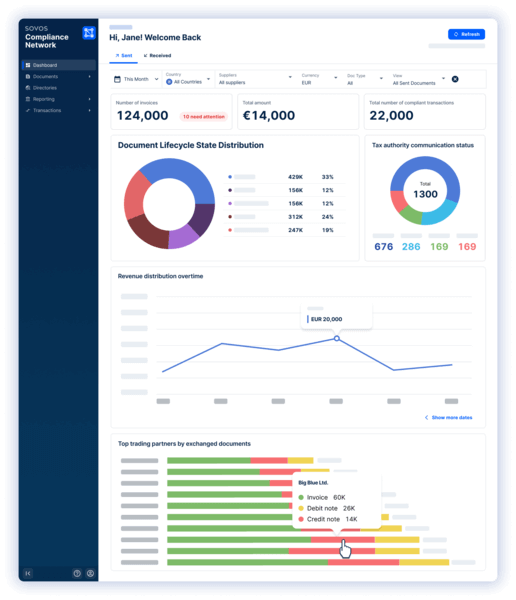
Sovos Compliance Network is complete, continuous and connected. We process over 6 billion compliant invoices per year through our Compliance Network, more than 60 times other industry providers.
A core component of our Indirect Tax Suite, Sovos Compliance Network helps you:
Effortlessly map indirect tax compliance requirements with suppliers, buyers and consumers
Ensure your transactional documents adhere to the latest local regulations
Connect seamlessly with the right government agencies and certified platforms
Distribute invoices to trading partners where required
Build the Sovos Compliance Network into every transaction
The solution provides:
B2B & B2G Transaction Compliance
The world’s first complete solution for e-invoicing compliance, including clearance, CTC and global post-audit models.
Prove integrity and authenticity with universal, compliant archiving, including compliance maps, preservation sets, timestamps and signing and validation services.
Chile has long been a leader in adopting electronic invoicing, starting in 2001 with voluntary adoption for taxpayers.
Its status as a pioneering country with e-invoicing is reflected by the fact that all taxpayers in the nation must issue and receive electronic invoices – one type of Electronic Tax Document (DTE).
This page has all the vital information you need to understand Chile’s e-invoicing regime and how to ensure compliance. Bookmark this overview to stay updated on any future regulatory updates.
The current legislation requires companies to send all DTEs to the SII, Chile’s tax authority, in real time, after which they will inform the taxpayer about their acceptance. In some cases, the SII's authorisation must precede the document's sending to the client. This is the case for dispatch guides not accompanied by electronic invoices.
Contingency
Mandatory for all DTEs that are sent to the SII for validation. However, the SII accepts that such documents continue to be issued when such a referral is not possible. In such cases, a contingency system has been established that will allow the SII to refer and validate these.
Synchronous process
All local or export invoices, or debit or credit notes, must be declared to – and validated by - the tax administration.
File retention
All documents must be retained for six years due to the provisions of the Chilean Tax Code.
Acknowledgement of receipt
In principle, recipients of electronic invoices must generate an acknowledgement of receipt for the invoices they receive. However, current legislation establishes that it will be considered formally accepted after a period of eight days from the receipt of an invoice.
Factoring operations
One of the most important changes introduced by the 30-Day Payment Law was the incentive for factoring operations with electronic invoices issued by taxpayers within the Internal Revenue Service billing system. The electronic invoice thus becomes a negotiable instrument for suppliers, who can sell such invoices on the market as if it were another security. This has resulted in the recipients of such invoices carefully monitoring the changes generated in the ownership of the invoices they have received.
Characteristics of electronic invoicing in Chile
Chile B2B e-invoicing
Chile mandates that every established company must issue and receive electronic invoices.
While the country’s journey with e-invoicing started in the early 2000s, it wasn’t until 2018 when it became mandatory for businesses of all shapes and sizes.
Businesses must follow many rules and requirements to be compliant with Chile’s B2B e-invoicing mandate. These include using an electronic signature, securely archiving e-invoices for six years, meeting the strict administrative procedure and more.
Chile B2G e-invoicing
As with B2B transactions, Chile requires B2G transactions to be documented and processed through electronic invoices. All organisations must issue and receive e-invoices when dealing with governmental and public administration entities.
B2G transactions have the same stringent requirements as B2B and B2C transactions where security is involved. These standards ensure that documents cannot be tampered with and are approved as authentic and accurate by the SII.
Types of electronic documents in Chile
Chile has requirements for other electronic documents beyond e-invoices. Regulations include other e-documents related to buying and selling goods that taxpayers should be aware of, such as:
Sales invoice: Required in B2B transactions and generators of tax credit.
Purchase invoice: For B2B purchases in which the buyer assumes the obligation to issue the invoice.
Dispatch guide: Mandatory document that authorises the transport of goods sold.
Sales and services ticket: Mandatory in cases of B2C sales. They don’t generate tax credit.
Invoice settlement: Issued by the commission agent to the client to invoice his commission and the registration of the payment to the principal.
Debit and credit note: They apply in all the above cases except for the dispatch guides.
Format of electronic invoices and documents in Chile
There are some common elements of electronic documents (DTE), such as e-invoices, used in Chile – including:
Header: Used to identify the sender, the receiver and the total amount, among other data.
Detail by item: Data on each item sold, such as weight, value and quantity.
Discounts and surcharges: Identifies the total discounts or surcharges.
Reference information: Identifies the documents associated with the issuer.
Commissions and other charges: Mandatory field for invoice settlements.
Electronic stamp of the SII: Electronic signatures on the fields defined as representative of the document, including the Folios Authorization Code provided by the SII.
Electronic signature: Verifies the integrity of the DTE’s content. E-signatures must use a digital certificate granted by an SII-accredited certification company.
Timeline of e-invoicing in Chile
A mandate as significant as Chile’s e-invoicing ruling takes time to develop and implement. Here are the key dates of its development:
2001: E-invoicing is implemented as a voluntary scheme for taxpayers
2014: VAT e-invoicing is made mandatory for established organisations
March 2018: B2B e-invoicing is made mandatory for established organisations
March 2021: B2C e-invoicing is made mandatory for established taxpayers
Penalties: What happens if I don’t comply with e-invoicing in Chile?
Chile has penalties in place for taxpayers who do not comply with the mandate’s requirements, including a fine of 50-500% of the amount of the operation.
The aforementioned fine applies to:
Failing to issue delivery guides for invoices, debit notes, credit notes, receipts
Using unauthorised receipts, invoices, debit notes, credit notes, delivery guides
The former will also result in the physical location where the violation was committed being closed for up to 20 days. Repeated violations of this kind within three years may result in imprisonment.
What else do I need for VAT compliance in Chile?
There are other obligations established taxpayers in Chile need to meet, including general VAT compliance. Not meeting what’s required by tax authorities and governments can be costly, and that applies in Chile – so be sure you know what is expected of your organisation through our overviews.
These requirements can become even more demanding when considering your business’ obligations in other countries. That’s why Sovos is your ideal compliance partner.
An e-invoice can be cancelled in Chile if the cancellation is issued in the same tax period. An electronic credit note containing a field that indicates the annulment must be generated.
In Chile, electronic tax documents (DTE) is a general name for digital documents related to buying and selling goods and services. Electronic invoices are the most prevalent type of DTE in the country.
In Chile, electronic invoices must be secured with an electronic signature – technology that validates the integrity of the document and its content. They must also be cleared via the SII before being sent to the buyer.
If the recipient of an electronic invoice does not generate an acknowledgement of receipt within eight days of receiving the document, it will be considered as formally accepted.
Customers have eight days to respond to an e-invoice once it has been sent through SII. If it is refused or not received, the buyer must contact the seller via email. If no acknowledgement is given within that period, it will be considered formally accepted.
Setting up e-invoicing in Chile with Sovos
Electronic invoicing is becoming more common globally, following the lead of Latin American countries like Chile, and compliance must be a priority.
E-invoicing is becoming global, but it’s fragmented everywhere you do business, solidifying the need to choose a single vendor for compliance. Sovos is a tax compliance partner you can trust.
Focus on what truly matters and reclaim your time, knowing Sovos has your back. Speak with a member of our team today to begin reclaiming your time.
Complete the form below to speak with one of our e-invoicing experts