dtc-wine-report-2025

2025 Direct-to-Consumer Spirits Shipping Report

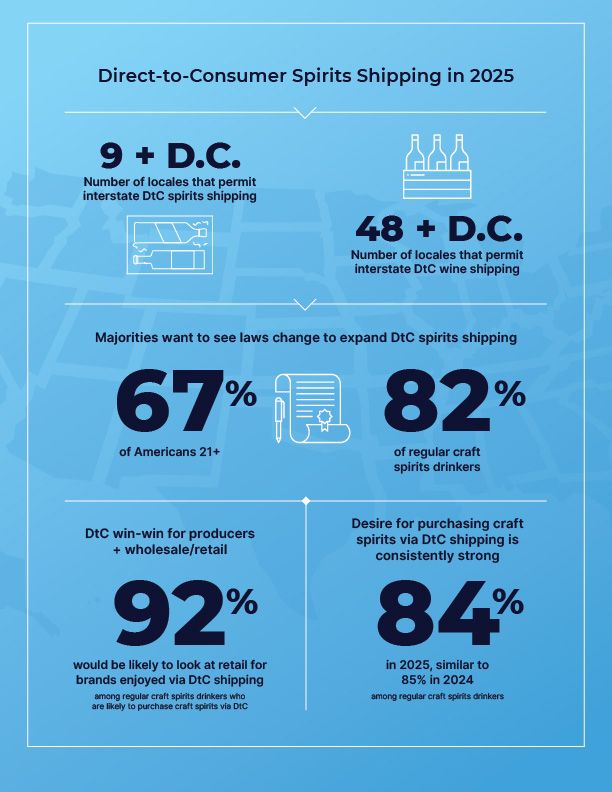
The spirits industry continues to face a pivotal moment. With only nine states and D.C. permitting interstate direct-to-consumer (DtC) spirits shipping (compared to 48 states and D.C. for wine) the gap between consumer expectations and legal access remains stark. The 2025 Direct-to-Consumer Spirits Shipping Report, produced in partnership with the American Craft Spirits Association (ACSA), explores this divide and the growing opportunity to modernize outdated laws.

What’s Inside?

This year’s report, based on a nationwide survey of 2,004 U.S. adults (including 752 regular craft spirits drinkers), reveals:

  • The Regulatory Landscape: A state-by-state breakdown of current DtC spirits shipping laws and limitations.
  • Roadblocks to Growth: How production caps, reciprocity rules and in-state-only permissions are stalling progress.
  • Legislative Developments: Updates on 2025 bills introduced in California, Iowa, Maine, Illinois, Hawaii and South Dakota.
  • Consumer Intent & Spend: 84% of regular craft spirits drinkers want DtC access. Those likely to purchase would spend $124/month, or $1,484 annually.
  • Retail Synergy: 92% of DtC buyers say they’d seek out brands in retail stores after discovering them via DtC.
  • ACSA’s Perspective: Why fair, inclusive DtC laws are essential for small distilleries and the broader spirits ecosystem.

Get the report now

Unmet Demand = Untapped Revenue for Distilleries

2025 Direct-to-Consumer Spirits Shipping Report - What is inside

Consumers are ready to get their favorite craft spirits delivered to their home, but current shipping laws

  • 77% of regular craft spirits drinkers have discovered a spirit while traveling that they wish they could buy at home. Unfortunately, many can’t replace their souvenirs, such as Kentucky bourbon or pre-mixed Sazeracs from New Orleans, due to restrictive shipping laws.
  • 74% say they would join a if DtC shipping were available, meaning distilleries are losing out on consistent revenue.
  • 85% would recommend a distillery offering DtC shipping to friends and family.

The message is clear: modernizing DtC laws isn’t just good policy—it’s good business.

“Expanding access represents a win for distillers, a win for consumers and a win for local economies. Now is the time for policymakers to modernize the distilled spirits marketplace and help craft distillers.”

The craft spirits industry can’t afford to leave money on the table.

Learn how DtC shipping could open new avenues for customer engagement and consistent revenue.

Download the report now

Consumer Survey Methodology

This survey was conducted online within the United States by The Harris Poll on behalf of Sovos ShipCompliant from August 7-11, 2025 among 2,004 U.S. adults ages 21 and older, among whom 752 drink craft spirits/liquor at least once per month. The sampling precision of Harris online polls is measured by using a Bayesian credible interval. For this study, the sample data is accurate to within +/- 2.6 percentage points using a 95% confidence level for adults ages 21+, and within +/- 4.3 percentage points using a 95% confidence level for those who drink craft spirits/liquor at least once per month. This credible interval will be wider among subsets of the surveyed population of interest. For complete survey methodology, including weighting variables and subgroup sample sizes, please contact helloship@sovos.com.

Subscribe to our Newsletter

Get monthly updates on Sovos ShipCompliant resources, data reports, fresh resources and more.

Subscribe now

Top 5 Signs Your Winery is Ready for DtC Compliance Software

A quick guide to gauging if your business could benefit from automating DtC shipping compliance.

Subscribe to our Newsletter

Get monthly updates on Sovos ShipCompliant resources, data reports, fresh resources and more.

Subscribe now

2022 Sovos ShipCompliant Beverage Alcohol Summit Recordings

The 2022 Sovos ShipCompliant Beverage Alcohol Summit took place virtually, March 16-17, 2022. The event turned the spotlight on challenges and opportunities across both the three-tier and DtC distribution channels for beverage alcohol companies of all types.

Access all recordings from the 2022 Beverage Alcohol  Summit here — free! Here’s a look at what’s included:

Growing a Beverage Alcohol Business With Empathy
Alexi Cashen, Elenteny Imports and St Hildie’s

Analysts’ Lens: Beverage Alcohol in Strange Times
Danny Brager, Brager Beverage Alcohol Consulting; Dale Stratton, Independent Consultant; Wine Market Council

Executive Order on Competition: What Might Lie Ahead
Christopher Riano, Holland & Knight LLP; Kaj Rozga, Davis Wright Tremaine LLP; Alex Koral, Sovos ShipCompliant (moderator)

TTB Regulatory Updates
Dave Wulf, TTB; Chris Thiemann, TTB; Alex Koral, Sovos ShipCompliant (moderator)

Regulatory Landscape for BevAlc: Today, Tomorrow, and Post-Pandemic
Adena Santiago, McDermott Will & Emery; Ryan Malkin, Malkin Law; Alex Koral, Sovos ShipCompliant (moderator)

Direct-to-Consumer Spirits Shipping: Why and How Now
Margie Lehrman, American Craft Spirits Association; Bob Budoff, DISCUS

Access all recordings from the 2022 Beverage Alcohol Summit here — free!

Subscribe to our Newsletter

Get monthly updates on Sovos ShipCompliant resources, data reports, fresh resources and more.

Subscribe now

Top 3 Things That Can Go Wrong if You’re Non-Compliant

The most essential considerations for compliant direct-to-consumer shipping

Subscribe to our Newsletter

Get monthly updates on Sovos ShipCompliant resources, data reports, fresh resources and more.

Subscribe now

The Case for DtC Beer Shipping

Introduction

The wine industry has been shipping direct-to-consumer (DtC) for 20 years, and this once-novel market expansion has proven win-win-win for producers (business growth), states (increased tax revenue) and consumers (increased choice) alike. And yet, beer DtC remains a much narrower market. Why?

Beer producers aren’t the only ones asking that question. Sovos ShipCompliant’s 2025 Direct-to-Consumer Beer Shipping Report found that more than four in five regular craft beer drinkers (83%) say that current beer shipping laws in the U.S. should be updated to make it legal in more states—as do 64% of all Americans age 21+.

Sovos-ShipCompliant-lessons-from-wine-shipping

Lessons from 20 years of DtC wine shipping

DtC wine shipping is a nearly $4 billion market as of 2024. Because DtC shipping and three-tier distribution complement one another, the three-tier system has continued to thrive in its central role in alcohol distribution even as the DtC channel has grown. In fact, while DtC wine shipping has been in place for two decades, it makes up 8% of total off-premise wine sales in the U.S. (as estimated by Jon Moramarco, managing partner at bw166).

The success the DtC wine channel has found has gone hand in hand with shippers’ commitment to following state regulations and tax requirements. DtC wine shippers participate in a safe, well-regulated market, complying with varying state regulations that include:

  • Getting properly licensed by the destination state;
  • Abiding by regulatory rulings of the destination state;
  • Conducting age checks and preventing sales to minors; and
  • Correctly determining, paying and reporting on taxes owed to the states.

Additionally, shippers abide by destination states’ jurisdiction in terms of other producer-enablement rules that include customer volume limits, the registration of brand labels and brand ownership requirements.

Sovos-ShipCompliant-case-for-dtc-beer

Distinct product offerings

The products that reach consumers through the DtC wine shipping channel are not the same ones they are shopping for at their local retail outlets. Rather, wineries typically offer special allocations or other higher-end, more limited offerings direct-to-consumer.

Similarly, beer lovers are not necessarily looking to ship products that can be easily found at local retail stores. However, breweries can offer highly allocated and limited run products that consumers would otherwise have difficulty gaining access to.

Thus, there is generally no direct competition between the products available through these different channels — though a producer that grows its fan base via DtC shipping can expect to see increased demand for their products sold through the three-tier system. In fact, the DtC beer shipping report found that 95% of regular craft beer drinkers who are likely to purchase craft beer via DtC shipping say they’d be likely to look at retail for brands enjoyed via the DtC channel.

An equitable marketplace?

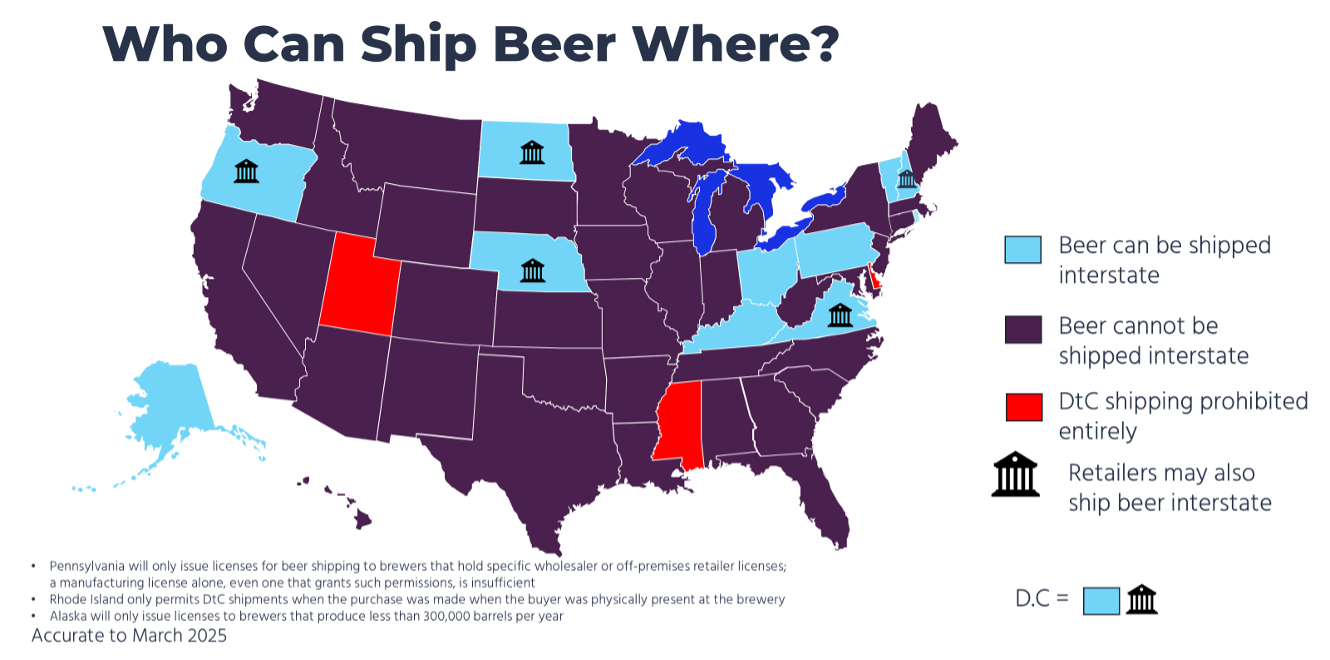
Across the vast majority of the U.S. — 47 states and the District of Columbia — DtC wine shipping is permitted. The map of where beer producers are legally entitled to ship DtC is much, much narrower.

Sovos-ShipCompliant-equitable-marketplace

* Pennsylvania will only issue licenses for beer shipping to brewers that hold specific wholesaler or off-premises retailer licenses; a manufacturing license alone, even one that grants such permissions, is insufficient.

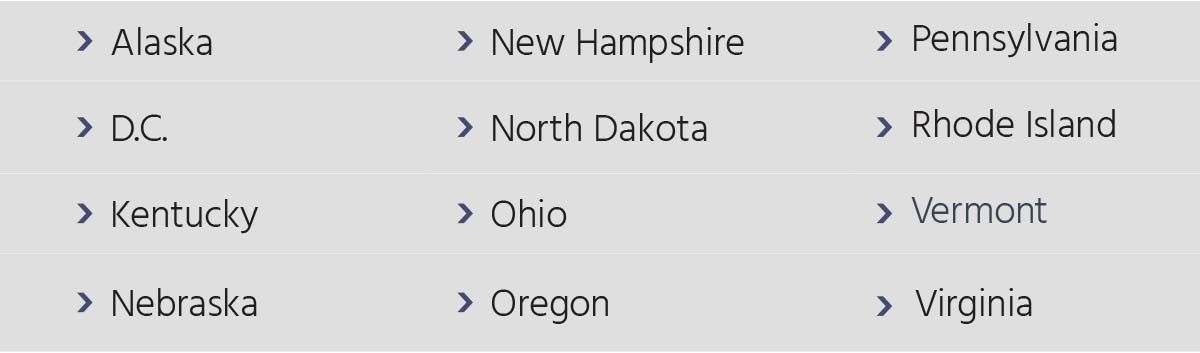
Only 12 locales are open for DtC beer shipping, compared to wine’s 48:

13-locales-dtc-beer

As beer producers have demonstrated through their compliant participation in the three-tier system, they are readily equipped to mimic the conforming behaviors of their winery counterparts in the DtC shipping channel.

Sovos-ShipCompliant-how-states-benefited

How states have benefited from DtC shipping

Naturally, states are eager to maximize the tax revenues they collect, as taxes fund their service to the public, including infrastructure, education and social services. 

The compliant actions of DtC alcohol shippers to date has enriched states’ coffers to the benefit of many. As a leading beverage alcohol compliance solutions provider, Sovos ShipCompliant has facilitated states’ securing hundreds of millions in tax revenue each year. Because the footprint for legal DtC shipping of non-wine beverage alcohol is limited, the vast majority of this tax revenue is driven by DtC wine shipments.

DtC Tax Revenue Paid to States via Sovos ShipCompliant

2017 $88.6 million
2018 $101.4 million
2019 $117.8 million
2020 $149.7 million
2021 $172.8 million
2022 $180.1 million
2023 $177.4 million
2024 $171.6 million
Total 2017-2024 $1.16 billion


States opening to the DtC shipment of beer would only grow these welcome additional revenues.

In conclusion

The case for beer DtC shipping is clear. The demand is strong from producers and consumers alike, and states stand to benefit greatly. Some 20 years of well-regulated DtC wine shipping have paved the way for the healthy expansion of DtC beverage alcohol shipping.

Beer producers simply want the same kind of DtC market access that wine shippers enjoy. The data shows that DtC wine shipping is profitable for states and can be done safely. Consumers are ready for more choice and are already utilizing the DtC market. The time for expanded DtC beer shipping permissions is now.

Subscribe to our Newsletter

Get monthly updates on Sovos ShipCompliant resources, data reports, fresh resources and more.

Subscribe now

The Case for Spirits Direct-to-Consumer (DtC) Shipping

Introduction

The wine industry has been shipping direct-to-consumer (DtC) for more than 15 years, and this once-novel market expansion has proven win-win-win for producers (business growth), states (increased tax revenue) and consumers (increased choice) alike. And yet, spirits DtC remains a much narrower market. Why?

Spirits producers aren’t the only ones asking that question. A Distilled Spirits Council of the United States (DISCUS) survey shows overwhelming consumer demand for DtC shipping of distilled spirits. Eight out of 10 consumers surveyed said distillers should be allowed to directly ship their products to legal-age consumers in any state. Additionally, some 76% said they would consider purchasing spirits online shipped directly from distillers to them from outside or within their state.

Sovos-ShipCompliant-lessons-from-wine-shipping

Lessons from 15 years of DtC wine shipping

DtC wine shipping is a $4.2 billion market as of 2021. Because DtC shipping and three-tier distribution complement one another, the three-tier system has continued to thrive in its central role in alcohol distribution even as the DtC channel has grown. In fact, while DtC wine shipping has been in place for 15+ years, it makes up 10%-11% of total off-premise wine sales in the U.S. (as estimated by Jon Moramarco, managing partner at bw166).

The success the DtC wine channel has found has gone hand in hand with shippers’ commitment to following state regulations and tax requirements. DtC wine shippers participate in a safe, well-regulated market, complying with varying state regulations that include:

  • Getting properly licensed by the destination state;
  • Abiding by regulatory rulings of the destination state;
  • Conducting age checks and preventing sales to minors; and
  • Correctly determining, paying and reporting on taxes owed to the states.

Additionally, shippers abide by destination states’ jurisdiction in terms of other producer-enablement rules that include customer volume limits, the registration of brand labels and brand ownership requirements.

Sovos-ShipCompliant-case-for-dtc-spirits

Distinct product offerings

The products that reach consumers through the DtC wine shipping channel are not the same ones they are shopping for at their local retail outlets. Rather, wineries typically offer special allocations or other higher-end, limited offerings via the DtC channel — compared to more inexpensive wines that are widely available at retail or for which a consumer would be hard-pressed to justify the shipping cost. In fact, the average price per bottle of wine shipped DtC hovers around $40, three to four times the average price paid at grocery stores and liquor shops.

Thus, there is generally no direct competition between the products available through these different channels — though a producer that grows its fan base via DtC shipping can expect to see increased demand for their products sold through the three-tier system. 

From a DtC shipping standpoint, a bottle of wine and a bottle of spirits look a lot alike — and as in wine, spirits producers offer a number of speciality or limited production releases — so there is every reason to expect that as more states open to DtC spirits shipping, the spirits industry will follow wine’s lead in offering distinct products via different channels.

An equitable marketplace?

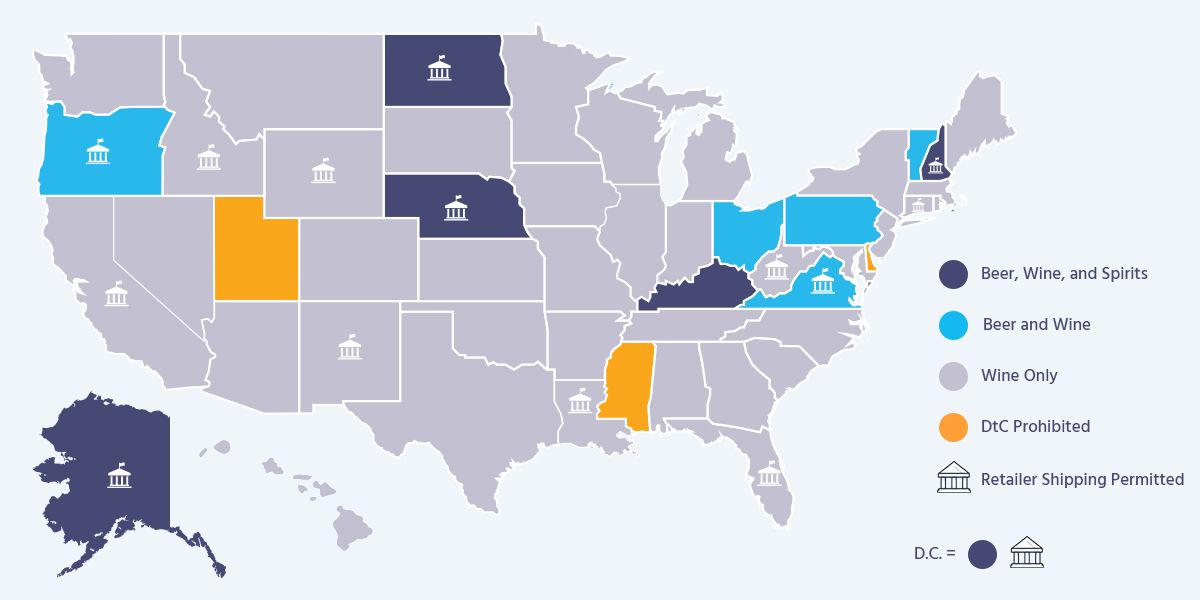
Across the vast majority of the U.S. — 46 states and the District of Columbia — DtC wine shipping is permitted. The map of where spirits producers are legally entitled to ship DtC is much, much narrower.

Sovos-ShipCompliant-equitable-marketplace

* Oregon will only issue licenses for beer shipping to breweries located in states that themselves permit DtC shipping of beer

* Pennsylvania will only issue licenses for beer shipping to brewers that hold specific wholesaler or off-premises retailer licenses; a manufacturing license alone, even one that grants such permissions, is insufficient

Accurate to October 2021

As the map demonstrates, the only seven locales open for DtC spirits shipping are Alaska, D.C., Kentucky, Nebraska, Nevada, New Hampshire, North Dakota and (in very limited fashion) Rhode Island, compared to wine’s 47.

As spirits producers have demonstrated through their compliant participation in the three-tier system, they are readily equipped to mimic the compliant behaviors of their winery counterparts in the DtC shipping channel.

What's fair for wine is also fair for spirits
Sovos-ShipCompliant-how-states-benefited

How states have benefited from DtC shipping

Naturally, states are eager to maximize the tax revenues they collect, as taxes fund their service to the public, including infrastructure, education and social services. 

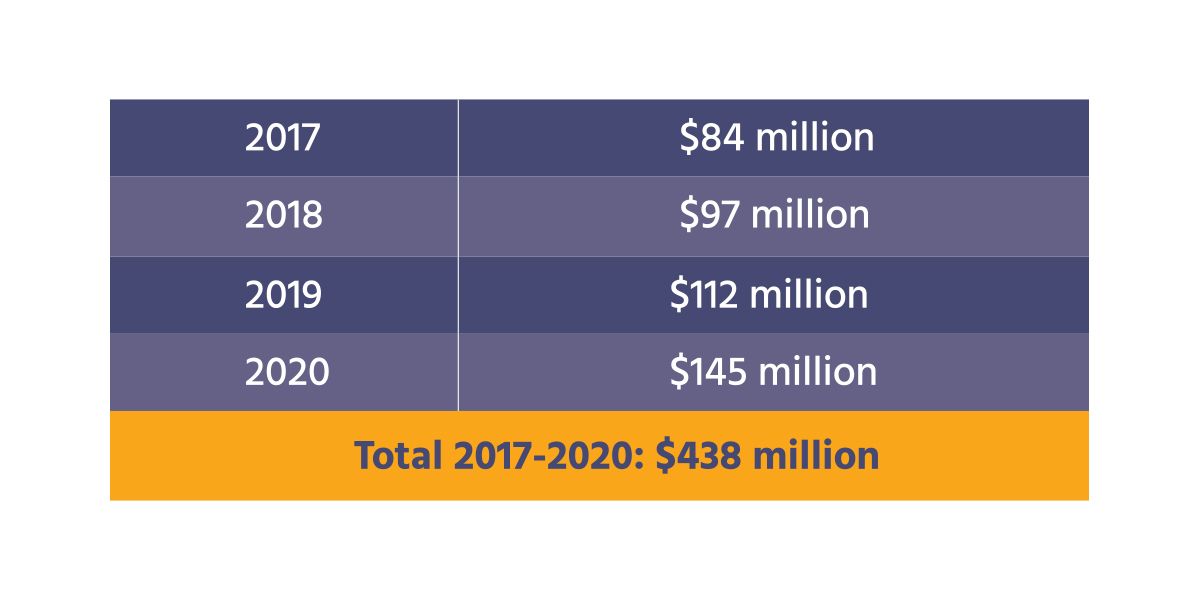
The compliant behavior of DtC alcohol shippers to date has enriched states’ coffers to the benefit of many. As a leading beverage alcohol compliance solutions provider, Sovos ShipCompliant has facilitated states’ securing hundreds of millions in tax revenue each year. Because the footprint for legal DtC shipping of non-wine beverage alcohol is limited, the vast majority of this tax revenue is driven by DtC wine shipments.

DtC Tax Revenue Paid to States Via Sovos ShipCompliant

Sovos-ShipCompliant-dtc-spirits-tax-revenue

States opening to the DtC shipment of spirits would only grow these welcome additional revenues.

In conclusion

The case for spirits DtC shipping is clear. The demand is strong from producers and consumers alike, and states stand to benefit greatly. More than 15 years of complaint DtC wine shipping have paved the way for the healthy expansion of DtC beverage alcohol shipping.

Spirit producers simply want the same kind of DtC market access that wine shippers enjoy. The data shows that DtC wine shipping is profitable for states and can be done safely. Consumers are ready for more choice and are already utilizing the DtC market. The time for expanded DtC spirits shipping permissions is now.

Subscribe to our Newsletter

Get monthly updates on Sovos ShipCompliant resources, data reports, fresh resources and more.

Subscribe now

DtC Alcohol Shipping Essentials: Getting Started & Staying Compliant

A free ebook for DtC shippers of wine, beer, spirits, cider and sake

Direct-to-Consumer Alcohol Shipping Essentials: Getting Started and Staying Compliant

Direct-to-consumer (DtC) alcohol shipping continues to grow in popularity. The rise of ecommerce along with a global pandemic have fueled consumers’ desire to have products shipped directly to their doors. Producers, retailers and others would-be shippers have started exploring how best to meet this increased demand—and finding that while DtC shipping represents an excellent channel for expansion, there are numerous rules and regulations to consider.

DtC shipping laws vary from state-to-state and can even diverge from one jurisdiction to another within a state. Understanding those nuances, and how to get started in DtC alcohol shipping in the first place, is not a simple task. Laws can and do change, further increasing the difficulty of maintaining compliance.

This free ebook details the basics of what you need to know about getting started, staying compliant and finding success in DtC alcohol shipping.

Topics include:

  • How to Get a License
  • Age Verification
  • Customer Aggregate Volume Limits (CAVL)
  • Brand Label Registration
  • Alcohol Not of Own Production (NOOP)
  • Tax Determination and Reporting

Download your free copy of this in-depth information today.

Get the ebook

Subscribe to our Newsletter

Get monthly updates on Sovos ShipCompliant resources, data reports, fresh resources and more.

Subscribe now

Infographic: Top 5 Things Cideries Must Know About DtC Shipping

Find out the most essential considerations for compliant direct-to-consumer cider shipping.

Subscribe to our Newsletter

Get monthly updates on Sovos ShipCompliant resources, data reports, fresh resources and more.

Subscribe now

Get to Know Our Integrated Partners

Video conversations featuring Sovos ShipCompliant integrated technology partners talking about their products and our integration

One important way Sovos ShipCompliant enables efficiencies for our clients is by being connected to the most commonly-used technology platforms in the beverage alcohol industry. Our expansive network of integrated tech partners — 60+ and growing — allows ShipCompliant customers to enjoy seamless operations via integrations spanning ecommerce, front end and point of sale (POS) systems to ERPs and fulfilment houses, from carriers to even state agencies — all integrated with our robust compliance solutions.


Our integrated partners are industry-leading software and on-premise solutions with which we’ve created direct integrations for real-time, alcohol-specific tax rates, compliance checks, order data and product SKU syncs.This allows different systems to “talk” to each other seamlessly.

Why do integrations matter?

Integrated technology platforms help eliminate time-consuming work, like transferring data from one system to the next, saving aggravation and minimizing the risk of human error. The time saved allows users to focus on other priorities within the business.

Meet the partners

The informal conversations featured in these videos are meant to explain in straightforward terms what each company offers and how their integration with Sovos ShipCompliant solutions works. We hope you find these chats helpful. You can also search for integrated partners by name, product type or integration level (e.g., platinum, certified) on our Integrated Partners page.

Partner Spotlight Video Series

Meet Bloom

Build on top of Shopify’s best-in-class e-commerce platform, Bloom provides everything a growing winery needs to sell online and manage their club memberships.

Meet VineSpring

VineSpring enables wineries, breweries and distilleries to manage ecommerce and club customers, orders, products, and inventory from any web-enabled device. VineSpring is a Sovos ShipCompliant Platinum Certified Partner.

Subscribe to our Newsletter

Get monthly updates on Sovos ShipCompliant resources, data reports, fresh resources and more.

Subscribe now

Meet Sovos ShipCompliant!

This one-minute video provides a quick introduction to our compliance and reporting solutions for wineries, breweries, distilleries, cideries, distributors, importers and other members of the beverage alcohol industry.

Subscribe to our Newsletter

Get monthly updates on Sovos ShipCompliant resources, data reports, fresh resources and more.

Subscribe now