As Insurance Premium Tax (IPT) regulations continue to evolve across Europe, staying compliant is more crucial than ever. This webinar will explore the latest IPT developments impacting insurers, brokers and captives managing cross-border programs. Our specialists will cover Lithuania’s entry into the IPT landscape, Slovakia’s upcoming tax rate increase and key trends shaping the European IPT environment for 2025. Gain practical insights to help your organisation plan ahead, stay compliant and optimise its tax strategy.

KSeF, or the National E-Invoicing System, is Poland’s approach to continuous transaction controls (CTC), a trend that sees tax authorities gaining real-time visibility of transactions. The ‘clearance’ model implemented in Poland demands that invoices be issued in a structured electronic format and undergo validity checks, ensuring compliance and accuracy of e-invoices before they are sent to recipients.

Operational on a voluntary basis since 2022, the KSeF e-invoicing system is set to become mandatory in phases starting February 2026. Poland’s e-invoicing requirements encompass both VAT active and exempt entities, covering B2B and B2G transactions, while B2C e-invoicing remains optional. Importantly, the system includes both domestic and cross-border transactions, although with specific rules for invoice exchange in cross-border scenarios.

KSeF 2.0: key changes and features

KSeF 2.0 emerged as a direct response to stakeholder feedback during the voluntary implementation phase. After extensive public consultations, the Polish Ministry of Finance addressed several critical concerns raised by businesses. These included the need for offline invoicing capabilities during connectivity issues, support for B2C transactions, clearer rules for self-billing in cross-border scenarios, better handling of complex business structures like VAT groups, and many other concerns.

The resulting KSeF 2.0 framework includes both legislative changes (through the KSeF 2.0 Act and other implementing regulations) and technical enhancements (via the new FA3 schema and API). The new system adds support for optional B2C invoicing, previously unavailable in the voluntary phase, giving issuers the discretion to include such transactions within KSeF. It also introduces the KSeF certificates, which will be used for authentication in the system and for the generation of the QR code used in the offline modes. Special attention is given to offline modes, particularly the “offline 24” mode, which allows for invoice submission by the next business day in case of issues on the taxpayer’s side.

Key functionalities and adjustments included in KSEF 2.0

QR codes will be required when exchanging invoices outside of KSeF both in online or offline modes with the need to add a second QR code for invoices issued in offline mode and sent to the recipient before KSeF clearance.


The timeline to KSeF implementation


What’s next for Poland e-invoicing requirments?

As Poland advances towards the full implementation of KSeF 2.0, businesses must stay informed and prepared for these regulatory changes. The system’s phased rollout offers a window for adaptation, but early compliance will ensure smoother transitions and mitigate potential disruptions.

Sovos has created a number of resources to help businesses prepare for Poland’s KSEF 2.0 e-invoicing requirements:

Sovos’ team of regulatory tax experts answer some of the most frequently asked questions about KSEF 2.0, an upcoming update to Poland’s national electronic invoicing system.

1. What are the main changes in KSeF 2.0?

KSeF 2.0 introduces several important features not available in the 1.0 system in use during the voluntary period. The most significant changes include:

2.    What is the implementation timeline for KSeF 2.0?

The KSeF 2.0 implementation begins with open testing from September 30, 2025, followed by KSeF certificates availability on November 1, 2025. As confirmed by the KSeF 2.0 Act, mandatory structured e-invoicing starts February 1, 2026 for taxpayers with sales exceeding 200 million PLN in 2024, and April 1, 2026 for all other taxpayers.

An exemption allows taxpayers with monthly sales below 10,000 PLN to continue issuing paper or electronic invoices until December 31, 2026.

3. Which entities are obligated to use KSeF?

According to the Polish legislation, the mandatory e-invoicing obligation through KSeF will apply to:

4. Does sole VAT registration in Poland mean a company is subject to KSeF?

Polish legislation states that the taxpayer must have either a registered office or a permanent establishment in Poland that participates in the transaction to fall under mandatory KSeF. VAT registration alone does not trigger the obligation.

5. What documents are included in KSeF and what are excluded?

Not all document types fall within the scope of the KSeF system. The system supports VAT invoices, corrective invoices, self-billing invoices, and VAT RR invoices (optional from April 2026). However, several documents are excluded from KSeF, including internal invoices, pro forma invoices, and traditional debit/credit notes.

6. Are cross-border transactions included in the KSeF mandate?

Yes, Polish businesses must submit e-invoices to KSeF for sales to foreign customers. After submission, the Polish supplier must provide the invoice to the foreign customer in an agreed format, including a QR code for KSeF access. This applies to all cross-border sales by Polish taxpayers under KSeF.

7. How can taxpayers access invoices from the KSeF system?

Taxpayers have multiple options to receive their e-invoices from the KSeF platform:

8. How does KSeF 2.0 handle B2C transactions compared to KSeF 1.0?

Unlike KSeF 1.0, which did not support B2C e-invoicing, KSeF 2.0 allows voluntary B2C e-invoicing. Consumers must still request an invoice before one can be issued, but the issuer decides whether to fulfill this request via KSeF or through traditional methods without requiring consumer consent.

9. How will consumers access their invoices in KSeF?

The KSeF 2.0 legislation establishes an “anonymous access” mechanism for consumers. When sellers issue e-invoices to consumers through KSeF, they must provide one of the following:

Consumers can use these methods to access their invoices without the need to log into the system.

10. How do credit and debit notes work in the KSeF system?

Traditional credit and debit notes as separate document types (commonly used in many countries) won’t be part of the KSeF system. Instead, all corrections must be made through a “corrective invoice” document type that KSeF supports. Additionally, correction notes issued by buyers in Poland will also remain outside KSeF’s scope.

11. What certificates or access credentials are needed to issue in KSeF 2.0?

Authentication can be done via:

The Trusted Profile method will be eliminated from 1 April 2026. KSeF Certificates will be available for download from November 1, 2025 via the Certificates and Authorizations Module (MCU), which will be made available in the KSeF domain.

12. What offline modes are available in KSeF 2.0?

KSeF 2.0 offers four offline modes. Offline24 mode is designed for issues on the taxpayer’s side, such as connectivity problems and internet outages. Offline mode is for planned system maintenance periods when KSeF is temporarily unavailable. Failure mode is for unplanned system failures that are officially announced in the bulletin of the Ministry of Finance. Total failure mode is for extraordinary situations like threats to the country’s infrastructure, announced through media channels.

13. What is the Offline24 mode in KSeF 2.0 and how does it work?

Offline24 mode is a solution created to address concerns about potential delays in invoice submission due to issues on the taxpayer’s side. It allows businesses to issue structured invoices outside the system, and to submit them to KSeF no later than the next business day following the FA(3) format.

14. How do recipients receive invoices issued in Offline24 mode in KSeF 2.0?

Domestic business recipients with a NIP receive invoices exclusively through the KSeF system after their submission and clearance. Other recipients (consumers, foreign entities, or entities without a NIP) receive invoices in a manner agreed with the buyer outside of KSeF, with one or two QR codes.

15. What are the QR code requirements for invoices in KSeF 2.0?

When an invoice is sent to the recipient outside KSeF, it must include one or two QR codes. There are two types of QR codes: one for accessing the invoice and another for ensuring integrity and authenticity. If the invoice is provided to the recipient after KSeF clearance, only the access QR code is required. When providing the invoice to the recipient before KSeF clearance, the two QR codes are needed.

16. Is a QR code required on non-domestic invoices?

Access QR codes are mandatory on all invoices exchanged outside the KSeF system, including cross-border transactions. Polish companies must first submit the e-invoice to KSeF, then provide it to foreign partners in any agreed format along with a QR code. This allows foreign recipients to verify the invoice’s authenticity and access it in the Polish tax authority’s system when needed.

17. What invoice format will be used in KSeF 2.0?

From February 1, 2026, KSeF 2.0 will exclusively use the FA(3) logical structure for all structured invoices. The FA(3) schema includes enhanced features like support for attachments, inclusion of new fields and other updates to code formats, schema variants, and data types.

18. What are invoice attachments in KSeF 2.0 and what can they contain?

Invoice attachments in KSeF 2.0 are an integral part of structured invoices designed specifically for entities who need to include complex detailed data in their invoices. Attachments can only contain mandatory invoice elements specified in the Polish VAT Act or closely related data, while including marketing information and advertising content is prohibited.

19. How can businesses include attachments with invoices in KSeF 2.0?

To include attachments with invoices in KSeF 2.0, businesses must submit a notification via the e-Tax Office to the National Tax Administration before using this feature. The attachment functionality, available from January 1, 2026, is valid for 2 years after approval and requires renewal to continue.

20. Will there be a transitional period when penalties won’t apply for KSeF-related violations?

Yes. From February 1, 2026, to December 31, 2026, financial penalties for KSeF-related violations will not be enforced. This transitional period allows businesses time to adapt without facing fines.


Want to learn more about KSEF 2.0 and Poland’s e-invoicing requirements?

Sovos has created a number of resources to help businesses prepare for Poland’s KSEF 2.0 e-invoicing requirements:

SAP’s Clean Core initiative is here — and with it comes renewed pressure to simplify custom code, retire bolt-ons, and modernize tax compliance. But when tax gets left behind, even the best SAP transformations can go off the rails.

Join us to uncover the tax pitfalls hiding in SAP environments — from audit-triggering errors to compliance gaps buried in AP files and vendor data. We’ll reveal the hidden cost of tax non-compliance in SAP environments – and how to fix it.

You’ll learn:

• How clean core strategy and indirect tax compliance are connected
• Why legacy tax logic and fragmented data derail SAP modernization
• Real-world examples of audits and penalties tied to outdated tax setups
• Practical steps to build compliant, audit-ready tax processes into your SAP rollout

Event

77th IFA Congress

Date

October 5 - 9, 2025

Time

08:25am - 21:30pm

Venue

Lisbon Congress Centre – CCL Praça das Indústrias 1, 1300-307 Lisboa, Portugal

Don't miss the event

Days
Hours
Minutes
Seconds
77th IFA Congress

Event summary

Sovos is proud to sponsor and participate in the 77th IFA Congress, where global tax leaders gather to explore the future of international taxation. As part of the programme, Sovos will host a seminar titled “Mirror Visibility in Motion: A Vision for Global Tax Compliance”, led by Christiaan van der Valk. The session will offer a strategic look at regulatory shifts, showcase customer success stories, and highlight how Sovos Intelligence empowers smarter, faster compliance decisions in an AI-driven world.

Meeting Venue

Lisbon Congress Centre – CCL | Praça das Indústrias 1, 1300-307 Lisboa, Portugal

Most finance and tax teams think they’ve got sales and use tax under control. Auditors know better.

In this webinar, we expose the hidden audit risk that’s catching even the most sophisticated companies off guard: use tax.

While sales tax automation gets all the attention, use tax compliance remains a patchwork of spreadsheets, siloed systems, and unvalidated assumptions – a goldmine for state auditors on the hunt for revenue.

Roadshow

Tax Compliance Summit Sovos Always On: Paris

Shape the Future of Global Tax Compliance

Date

November 19, 2025

Time

9:00am - 5:00pm

Venue

La Fabrique République, 52 ter Rue des Vinaigriers, 75010 Paris

Don't miss the event

Days
Hours
Minutes
Seconds
taxation of motor insurance policies france

Event summary

Tax compliance and digital transformation are converging faster than ever. From e-invoicing and real-time reporting to AI-driven compliance, automation, and data governance, organisations across Europe are rethinking how tax and technology intersect.

At the Tax Compliance Summit – Sovos Always-On Paris, industry leaders, policymakers, and technology experts will explore the evolution of the enterprise ecosystem — from ERP and financial transformation to the modernisation of EDI, P2P and AP automation, T&E integration, and the reinvention of Order-to-Cash processes. The discussions will also address how artificial intelligence is reshaping the relationship between businesses and tax authorities, and what lies ahead for France’s digital tax landscape.

Building on the success of last year’s edition, the event expands beyond the French e-invoicing mandate to provide a comprehensive 360° view of compliance, innovation, and digital regulation in Europe.

All sessions will be conducted in both French and English, with simultaneous translation available.

Thanks to our Guest Speakers

2P - logo

Agenda

8:00 – 9:00 Registration & Breakfast

9:00 – 9:20 Welcome Session

– Christiaan Van der Valk, General Manager Indirect TaxTech at Sovos
– Elcim Sirek, EMEA VP Sales at Sovos

9:20 – 9:50 – Session 1

Setting the Scene: Understanding the Major Shifts Ahead This opening session will provide a clear and practical overview of the ongoing transformations in France, across Europe, and worldwide focusing on e-invoicing, real-time reporting, and the digitalisation of business processes. High-level experts from both French and European administrations as well as the private sector will share their insights on how emerging technologies — particularly artificial intelligence — are redefining compliance, enterprise systems, and interactions across the digital economy.
Moderator:
– Marcus Laube, General Manager Indirect TaxTech at billentis
Panellists:
– Cyrille Sautereau, FNFE-MPE President & Admarel Conseil CEO
– Giacomo Luchetta, Founding Partner at Syntesia
– Lefteris Leontaridis, Operation Manager at Peppol

09:50 – 10:20 – Session 2

A 360° View of the Enterprise Ecosystem This session will offer a structured, high-level overview of enterprise ecosystems and the tools shaping them and will cover supplier and buyer environments across all industries. It will highlight how e-invoicing and e-reporting reforms, along with continuous tax controls, fit strategically into these ecosystems. This presentation will set the stage for the expert panels that follow, each exploring specific processes and technologies.
Moderator:
– Christiaan Van der Valk, General Manager Indirect TaxTech at Sovos
Panellists:
– Jurgen Jaffré, Project Manager Global Indirect Taxes at P&G
– Stéphane Mermet, VP Sales at Arrow

10:20 – 10:50 – Session 3

ERP & Financial Transformation: From Modernisation to Real-Time Compliance As companies move their ERP and accounting systems to the cloud, they also face a new regulatory landscape of e-invoicing, real-time reporting, and automated controls. This session will show how to turn this financial transformation into an opportunity for innovation by embedding compliance, audit, and tax directly into digital processes.
Moderator:
– Jean-Charles Orsini, Avocat & Partner Indirect Tax at Deloitte Société d’Avocats
Panellists:
– Eladi Minguez, Director Product Manager at QAD

10:50 – 11:10 – Keynote 1

– François Micheau, Managing Director at Accenture Strategy

11:10 – 11:35 – Coffee Break

11:35 – 12:05 – Session 4

Rethinking EDI for the Modern Digital Landscape EDI remains a cornerstone of B2B automation across industries such as trade and manufacturing. But with new e-invoicing and real-time reporting requirements, traditional EDI models are being challenged. This session explores how to evolve EDI to meet these demands, optimising data quality, avoiding dual flows, and integrating seamlessly with national platforms without compromising performance.
Panellists:
– Sébastien Vugier, Transformation & Offering Strategy Director at Cegedim

12:05 – 12:20 – Keynote 2

– Carmen Ciciriello, CEO at Celeris

12:20 – 13:00 – Session 5

Procure-to-Pay (P2P) & AP Automation: Collision or Convergence with E-Invoicing? P2P and AP automation solutions now include advanced features such as supplier management, automated matching, and intelligent validation often powered by AI and hosted in the cloud. The rise of real-time e-invoicing introduces both new compliance challenges and unprecedented opportunities for automation. This session examines how automation systems and P2P networks can align with open interoperability models whether centralised or PEPPOL-based to turn mandatory data exchanges into drivers of transparency and efficiency.
Panellists:
– Alexander Pham, Senior Director, Strategic Value Advisory, EMEA
– Ahmadou Yves Monfopa, SVP Partner Ecosystem & MD France at Serrala
– Claire Goad, Sr. Vice President, Invoice Automation Sales & Delivery at Tungsten
– Yann Ravel-Sibillot, PDG & Founder at Flowie

13:00 – 14:10 – Lunch Break

14:10 – 14:30 – Session 6

T&E in the E-Invoicing Era: When Receipts Are No Longer Enough Travel and expense management connects employee behaviour with corporate accountability. With the rise of real-time e-invoicing, traditional use of scanned receipts for VAT recovery or tax deductions is being challenged. This session explores how T&E platforms can balance employee convenience, accurate reimbursement, and regulatory compliance in a world where every business expense must now generate a compliant electronic invoice.
Moderator:
– Gwenaëlle Bernier, Partner & Avocate Associée G56, Tax Technology & Transformation at EY
Panellists:
– Damien Moras, Founder and Managing Director at VAT4U
– Jurgen Jaffré, Project Manager Global Indirect Taxes at P&G

14:30 – 15:10 – Session 7

Reinventing O2C: When Getting Paid Becomes Regulated Order-to-Cash (O2C) covers the entire customer journey from order and invoicing to payment and satisfaction. As e-invoicing and real-time controls expand, suppliers must integrate billing and compliance seamlessly. This session shows how to turn regulatory requirements into a competitive advantage connecting invoicing networks with O2C systems to improve visibility, accelerate payments, and strengthen customer trust.
Moderator:
– Jenny Nittmann, Founder and Managing Director of Nitt & Huff
Panellists:
– Anna Mevellec, Interoperability & Compliance Product Manager at Esker
– Romaric Casabielhe, Architect Salesforce Revenue Cloud at 2Pace

15:10– 15:30 – Keynote 3

– Clara Durodié, CEO at Cognitive Finance

15:55 – 16:25 – Session 8

Symmetry Between Business and Tax Authorities: Using AI to Maintain Compliance Tax authorities now have real-time access to corporate data through systems such as CTC, SAF-T, banking, and customs. Thanks to AI, they can analyse and interpret this data before companies even see it themselves. This session introduces the concept of Mirror Visibility: enabling companies to view their data as the authorities do through AI-powered analytics. This restores transparency, prevents disputes, and fosters a more balanced compliance dialogue.
Moderator:
– Gwenaëlle Bernier, Partner & Avocate Associée G56, Tax Technology & Transformation at EY
Panellists:
– Jonathan Jenkyn (JJ), Senior Security Assurance Solution Architect at Amazon Web Services
– Jorge Ribeiro, Director Product Management R&D at Sovos
– Maria Aida Cavalera, Researcher at Osservatori Digital Innovation at Politecnico di Milano

16:25 – 16:55 – Session 9

Final Perspectives: Shaping the Future of France’s Digital Tax Landscape This closing session will bring together key insights from throughout the day. Speakers will discuss the practical evolution of France’s e-invoicing and e-reporting landscape, early implementation lessons, and how these developments align with global trends. The discussion will outline a forward-looking vision for France’s role in the global shift toward real-time, data-driven tax and business ecosystems.
Moderator:
– Asia Jane Leigh, Researcher Analyst at Osservatori Digital Innovation at Politecnico di Milano
Pannelists:
– Celestyna Piech, Senior Principal at Accenture
– Nicolas Brusset, Finance Director at Tarkett

16:55 – 17:00 – Close of the Summit

– Christiaan Van der Valk, General Manager Indirect TaxTech at Sovos

17:00 – 18:00 – Networking & Happy Hour

Speakers

Christiaan Van der Valk

General Manager Indirect TaxTech at Sovos

Elcim Sirek

VP Sales EMEA at Sovos

Cyrille Sautereau

President FNFE-MPE & CEO Admarel Conseil

Lefteris Leontaridis

Operation Manager at PEPPOL

Giacomo Luchetta

Founding Partner chez Syntesia

Jurgen Jaffré

Project Manager Global Indirect Taxes at P&G

Sébastien Vugier

Transformation & Offering Strategy Director at Cegedim

Gwenaëlle Bernier

Partner & Avocate Associée G56, Tax Technology & Transformation at EY

Damien Moras

Founder and Managing Director at VAT4U
Anna Mevellec

Anna Mevellec

Interoperability & Compliance Product Manager at Esker

Jean-Cyril Schütterlé

VP Product Management at Sovos

Marcus Laube

Owner & CEO at billentis

Nicolas Brusset

Finance Director at Tarkett

Asia Jane Leigh

Researcher Analyst at Osservatori Digital Innovation at Politecnico di Milano

Maria Aida Cavalera

Researcher at Osservatori Digital Innovation at Politecnico di Milano

Claire Goad

SVP of Invoice Automation Sales & Delivery at Tungsten

Jean-Charles Orsini

Avocat & Partner Indirect Tax at Deloitte Société d’Avocats

Jenny Nittmann

Founder and Managing Director of Nitt & Huff

Philippe Akerman

Director Finance Process Automation at Viseo

Clara Durodié

CEO at Cognitive Finance

Carmen Ciciriello

CEO at Celeris

Yann Ravel-Sibillot

PDG & Founder at Flowie

Stéphane Mermet

VP Sales at Arrow

Romaric Casabielhe

Architect Salesforce Revenue Cloud at 2Pace

Jonathan Jenkyn (JJ)

Senior Security Assurance Solution Architect at Amazon Web Services

Eladi Minguez

Director Product Manager at QAD

Ahmadou Yves Monfopa

SVP Partner Ecosystem & MD France at Serrala

Alexander Pham

Senior Director, Strategic Value Advisory, EMEA

Space is limited, request your spot now

Who should attend

Tax Compliance Summit – Sovos Always On is specifically designed for professionals who oversee key areas of business operations, including tax planning and strategy, compliance operations and systems, M&A strategy and data integration, digital and ERP transformation, tax research and reporting, and global finance efficiency.

Meeting Venue

La Fabrique République, 52 ter Rue des Vinaigriers, 75010 Paris

Request a seat

Event

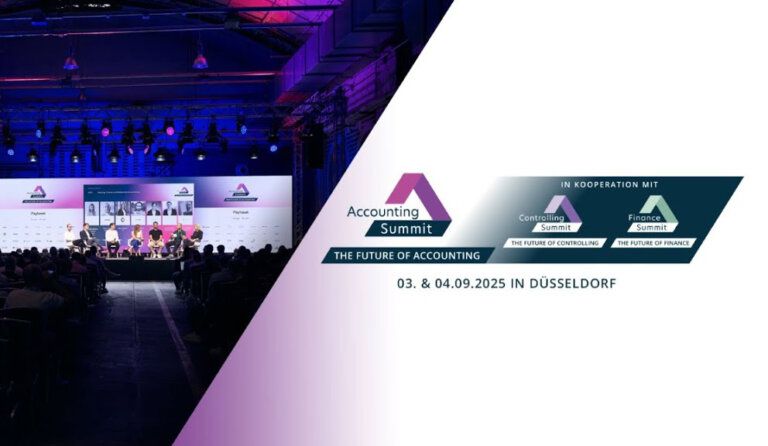
Accounting Summit 2025, Düsseldorf

Date

3 - 4, September 2025

Time

08:30am - 6:00pm

Venue

AREAL BÖHLER Hansaallee 321 40549 Düsseldorf

Don't miss the event

Days
Hours
Minutes
Seconds
Event - Accounting Summit 2025, Düsseldorf

Event summary

We’re excited to announce Sovos as a proud exhibitor at the Accounting Summit 2025, taking place this September in Düsseldorf. This event brings together leading innovators and decision-makers in accounting, finance, and tax to explore the digital transformation shaping tomorrow’s financial landscape.


Our very own Christiaan Van Der Valk, General Manager Indirect TaxTech & VP Regulatory, will join the conversation with a session titled:

Decoupling Strategy for Strength: One Compliance Platform, Flexible Automation.

Session Overview:

As governments worldwide increasingly base enforcement strategies on real-time transaction data, companies must rethink how they approach compliance and automation. In this session, Christiaan will explore how organizations can strengthen resilience and agility by building modular, future-proof compliance frameworks, designed for a world where Mirror Visibility is no longer optional.

This session will cover:

  • Truth in the transaction: How governments are turning real-life transaction data and continuous observation of economic operations into the backbone of enforcement strategies.
  • Mirror visibility: Why businesses must be able to see what tax administrations see, ensuring control in an environment where every transaction is monitored.
  • Modular future: How to reimagine automation as composable modules, seamlessly integrated with local compliance functionality, with agentic AI acting as the “super-glue” of tomorrow’s workflows.

Attendees will walk away with a clear vision for building compliance strategies that balance centralization with flexibility, while staying fully aligned with ever-changing regulatory landscapes.

We look forward to connecting with industry peers and exploring the future of compliance, automation, and digital accounting in Düsseldorf!

For more information, agenda, and registration, visit the Accounting Summit website.

Meeting Venue

AREAL BÖHLER Hansaallee 321 40549 Düsseldorf

Event

Tax Technology Conference 2025

Date

November 3-4, 2025

Venue

Osloer Str. 5, 60327 Frankfurt am Main, Germany

Event - Tax - Technology Conference - Tax Tax Wild

Event summary

We’re excited to announce Sovos as a proud Gold Sponsor of the Tax Technology Conference 2025, taking place this November in Frankfurt. This event brings together pioneers and thought leaders at the intersection of tax and technology to explore the latest innovations, regulatory updates and digital strategies transforming the tax landscape.

The Good, the Bad & the Compliant: Mirror Visibility and AI in the Wild Wild Tax

Session Overview:
In a global tax landscape that’s becoming more digitised, fragmented and unpredictable, navigating compliance is increasingly like surviving in the “Wild Wild West.” Governments are deploying real-time data collection tools, expanding e-invoicing mandates, and leveraging AI to detect non-compliance faster than ever before. So how do businesses keep up and stay compliant, without becoming the next cautionary tale?

Join Christiaan Van Der Valk, a leading authority in regulatory technology and digital tax, as he explores how forward-thinking companies can harness “mirror visibility” and AI-driven tools to not only survive but thrive in this new era of tax compliance.

This session will delve into:

  • The global rise of Continuous Transaction Controls (CTCs) and real-time reporting
  • How AI is being used, by both tax authorities and businesses, to interpret and act on vast amounts of transaction data
  • Practical strategies to future-proof your tax and compliance operations in a rapidly evolving digital environment
  • Real-world examples of success and failure and what we can learn from both

Attendees will walk away with a clear understanding of the opportunities and risks AI presents in tax compliance, and how to build the right digital infrastructure for sustainable, scalable and fully compliant operations.

With a wild west theme underscoring the challenges and opportunities of modern tax, this conference promises to be an engaging frontier for sharing ideas and advancing tax technology.

We can’t wait to saddle up and connect with everyone in Frankfurt!

For more information, agenda, and registration, visit the Tax Technology Conference website.

Meeting Venue

Osloer Str. 5, 60327 Frankfurt am Main, Germany

Event

SAPinsider EMEA Conference 2025

Date

1-3 October, 2025

Venue

Tivoli Hotel & Congress Center | Arni Magnussons Gade 2, 1577, Copenhagen, Denmark

Event - SAPinsider EMEA 2025

Event summary

Sovos is proud to be a Sponsor of SAPinsider EMEA 2025, taking place in Copenhagen — the essential event for SAP users, experts and innovators focused on driving real-world results. Join us as we dive into how to get more from the SAP technologies you already use, while uncovering what’s next across finance, GRC, data, security and more.

Whether you’re planning a transformation, in the midst of migration or looking to optimise your SAP investment, SAPinsider EMEA 2025 is where strategy meets execution — and Sovos is here to help you lead with confidence.

We’re excited to be sharing the stage with our customer KION, where we’ll talk about:

KION’s Blueprint for SAP S/4HANA Success: Standardised Indirect Tax Determination for Global Compliance Excellence featuring Stefani Mohr, Tax Compliance Officer (KION Group) and Christopher Lewis, Solutions Consultant (Sovos).

Discover how KION Group used a standardised indirect tax determination framework to anchor their SAP S/4HANA migration. The session will show how determination logic drives compliance across every process, with practical insights into testing, localisation, and integration for sustainable, future-ready operations.

For more information, agenda visit SAPinsider EMEA Conference 2025 and when registering use discount code: SOVOSVIP

Meeting Venue

Tivoli Hotel & Congress Center | Arni Magnussons Gade 2, 1577, Copenhagen, Denmark

Event

Gartner CFO & Finance Executive Conference 2025

Date

September 10-11, 2025

Venue

Peninsula Square London SE10 0DX,
United Kingdom

Event - Gartner CFO & Finance Executive 2025

Event summary

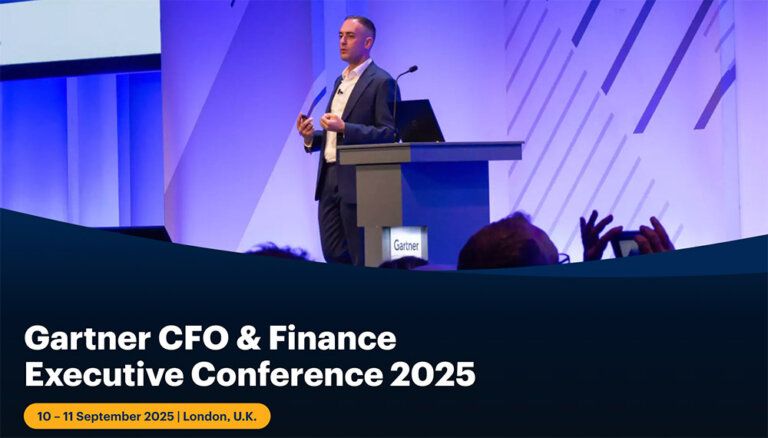
Sovos is proud to be a Silver Sponsor of the Gartner CFO & Finance Executive Conference 2025 — the premier event for CFOs and finance leaders navigating today’s most critical priorities. From managing risk and boosting efficiency to driving profitability and long-term growth, this conference delivers expert insight for success in an increasingly volatile and uncertain environment.

We’re excited to be hosting our own session:

Built for Visibility, Driven by Compliance: Unlocking the Composable Enterprise.

Join Ryan Ostilly, VP Product Management, as he explores how enterprises can respond to two major revolutions — real-time tax demands and AI-driven ERP transformation. Learn how modular systems can enable “mirror visibility” with tax authorities by connecting core business functions to a dedicated tax suite. Discover how aligning internal and external data reduces risk, enhances agility and builds trust by ensuring compliance in a rapidly evolving regulatory world.

With the finance landscape changing fast, we can’t wait to engage with industry leaders and peers on the future of tax, finance and transformation.

For more information, agenda and registration visit Gartner CFO & Finance Executive Conference.

Meeting Venue

Peninsula Square London SE10 0DX, United Kingdom

Event

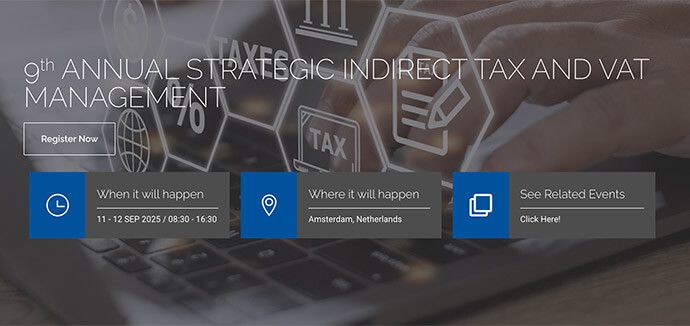
9th Annual Strategic Indirect Tax and VAT Management

Date

September 11-12, 2025

Venue

Stationsplein Zuid-West 951, 1117 CE Schiphol, Amsterdam, Netherlands
Event - 9th Strategic Indirect TAX - VAT

Event summary

Sovos is proud to be a Premium Sponsor of the 9th Indirect Tax & VAT Management Summit — the leading event for global tax professionals tackling the biggest challenges in indirect tax and VAT. This two-day summit promises expert panels, real-world case studies and hands-on insights into the future of digital tax.

With mandates like the EU’s VAT in the Digital Age (VIDA) and global shifts in tax reporting, it’s never been more critical to stay ahead. We can’t wait to join industry leaders and peers as we explore the impact of e-invoicing, tax automation and cross-border compliance.

Don’t miss our session with Christiaan Van Der Valk, GM Indirect TaxTech.

For more information, agenda and registration visit 9th Annual Strategic Indirect Tax and VAT Management.

Meeting Venue

Stationsplein Zuid-West 951, 1117 CE Schiphol, Amsterdam, Netherlands

From Europe to Southeast Asia, governments are reshaping e-invoicing rules and timelines, putting pressure on businesses to adapt. We will break down the latest changes across these key jurisdictions.

Event

SAPinsider Europe Super Summit

Date

June 17-18, 2025

Venue

Hilton Vienna Park | Am Stadtpark 1, 1030 Vienna, Austria

Event - SAPInsider Vienna 2025

Event summary

Join Sovos at the SAPinsider Europe Super Summit in Vienna!

We’re proud to be Gold Sponsors of From Migration to Modernization: Supercharging Your Business Transformation.

Whether you’re planning your move to SAP S/4HANA or optimizing an existing deployment, this summit will help you go beyond migration to drive true enterprise transformation. Discover actionable insights on data governance, cybersecurity, cloud scalability, intelligent automation, and more—all grounded in real-world expertise.

To review the full agenda for this event, click here.

Meeting Venue

Hilton Vienna Park | Am Stadtpark 1, 1030 Vienna, Austria

We recently partnered with StudioID on a global survey of 150 finance leaders to reveal significant insights into how companies are navigating the increasingly complex world of indirect tax compliance. The research, which included CFOs, EVPs/SVPs/VPs of Finance, and Finance Directors from companies with revenues ranging from $500 million to over $5 billion, provides a comprehensive look at the strategies finance leaders are implementing to stay ahead of changing regulations.

Real-Time Reporting Becomes Essential

The survey found that an overwhelming 95% of finance executives believe ensuring accurate real-time data reporting is important or extremely important for improving tax and compliance operations. This shift reflects a fundamental change in how tax authorities operate globally.

Previously in indirect tax, the way that the government could enforce the law was always through periodic reporting, but it was an unsophisticated instrument. Now, continuous transaction controls have become very popular since it’s about sending data in real time to the government.

This transition means businesses are no longer simply reporting their subjective view of a period’s aggregate sales and purchasing numbers —tax authorities are increasingly gathering authenticated data in real-time and informing companies of their liability instead. The stakes are higher than ever, with non-compliance potentially halting business operations entirely rather than just resulting in penalties.

Navigating Complex Jurisdictions

The complexity of global tax compliance is staggering. Approximately 30% of both US-based and international companies surveyed sell products and services across 2,000 to 5,000 different tax jurisdictions. Each jurisdiction has its own rules, rates, and reporting requirements. Requirements are also increasingly dynamic, with laws and technical specifications evolving to reflect tax administrations’ fine-tuning operations at an ever-increasing rate.

With initiatives like VAT in the Digital Age (ViDA) and e-invoicing mandates rolling out across Europe and beyond, companies must stay ahead of regulatory changes. Encouragingly, 87% of finance executives report having systems and processes in place to anticipate these upcoming mandates.

Top Challenges in Implementation

When it comes to successfully implementing current and upcoming e-invoicing mandates, finance leaders identified two primary challenges:

  1. Staying informed about domestic and international compliance requirements (38%)
  2. Choosing the right platform that can seamlessly integrate with existing systems (49%)

Additionally, 56% of respondents mention difficulty in making business decisions due to limitations around tax and compliance data accessibility and accuracy.

Strategic Responses to Tax Complexity

Finance leaders are implementing several key strategies to improve their indirect tax and compliance operations:

These investments are paying off—76% of finance executives report seeing a positive return on investment from their tax compliance software. However, cost remains a significant concern, with 91% identifying “lowering or maintaining compliance costs” as a top priority.

The Problem of Point Solutions

One notable finding is that 73% of respondents believe their companies use too many point systems to meet tax obligations across different geographical locations. The median number of systems currently in use is 40, with most wanting to reduce this number significantly.

There seems to be a lot of confusion in the market, whereby a lot of businesses think they need to replace their business software with regulatory-driven software. This simply isn’t true as there are multiple ways that leaders can make existing business software compliant.

Looking Ahead

As tax authorities worldwide continue advancing their technology, making compliance more complex and demanding, finance leaders must balance compliance requirements with business objectives. The most successful approach integrates tax considerations into core business processes rather than treating them as separate functions.

The message is clear: while tax compliance is becoming more complex, the right strategies and technologies can transform this challenge into an opportunity for greater efficiency and intelligence about your business. Whatever you set as your business objectives, make sure that your compliance software works in such a way that the tax is never a burden.

By staying ahead of regulatory changes and investing in the right solutions, finance leaders can ensure their organizations not only remain compliant but thrive in an increasingly complex global tax landscape.


Want to learn more about how finance leaders are adapting to the changing indirect tax landscape? Download the full research report, “The Future of Indirect Tax: How Finance Leaders Are Staying Ahead of Changing Regulations” for comprehensive insights and strategic recommendations. Download Now

Event

7th Annual VAT Management Summit

Date

June 3-4, 2025

Venue

Congress Centre 28 Great Russell St, London WC1B 3LS, United Kingdom

Event - 7th Annual VAT Management Summit

Event summary

We are thrilled to announce that Sovos will be Diamond Sponsors at the 7th Annual VAT Management Summit in London. The event brings together leading experts and professionals to discuss the latest trends, regulatory updates, and best practices in VAT compliance, indirect tax management and the global digital transformation of tax.

Both Christiaan van der Valk, General Manager, Indirect Taxtech and Ryan Ostilly, VP Product Management at Sovos, feature on the packed agenda.

To review the full list of this year’s topics and speakers, download a brochure, and register for the event, click here.

Meeting Venue

Congress Centre – 28 Great Russell St, London WC1B 3LS, United Kingdom

As indirect taxes (sales tax, VAT, GST) continue to play an increasingly vital role in global economies, tax authorities are modernizing their processes to improve efficiency and oversight. This evolving landscape presents businesses with both new opportunities and complex challenges when it comes to maintaining compliance.

Join Sovos expert Christiaan Van der Valk as he highlights five key trends in Indirect Tax Digitization, offering valuable insights into how businesses can adapt to the shifting regulatory environment. You will also learn strategies for staying compliant and ahead of the curve in this rapidly changing space.

We will cover:

The shifting landscape of indirect tax and its growing significance.

The five key trends business leaders must take into consideration when developing their tax and compliance strategy

How to develop a long-term plan and stay ahead


We hope to see you there!

In today’s digital world, every department across a business seeks money and resources to enable or expand digitization projects. The tax team must build a solid justification that demonstrates the value that will be returned to the business that also aligns with interconnected projects, such as ERP upgrades and government-mandated digitization initiatives.
Join us on 27 May for valuable takeaways you can put directly into practice in your organization.