A Buyer’s Guide to DtC Alcohol Shipping Compliance Software
Choosing the right solution for your business
With rising ecommerce demands and more people than ever before working remotely, direct-to-consumer (DtC) shipping of beverage alcohol has also grown in popularity. Consumers have become accustomed to being able to have their favorite wines, beers, and spirits shipped directly to their front door. Producers, shippers, and retailers are all working toward maintaining DtC compliance, but it’s hardly an intuitive process, especially as businesses grow and regulatory landscapes change.
Whether you’re a large-scale winery expanding into new states or a small-scale distillery growing its product line, you’ve come to the realization that maintaining DtC shipping compliance is no easy feat. You understand what you need to do, but perhaps aren’t sure the best way to go about doing it. Is investing in DtC shipping compliance software even necessary?
Not making that investment could cost your organization time and money—especially if you are shipping to more than a couple of states or to states with complex rules and reporting requirements. Maybe you have one employee dedicating days every single month to trying to account for all state requirements. What happens if you catch a mistake? Do you ship the product out, knowing you’ll get fined after the fact? Or do you delay the shipment, leading to unhappy customers?
The cost of “doing nothing” can be immense, which is why we’ve outlined how to find the right DtC alcohol shipping compliance software.
What Is DtC Alcohol Shipping Compliance Software?
DtC alcohol shipping compliance software is a specialized solution that helps wineries, breweries, distilleries, and retailers manage the complex regulatory requirements of shipping alcohol directly to consumers. From state-by-state shipping rules to tax calculations and reporting obligations, this software centralizes and automates critical compliance tasks.
Instead of manually tracking changing laws, businesses can rely on DtC alcohol shipping compliance software to stay current with regulations, ensure orders meet shipping eligibility requirements, and maintain accurate records for audits and filings.
Most solutions include capabilities such as automated tax determination, license tracking, reporting and filing support, and real-time validation of shipping rules. These tools reduce the risk of noncompliance while enabling businesses to confidently scale their direct-to-consumer operations.
Why Direct-to-Consumer Alcohol Compliance Is So Challenging
Direct-to-consumer alcohol shipping compliance is uniquely complex because there is no single, unified regulatory framework. Each state—and sometimes local jurisdiction—has its own set of rules governing who can ship alcohol, what products can be shipped, and under what conditions.
For example, requirements may vary based on:
- Product type (wine, beer, spirits, cider or other)
- Volume limits per customer
- Dry counties or restricted shipping areas
- Licensing requirements for producers and retailers
- Ongoing regulatory changes
As businesses expand into new markets, keeping track of these variations becomes increasingly difficult. Without the right systems in place, even small errors can result in shipment delays, fines, or license risks.
Get the big picture on DtC shipping requirements across the state in our complimentary eBook, DtC Alcohol Shipping Essentials: Getting Started & Staying Compliant.
The Hidden Costs of Managing Compliance Manually
- Regulatory research burden
Keeping up with state-by-state alcohol shipping regulations requires constant monitoring, and manual research increases the risk of outdated or inaccurate information. - License and renewal tracking
Managing multiple licenses and renewal deadlines can become overwhelming, with missed dates potentially disrupting operations. - Tax calculation errors
Varying tax rates across states, products, and jurisdictions make manual calculations error-prone, leading to penalties or rework. - Reporting and filing risks
Different requirements and deadlines across jurisdictions increase the likelihood of missed or inaccurate filings. - Employee time costs
Teams spend significant time on compliance tasks, limiting their ability to focus on other revening-growing activities. - Risk of fines and license suspension
Errors in filings or unauthorized shipments can lead to fines, audits, or loss of shipping privileges.
Regulatory Research Burden
Alcohol shipping regulations don't stand still. States update laws, adjust volume limits, and introduce new requirements on a rolling basis, and it falls on your team to catch every change. At the federal level, the Alcohol and Tobacco Tax and Trade Bureau (TTB) sets baseline requirements for direct shipping, but state laws add another layer of complexity that varies by jurisdiction, product type, and local rule. For businesses using beverage alcohol compliance software, regulatory updates are maintained automatically by a team of experts. Without it, someone on your team is constantly monitoring legislative updates, cross-referencing product-specific rules, and verifying local restrictions like dry counties. This kind of ongoing regulatory research is time-consuming on its own, but the real risk lies in what gets missed. Outdated information can lead to non-compliant shipments, and by the time a violation surfaces, the damage is already done: fines, delays, and frustrated customers.
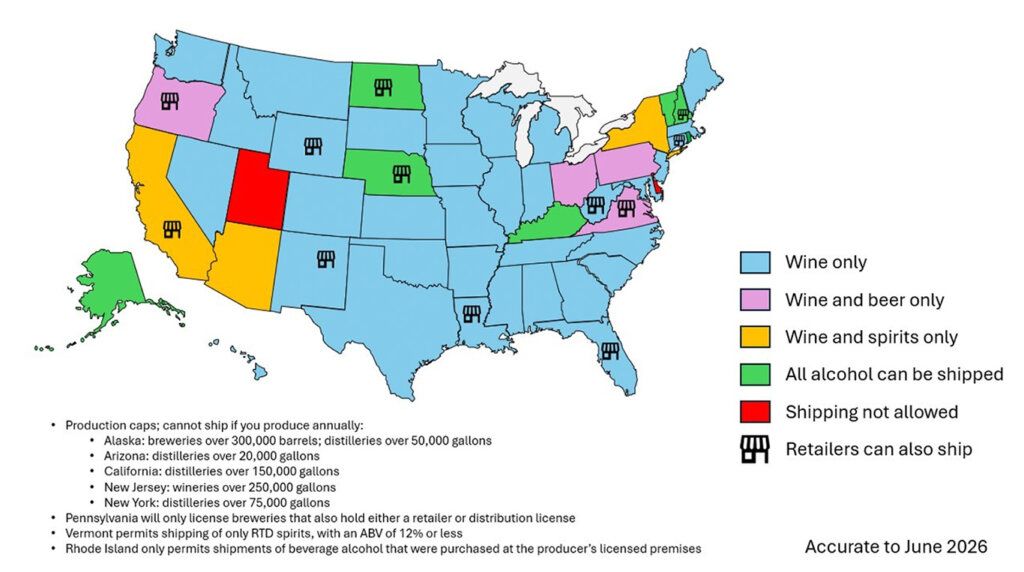
Who Can Ship What Where?
License and Renewal Tracking
Shipping alcohol DtC requires maintaining active licenses in every state where you operate, and each state has its own application requirements, fees, and renewal timelines. Managing this manually, whether through spreadsheets, calendar reminders, or physical files, leaves too much room for error. A missed renewal deadline doesn't just mean extra paperwork; it can mean losing the ability to ship into that state entirely until the license is reinstated. As your business expands into new markets or adds product lines, the number of licenses to track grows quickly, turning what was once a manageable task into a significant operational risk.
Tax Calculation Errors
Alcohol taxation is among the most complex in the country. Rates vary not just by state, but by product type, volume, alcohol content, and even local jurisdiction. In some areas, the applicable tax rate can change from one side of a street to the other. Without alcohol tax compliance software, calculating these figures manually for every order across every state you ship into creates enormous potential for error. Underpaying can result in penalties and back taxes; overpaying affects your margins and customer experience. And because alcohol taxes are applied differently than general merchandise taxes, generic accounting tools typically aren't equipped to handle the nuances, leaving compliance teams to fill the gap by hand.
Reporting and Filing Risks
Most states that permit direct-to-consumer alcohol shipping compliance require regular reports detailing what was shipped, to whom, and in what quantities. Deadlines, formats, and submission methods vary by jurisdiction, and the volume of data involved grows with every new state you enter. Teams managing this manually often find themselves piecing together records from multiple sources—including order management systems, carrier data, and tax worksheets—to compile each report. The margin for error is wide, and a late or inaccurate filing can trigger audits, penalties, or increased regulatory scrutiny. As shipment volumes increase, so does the complexity of staying on top of every reporting obligation on time.
Employee Time Costs
Compliance is necessary, but it doesn't have to consume your team. For businesses relying on manual processes, compliance tasks such as researching regulations, tracking licenses, calculating taxes, and preparing reports can easily consume several days of employee time each month. That's time that could be spent on customer acquisition, operational improvements or business growth. Wineries, breweries, and distilleries of all sizes face this challenge, which is why brewery compliance software and broader beverage alcohol compliance software solutions are increasingly becoming a standard investment rather than an optional one. As order volumes increase and you expand into new states, the burden grows proportionally. The compounding cost isn't just in hours; it's in the opportunity cost of skilled employees spending their days on repetitive administrative work rather than higher-value initiatives.
Risk of Fines and License Suspension
The consequences of non-compliance aren't theoretical. They're real, and they can be severe. Shipping to a state without the proper license, exceeding a customer's volume limit, or failing to remit taxes accurately can result in cease-and-desist letters, monetary fines, or the suspension of your shipping privileges. In some cases, losing a DtC license can trigger scrutiny of related licenses, including production permits. Beyond the direct financial cost, compliance violations can damage your brand's reputation and erode trust with state regulators, making future license approvals more difficult. For growing businesses, the cost of a single significant violation can far exceed what compliance software would have cost to implement.
Manual Compliance vs DtC Compliance Software
Managing compliance manually may seem manageable at first, but it becomes unsustainable as businesses grow.
| Manual Compliance | DtC Compliance Software |
|---|---|
| ✘ Time-consuming regulatory research | ✔ Automated regulatory updates |
| ✘ Manual tax calculations | ✔ Accurate, automated tax determination |
| ✘ High risk of errors and missed deadlines | ✔ Built-in compliance safeguards |
| ✘ Limited scalability | ✔ Supports growth across multiple states |
| ✘ Reactive compliance approach | ✔ Proactive, real-time validation |
For many businesses, investing in DtC alcohol shipping compliance software shifts compliance from a reactive burden to a scalable, efficient process.
Essential Features to Look for in DtC Alcohol Shipping Compliance Software
When evaluating alcohol shipping compliance software, it’s important to look for features that address the full lifecycle of compliance.
Key capabilities include:
- Real-time compliance validation
Ensures orders meet shipping rules before fulfilment - Automated tax calculation
Calculates accurate tax rates across jurisdictions - License management tools
Tracks licenses, renewals, and jurisdiction requirements - Reporting and filing support
Simplifies preparation and submission of compliance reports - Integration capabilities
Connects with ecommerce platforms, ERPs, and order management systems - Audit-ready recordkeeping
Maintains detailed transaction and compliance records
Selecting a solution with these features helps reduce risk while improving operational efficiency.
Questions to Ask Before Choosing a Compliance Solution
Before selecting a DtC alcohol shipping compliance software provider, consider the following questions:
- How frequently are regulatory updates maintained?
- Does the solution support all states where we currently ship—or plan to expand?
- How does the platform handle tax calculation and reporting?
- Can it scale with increasing order volume?
- What integrations are available with existing systems?
- What level of support and onboarding is provided?
These questions can help ensure the solution aligns with both current needs and long-term growth plans.

How DtC Compliance Software Supports Business Growth
As businesses expand their direct-to-consumer operations, compliance complexity grows alongside them. DtC compliance software enables organizations to scale without increasing compliance risk.
By automating key processes such as tax calculation, reporting, and license tracking, businesses can:
- Enter new markets with greater confidence
- Reduce operational bottlenecks
- Improve order processing efficiency
- Enhance customer experience through faster fulfilment
Ultimately, compliance software allows teams to focus less on manual compliance tasks and more on strategic growth initiatives.
What to Expect During Compliance Software Implementation
Implementing compliance software typically involves integrating the solution with existing ecommerce or order management systems, configuring jurisdiction-specific settings, and training internal teams. While timelines can vary, most organizations can expect a structured process that includes initial system setup and configuration, data migration or system integration, user training, and ongoing support during onboarding. A well-managed implementation ensures a smooth transition from manual compliance to a more automated, scalable approach.
Why Beverage Alcohol Producers Choose Sovos ShipCompliant
Beverage alcohol producers choose Sovos ShipCompliant because it is purpose-built to address the complexities of direct-to-consumer alcohol shipping compliance.
ShipCompliant helps businesses:
- Automate compliance across multiple jurisdictions
- Calculate taxes accurately in real time
- Manage licenses and reporting obligations
- Stay current with evolving regulations
With deep industry expertise and a focus on accuracy and scalability, Sovos ShipCompliant enables businesses to confidently grow their DtC operations while reducing compliance risk.
Conclusion
Managing direct-to-consumer alcohol shipping compliance is becoming increasingly complex as regulations evolve and businesses expand into new markets. Relying on manual processes can introduce unnecessary risk, inefficiencies, and missed growth opportunities.
DtC alcohol shipping compliance software provides a scalable, automated approach to managing regulatory requirements, helping businesses reduce risk while improving operational efficiency.
Ready to simplify your compliance process?
Explore how Sovos ShipCompliant can support your DtC growth and help you stay ahead of changing regulations.
FAQs
Why do wineries need compliance software?
Wineries need wine shipping compliance software to manage complex state regulations, ensure accurate tax calculation, and streamline reporting requirements when shipping directly to consumers.
What does alcohol compliance software do?
Alcohol compliance management software automates regulatory tasks such as tax calculation, license tracking, reporting, and validating shipping eligibility based on state laws.
Do wineries need compliance software to ship alcohol?
While not always required, compliance software significantly reduces risk and improves efficiency, especially for wineries shipping to multiple states.
How does compliance software help with taxes?
It automates alcohol tax determination across jurisdictions, reducing errors and ensuring accurate filings.
Can compliance software manage licenses and renewals?
Yes, most solutions include tools to track licensing requirements and renewal deadlines across states.
Does compliance software support beer, wine and spirits shipping?
Many platforms support compliance for multiple product types, including wine, beer, and spirits, depending on jurisdictional rules.
How long does compliance software implementation take?
Implementation timelines vary depending on business complexity, integrations, and data migration needs.
Subscribe to our Newsletter
Get monthly updates on Sovos ShipCompliant resources, data reports, fresh resources and more.
Subscribe now