In the fall of 2024, New York became the latest state to open its doors to direct-to-consumer (DtC) spirits shipping, marking a significant milestone for the industry. As one of the most populous states with a thriving market for craft and high-end spirits, the shift was expected to create substantial new opportunities for distilleries nationwide. Now, several months later, where does the market stand? And what does this mean for the future of DtC spirits shipping across the U.S.?
According to the New York State Liquor Authority (SLA), only a handful out-of-state distilleries have obtained Direct Liquor Shipper licenses since they became available. Meanwhile, all New York-based craft distilleries were automatically granted shipping privileges when the law went into effect.
New York is currently witnessing the establishment and stabilization of its internal DtC market, with in-state distilleries naturally leading the way in adoption. At the same time, out-of-state participation remains limited, as many distilleries are still evaluating the opportunity, navigating regulatory requirements and building awareness. As the market matures and more businesses recognize the potential, participation—both from in-state and out-of-state distilleries—is likely to grow.
Alex Koral, Regulatory General Counsel at Sovos ShipCompliant, emphasizes that it’s still early days:
“It takes time for a DtC program to gain traction. The licensing process is just beginning, and New York employs a reciprocity rule that inherently limits the distilleries that are eligible to ship to the state, keeping license numbers artificially low as long as it remains in effect. We’ll have a better sense of the law’s impact as more businesses and consumers engage with the new shipping options.”
One of the biggest takeaways from the 2024 Direct-to-Consumer Spirits Shipping Report is that consumer demand for DtC spirits shipping is not slowing down. In fact, it’s rising. Sixty-five percent of Americans 21+ want to see laws change to expand DtC spirits shipping, while the desire for purchasing spirits through the channel has risen to 85%.
Craft distilleries rely on DtC shipping to reach consumers who cannot find their products in local stores. Meanwhile, consumers expect the convenience of ordering their favorite spirits online, just as they do with wine and, of course, countless household products. However, unlike wine—which can be shipped to nearly every U.S. state—spirits face far more restrictions, with interstate spirit permitted in only nine locales as well as D.C.
Historically, regulatory changes in major states like New York and California have often set the stage for broader industry adoption. When a state with a large population and significant market influence embraces a new policy—whether it’s DtC wine shipping, cannabis legalization or craft beer self-distribution—other states take notice. The same could hold true for spirits.
New York’s decision to allow DtC spirits shipping was a landmark move, but its ultimate impact will depend on how effectively the market develops. The success of this program might provide the momentum needed to push DtC spirits shipping forward on a national scale. However, several key questions remain.
While it’s too early to predict exactly which states will introduce DtC spirits shipping bills next, large population centers and states with a strong craft spirits presence are natural candidates for future expansion. Two states that have already shown signs of movement are California and Colorado—each in a different stage of exploring DtC spirits reform.
Resistance to DtC spirits shipping often comes from wholesaler and retail associations concerned about bypassing the traditional three-tier system. However, two decades of well-regulated DtC wine shipping provide a clear precedent—and the data overwhelmingly supports expansion.
States with legal DtC wine shipping have successfully collected significant tax revenues, maintained effective regulatory oversight, and even seen declines in underage alcohol consumption. Meanwhile, the wholesale and retail tiers remain strong, with distributors continuing to thrive and retailers adapting to a changing marketplace. The evidence is clear: DtC shipping can coexist with the traditional system without causing harm to existing businesses.
Legislative change is often slow and even states that are receptive to reform will take years to develop and implement effective policies. Turning to the wine industry as a precedent, it has taken over two decades to get DtC wine shipping to its current state, yet it still hasn’t been legalized in every state.
In the meantime, distilleries looking to expand their footprint should prepare for a dynamic landscape. To gain a deeper understanding of the evolving DtC spirits landscape, download the 2024 Direct-to-Consumer Spirits Shipping Report today.
By Tom Wark, Executive Director, National Association of Wine Retailers
We are often reminded by the media and those in the wine industry—as well as by wine enthusiasts—that the three-tier system of alcohol distribution in most states hinders consumer access to the expansive number of wines available in this country. Some would argue that the rise of winery-to-consumer direct shipping over the past 20 years has mitigated this problem. However, as described by the National Association of Wine Retailers in the recent white paper, Interstate Retailer DtC Wine Shipping: A Primer for Lawmakers, Regulators and Stakeholders, the primary obstacle to product access facing wine consumers is the numerous states that ban wine shipments from out-of-state retailers.
Today, 37 states ban consumers from receiving wine shipments from out-of-state retailers. These bans apply to brick-and-mortar retailers, internet retailers, retailer wine-of-the-month clubs and auction houses, all of which are licensed in their respective states as retailers. As a result of these state bans on shipments from out-of-state retailers, consumers in those states do not have access to:
It is not hyperbole to note that over a million imported, out-of-vintage and collectible wines are inaccessible to consumers due to these bans on interstate shipments by retailers. This is because wholesalers in any given state distribute only a small minority of the wines that are actually available somewhere in the country and sold by specialty retailers, auction houses and retailer wine-of-the-month clubs, not by wineries.
The near-ubiquitous bans on shipments from out-of-state wine retailers have undoubtedly stunted the growth of the wine industry by barring consumers from accessing some of the most interesting, unique and talked-about wines sold in the United States. These bans not only harm consumers who can’t access wines, they also injure producers, wholesalers and retailers.
Producers and importers who sell all or parts of their production via the three-tier system would see those wines move off the shelves faster if retailers could offer them via direct shipment. Wholesalers also would benefit from retailer-to-consumer interstate shipping. If the mainly small-production domestic and imported wines that make up the majority of trailer shipments moved out of retailers’ inventory at a higher velocity, the wholesalers who supply them to retailers would have the opportunity to replace them with more wines. Finally, states benefit from retailer-to-consumer wine shipments due to the increased tax revenue these additional sales would bring to the states that currently ban this form of distribution.
In general, retailer shipping laws have been thwarted by retailers who have no interest in direct shipping but don’t want the competition from out-of-state retailers, by wholesalers who view interstate retailer shipments as a threat to the three-tier system, by producers who have no interest in seeing retailers in the direct shipping channel, and by lawmakers who have received generous campaign contributions from opponents of retailer shipping.
Yet in those states where retailer DtC wine shipping laws have been passed, there has been no evidence of reduced sales by in-state producers, retailers or wholesalers. Still, opponents of retailer shipments have been successful in making the arguments that wine shipments from out-of-state retailers would provide minors with greater access to alcohol, overwhelm a state’s alcohol regulators, cost sales to in-state sellers and make it difficult to collect taxes on these shipments.
The NAWR white paper, however, demonstrates there is a tried-and-true method of regulating retailer wine shipments that addresses all of these claims. That system of regulation for retailer wine shipments should look familiar to the industry:
State lawmakers could readily begin implementing these commonsense and tested regulatory arrangements so that consumers can access all the wines they want. Also of note, many state bans violate the U.S. Constitution by allowing their in-state retailers to ship wine to their consumers while banning out-of-state retailers from doing the same.
Currently, NAWR is helping to support seven lawsuits challenging this sort of unconstitutional discrimination. We expect these lawsuits to eventually result in legal victories that dictate retailers, like wineries, may not be discriminated against when it comes to the sale and shipment of wine to consumers.
We look forward to the creation of an even playing field for the sale and distribution of wine, allowing consumers to access the wines they want and helping wine industry regulation move into the modern era.
Learn more
Read the NAWR white paper, Interstate Retailer Wine Shipping: A Primer for Lawmakers, Regulators and Stakeholders.
The direct-to-consumer (DtC) wine shipping channel faced a storm of challenges in 2024, navigating some of the toughest market conditions in over a decade. As inflation tightened wallets and consumer behaviors shifted, the industry recorded its steepest declines in shipment volume and value since the inception of the Direct-to-Consumer Wine Shipping Report in 2010.
The DtC channel recorded double-digit declines in shipment volume, falling 10% year-over-year (YoY) to 6.4 million cases. Shipment value also took a hit, dropping 5% from 2023 to $3.94 billion. Additionally, the average bottle price (ABP) climbed 6% to a record $51.20.
These numbers reflect a market in flux—one where shifting consumer behaviors, economic pressures and evolving trends are rewriting the rules for wineries and consumers alike. But what’s really behind the challenges facing the DtC wine industry?
The 2025 Direct-to-Consumer Wine Shipping report sheds light on how the market navigated significant challenges in 2024. While broader industry pressures like inflation, shifting health narratives, the rise of the no/low-alcohol trend and competition from cannabis created a turbulent environment, the data highlights three critical trends that shaped the DtC channel’s performance: a sharp decline in lower-priced wines, stagnation in the ultra-premium segment and disappointing outcomes for large wineries.
A striking trend was the rapid descent that continued across the lower-priced wine category. This $40-and-under per bottle segment experienced a 15% decrease in volume following an 11% drop in 2023. While DtC wines are often associated with premium pricing, lower-priced bottles still account for more than half of the channel’s total shipment volume, making these consecutive double-digit losses particularly challenging.
On the other end of the spectrum, ultra-premium wines priced at $80 or more per bottle also struggled to maintain momentum. Historically, this category has demonstrated a certain level of resilience during economic downturns due to being supported by a consumer base that is less sensitive to price fluctuations. However, the narrative shifted as shipment volume grew by just 2%, a not-insignificant drop from the 5% growth seen in 2023.
Large wineries—those that produce 500,000 or more cases annually—were another segment that struggled in 2024. After an ABP increase of 13% to $22.53, more than double the 6% average increase across the channel, these wineries experienced an 18% decline in shipment volume and a 7% decrease in value YoY. Though these wineries represent a smaller share compared to their small and medium-sized counterparts, this notably poor performance had a sizable impact on the overall channel.
Amid widespread declines across the DtC shipping channel, the Rest of the U.S. stood out as an outlier. While the West Coast regions grappled with double-digit declines in shipment volume, this massively diverse category managed to limit its losses to just 1%.
Over the past five years, wineries in the Rest of U.S. have taken a notably conservative approach to pricing, raising ABP by 13% since 2020. This restrained approach contrasts with regions like Napa and the Central Coast, where price increases ranged from 23% to 47% for the same period. This pricing discipline persisted in 2024. While most regions continued to raise their ABP significantly, wineries in the Rest of U.S. held prices steady with a less-than-1% decrease YoY.
As stable pricing effectively minimized volume losses, the region also experienced a modest 1% decline in shipment value YoY. This minimal change in value underscores the delicate balance wineries must navigate to maintain affordability while ensuring enough revenue growth to offset production, labor and shipping costs.
The challenges faced by the DtC wine market last year are just one chapter in a much larger story. Across the board, the numbers tell a sobering tale: U.S. total beverage alcohol (TBA) volumes continued their descent in 2024. According to International Wine and Spirits Research (ISWR), TBA volumes dropped by 2.8% in the first seven months of 2024, a sharper decline than the 1.9% originally forecasted.
While the numbers for 2024 are daunting, they are not the end of the story. The DtC wine shipping channel may be facing challenges, but with the right strategies, continued strength may lie ahead. Wineries that lean into innovation will be better positioned to weather the storm and thrive in the years to come.
Want to dive deeper? Download the full report for a comprehensive analysis and actionable insights to drive success in 2025 and beyond.
Learn why Tennessee’s Alcoholic Beverage Commission (TNABC) is cracking down on ‘agent of the consumer’ sales for DtC wine shippers.
The Tennessee Alcoholic Beverage Commission (TNABC) recently sent a notice to licensed direct-to-consumer (DtC) wine shippers indicating that shipping as an “agent of the consumer” is a violation of the state’s laws.
This practice, also sometimes called a “passage of title” sale, has become increasingly popular among some members of the beverage alcohol industry looking to engage in DtC sales without complying with state licensing requirements. However, it has never been endorsed as an acceptable practice by any state regulatory agency, and the action by the TNABC clearly demonstrates the wrongness of this kind of sale when it comes to alcoholic beverages.
An “agent of the consumer” sale relies on contract gimmickry to get around the common rules that govern the DtC alcohol shipping market by including some key provisions in the terms and conditions.
First, the sale is determined to be finalized at the seller’s place of business, which often is a licensed retail shop or winery where alcohol can otherwise be legally and freely sold. This sets up the consumer as the owner and controller of the products purchased as soon as the credit card payment goes through.
The terms and conditions then set out that the consumer will take sole responsibility for the subsequent shipment, that the consumer is directing the seller to take this action (hence the seller is the consumer’s “agent”) and that the consumer will ensure that the shipment is in compliance with any relevant state laws that govern the shipment.
So agreed, the sale is completed and the seller ships off a package containing alcoholic beverages on behalf of the consumer, who has (knowingly or not) assumed total control of the entire process.
On its face, this theory of sale does seem attractive, as it avoids the onerous burdens that come with abiding by various state laws governing alcohol shipments. Instead of getting a license and paying taxes and tracking consumer volume limits and checking ages and properly labeling their packages, the seller can just say that that’s for the consumer to do. Even if they are a type of seller that is otherwise unable to get a shipping license in the state they’re shipping to, that doesn’t matter under an “agent of the consumer” sale.
And indeed, adjusting the language of a contract to come to a more favorable situation for the consumer or seller is common in commerce. When it comes to t-shirts or scrap metal or apples, it can be incredibly useful to prescribe what taxes will apply or in which jurisdiction litigation will take place in.
However, the problem when it comes to the DtC wine shipping market is that this kind of gimmickry just does not work, specifically when it comes to contracting away the regulatory burden.
As clearly stated in TNABC guidelines, only wineries properly licensed and authorized by the TNABC can ship wine to Tennessee consumers. Every other shipment of alcohol into the state of Tennessee is in violation of the state’s laws and brings the risk of cease-and-desist notices, fines and even potentially criminal charges.
Indeed, the state’s stark language that licenses are required to ship alcohol signals the clearest problem with the “agent of the consumer” sale: even if a seller and consumer agree that the consumer will be responsibility for the compliance of the shipment, there is almost no ability for an unlicensed consumer to ship alcohol—even to themselves. (In the few states that do allow a consumer to direct an out-of-state seller to ship alcohol on their behalf—Rhode Island, Hawaii, Connecticut—this is largely limited to small amounts from producers only.)
That is, while I can certainly take a trip to, let’s say, Los Angeles; and while there I can go into any off-premises retailer and buy as much alcohol as I can carry or afford; I cannot then go down to the local shipping store and hire a common carrier to deliver my purchase to my home. To the extent the state where I live allows it, I can bring the alcohol I bought on vacation back with me under a personal importation right, but this requires that I personally import it, in my luggage or in my car but not through a third-party common carrier.
Indeed, in almost every state, it is illegal for anyone but a licensed business to ship alcohol. At best these “agent of the consumer” sales simply set up the consumer to break the law and risk prosecution by their local alcohol authority. But as Tennessee has made clear, despite the contract language, the seller will also become subject to scrutiny.
It is certainly true that DtC shipping can be complicated and expensive. It is unsurprising that some will look for loopholes to get around these burdens or state laws that otherwise prohibit them from getting the necessary licenses. But gimmicks will only get you so far and just because you put something down in writing doesn’t make it automatically legitimate.
The only real way to participate in the DtC shipping market is compliantly. State laws matter and will be enforced by regulators. The solution to addressing laws you disagree with is to go to the legislatures and change them, not pretend they don’t exist.
Interested in learning about DtC shipping laws in other states? Search wine shipping rules by state on our interactive guide page.
When no one is home to sign for an alcohol delivery, it becomes more than just a minor hiccup for direct-to-consumer (DtC) alcohol shippers. It’s a domino effect that transforms a perfectly curated product into a customer’s disappointment before it’s ever opened. This becomes an even higher stakes challenge for products like wine that are as much about experience as they are about quality.
In this blog, we’ll explore why signature requirements are non-negotiable, the broader implications of a failed wine delivery attempt and the steps DtC wine and other alcohol shippers can take to minimize these challenges while keeping customers happy.
Unlike your typical online order, all alcoholic beverages shipped directly within the United States come with strict legal requirements. Any alcohol shipment, including wine, must be accepted by an adult 21 years or older. To ensure compliance, carriers must obtain a signature and verify the recipient’s government-issued photo ID at the time of delivery. If no eligible person is available to sign for the package containing alcohol, the delivery attempt is deemed unsuccessful.
Wine shipping rules and signature requirements are in place to ensure compliance with state and federal regulations while protecting both wineries and customers. A missed delivery doesn’t just mean inconvenience for the customers, it can cost shippers big.
Compliance, however, is only part of the equation—especially for wineries and other wine clubs. Wine is a sensitive product, especially when it comes to temperature. With an optimal storage temperature between 53°–57°F, even minor deviations can significantly affect quality. Prolonged exposure to high temperatures during warm months can cause corks to expand, leading to oxidation and undesirable flavors. On the flip side, freezing winter temperatures can result in cracked bottles or peeling labels, making wine shipping even more challenging for wineries and other wine clubs.
The impact of a failed delivery goes far beyond the bottle, too. Customers who encounter delays, poor communication or damaged shipments are less likely to reorder. And with wine shipments averaging between $100 and $1,500 in value, customers’ expectations are understandably high. A failed alcohol delivery often tarnishes the customer experience and damages brand loyalty.
According to Sovos ShipCompliant’s own proprietary research, customers are 30% more likely to reorder if their shipments are delivered on the first attempt. While delivery challenges are inevitable, a missed delivery is what truly sours the experience. The good news is that there are several proactive measures DtC alcohol shippers can take to reduce their frequency and impact.
Whether they’re eagerly awaiting a special bottle of wine for an event or simply planning their day around a delivery, customers rely on businesses to keep them in the loop. That’s why the foundation of a successful delivery is clear communication. From the moment an order is placed, ensure customers understand what’s required to receive their shipment:
Real-time tracking turns the delivery process into an extension of the customer experience. Consider Delivery Experience solutions from Sovos ShipCompliant, for example, which empowers shippers with detailed shipping status information, allowing them to proactively communicate updates to customers. In turn, shippers can reduce uncertainty and enhance peace of mind by keeping customers informed about where their order is in its journey.
One way that wineries and other DtC shippers can keep customers informed is through SMS/text notifications. These tools enable businesses to keep up with modern consumer expectations by communicating with customers and allowing them to adjust their plans or reroute shipments if necessary. Businesses that opt in to services like those provided by RedChirp, for example, have seen a 24% decrease in return rates, fewer failed delivery attempts and a 74% reduction in shipment damages.
Learn More: (Webinar) Reduce Returns with Automation Powered by Sovos ShipCompliant & RedChirp
Life happens, and customers aren’t always available when their DtC shipment is scheduled to arrive. To address this, carriers like FedEx and UPS allow packages to be rerouted to nearby facilities with a variety of alternative delivery services such as Hold-at-Location (HAL). These options offer a convenient way for customers to pick up their shipment of wine, while also ensuring the shipper meets compliance with signature requirements.
Today’s customers expect transparency, speed and convenience, including when it comes to receiving their favorite bottle of wine, spirits or beer. With real-time tracking and proactive communications, customers can stay in the know as businesses drastically reduce the likelihood of failed attempts. These small but impactful moments show customers that their experience matters, building loyalty and encouraging repeat orders.
With the right strategies in place, wineries and other DtC alcohol shippers can stay focused on what they do best. Sovos ShipCompliant is here to help you ensure your products reach customers safely, compliantly and with minimal hassle. Discover how we’re solving compliance for every step in the DtC alcohol shipping journey.
California’s bottle bill got a major upgrade earlier this year, and it’s changed the rules for wineries, distilleries and beverage distributors in a big way. For the first time, wine and spirits manufacturers will need to register with CalRecycle, report sales and pay California Redemption Value (CRV) fees for containers sold or shipped to California.
The state’s push for sustainability has a direct impact on how the industry produces, labels and distributes beverages. Whether you sell directly from your tasting room, distribute through retailers or ship to California consumers, these changes demand attention. In this blog, we’ll break down the key updates and provide guidance to help your business prepare.
Effective January 1, 2024, the California bottle bill now includes wine and spirits containers, alongside beer, under its container deposit system. As a result, wineries and distilleries must comply with CRV registration, payment and reporting obligations. Beer, already included in the program, remains unchanged.
Another major update is set to go into effect on July 1, 2025. All wine and spirits containers sold in California must comply with California Redemption Value (CRV) labeling requirements.
All sales made within and/or shipped to retailers and residents in California are included in the bottle bill. This includes containers for wine, beer, malt beverages and spirits. The rules also extend to innovative packaging formats such as box, bladder, pouch or similar containers, ensuring that modern packaging doesn’t escape the recycling loop.
While beverages sold for on-site consumption in a tasting room are not subject to CRV reporting or fee payment, any sealed to-go containers sold from tasting rooms or shipped directly to consumers for off-site consumption must comply with all CRV requirements.
However, there are some exceptions. Products filled and labeled before January 1, 2024 are exempt from the new CRV labeling requirements. Additionally, wine and spirits sold for on-site consumption, such as those served in tasting rooms, are not subject to reporting or fee payment obligations.
The beverage container recycling rates in California are determined by container size and type. For containers smaller than 750 mL (less than 24 fluid ounces), the redemption value is 5 cents per bottle. Larger containers of 750 mL or more are subject to a 10-cent CRV per bottle. Non-traditional containers such as boxes, bladders and pouches carry a higher CA CRV of 25 cents per container.
| Bottle smaller than 750 mL (less than 24 fluid ounces) | CRV=5 cents per bottle |
| Bottles 750 mL or larger (24 fluid ounces or more) | CRV=10 cents per bottle |
| Boxes, bladders, pouches and similar containers | CRV=25 cents per container 00 |
All businesses that meet the bill’s definition of a “beverage manufacturer” or “distributor” must register through CalRecycle’s online portal. Understanding the associated roles and responsibilities is essential for businesses navigating the requirements.
Under the California bottle bill, a beverage manufacturer includes any entity that bottles, cans or fills beverage containers in California, holds a manufacturing license from the California Department of Alcoholic Beverage Control (ABC) or imports beverages for sale in the state. Third-party bottlers qualify as manufacturers only if they both fill and sell the containers, although reporting and fee obligations can be transferred to producers through Pay on Behalf agreements.
Out-of-state wineries and distilleries shipping exclusively to California importers are exempt from registration, as the importer assumes responsibility for fees. However, those shipping directly to California consumers may need to register as both Beverage Manufacturers and Distributors.
Beverage manufacturers must now report and pay CRV and processing fees for all containers sold or transferred, even if these were filled and labeled before this date. Processing fees vary based on the container material, with the 2024 fee for glass containers set at $0.00576 per unit. These fees, along with CRV payments, are to be submitted monthly as of March 10, 2024.
A distributor, on the other hand, is any entity that sells or imports beverages in qualifying containers to California dealers, consumers or producers. This includes businesses holding an ABC direct shipper permit. Registration ensures compliance with reporting and payment obligations under the updated bottle bill, and companies operating multiple brands may consolidate registrations under a single federal tax ID when applicable.
Distributors are also subject to reporting and paying CRV fees. They are allowed to retain a 1.5% administrative fee to cover their costs. Smaller businesses may qualify for annual payment schedules, provided they fall below specific thresholds for annual CRV and processing fees. Importantly, costs can be passed on to consumers, who can redeem their bottles at recycling centers to recover the CRV.
Failure to adhere to California’s bottle bill regulations can result in serious penalties, including fines, suspension of licenses or permits and even revocation of business licenses. These consequences underscore the importance of compliance and timely action to meet the new requirements.
With the changes already well underway, now is the time to act. Businesses should:
Take a deeper dive into the implementation of California’s bottle bill and explore other regulatory changes in our exclusive, on-demand webinar, ‘Regulatory Opportunities and Challenges in DtC Shipping Across the States’.
This informational blog does not constitute legal advice. Reach out with specific questions about your business’s responsibilities under California’s bottle bill.
Gillian is the founding member of Gillian Garrett Law, PC. She advises and represents alcohol beverage industry clients on California and federal alcohol law. She can be reached at gilliangarrettlaw.com.
Although hard to believe, unclaimed property obligations impact ALL industries, including wineries and other wine clubs. While most companies typically only associate unclaimed property with outstanding checks, including accounts payable and payroll, there are other exposures for wineries and wine clubs to consider. Understanding these risks and the requirements for property reporting is critical for staying compliant and avoiding costly penalties.
While organizations should still consider outstanding checks, another significant exposure for wineries and wine clubs could result from products sold to customers that are never received. This includes:
As a first rule of thumb, if a customer purchases a product that cannot be delivered or the customer fails to pick it up, the funds should be returned directly, ideally in the same form of payment. Alternatively, wineries could use undistributed funds to offset purchases made by the same customer at a future date.
Failure to utilize either of these options to handle the outstanding obligation to the customer will result in accounts receivable credits on a company’s ledger. With this in mind, wineries and other wine clubs should analyze balances due to others aged three to five years to identify properties considered reportable to the states as unclaimed property.
Dormancy periods are a key component of unclaimed property compliance, as they dictate the length of time before unclaimed funds or assets are considered abandoned property and therefore subject to state reporting requirements. Each state establishes its own dormancy periods, which typically range from three to five years. Once this period expires, businesses are required to report unclaimed property to the appropriate state authority.
During the dormancy period, businesses are expected to attempt to reconcile outstanding balances with property owners. Organizations should understand their obligation to conduct state-required due diligence mailings, which involves sending letters to property owners notifying them of the property that is due to them and giving them an opportunity to claim it before it is reported to the states. Specific requirements regarding reportable populations, timelines, due diligence requirements and reporting methodologies vary widely from state to state.
To minimize unclaimed property exposure, best practice for wineries and other wine clubs is to notify customers of balances or unreceived products within 90 to 180 days from the balance creation. Outreach efforts conducted within this period have a greater chance of customers responding compared to those conducted three to five years after the fact.
Ignoring or incorrectly reporting property can have serious consequences. Businesses that fail to comply with state requirements may face audits, interest and penalties on overdue filings. In severe cases, non-compliance disputes have even escalated to the Supreme Court, highlighting the importance of compliance with unclaimed property laws.
Whether it’s understanding dormancy periods and property types, or navigating state-by-state requirements, Sovos is here to help. For a deeper dive, watch our free on-demand webinar, What Beverage Alcohol Companies Need to Know about Unclaimed Property.
Contact us to learn more about the services Sovos provides to help your organization achieve and stay in compliance with the ever-changing world of unclaimed property.
Direct-to-consumer (DtC) alcohol shippers are no strangers to navigating a complex regulatory landscape. However, recently, a new challenge has emerged—the rise of retail delivery fees. From excise taxes to shipping restrictions, the industry has long dealt with a maze of state-specific rules that require careful attention and precise compliance.
Read on to explore how RDFs are affecting DtC alcohol shipping, why more states are likely to adopt them and what strategies businesses can use to stay compliant as this trend continues to grow.
A retail delivery fee (RDF) is exactly what it sounds like—a fee that a state can impose on a retail sale of goods that are delivered to the consumer from a remote business location. RDFs are like other add-on fees including bottle bills and sales taxes in the way that states impose them on various sales. However, there are unique rules on when and how they will apply to a given retail sale.
As of now, only two states—Colorado and Minnesota—have implemented RDFs. While this may initially seem to have a limited impact on the DtC shipping market, there are likely to be widespread implications long-term as other states explore similar measures.
The Colorado RDF is currently $0.29 per order, with the rate scheduled to increase annually. Only businesses with a sales tax account in Colorado are obligated to collect the fee. However, Colorado has established a $500,000 annual retail revenue threshold for the RDF, meaning that many businesses—particularly DtC shippers—may not be subject to the fee even if they have a sales tax liability in the state. For those businesses that do meet the threshold, the RDF must be collected on every order shipped to Colorado and remitted separately from other state taxes.
The Minnesota RDF is set at $0.50 per order. The state has a higher threshold of $1 million in annual retail sales before a business becomes liable for the fee. Additionally, the RDF only applies to orders exceeding $100, meaning smaller transactions, such as a pizza delivery, will not incur the fee in Minnesota—unlike in Colorado, where even small orders are subject to the fee.
With the 2025 legislative sessions approaching, it is highly likely that more states will introduce bills related to RDFs. Washington state has commissioned a study to explore the potential implementation of an RDF, and New York has introduced legislation to assess delivery fees, including specific fees for transactions in New York City. Nevada and Ohio have also examined the fee’s feasibility in recent years, although neither state has taken significant action.
In both Colorado and Minnesota, retailers required to collect the RDF must charge consumers at the time of purchase, much like sales tax. However, as DtC wine shippers know all too well, even fees that can’t be directly assessed—such as excise taxes—are often included in the listed price of goods, ultimately raising the cost for consumers.
In just two years, Colorado has already pulled in over $130 million from adding the delivery fee to retail purchases. While Minnesota’s has not been in effect long enough to generate statistics, it projects to also collect tens of millions in additional revenue per year. With those numbers, it is extremely likely then that more states will follow the established precedent and adopt their own related fees.
The primary reason states are adopting RDFs is simple, as they provide an additional source of revenue. With state budgets under pressure and politicians hesitant to raise taxes directly, this add-on offers a way to generate additional funds without the political fallout of new taxes. By labeling them as “fees” instead of taxes, states can sidestep the need for voter approval, which is required for tax increases in states like Colorado. This distinction makes it easier for lawmakers to implement these fees, even though the cost falls on consumers.
As electric vehicles become more prevalent, gasoline tax revenues are expected to sharply decline. Gas tax receipts peaked at $65 billion in 2020 but are projected to drop to just $20 billion by 2050. To fill this gap, states need to get creative, and RDFs are just one potential solution.
Additionally, RDFs serve another strategic goal: ensuring that companies contributing to the wear and tear on public infrastructure pay their fair share. This is particularly relevant for massive online retailers like Amazon, whose delivery networks place substantial strain on roads. While Amazon is a prime target for these fees, other online retailers and businesses reliant on remote fulfillment are also likely to be affected as these fees gain traction.
While implementing RDFs on a state-by-state basis may simplify adoption in the short term, it fragments the regulatory environment, creating a patchwork of liabilities and jurisdictions that businesses must navigate. This increasingly complex system places a heavy burden on online sellers, such as DtC wine shippers, who are tasked with managing these diverse and evolving requirements.
The question is: how can businesses keep up with these variations without losing their minds or risking costly compliance errors? The real advantage comes from building systems that can handle whatever comes next. By engaging with compliance experts, using centralized platforms to track legislative changes and adopting technology to automate the compliance process, alcohol shippers can stay ahead of the curve and mitigate the risk of non-compliance.
When engaging in direct-to-consumer (DtC) shipping of alcohol, compliance with different state laws is paramount and so keeping up with law changes is critical. In 2024, the rules in several states for DtC have already been adjusted or will change soon. Here is a review of the major rule changes DtC shippers should be aware of.
Massachusetts has added an ‘own production’ requirement to its DtC wine shipping law. Under this new rule, licensed wine shippers will only be permitted to ship wines that either they produce or that are produced for them under an exclusive contract. Further, the wine shipper must own the brand name under which the wine being shipped is sold. These own production rules are common and are intended to prevent a DtC shipper from acting as a tacit out-of-state distributor, selling many brands that they have nothing to do with.
This has been an issue for the Massachusetts Alcohol Beverage Control Commission, which claims that 40% of wine shipments to the state have come from only 20 licensees. Whether this new law will improve this situation in the eyes of the ABCC remains to be seen, but residents of the Bay State will certainly see some reduction in the brands available to ship to them going forward.
Nevada has technically not changed its DtC statute, but it has recently reviewed its law to read that fulfillment houses that facilitate DtC shipments of wine into the state must hold a Certificate of Compliance. Under this new interpretation, all parties sending alcohol into Nevada must be licensed, including agents of otherwise licensed entities.
Going forward, when a winery applies for a license to ship direct to a customer in the state, it must indicate the specific address where their shipments will originate. If that location is not owned by the winery, the application will not be approved unless the state has an existing record of a Certificate of Compliance for that address. By adopting this new requirement, Nevada joins a grip of other states that require licensing for fulfillment houses.
Maine has also added a licensing requirement for fulfillment houses servicing shipments to the state. This rule will take effect on January 1, 2025. fulfillment houses will need to register all locations they will ship wine from at a cost of $60 per address. In addition, fulfillment houses will need to file a quarterly report with the state. Further, Maine has adjusted their reporting requirements for Direct Shipper Licensees.
Starting January 2025, all licensees will need to file their excise tax return and shipping report quarterly, rather than an annual frequency based on the month their license was issued. While this will mean submitting more returns in a year, it will provide welcome uniformity to the state’s tax filing schedule. This also means that direct shippers will need to file a return in January to cover their shipments back to their last filing in 2024, and then file on a regular basis going forward.
Nebraska now requires all brand/labels sold in the state to be registered with the Liquor Control Commission, including all DtC shipped products. An existing registration for three-tier distribution will suffice for DtC shipping—there is no need to double register if a producer is selling their brands in both channels. While the state’s brand registration law has been in effect for several months already, it had granted a term of leeway that is set to end on December 31, 2024.
One of the most exciting areas of DtC alcohol shipping has been the expansion of the channel to products beyond wine, with the spirits industry being particularly active in lobbying states to change their laws.
To this, New York also passed a law to extend shipping permissions to include DtC shipment of spirits and cider products as of November 18, 2024. Distillers looking to begin shipping to New York are advised to take note of the laws surrounding shipping, particularly the state-specific reciprocity restrictions around which distilleries it will issue licenses to.
California also has been active for DtC spirits shipping legislation in the last few years. However, the state has not been able to pass a proper DtC shipping bill and has merely been extending its COVID-related shipping rule. The latest version, passed earlier this year, keeps the “temporary” allowance in effect until January 1, 2026.
Since this law is only applicable to in-state distilleries, it is in apparent violation of the Supreme Court’s Granholm ruling, and so stands on shaky ground. However, the state continues to promise that it will resolve the issue and pass a proper, nation-wide DtC spirits shipping law next year, which we’re all holding our breath for.
As DtC shipping laws change and continue to spread to additional states, we at Sovos ShipCompliant will be sure to keep you informed. Catch the replay of our annual year-in-review webinar, where we discussed the regulatory changes in 2024 along with product updates and reporting best practices.
While wine lovers have enjoyed the convenience of direct-to-consumer (DtC) shipping for nearly two decades, the craft spirits market is still not afforded the same access. Outdated and restrictive spirits shipping laws have kept the spirits industry from fully leveraging the benefits of DtC shipping, leaving both consumers and distillers unable to enjoy its full potential.
We partnered with the American Craft Spirits Association to understand both the widespread demand for regulatory reform, as well as the far-reaching impact that expanded direct shipping privileges would have across the industry. While it was no surprise that craft spirits enthusiasts and distilleries are calling for change, the 2024 Direct-to-Consumer Spirits Shipping Report revealed two new insights that underscore the broad-based demand for reform and its potential benefits.
Let’s explore these findings in more detail to better understand how shipping reform could transform the future of the spirits industry.
Americans nationwide agree that it’s time for change. A significant 65% of the adults surveyed believe that laws should be changed to allow spirits to be shipped directly to consumers in more states. This isn’t just a small group of craft spirits fans; it’s a broad-based demand for more flexibility and consumer choice.
Among regular craft spirits drinkers, this sentiment is even stronger, with 81% in favor of legislative changes to enable more widespread DtC shipping. Many of them have traveled, discovered new spirits, and been frustrated by their inability to purchase these products once they return home.
The demand for consumer shipping reflects changing consumer expectations in a world where convenience and choice are increasingly important. Consumers want more control over their purchasing decisions, and they’re frustrated by the regulatory barriers that prevent them from accessing products they want.
The report found that 92% of regular craft spirits buyers who purchase through DtC channels say they actively seek out those same brands at retail locations. Of those, 45% are very likely to do so. This means that direct spirits shipping not only offers consumers a convenient way to access their favorite product, but also acts as a driver of retail sales, creating a win-win-win scenario for consumers, distilleries and retailers.
In many ways, this movement mirrors what happened with the wine industry two decades ago. The DtC wine shipping market is proof that allowing consumers to receive shipments directly from producers benefits all parties involved—producers gain broader market access, consumers enjoy greater choice and convenience, and the states benefit from increased tax revenue.
With over 15 years of successful wine shipping as a proven model, there is no question that the spirits industry can follow the same path—safely, compliantly, and profitably. The time to expand DtC spirits shipping is now, opening the door to a more accessible and profitable future for everyone involved.
Download the 2024 Direct-to-Consumer Spirits Shipping Report for more key insights on consumer demand, market opportunities and the critical need for legislative reform.
The direct-to-consumer (DtC) wine shipping channel has seen a continuation of movement tracked in the January release of the Sovos ShipCompliant/Wine Business Analytics Direct-to-Consumer Wine Shipping Report, with the top destination states experiencing a dip in volume and value.
The latest data for the U.S. wine DtC shipping market reveals shipment data trending downward. Nationwide, shipment volume has declined by 11% for the January-June 2024 period, amounting to 3.1 million in cases sold, while the overall value of these shipments has decreased by 5%, totaling $1.8 billion. Amidst these declines, the average bottle price has increased by 6%, reaching $48.96. All regions across the country experienced losses in both shipment volume and value, reflecting the broader challenges faced by the industry.
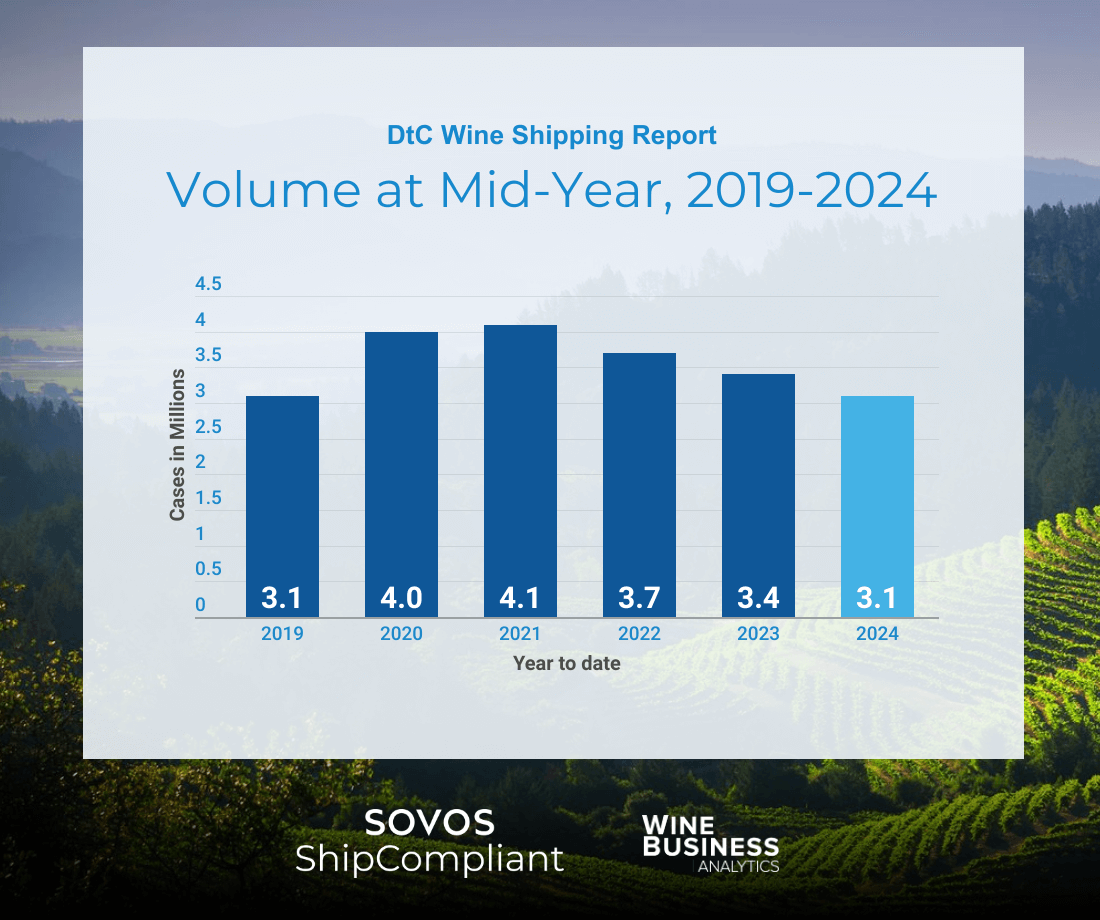
Note: The proprietary data featured in this mid-year report is compiled from an algorithm measuring total DtC shipments based on millions of anonymized direct shipping transactions filtered through the ShipCompliant system and paired with WineBusiness Analytics’ comprehensive data on U.S. wineries, resulting in the most accurate depiction of the DtC wine shipping channel.
Here is a deeper look at the changes in the DtC shipping channel from January through June of this year.
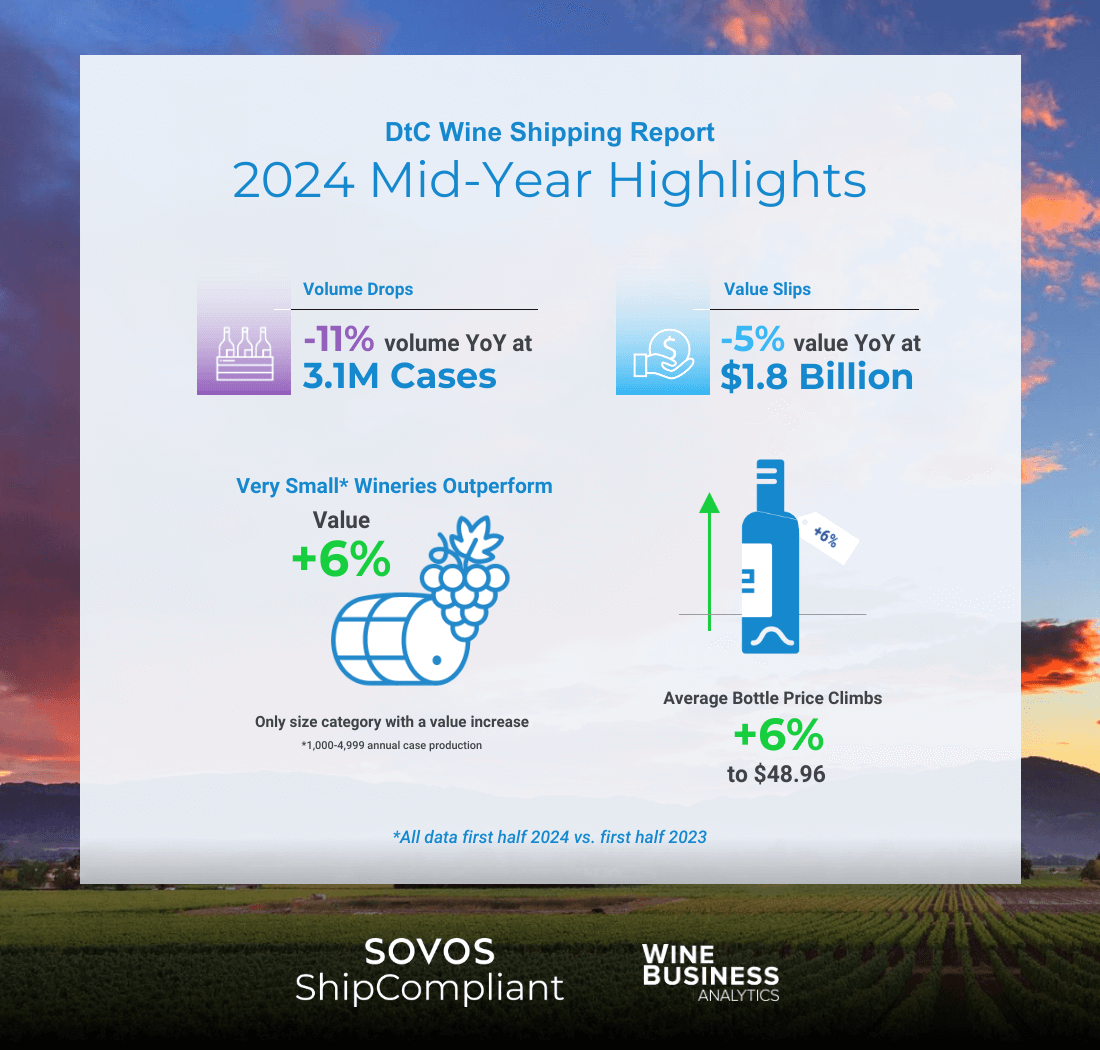
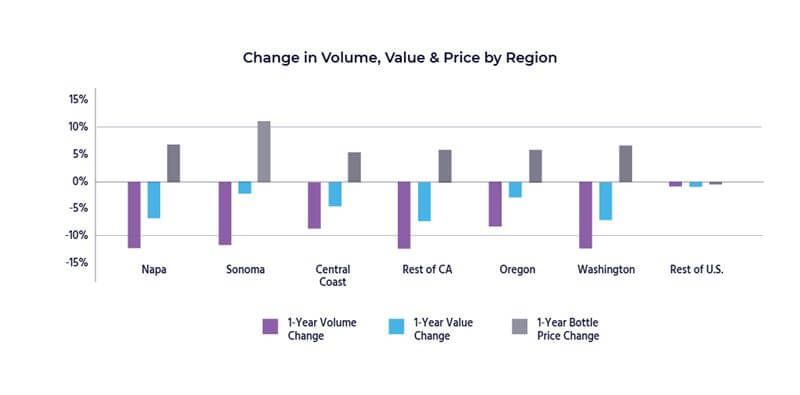
Overall, the average price of a bottle shipped DtC now stands at $48.96, a solid 6% increase. The area grouped as Rest of California* saw a 10% rise in average bottle price, the highest percentage increase in the country, followed by a tie of an 8% increase seen by both Oregon and Sonoma.
* Rest of CA = Wineries in Mendocino, Lake, Livermore and Temecula counties and the Sierra Nevada region, plus all other areas outside the Central Coast, Napa County and Sonoma County
It comes as no surprise that once again, as has been the case since the inception of our Direct-to-Consumer Wine Shipping Mid-Year Report, California is the top destination state, maintaining its 29% share from last year.
In terms of volume, there were no positive volume growths among the top 10 destination states. However, small-volume states Alabama (20%) and Arkansas (1%) saw an increase in volume through the mid-year. Similarly, there were no top 10 ship-to states that recorded a positive value increase, but Alabama (17%) Arkansas (4%), Hawaii (5%), North Dakota (10%), New Mexico (5%), Kentucky (2%) and Tennessee (1%) all achieved an increase in value.
Wineries in all regions noted a decline in both volume and value, with Central Coast experiencing the most drastic changes in volume (-14%) and value (-9%). The Rest of the US* had the smallest decline in volume (-5%), while the Rest of California had the smallest decline in value at –1%.
*Wineries in every other state aside from California, Washington and Oregon.
The largest wineries — those who produce 500,000+ cases per year — saw a 14% increase in average bottle price, climbing to $22.12. This marks the highest bottle price growth in the channel, though the largest wineries also experienced a 16% drop in volume growth. The second best-performing segment in average bottle price was small wineries who produce less than 1,000 cases. Their average bottle price is now $68.69, a 13% jump from January. We reported similar results for these two segments in the 2023 Direct-to-Consumer Wine Shipping Mid-Year Report.
Only very small wineries (with production of 1,000-4,999 cases per year) demonstrated an increase in value, with a 6% rise. On the other hand, medium-sized wineries (50,000-499,000 cases) faced the steepest declines, with a -17% drop in shipments and a -15% decrease in value.
Of the top four wine types (Cabernet Sauvignon, Pinot Noir, Chardonnay, Red Blend) that account for 54% of the total share of the volume of wine shipped DtC, each saw negative value growth (-3% to -6%), and all but Red Blend had an increase in average bottle price.
In terms of volume growth, White Blend (3%), Cabernet Franc (13%), Fume/Sauvignon Blanc (2%) and Sangiovese (11%) saw increases. Pinot Grigio had the largest volume decline at –24%.
Cabernet Franc led with a 26% increase in value. Other varietals that saw value increases include White Blend (11%), Fume/Sauvignon Blanc (5%), Other Red (3%) and Sangiovese (13%), with Merlot experiencing the largest decline in value at –15%.
“What we’ve seen in the winery DtC shipments market this year is similar to the wider U.S. wine market. While this recent trend is new for the DtC sector, which has traditionally outperformed the total market, it is indicative of a mature and integrated DtC sector rather than challenges unique to the business of DtC shipments or a widespread change in consumer sentiment regarding direct shipments,” observed Andrew Adams, an editor with WineBusines Analytics. “It’s also encouraging to see an increase in shipments to states such as Alabama and Kentucky as that growth is a reminder that the U.S. wine business is truly a national one that continues to offer opportunities for proactive wineries.”
With an unpredictable economy, a turbulent U.S. political landscape and shifting consumer preferences in beverage alcohol, predicting the future of the DtC wine shipping channel is challenging. No matter how the market evolves, we will continue to offer our observations and insights. Our comprehensive 2025 report will be released next January. In the meantime, you can explore detailed 2024 findings by downloading your free copy of the 2024 Direct-to-Consumer Wine Shipping Report.
This data was compiled in partnership with WineBusiness Analytics, a leading source for wine industry data.
Find the most comprehensive look at the DtC wine shipping channel in the 2024 Direct-to-Consumer Wine Shipping Report.
As craft distillers work to grow their business and market presence, they must contend with innumerable challenges, not least of which is simply being able to access consumers across the country due to restrictive state laws. To help relieve these headwinds, industry groups along with consumer advocacy organizations have taken to supporting efforts to expand distillery access to direct-to-consumer (DtC) shipping privileges.
Any such efforts to grow the DtC shipping map, however, have been met with implacable opposition, which regularly trots out a parade of horribles that could (but never actually seem to) happen if DtC is permitted to exist. Recently, the Wine & Spirits Wholesalers of America (WSWA), an industry trade group representing some of the largest players in the beverage alcohol industry, has brought up a new talking point that simply does not seem to be grounded in logic.
In its recent response to the American Craft Spirits Association (which supports greater DtC options), WSWA argues that DtC spirits shipping should not be expanded beyond the eight states where it is currently allowed because “data shows DTC sales in the wine and spirits sector have been declining year over year.” Seemingly, because DtC shipping won’t make every distillery a billion dollars, it’s not worth even trying?
This argument, however, both grossly misrepresents the reality of the DtC market over the last decade and, if taken seriously, would undermine the value of any market that has faced a downturn, including the three-tier system itself.
A central flaw in the claim that declining sales means craft distillers shouldn’t be allowed to try to grow their DtC shipping options is that it’s a willful skewing of the data. Since it is likely that the latest Sovos ShipCompliant/WineBusiness Analytics Direct-to-Consumer Wine Shipping Report is the source of these claims, we look to it to correct the record.
Now, it is true that the last two years have seen a decline in the DtC wine shipping market (we have found that the DtC spirits market is too limited due to restrictive state laws for there to be sufficient sales data to work from). In 2022 and 2023, the volume of wine shipped DtC dropped 10.3% and 6.5%, respectively; the value of the wine DtC market declined 1.6% in 2022 but was effectively even in 2023. Year-to-date data also show that the market is below 2023 numbers, though the busy holiday season is yet to come.
So true, the channel has experienced decreases. But these are hardly disastrous numbers, and they must be put in context of the extreme growth the market saw in 2020 and 2021, where the value of wine shipments grew 14.9% and 13.4% respectively. Returning to normal after the pandemic years does not signal a worthless market. This is especially true when considering the past 10 years, wherein DtC wine shipments doubled in terms of volume and tripled in value to annual sales of $4 billion.
While it is difficult to predict the future of any market, it is a near guarantee that if more states (perhaps New York soon?) were to grant craft distillers DtC shipping privileges, the DtC spirits shipping channel would grow in volume and value. Certainly, whenever a new state opened to DtC wine shipping, the effect was immediately noticeable in the market, such as in 2016 when the market grew in value by 18.5% after Pennsylvania began allowing DtC shipping of wine.
Even if the DtC spirits shipping market is not as successful as the DtC wine shipping market (for one, there are many fewer distilleries out there than wineries, which would limit the market size), an extra billion or two dollars in annual sales is not something to sneeze at. And it is important to keep in mind that any growth in DtC spirits would be extra sales, as trends suggest that DtC sales have been largely additive to the overall wine market.
Where the opposition to DtC shipping often falls flat is that it so often frames the alcohol market in black and white terms. If DtC is allowed to expand, it must do so at the expense of the three-tier system—and so any attempts to expand DtC availability must be completely rebuffed or else the three-tier system will collapse. This all-or-nothing mindset, however, leaves those opponents to adopt arguments that often fail the sniff test.
This is unfortunate as the anti-DtC contingent is broadly alone in thinking that DtC shipping should (or even could) replace the existing system. Even those who do advocate for an end to the strict three-tier market don’t think that wholesalers should not (or, again, even could not) be part of the beverage alcohol market—they simply don’t think that wholesalers need to depend on restrictive state laws that force producers and retailers to use them. If wholesalers bring value to the brands they distribute, then they shouldn’t need the law to shore them up.
Indeed, DtC shipping of alcohol can and should work hand-in-hand with the three-tier system. Numerous wineries have established and grown wholesale distributions based on their DtC sales. With their DtC sales data, those wineries were able to demonstrate to prospective wholesalers that they had an established market in a state and so should be carried in local liquor stores and restaurants.
Yes, DtC shipping of alcohol can be difficult and expensive, and it is not a panacea that will make all producers rich. But it is an option; one that, with clear and effective laws, can be made safe, healthy and compliant; one that lets consumers access the thousands of small craft distillers that are so often excluded from the three-tier system.
A new regulatory framework for direct-to-consumer (DtC) shipping of beverage alcohol in Alaska is set to take effect on Friday, August 23, 2024.
These new rules govern how in-state and out-of-state producers can ship their products to consumers in Alaska following the passage of SB 9 in 2023, an omnibus bill that affected almost every part of the state’s beverage alcohol industry. By setting down clear and manageable requirements for wineries, breweries and distilleries to follow, the Alaska Alcohol and Marijuana Control Office (AMCO) has brought some welcome stability to the state’s DtC channel, which had previously operated under limited regulatory management.
Under the new rules adopted by AMCO, producers who want to ship their products to Alaska consumers will need to comply with the following requirements:
Notably, Alaska does not have a state-level sales tax, so assuming liability for sales tax is not a requirement for getting an Alaska DtC license. However, the state does allow communities in the state to establish and assess their own sales taxes, and shippers that have economic nexus in Alaska (make over $100,000 in annual gross sales to the state) will need to register with the state’s Remote Seller’s Sales Tax Commission to remit those local taxes.
Further, the allowance for out-of-state retailers to ship DtC to Alaska residents has now been removed.
DtC shippers who have been patiently waiting for final adoption of the new DtC shipping rules can now apply for licenses and begin to service their consumers in the Last Frontier.
On August 18, 2024, Governor Kathy Hochul signed into law SB 2852-A, adding spirits, ciders and meads to the list of products that are permitted to be shipped direct-to-consumer (DtC) in New York.
This makes the Empire State the ninth to permit their consumers to receive direct shipments of spirits and removes a technical barrier that blocked apple- and honey-based alcoholic beverages from enjoying existing DtC wine shipping privileges as they can in most other states.
SB 2852-A mimics the rules for DtC shipping of wine, which have been in place in New York for nearly two decades. Under these rules, distilleries, cideries and meaderies that will DtC ship their products to New York consumers must:
There are, however, two provisions in these laws that will limit the number of brands that New York consumers will have access to.
First, New York will only issue DtC permits to distilleries that produce less than 75,000 gallons per year. New York restricts shipping of spirits to only in-state craft distillers (Class A-1, B-1, C or D Distiller licensees) and a provision of SB 2852-A similarly restricts DtC shipping to only out-of-state distillers of an equivalent size. There are no production caps for cideries or meaderies.
Second, New York will impose reciprocity restrictions on out-of-state shippers, meaning that only distilleries, cideries and meaderies that operate in states that themselves grant New York producers equal DtC shipping permissions will be permitted to DtC ship to New York consumers.
The reciprocity rule is a carryover from the existing wine law, though its effect on DtC spirits shipping will be much more restrictive. This is because only eight other states permit New York distilleries to DtC ship. As such, New York consumers will only be able to receive shipments from distilleries in those eight states. In contrast, reciprocity is nearly a moot issue with wine (and cider and mead) as almost every state in the U.S. permits DtC shipping of those products—only wineries in Delaware, Mississippi and Utah are blocked from the New York market, whereas most distilleries from California to Maine will remain out of reach to New York consumers.
While reciprocity rules may make some sense in theory (why grant permissions if you can’t receive equal treatment?), they remain a controversial part of the DtC channel. Notably, New York is currently the only state with reciprocity rules, ever since Oregon removed its reciprocity restrictions for beer DtC shipping after facing a lawsuit from Washington brewers.
The main reason that New York’s reciprocity rules for wine were never challenged was that most other states quickly jumped onto the DtC wine bandwagon, limiting their negative effect. In the case of spirits, however, there might come a point when a Tennessee distillery wonders why they are ineligible to ship DtC when their neighbors in Kentucky are free to and decide it’s worth challenging New York’s law in court.
Certainly, we can hope that Tennessee, and many more states, will soon adopt DtC spirits shipping laws, mooting New York’s reciprocity restrictions and granting their consumers greater access to the national spirits market. But until that does happen, New York consumers will be limited in the distillers they can access.
DtC shipping is wildly popular among craft drinkers, with large majorities supporting efforts to make it more available (even most non-craft drinkers think the laws should be modernized). A state the size of New York represents a huge new market for craft distilleries, which is especially welcome as so many craft distilleries continue to struggle to get their products distributed through the “standard” three-tier channels. Even with the production cap and reciprocity restrictions, New York consumers themselves can greatly benefit from being able to buy and receive more products from their favorite producers across the country.
I recently had the privilege of speaking on a panel at the National Conference of State Liquor Administrators (NCSLA) Annual Conference, a regular meeting of regulators, attorneys and other members of the beverage alcohol industry to discuss important issues affecting our trade.
Alongside Claire Mitchell, of Stoel Rives, and Erlinda Doherty, of Vinicola Consulting, and moderated by Marbet Lewis, of Shutts & Bowen, we discussed the implications of increased use of artificial intelligence (AI) technology on the alcohol industry.
Broadly, AI refers to a spectrum of developing software services that, utilizing ever faster processors, can analyze vast quantities of data. From the patterns it pulls from its input data, it can respond to a wide variety of prompts from a person, everything from recommending a movie to watch to formulating novel cancer drugs, depending on how it has been programmed.
As talked about as AI is these days, there is still much about it that remains purely speculative: how it could improve work, what systems it might disrupt, whether it will be the best invention since sliced bread or if it will kill us all. Our panel, then, was also largely about the potential impact of AI in the beverage alcohol industry, how it could affect production, marketing and regulation, without firm conclusions about whether that impact will be positive or negative.
AI is, above all, a research tool, with the potential to look at millions of data points and provide analysis at the drop of a hat. As such, AI can help:
AI is, above all, artificial, meaning it exists outside of the real world and (so far) cannot appreciate what humans do. As such, AI may fail to:
AI also uses past searches to develop future prompts. This means that if you input trade secrets or other proprietary formulas into an AI program, the AI may reprint them in future searches, including by your competitors!
Among the highest profile uses of AI is image generation. It therefore has broad potential for producers to rapidly produce labels and other marketing material, either entirely from scratch or building on established brand marks.
AI could also revolutionize the regulation of beverage alcohol labels, readily reviewing them for compliance with federal and state laws. If properly adopted by the TTB, COLA approvals could become almost instantaneous, allowing reviewers to focus on more important issues than the proper punctuation of the Government Warning.
AI brings with it an array of copyright concerns, namely:
Even if AI is thoroughly trained in federal and state labeling rules, it can never be relied on as the sole reviewer. A human eye will always need to be involved, especially for more nuanced situations, like health claims or disparagement of other producers.
Tireless and perceptive, AI could potentially provide continuous, end-to-end tracking of where, when and how beverage alcohol is shipped and distributed across the country. This could be a major benefit to the industry by:
AI can also improve things for alcohol regulators by reviewing the reports they receive for legally questionable or problematic occurrences.
There already are services that provide continuous, end-to-end tracking of shipping and distribution of beverage alcohol, including reviewing individual orders for their compliance with state laws and generating necessary tax and shipping reports. While AI could potentially improve those services, is that really the best use of AI?
Similarly, AI could end up being either a far too over- or under-zealous regulator, either wrongly tagging innocent orders for imagined sins or missing obvious errors. As ever, a human will still need to review and check any compliance issues an AI system will flag. If AI ever starts enforcing laws on its own, that could be a scary day.
The legal field is often brought up as being particularly threatened by AI disruption. However, by all accounts we are still decades away from a robot Perry Mason. Instead, AI could be a valuable tool for attorneys by:
Despite its prevalence, AI still has much to learn, limiting its ability to assist attorneys at present. Attorneys looking into using AI need use caution and recognize that:
AI undoubtedly has a tremendous amount of real-world potential. As a nearly instantaneous research and analysis tool, it could vastly simplify many tedious and complex tasks that humans struggle with. It’s easy to imagine how your own work and life could be improved if AI were to take over the drearier parts.
However, like any system, AI brings with it very real negatives along with the potential positives—and of course, there are always unknown factors that will throw off even the best laid plans. Ultimately, AI is a tool, and like any tool, it will only be as effective as the hands that wield it.
Subscribe to the Sovos ShipCompliant blog to get the latest insights on beverage alcohol compliance sent to your inbox.
Guest blog written by Susan DeMatei, President, WineGlass Marketing
WineGlass Marketing recently conducted a study to explore how Millennials and Gen X feel about wine, wine culture and wine country. The goal was to gain insight into how we can make wine, wine club and wine country appealing to these new audiences.
Here are just some of the research highlights we’ll discuss in the webinar.
What sets Millennials and Gen X apart is not just their preference for wine over other alcoholic beverages, but also their willingness to invest in quality. Complementary research conducted by the Wine Market Council confirms that Millennials are more likely than Boomers to purchase a bottle of wine over $20, a testament to their discerning taste and appreciation for the finer things in life.
These consumers grew up with the internet, so they are accustomed to choice. They seek variety and are in a constant state of trial. Therefore, do not be surprised when you hear statistics about RTDs, beer or other adult beverages — which don’t mean they aren’t also consumers of wine.
When surveyed, this group expressed a strong inclination to enjoy wine in social settings, be it at home with friends or at lively events, bars and clubs. This underscores the social nature of wine consumption, emphasizing the need to foster a vibrant wine culture.
Liquor and grocery stores are the predominant sales channels. Still, Millennials are twice as likely to use a delivery app, shop online at a retailer like wine.com or buy from a winery’s website than Gen X. If you haven’t started to develop significant brain power internally focusing on your web strategy, it’s time to make that a priority.
This group shared strong opinions about visiting wineries. Throughout the study, we saw that it seemed like an unnecessary expense and hassle to enjoy a product they already loved. They are fearless in trials and don’t feel the need to follow a brand to its “roots.”
Our panel of wine drinkers had some positive things to say about wine clubs, but when they weren’t in a club, the reasons were variety and control. It seems that flexibility and choices are more important to Millennials and Gen X than the club discounts.
The research featured 28 questions asking respondents’ beliefs about a variety of topics, from alcohol levels to packaging. Overall, they show an affinity for value, moderation, exploration and authenticity. They are looking for brands with straightforward values that match their own, and nothing too extravagant or wasteful. They also clearly have a joy for exploration.
The survey pointed out some clear directions for wineries wanting to shift from Baby Boomers toward Gen X and Millennials. It is clear that these consumers do not value what previous consumers have, and do not make decisions or shop the same. Change is always difficult, but we must begin to shift our presentation of wine to consumers or risk quickly losing relevance. Some wineries are well on their way. We have plenty of tools at our disposal to facilitate this shift, and there are millions of new wine consumers eager to hear from us.
Learn more about wine country and Sovos ShipCompliant here.
The New York legislature recently passed A3132A, a bill that will expand the range of products that residents of the state can have direct-to-consumer (DtC) shipped to them. The bill is now in the hands of Governor Kathy Hochul—meaning that unless she decides to exercise her veto power, producers across the country will soon be able to ship their spirits, ciders and meads into the Empire State.
Currently, New York only permits the DtC shipping of wines, excluding lower-ABV non-grape products that do not use “wine” in their branding. By extending DtC permissions to these additional product classes, New York is set to establish one of the largest potential growth areas for cideries, meaderies and—in particular—distilleries engaged in DtC shipping.
As written, A3132A follows the existing rules for wine shipping in New York, which all parties shipping alcohol DtC into the state must abide by. These rules require DtC shippers to:
Further, only distilleries that produce less than 75,000 gallons per year will be able to engage in DtC shipping of spirits. (The rule is that for in-state spirits producers, only class A-1, B-1, C or D licensees can DtC ship, and that equivalent production caps will be imposed on out-of-state distilleries.)
As a near clone of the existing wine DtC law, the new provisions for spirits, cider and mead all contain an unfortunate carryover: reciprocity restrictions. For DtC shipping, reciprocity is the concept that a state will only permit producers in other states to DtC ship to their residents if those producers operate in states that themselves would permit the initial state’s producers to ship to their residents—effectively a “you scratch my back” situation.
While these rules were common in the early days of DtC wine shipping, New York is now the only state in the country with reciprocity written into their statutes (at least since Oregon removed its reciprocity rules for DtC beer shipping last year at the threat of litigation). As such, they are very much an anachronism, and it is unfortunate to see New York carry over these limitations to the new product types.
This is especially so for spirits, as only eight other states and D.C. permit DtC shipping of spirits, so New York consumers will be severely limited in the number of producers they will have access to, until more states step up and extend DtC spirits shipping permission. Notably, Kentucky does permit DtC shipping of spirits, so New Yorkers can tour the Bourbon Trail knowing they can join clubs and have shipments sent to their homes; Tennessee bourbon, though, will be left out. (Cider and mead are permitted to be shipped under almost every other state’s wine DtC shipping laws, so producers in only a few states will be excluded from the New York market.)
Overall, it is very heartening to see New York open to more DtC shipping availability, especially as efforts in other states have been limited in recent years. As a major market, New York is poised to demonstrate how it can support craft businesses and extend consumer choice by making the national spirits market at least that much more available. This is in stark contrast to California, which has failed to move past its “temporary” rules for DtC shipping of spirits that is (unconstitutionally) only available to in-state distilleries.
DtC shipping of spirits is popular, with a majority of regular spirits consumers and non-drinkers alike supporting changing state laws to expand its availability. Hopefully New York can spur further changes across the rest of the country.
Interested in learning about DtC shipping laws in other states? Search wine shipping rules by state on our interactive guide page.
Over May 8-9, Sovos ShipCompliant hosted its 19th annual Wine Summit. For two days, wine makers, managers, consultants, attorneys and other industry members gathered at the Napa Valley Marriott to hear from a cavalcade of experts on regulatory and marketing advice and updates related to the wine industry.
Rob McMillan from Silicon Valley Bank talked on how current market trends will affect the future of the wine industry. Acknowledging that the industry is experiencing a global downturn unlike anything seen in the last 30 years, Rob was optimistic about wine’s ability to persevere as a valuable and desirable commodity. Still, it will require adaptation and industry-wide cooperation to determine the best steps forward—along with the release of the 2023 vintage, which Rob was particularly bullish about. Accurate and timely market data is also critical for understanding where the industry is going, so make sure to participate in the SVB surveys when they come around.
Aniko Ritchie, representing the Tax and Trade Bureau (TTB), provided helpful guidance and updates for wineries managing their federal regulatory obligations. Her overall message was that, while the TTB is here to help, wineries can do themselves a world of good by getting ahead of any potential issues. Maintaining comprehensive records going back several years, timely reporting of any changes to a licensee’s ownership or premises and voluntarily disclosing any errors are the best ways to avoid problems and ensure your experiences with the TTB are nothing but positive.
Matt Botting, general counsel for the California Alcoholic Beverage Control, and Risa Williams, investigations sergeant for the Arizona Department of Liquor Licensing and Control, spoke on state-related issues at the 19th annual Wine Summit; primarily on compliant direct-to-consumer (DtC) shipping of wine. By understanding the permissions and obligations that come with state licenses, wineries can recognize what sales options are available to them and how to remain in the good grace of the state regulators as they look to expand consumer reach out.
Chuck Maniace, VP of regulatory analysis & design for Sovos, presented on sales tax issues as they affect DtC wine shippers. Sales tax can be a complicated issue for any business, but DtC wine shippers face numerous unique challenges including unique nexus considerations and special rates and taxes that apply only to wine. However, with care and attention—and specialized software support—sales tax needn’t be too daunting for any winery to manage.
Ian Consoli from Tablas Creek Vineyard, Carol Reber from The Duckhorn Portfolio and Quinton Jay from Bacchus Consulting Group discussed ways for wineries to extend their markets through combined DtC shipping and three-tier distribution. Indeed, it is a mistake for wineries to consider these as separate channels and not simply different sides of a winery’s overall business strategy. A unified message and brand identity can work for both DtC sales and three-tier distributions and ensure that consumers will recognize your wines wherever they see them. Time and experience have clearly demonstrated that DtC shipments can buoy three-tier sales—and vice versa. Still, the panelists warned against distributors demanding wineries shut down their DtC shipping programs before they will carry the winery’s products.
Jen Purcell from Avaline, Victoria Anderson from Hudson Ranch and Vineyards and Nigeria Cole from Sonoma State University examined how wineries can best reach out to younger and more diverse consumer bases as part of their business strategy. Central to their message was the need for clear and open communication. Wine can be intimidating, with all of its foreign verbiage and arcana, but the industry must move beyond this image if it will return to growth in the coming years. With transparency about what’s in the bottle—in terms of the tasting experience, its environmental impact and its nutritional content—wineries can better engage with new consumers and expand their market base. Diversity within the winery itself will also help project an accessible and friendly face that demonstrates firsthand that wine truly is for everyone.
Bahaneh Hobel, of Dickenson Peatman Fogarty, Rebecca Stamey-White, of Hinman & Carmichael, and Melanie Full, general counsel for Gallo, provided the attorneys ’perspective, discussing several issues currently affecting the wine industry. Local land use came up, relating to recent action taken against Napa-area wineries that had exceeded what was permitted under their licenses. Recent enactment of the federal Coporate Transparency Act also was addressed, as an underdiscussed and novel regulatory obligation that many wineries may soon be subject to. Following the overall message from the conference, the panel noted the importance for wineries to take care and pay attention to the details—and consult with experts—to avoid compliance issues.
Steve Gross, VP of state relations for Wine Institute, closed out the day with his regular State of the DtC Industry update. Steve remarked on the many ongoing ways that Wine Institute is working to improve regulatory conditions for wineries engaged in DtC shipping—and to stave off efforts to retrench the hard-earned permissions we do enjoy today. Of note were the ongoing rollout of new DtC regulations in Alaska, fixing numerous problematic rules that were recently adopted in Wisconsin and finally removing the production cap in New Jersey. The wine industry owes a great deal of thanks to Steve and his team for their ongoing work over the years to grow DtC wine shipping into what it is, and we at Sovos ShipCompliant are ourselves grateful to Steve for speaking at almost every Wine Summit.
With a successful conference under our belts, we look now to next year’s Wine Summit, which comes weighted with importance as both the 20th annual event and the 20-year anniversary of the Granholm v. Heald Supreme Court ruling that undergirds the DtC wine shipping market. We hope to see you there!
Interested in learning more about the DtC wine industry? Find the highlights from our 2024 Direct-to-Consumer Wine Shipping report on our blog.