Effective January 2026, California is fully opening its doors to direct-to-consumer (DtC) shipping of distilled spirits. Until recently, only distillers located within California were permitted to ship spirits directly to residents. This policy originated after the widespread shutdowns in 2020, which prompted temporary measures to support local businesses. The law allowing in-state direct-to-consumer shipping was extended annually until a legal challenge, referencing the Granholm ruling, questioning its fairness.
In November of 2025, we hosted a webinar featuring Michael Walker on behalf of the American Craft Spirits Association (ACSA) , featuring a deep dive on everything that distillers needed to know before shipping to California.
The state’s one-year pilot program, effective January 1, 2026, opens the door for both in-state and out-of-state craft distillers to ship directly to consumers, provided they meet strict compliance requirements. This shift not only expands market access but also signals potential trends for other states to follow.
With the passing of AB 1246, California’s DtC spirits shipping laws have undergone significant updates. Here’s what producers need to know.
Navigating alcohol shipping compliance in California, like in all states, requires attention to detail.
The pilot program is currently scheduled to end on December 31, 2026. While it’s uncertain whether lawmakers will extend or make the program permanent, history suggests there’s a precedent for renewal. Our annual Direct-to-Consumer Spirits Shipping Report, produced in collaboration with the ACSA, consistently demonstrates that consumers want increased access to spirits. The repeated extensions of California’s in-state shipping laws further illustrate that support from both consumers and lawmakers can drive meaningful change.
Yes, starting January 1, 2026, both in-state and out-of-state craft distillers can ship spirits directly to California consumers, provided they obtain the required license and comply with all regulations.
To DtC ship spirits into and within California, you will need a Type 94 license.
Yes, there is a 2.25 liter per person per day volume limit for DtC spirits shipments in California.
Shippers must register as both manufacturers and retailers, collect and remit bottle deposits, and file regular tax and compliance reports with California agencies.
Yes, as long as the distillery meets California’s definition of craft distillery and secures the appropriate licenses, out-of-state distilleries can DtC ship to California residents effective January 1, 2026.
Non-compliance can result in fines, loss of licenses, and enforcement actions from state and federal agencies. Compliance failures may also impact other production licenses and future business opportunities.
On October 3, Governor Gavin Newsom signed AB 1246 into law, making California the latest—and largest—state to enable consumers to receive direct-to-consumer (DtC) shipments of distilled spirits beverages. This landmark legislation marks a major advancement for California DtC spirits shipping, opening new opportunities for producers and consumers alike and reshaping the landscape of California alcohol shipping laws.
California AB 1246 is a groundbreaking bill that introduces DtC spirits shipping to California. Signed into law in 2025, it allows eligible distilleries to ship distilled spirits directly to California consumers using common carriers.
The law goes into effect on January 1, 2026, and is currently set to expire on December 31, 2026.
While the number of states that permit DtC shipping of spirits remains low, it is expected that California’s actions, following the adoption of DtC spirits shipping in New York in 2024 and Kentucky in 2021, will spur further states to act.
As the latest Direct-to-Consumer Spirits Shipping Report indicates, consumers remain overwhelmingly interested in the prospect of increased market access that DtC shipping offers.
When AB 1246 comes into effect on January 1, 2026, distilleries across the country will be able to ship their products to consumers in California using common carriers.
To participate in California DtC spirits shipping, distilleries must comply with the following California Alcohol Beverage Control (ABC) DtC compliance rules:
AB 1246 stands out among alcohol shipping laws for several reasons:
Presumably, there will be legislation in 2026 to extend DtC spirits shipping (hopefully without an expiration date), though surely lawmakers will be looking at how well the industry complies with the current rules before making the decision to extend or make permanent California DtC spirits shipping.
Regardless of the oddities and issues with the California bill, it is a remarkable step forward for the DtC spirits shipping market and a welcome shift in policy from the state, which had been dragging its feet for years on rectifying an instate-only shipping program. This new law brings the state into alignment with the Supreme Court’s past rulings on the unconstitutionality of DtC shipping options that exclude out-of-state parties.
The market for California DtC spirits shipping is still emerging, but its potential is enormous. If more states follow California’s lead, the industry could see a dramatic expansion in consumer access and brand growth.
By passing AB 1246, California is setting a precedent for modernizing alcohol distribution and embracing the future of DtC spirits law.
California AB 1246 represents a pivotal shift in how distilled spirits can be sold and shipped, with wide-reaching implications for distilleries, consumers and regulators.
For distilleries, it opens the door to a powerful new sales channel—California DtC spirits shipping—but also introduces new compliance responsibilities under California ABC DtC compliance rules.
Consumers benefit from expanded access to craft spirits, including offerings from out-of-state producers.
Policymakers gain a real-time opportunity to evaluate how well the industry adheres to California alcohol shipping law. The success of this one-year pilot will likely shape future legislation, making 2026 a critical year for the evolution of alcohol shipping compliance.
AB 1246 is a new California law signed by Governor Gavin Newsom that allows consumers to receive direct-to-consumer shipments of distilled spirits from eligible distilleries. It goes into effect on January 1, 2026 and is currently set to expire on December 31, 2026.
Only distilleries that meet the definition of a California craft distillery (producing less than 150,000 gallons annually) are eligible. This includes both in-state and out-of-state producers.
Distilled Spirits Direct Shipper Permit issued by the California ABC will cost $25.
Distilleries must file a report with ABC detailing the total amount of spirits shipped into California in the prior year. The current deadline is January 1.
The U.S. wine industry has spent decades building a thriving direct-to-consumer (DtC) shipping channel that’s now worth nearly $4 billion annually. Spirits, on the other hand, are still stuck at the starting line. The 2025 Direct-to-Consumer Spirits Shipping Report, co-published by Sovos ShipCompliant and the American Craft Spirits Association (ACSA), reveals just how wide the gap has become and why it’s time for change.
The success of the DtC wine shipping channel is a result of persistence, policy reform and consumer loyalty. Today, 48 states plus Washington D.C. allow wineries to ship directly to consumers across state lines. This legal framework has enabled wineries to build sustainable revenue streams outside of the three-tier system.
In 2024:
These numbers reflect a healthy market where consumers expect to buy wine online, and producers have built robust spirits and wine compliance systems to meet demand.
In stark contrast, the DtC spirits market remains heavily restricted. Only nine states plus D.C. currently allow interstate DtC spirits shipping. That means the vast majority of U.S. consumers cannot order spirits from out-of-state distilleries.
These limitations stifle growth for small distilleries and frustrate consumers eager to support craft producers. The result is a market that’s ready to explode but can’t.
According to the 2025 Direct-to-Consumer Spirits Shipping Report:
DtC alcohol shipping isn’t just about convenience—it’s about survival and growth for small producers. The wine industry has proved that DtC wine and spirits shipping can coexist with the three-tier system.
DtC shipping helps distilleries build direct relationships with customers, gather feedback, and test new products. Consumers get access to the products they love, regardless of geography. In fact, 92% of DtC spirits buyers say they’d seek out brands in retail after discovering them online.
Legislative reform is essential to unlock the full potential of direct-to-consumer wine and spirits. Lawmakers and regulators must listen to consumer demand and modernize spirits shipping laws.
The spirits industry is chomping at the bit to follow wine’s lead. It’s up to lawmakers and regulators to listen.
Download the 2025 Direct-to-Consumer Spirits Shipping Report for more key insights on consumer demand, market opportunities and the critical need for legislative reform.
Wineries benefit from decades of advocacy and policy reform that opened up DtC wine and spirits shipping channels. Distilleries face outdated laws and regulatory barriers that limit their ability to ship directly.
As of October 2025, Alaska, Arizona, Kentucky, Nebraska, New Hampshire, New York, North Dakota, Rhode Island and Vermont, as well as the District of Columbia allow DtC spirits shipping.
In 2024, California passed a proper DtC spirits shipping bill that provides market access to distilleries across the country; however, the law is set to expire by December 31, 2026 unless extended by the state.
The direct-to-consumer (DtC) wine shipping channel has seen a continuation of the trajectory tracked in the January release of the Sovos ShipCompliant/WineBusiness Analytics Direct-to-Consumer Wine Shipping Report, with the channel experiencing a dip in volume and value. This year’s review of the DtC market at the mid-year digs into those numbers, trends by average bottle price, winery size, destination state and varietal — and also introduces two new data points on basket composition, enhancing this comprehensive examination of DtC wine.
Note: The proprietary data featured in this mid-year report is compiled from an algorithm measuring total DtC shipments based on millions of anonymized direct shipping transactions filtered through the ShipCompliant system and paired with WineBusiness Analytics’ comprehensive data on U.S. wineries, resulting in the most accurate depiction of the DtC wine shipping channel.
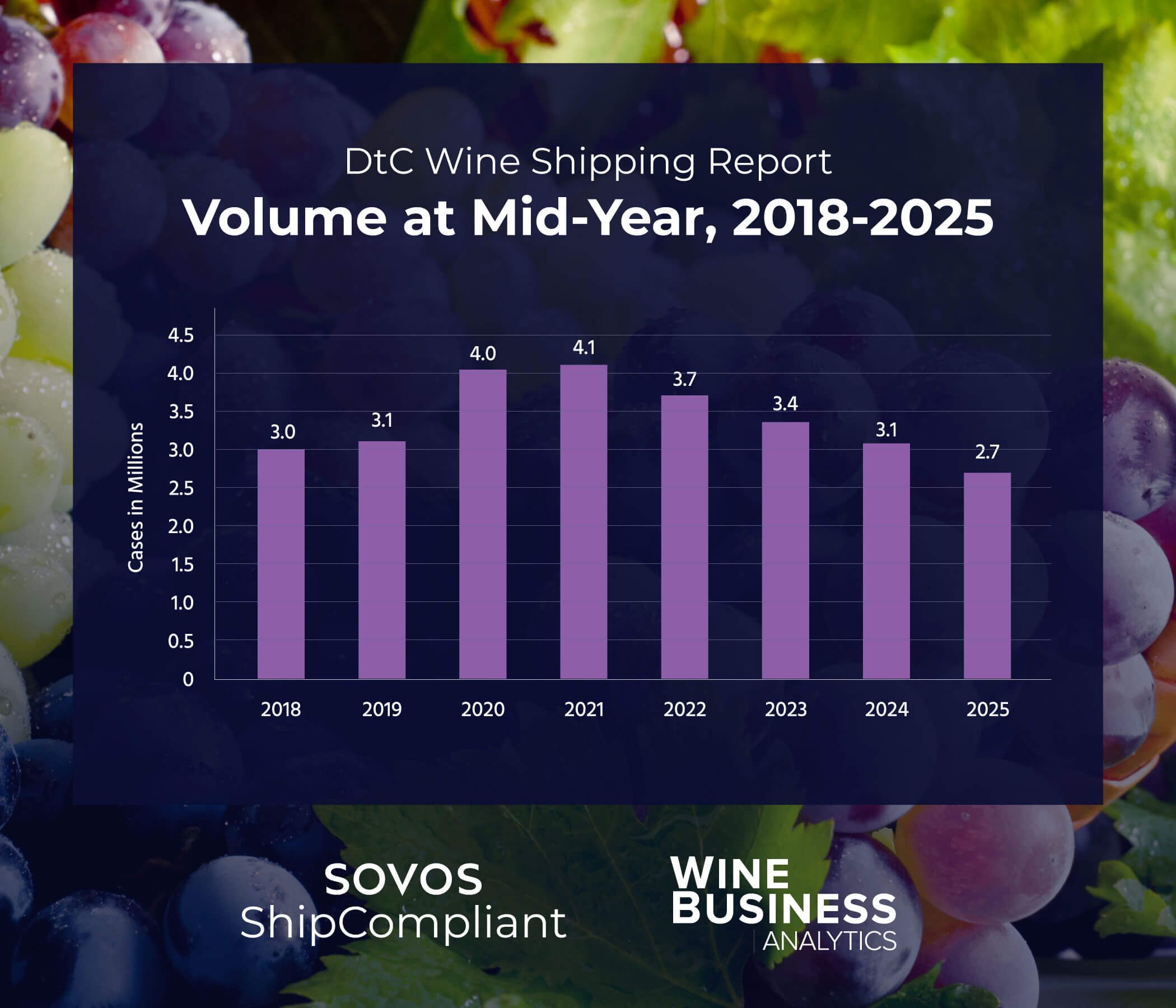
The latest data for the U.S. wine DtC shipping market shows that market value and volume have continued the downward trend seen since 2022. Nationwide, shipment volume has declined by 12% for the January-June 2025 period, amounting to 2.7 million cases sold, while the overall value of these shipments has decreased by 6%, totaling $1.7 billion. Average bottle price has experienced a steady increase over the last three years, with prices rising this year by 8%, reaching $52.68.
“This is definitely not what U.S. wineries were hoping to see in terms of total DtC shipment volume at this time of year,” said Andrew Adams with WineBusiness Analytics. “There was some optimism at the end of 2024 that declines would moderate through this year but that has not been the case. We are seeing the impacts of wine’s bigger challenges in the DtC market.”
Read on for a deeper look at the changes seen in the DtC shipping channel from January through June of 2025.
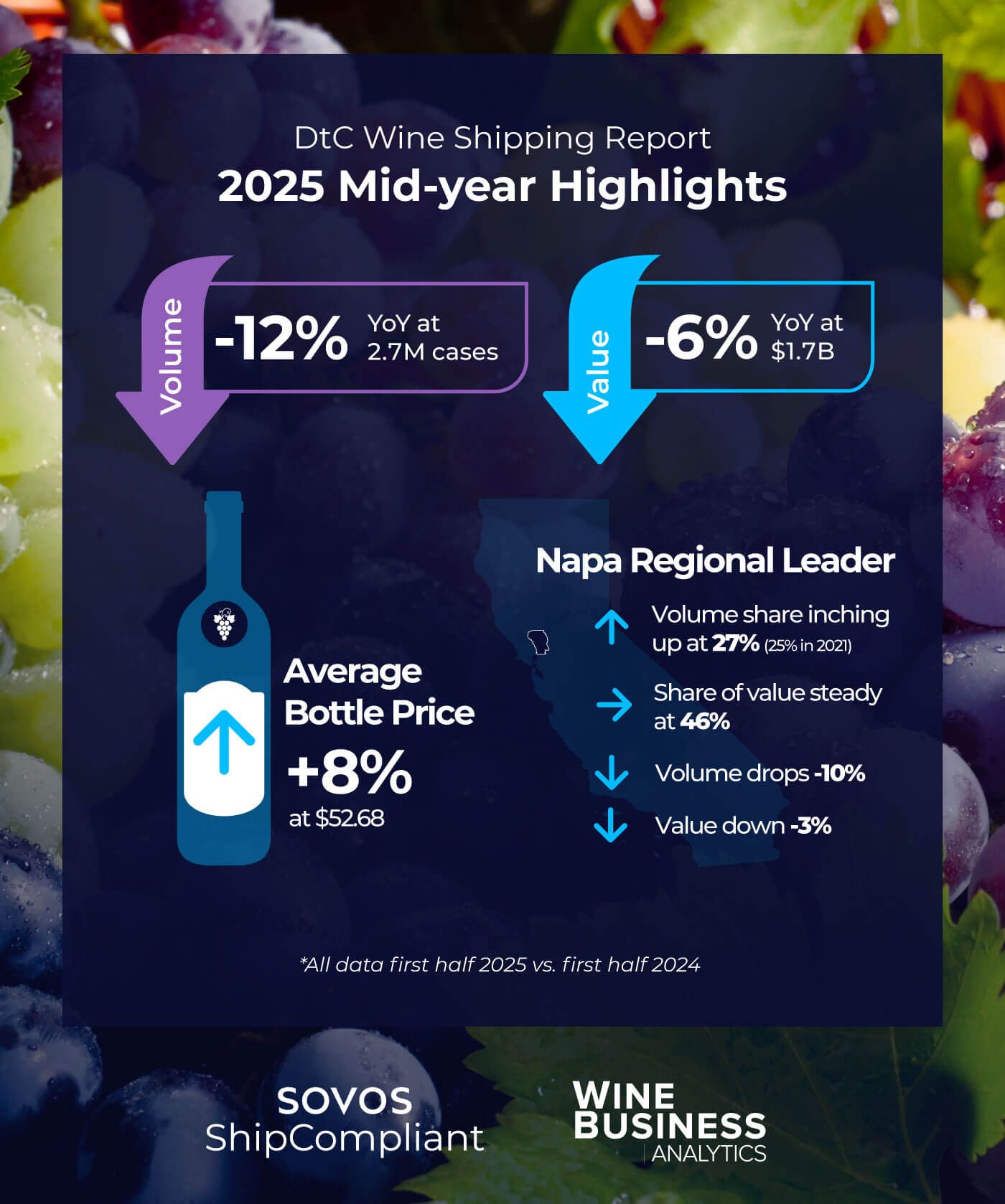
The average price of a bottle shipped DtC has climbed to $52.68, an 8% year-over-year increase. Notably, the average price per bottle has increased by $14.38 since 2018, which is a 38% growth, outpacing the Consumer Price Index inflation.
This year’s rise is largely propelled by significant gains in several key regions. Notably, the Rest of California* segment experienced the largest percent change, up 14% to $32.12. Sonoma also posted a substantial increase, with its average bottle price climbing 9% to $37.96. Meanwhile, Napa continues to be the outlier, maintaining its position as the most expensive region, with its average bottle price nearing the $100 mark at $92.29, up 8% from last year. Napa’s elevated pricing pulls the overall national average upward, as it is the only region consistently above the average benchmark. In contrast, Oregon was the sole region to report a decline in average bottle price at the mid-year, dropping 3% to $49.43.
* Rest of Calif. = Wineries in Mendocino, Lake, Livermore and Temecula counties and the Sierra Nevada Foothills region, plus all other areas outside the Central Coast, Napa County and Sonoma County.
California remains the leading destination state for DtC wine shipments, though its volume share slipped to 28% from 29%. Winery shipments to California fell 14% in volume to 765,000 cases and 10% in value to $482 million year-over-year.
The top ten destination states by volume at the mid-year are:
Michigan stands out as one of only two states to register positive volume growth, with a 1% increase. Michigan’s volume share climbed to 3%, up from 2% the previous year, while value grew by 3%.
Alaska also recorded growth, posting a remarkable 46% jump in volume, though this is from a small base as the state still accounts for less than 1% of total volume. An impressive 93% increase in shipment value can be attributed to a new winery licensing requirement that took effect in January of 2024.
In total, eight states achieved positive value growth: Alaska (+93%), Arkansas (+7%), Idaho (+7%), Kentucky (+6%), Michigan (+3%), South Carolina (+5%), Tennessee (+3%) and Wyoming (+8%).
Across the board, all regions reported declines in both volume and value. Notably, the Rest of California’s share of volume (10%) dipped below both the Rest of U.S. (11%) and the Central Coast (11%) for the first time, driven by the segment’s most dramatic volume decrease (-24%) and largest value decline (-14%) among tracked regions. The Central Coast, meanwhile, experienced the smallest reduction in shipment volume, down just 6% year-over-year.
All winery size categories experienced declines in shipment volume, yet every segment reported an increase in average bottle price (ABP). Notably, very small wineries (1,000–4,999 cases annual production) were the only group to register an uptick in shipment value, leading to a remarkable 15% rise in ABP to $79.34 as shipment volume slipped by 12%. The largest wineries (500,000+ cases) faced the steepest declines, with volume plummeting by 24% and value dropping by 14%; however, they still recorded the third-largest ABP increase at 14%. Limited production wineries (producing fewer than 1,000 cases/year) surpassed the $100 ABP mark, reaching $112.76 after a 15% jump, tied for the largest ABP change among all segments, while seeing both volume (-18%) and value (-6%) contract within the period.
Cabernet Sauvignon maintained its lead with a 16% share of total volume despite a notable 13% decline in shipment volume compared to last year. The varietal’s dominance in value is even greater, representing 29% of total DtC shipment value despite a 4% decrease YoY. Cabernet Sauvignon remains the highest-priced varietal, with the average bottle price climbing to $98.35.
Pinot Noir followed with a 15% share of volume, down 12% YoY, and accounted for 16% of value, reflecting a 10% decrease. Its ABP reached $55.59, making it the third highest among major varietals. Red Blend shipments represented 13% of volume (down 17%) and 16% of value (down 7%), with the second highest ABP of $63.69. Chardonnay saw a 10% share of volume (down 9%) and 9% share of value (down 4%).
Among notable trends, Riesling—while holding just 2% of volume share—was the only major varietal to post positive volume growth, increasing by 2%. Reflecting the greater diversity of wines in the DtC market, the Other category also recorded growth, and together they contributed to an 11% rise in value, though Riesling accounted for the larger share of that increase. Cabernet Franc posted the fourth highest ABP at $53.90. Impressively, average bottle prices increased across all varietals (excluding unspecified wines), highlighting a continued shift toward higher value in the DtC channel.
A close examination of shipment baskets reveals consumer preferences in the DtC wine shipping channel. Orders containing four to six bottles are the most popular, making up 25% of all shipments. Following closely behind, large orders of 12 or more bottles account for a substantial 22% share. In contrast, single-bottle orders are the least common, comprising just 13% of total shipments.
This year, the average number of bottles per shipment has edged upward, rising from 9.5 bottles in 2024 to 9.9 bottles in 2025, an increase of 5%. “It appears consumers and wineries may be moving more wine in fewer shipments to save money and that could explain some of the decline in shipments,” Adams said. “We’ve also seen data that suggests more consumers are picking up their wine club allotments at the winery. These trends don’t account for the full decline in total shipment volume but reaffirm the opportunities in direct sales.”
The average order value of DtC shipments has also seen significant growth, jumping from $463 to $521, which represents a 13% increase. “The increase in average order value aligns with the ongoing stability in the DtC market for more expensive wines,” Adams noted. “It also reflects the increased cost of selling and shipping wine direct as well as declining shipment volumes across the entire channel.”
With economic uncertainty, a turbulent U.S. political climate and evolving consumer preferences in beverage alcohol, forecasting the future of the DtC wine shipping channel remains complex. Still, no matter how the market adjusts, we remain committed to providing timely observations and insights. Our full 2026 report will be released in January, but in the meantime, you can explore the latest trends and performance metrics by downloading your complimentary copy of the 2025 Direct-to-Consumer Wine Shipping Report.
This data was compiled in partnership with WineBusiness Analytics, a leading source for wine industry data.
DtC wine shipping is when a winery sells and ships its wine directly to the consumer, outside of the three-tier system that includes distributors and retailers.
So far in 2025, the top five DtC wine shipping destination states by volume were California, Texas, Washington, Florida and New York.
Cabernet Sauvignon and Pinot Noir had the largest share of volume in the first half of 2025.
The average price per bottle shipped has been increasing since 2018 and is now $52.68.
On August 15, Delaware Governor Matt Meyer signed HB 187, a bill that establishes direct-to-consumer (DtC) wine shipping privileges in the state. While the addition of another state to the DtC wine shipping map is usually a cause for celebration at Sovos ShipCompliant, there are many reasons to take exception to this bill. Examining the bill, it seems to be more of a poison pill to deflect actual efforts to enable DtC shipping in the state than the positive development for Delaware consumers that it is touted as.
On its face, HB 187 largely resembles the model DtC wine shipping bill that has now been adopted by every state besides Utah. However, there are several additional provisions and numerous devilish details that make the law largely problematic.
Under HB 187, DtC wine shippers servicing Delaware consumers will have to:
The HB 187 Delaware DtC bill largely resembles the model DtC wine shipping law adopted by every state except Utah. However, it introduces restrictive provisions that make Delaware direct-to-consumer wine regulations problematic.
How much does a license cost under HB 187?
The licensing fees in the Delaware wine shipping law are among the highest in the country:
| Annual Volume Shipped | Cost | Correct amount |
| Up to 200 cases | $400 | Every 2 years |
| Over 200 cases | $3,600 | Every 2 years |
Even the higher volume license only allows shipping up to 1,800 cases a year, making it financially unviable for most wineries.
DtC shippers will be limited to shipping no more than three (3) cases of wine per household per year.
Delaware’s wine shipping license fees are exceptionally high. Even the “reduced” $400 license fee is at the high end of DtC shipping licenses across the country, and that allows for only 200 cases per year. The $3,600 is more than double the next highest price license, issued by Illinois for wineries that produce more than 500,000 gallons of wine per year.
But even the higher price license will only allow shipping up to 1,800 aggregate cases, which is such a low volume that it strains credulity that any winery will want to go to through the cost and effort.
Perhaps the most problematic constraint is the prohibition of selling at both wholesale and DtC at the same time. Not only does this sort of rule always severely restrain the DtC shipping channel (such as in Indiana or Louisiana), that Delaware’s ban applies to all brands and subsidiary brands of currently distributing wineries will result in even many small labels that are generally only available through DtC shipment not being available in the state.
Wineries must:
Despite its appearance, HB 187 is a poison pill for DtC shipping:
These constraints mean most wineries will likely avoid the Delaware market.
In all, the problematic elements of the bill create a monster that Free the Grapes! has said needs to be revamped by the state. Indeed, one of the most pernicious elements of the bill is that it actually sets back the pro-DtC movement in Delaware by establishing a regime that gives the state enough cover to say is available but is instead full of poison provisions that will be extremely difficult to cleanse.
Optimistically, the problems with HB 187 will become immediately apparent and force the lawmakers back to the table to create a DtC wine shipping arrangement that wineries will want to engage in. But the effort to even get this far in Delaware have been long-drawn and painful enough that, unfortunately, this troublesome law will be the best we can get for now.
Delaware joins the DtC map with a law that may set back the movement in the state more than advance it.
Nationwide, states are moving toward inclusive, consumer-friendly shipping laws. Delaware’s approach stands in stark contrast.
Only farm wineries can apply for a Delaware wine direct shipper license.
Yes, but only if they meet the farm winery definition and are not affiliated with a Delaware wholesaler.
Direct-to-consumer (DtC) shippers are restricted to a maximum of three cases of wine per household annually, in accordance with customer volume limits.
No, any winery affiliated with a wholesaler is prohibited from DtC shipping.
HB 187 was signed into law on August 15, 2025, which would indicate that under Delaware law the bill will take effect in October, depending on additional rulemaking required by the state.
Direct-to-consumer (DtC) wine shipping has evolved significantly over the past two decades, from a niche service to a cornerstone of many wineries’ sales strategies. In 2025, two long-restricted states, Arkansas and Mississippi, passed new DtC wine shipping laws that significantly expand access for consumers and open new markets for producers.
The changes outlined in HB 1476 , SB 2145 and SB 2851 mark a turning point for wine lovers in Arkansas and Mississippi and reflect a broader shift in alcohol shipping regulations and signal growing momentum for reform nationwide.
The Mississippi DtC wine shipping laws were enacted through SB 2145 and SB 2851 and took effect on July 1, 2025. The laws allow both in-state and out-of-state wineries to apply for DtC permits in Mississippi and ship wine to consumers across the state (within monthly volume limits). For years, Mississippi was one of the last holdouts—now it becomes the 48th U.S. state (plus Washington, D.C.) to allow some form of DtC wine shipping.
In April, Arkansas passed HB 1476, removing its long-standing requirement that consumers purchase wine on-site at a winery in order to have it shipped home. Under the new law, Arkansas residents can now purchase wine online and sign up for clubs offered by licensed wineries. Many restrictions remain, including bans on shipments to “dry” regions in the state, and licensees can only ship up to 24 cases per household per year. But the law change opens the door to much greater access to the national wine market.
These two updates may seem incremental—but their impact is meaningful.
For wineries with established DtC programs across the country, entering Arkansas and Mississippi is a relatively simple lift—with real potential to grow their customer base. But they also come with responsibilities.
Wineries must apply for a DtC wine license in Mississippi, whether in-state or out-of-state. This includes submitting applications and adhering to Mississippi alcohol shipping regulations. As with many new laws, implementation details may evolve. Wineries need to monitor developments closely and stay in step with reporting requirements.
Wineries must collect sales and excise taxes and maintain accurate records. Winery shipping compliance in Mississippi requires ongoing diligence.
Age verification is mandatory. Wineries must also respect household volume limits and avoid shipping to restricted regions.
The DtC wine map is more complete than ever. What began as a patchwork of restrictive laws has evolved into a more open—though still regulated—system. As consumer expectations shift toward convenience and variety, direct-to-consumer wine shipping in 2025 will only grow in importance.
Yes. Under the Mississippi DtC wine shipping law, out-of-state wineries can apply for permits and ship directly to consumers.
To adhere to Mississippi DtC wine shipping laws, wineries must obtain DtC wine permits and comply with all licensing and reporting requirements.
Yes. Mississippi enforces monthly volume limits, and Arkansas restricts shipments to 24 cases per household annually.
Mississippi offers broader access, while Arkansas maintains restrictions in dry counties and caps annual shipments.
Only Utah and Delaware continue to prohibit most forms of DtC wine shipping. Check out Sovos ShipCompliant’s comprehensive guide for state-by-state wine shipping rules for up-to-date information on each state’s DtC wine shipping laws.
As wine lovers raise a glass to celebrate National White Wine Day on August 4, we’re taking a look at how white wines—particularly Chardonnay and Sauvignon Blanc—have performed in the direct-to-consumer (DtC) shipping channel over the past three years.
While the DtC market has faced economic pressure and shifting consumer behavior, these two white varietals have shown notable resilience and, in some cases, surprising growth. Drawing from the 2023, 2024 and 2025 Direct-to-Consumer Wine Shipping Reports (published by Sovos ShipCompliant in partnership with WineBusiness Analytics), here’s how these white wines have weathered the industry’s ups and downs—and what these trends signal for the wine industry in 2025.
Over the past three years, the DtC wine shipping channel has experienced steady year-over-year declines in both volume and value. After a 10.3% drop in volume in 2022, shipments fell another 6.5% in 2023 and 10% in 2024—the sharpest decline recorded in the 16-year history of the DtC wine shipping report. Value followed suit, slipping 5% in 2024 to $3.94 billion, despite average bottle prices climbing to a record $51.20.
Lower-priced wines (under $40) were hit hardest, but the slowdown impacted nearly every region, winery size and varietal. Despite these challenges, white wines—especially Chardonnay and Sauvignon Blanc—continued to resonate with consumers, demonstrating notable strength amid a declining DtC landscape.
White wines have held especially strong in California’s top producing regions, with Sonoma and the Central Coast standing out. These regions have adapted their pricing strategies to account for inflation, while also appealing to consumers looking for freshness, food-friendliness and relative value compared to premium red wines.
Sonoma County has leveraged Pinot Noir and Sauvignon Blanc to drive DtC performance. Despite a 12% overall volume drop in 2024, the county saw bright spots in its white wine program, particularly through increased average bottle prices and growing Sauvignon Blanc demand.
The Central Coast wine industry, long praised for their quality-to-price ratio, continued to ship significant volumes of both Chardonnay and Sauvignon Blanc. In 2024, Sauvignon Blanc’s surge helped offset broader volume declines in the region, even as total volume declined 9% year-over-year.
As one of the most widely produced and shipped white wines, Chardonnay has remained a core varietal in the DtC channel, consistently appearing among the top five wines shipped from regions like Napa, Sonoma and the Central Coast.
In 2022, Chardonnay shipments softened alongside the broader market, but its long-standing popularity kept it firmly entrenched in the DtC mix. The 2023 report (reflecting 2022 data) noted across-the-board shipment declines, yet Chardonnay maintained its volume leadership among white wines.
In 2023, Central Coast Chardonnay stood out. Even with economic pressure and a general decline in shipments, Central Coast wineries saw only an 8.6% drop in Chardonnay volume, while the value of those shipments rose 6.5%, driven by a 16.6% increase in average bottle price to $43.11. This suggests that even as consumers tightened their wallets, they continued to invest in premium, well-known white wines.
Chardonnay’s sales performance across top-producing regions like Napa, Sonoma and the Central Coast highlights its enduring appeal and steady role in DtC programs—even as the market evolves.
Sauvignon Blanc has quietly emerged as one of the most promising white varietals in the DtC channel, with recent reports showing meaningful gains in both volume and value.
In the 2024 report (covering 2023 data), Sauvignon Blanc was identified as one of the only varietals to show positive movement, with strong regional gains beginning to surface. The 2025 report (covering 2024 data) confirmed the upward trend.
In Sonoma County, Sauvignon Blanc shipment volume increased by 2%, while the value of those shipments rose 8%. This was driven by a 5% increase in average bottle price, showing that consumers were willing to pay more for the varietal even amid tightening budgets.
The Central Coast saw even more dramatic gains. Sauvignon Blanc shipments surged 18% in volume year-over-year, with a 26% increase in value, despite a 7% increase in price. This made it one of the best-performing white wines across any region and varietal category in 2024.
Its consistent momentum suggests even greater potential heading into the next DtC cycle.
While the broader DtC channel continues to face pressure—from inflation and shifting alcohol consumption habits to competition from cannabis and wellness trends—2025 wine industry trends show white wines experiencing encouraging signs of resilience.
Chardonnay sales performance remains a dependable anchor for many winery DtC programs, while Sauvignon Blanc is quickly becoming a varietal to watch. Consumers are demonstrating interest in white wines that deliver freshness, complexity and value, especially as summer buying behaviors and lighter drinking preferences remain top of mind.
As we toast National White Wine Day, it’s clear that white wines still have a strong place in the evolving DtC landscape.
For a deeper dive into varietal performance and regional shipping trends, explore the full 2025 Direct-to-Consumer Wine Shipping Report.
The “Shutdown Fairness Act,” signed in November 2025 to end the government shutdown, included a provision banning the sale of most hemp-based THC products. Going forward, under federal law, hemp-derived products cannot have a THC content greater than 0.4 mg. It is expected that this action will severely diminish–if not outright eliminate–much of the existing hemp-derived beverage market.The swift growth of hemp-derived CBD and THC beverages has introduced a wave of innovation to the beverage industry, along with a fair amount of legal confusion.
These products are showing up everywhere: on retail shelves, in tasting rooms and in the hands of curious consumers looking for functional alternatives to traditional alcohol or cannabis products. And yet, their legal status remains anything but straightforward.
In a Sovos ShipCompliant webinar, Emily Harris Gant, principal at Foster Garvey and chair of its alcohol beverage and cannabis practices, shared insights into the complex legal and regulatory landscape shaping this emerging category.
The federal government’s definition of hemp is any part of the Cannabis sativa L. plant, including all derivatives, with a delta-9 tetrahydrocannabinol concentration of not more than 0.3% on a dry weight basis.
In practical terms, hemp-derived beverages typically contain CBD. Different states have different rules about whether you need a hemp-specific license to produce or process these beverages.
The 2018 Farm Bill removed hemp (defined as cannabis with no more than 0.3% delta-9 THC by dry weight) from the federal definition of marijuana. However, this change introduced new regulatory challenges, particularly for beverage producers.
Under the Federal Food, Drug, and Cosmetic Act, the FDA prohibits the interstate sale of beverages infused with hemp-derived ingredients, as it deems those products to be “adulterated.” This includes most CBD- and THC-infused products. However, ingredients classified as Generally Recognized as Safe (GRAS), such as hulled hemp seeds, hemp seed protein powder and hemp seed oil, are permitted in food and beverages sold across state lines.
For alcoholic hemp-infused beverages, the Alcohol and Tobacco Tax and Trade Bureau (TTB) requires formula approval, which includes lab analysis. However, that approval is only granted for products containing GRAS-listed hemp ingredients. Labeling is tightly regulated: terms like “hemp” are only allowed in a TTB-approved statement of composition (e.g., “ale brewed with hemp seeds”) and must not reference marijuana or psychoactive effects. Products containing federally controlled substances, including cannabis, are ineligible for formula or label approval—regardless of whether they are sold interstate or intrastate.
Like producers of wine, beer and spirits, producers of hemp-derived beverages must contend with state-specific laws and federal regulations. These laws are constantly changing, so check with your state.
As of February 14, 2025:
The states that currently allow the sale of hemp-derived beverages include:
Licensing challenges are another major concern for operators entering the hemp beverage space. Those operating under TTB permits or state alcohol licenses may risk those licenses by producing hemp-derived beverages on the same premises. Producers need to consider:
In some jurisdictions, dual licensing is possible; in others, it’s expressly prohibited. These rules differ widely and are evolving quickly, making it essential to consult legal counsel before launching or expanding a hemp-infused beverage program.
The hemp beverage market is growing fast, but the legal frameworks governing it remain unsettled. At the federal level, while parts of the 2018 Farm Bill were extended, they were set to expire at the end of September 2025. However, further disagreements between the parties in Congress over other spending bills has resulted in a government shutdown that has delayed any new legislation that could reshape the landscape either by restricting ingestible hemp products or creating a more unified regulatory structure.
Meanwhile, state-level regulation is accelerating, with new rules on potency, packaging, labeling and age restrictions emerging regularly. For producers, this means navigating a fragmented and fast-changing environment where missteps can lead to serious legal and financial consequences.
To succeed in this space, businesses must prioritize:
These steps are critical to building a compliant and sustainable hemp beverage program.
Access the full webinar recording here.
Not entirely. While the 2018 Farm Bill legalized hemp with ≤0.3% delta-9 THC, the FDA still prohibits interstate sales of most hemp-infused beverages unless they contain GRAS-listed ingredients.
As of February 2025, 24 states allow retail sales of hemp-derived delta-9 THC beverages. However, rules vary widely by state, and some impose potency limits or outright bans.
Licensing depends on the state. Some require separate hemp processor licenses, while others prohibit dual licensing with alcohol permits. Always consult local regulations.
Stay informed, consult legal experts and monitor both federal and state-level changes. Compliance requires ongoing diligence and a tailored strategy for each jurisdiction.
Keep an eye out for fresh webinar announcements from the Sovos ShipCompliant LinkedIn feed. Learn more about Emily Harris Gant and Foster Garvey here.
For 20 years, the Sovos ShipCompliant Wine Summit has been about gathering winery professionals with the authorities and leaders who make the industry move. At this year’s Wine Summit, attendees heard directly from the regulators, attorneys and brand leaders shaping the future of the wine industry. As economic pressures, shifting consumer preferences and more tasting rooms than ever compete for attention, the questions facing wineries today aren’t hypothetical—they’re operational.
This year’s sessions offered a window into how leading wineries are adapting, where legal experts say the gray areas are and why the industry’s most resilient players are rethinking not just how they sell, but who they’re selling to.
As a highly regulated industry, wineries are no strangers to significant business hurdles. Yet the challenges facing beverage alcohol today are at least as numerous and significant, if not more so, than ever. Aging Baby Boomers and younger consumers are focused on moderation and non-alcoholic adult beverages, cannabis, inflation, along with global attention on the health impacts of alcohol. Add to this changing palates and occasions, technology and the pressure of how to connect with digital natives.
Keynote speaker Evan Shirley, an associate partner at Clarkston Consulting’s management and operations practice, spoke about how these factors are shaping the wine market and influencing purchasing decisions, and how savvy wineries can keep pace.
For wineries to keep up, they need to evaluate and adjust in several arenas, including:
As Evan noted: “Amid disruption, wine has enduring cultural, emotional, and sensual value. But it needs to be rearticulated for the new consumer. Think of wine as a story and experience, not just a product, with hospitality as a frontline differentiator.”
Wineries today are navigating a landscape filled with uncertainty around supply chain, shifting regulations and more. From fluctuating tariffs to evolving state-by-state shipping laws and cuts to the TTB, the regulatory environment is complex and constantly changing.
It was a privilege to have esteemed experts join us at the Sovos Wine Summit to share their invaluable insights on federal and state beverage alcohol regulations. Janelle Christian and Aniko Kasprian from the TTB provided crucial guidance on navigating complex federal compliance requirements, while Robert de Ruyter from the California ABC offered expert perspective on state-level enforcement and regulatory trends. Their participation added incredible depth to the conversation and gave attendees direct access to the knowledge and clarity needed to stay ahead in an evolving industry.
Rounding out the conference was Steve Gross, vice president of state relations at the Wine Institute, with his signature update on regulatory and legislative activities impacting the wine industry, with a focus on direct-to-consumer shipping regulation and what’s on the horizon in the coming months and years.
Much has changed since the Wine Summit started two decades ago. Back then, complexity and confusion were the watchwords of DtC shipping, with states applying a hodgepodge of haphazard laws across the country. For most of the country, DtC shipping was prohibited in any form, while other states adopted patchwork fixes that only the most diligent or wonkish of wineries could manage.
With time, patience and tremendous amounts of support from wine makers and wine lovers, along with industry organizations that fought the good fight, like Free the Grapes! and Wine Institute, the laws across the country changed, so that today we are able to enjoy a much different map, where consumers in nearly every state have the ability to purchase and receive shipments directly from their favorite wineries around the country.
That is not to say that the future of the wine industry looks free and breezy. There are real fears and concerns for the future of our industry, such as how to keep up your sales and where growth will come from. To me and our Wine Summit guest speakers, the headwinds we see are not reason to panic, but a call for renewal and reinvigoration.
Stay informed with the latest compliance updates and industry trends. Subscribe to the Sovos ShipCompliant newsletter for valuable insights delivered straight to your inbox.
Key Highlights:
Within the three-tier system that governs how alcohol is sold and distributed within the United States, importers are considered a type of supplier. As such, they are largely regulated like domestic producers, meaning they must distribute through wholesalers, who will sell to the retailers, where customers will finally be able to purchase the importer’s products. To succeed in the three-tier market, businesses must understand and follow all importer compliance requirements, which include getting federal alcohol importer licensing and state licenses, and following strict product registration rules.
However, importers are not entirely like other suppliers, and they have their own additional hoops to jump through. With that in mind, we’ve compiled some helpful information relating to alcohol import compliance and how beverage alcohol importers are regulated in the U.S.
Alcohol importer compliance refers to the set of federal and state regulations that govern how imported alcoholic beverages enter and move through the U.S. market. Importers operate within the three-tier system but face additional requirements beyond those of domestic producers, including three-tier system import rules and customs clearance for alcohol.
At the federal level, importers must comply with all regulations enforced by the Alcohol and Tobacco Tax and Trade Bureau (TTB). This includes obtaining the appropriate licensure, paying applicable taxes, and meeting labeling standards before products can be sold.
Importer compliance requirements include getting an Importer’s Permit from the TTB, and complying with the tax remittances required under federal law. To qualify, importers must “maintain and staff a business office in the United States,” though having a commercial arrangement with an existing importer eliminates the need for this license. This step is foundational to meeting federal importer compliance requirements.
Much like getting a domestically produced beverage to market, obtaining a Certificate of Label Approval (COLA) is a key step for importers. This is how importers demonstrate to federal regulators that their product labels and packaging comply with regulations set by the TTB. Obtaining a COLA is a key first step in getting individual products to market, as Customs will reject any entry without label approval.
Distributor information is often required for state regulators to better understand how alcoholic beverages are sold. As importers are not the actual producers of their product, it’s pertinent to have all proper authorizations and contracts on hand to prove that your products are being sold legitimately.
Importers must also navigate varying rules for beer, wine, and spirits. Understanding these state-specific importer compliance requirements is key to successful market entry. Additionally, most states have their own registration requirements that must be met before products can be sold within their borders. Whether you are making your first foray into the three-tier system or are looking to expand operations into another state, ensuring accurate brand label registration will help you maintain compliance and let you bring products to market faster.
For importers dealing with the product registration puzzle, it is essential to maintain good records of Primary American Source (PAS) letters. These letters are issued by the actual manufacturer and make it clear that you are considered the owner of the imported product in the U.S., and thus legally authorized to sell it. Many states restrict wholesalers from distributing alcohol obtained from anyone but the manufacturer, the PAS, or an authorized brand owner. Having the proper documentation to prove you are authorized to sell an imported product and to direct its distribution within the U.S. is therefore vital to smooth label registrations. Understanding each state’s requirements and having the necessary documentation can make the overall process much quicker to navigate.
Importers must maintain accurate records of:
These documents confirm legal authorization and help satisfy ongoing importer compliance requirements for audits and inspections.
Perhaps the most common source of compliance risk for beverage alcohol importers comes into play when it comes to direct-to-consumer (DtC) shipping. Almost all state DtC permissions are restricted to domestic producers or retailers, which makes it difficult for importers to take part in DtC shipping. This is especially true for businesses licensed solely as importers.
The best advice for any importer is to talk to your attorney. Direct, specific legal advice is critical for an importer to understand what your obligations are and will be as well as what legal restrictions there are to contend with.
Compliance technology automates license tracking, product registrations, and reporting. It reduces manual errors and ensures timely renewals—critical for avoiding costly delays or penalties and meeting complex importer compliance requirements.
Sovos ShipCompliant provides end-to-end compliance solutions for beverage alcohol businesses, including:
Importing alcohol into the U.S. requires navigating complex federal and state regulations. From permits and product registrations to recordkeeping and DtC restrictions, compliance is non-negotiable. Leveraging technology and expert support can help importers meet importer compliance requirements and avoid costly missteps.
Per TTB importer rules, an Importer’s Permit is required, along with state-specific licenses for each jurisdiction where products are sold.
Importers must comply with federal excise tax requirements and any applicable state taxes.
Generally, no. Most states restrict DtC shipping to domestic producers or retailers. Limited exceptions exist but often require additional licenses and physical retail locations.
Missing licenses, incomplete registrations, lack of PAS documentation, and misunderstanding state laws.
Effective July 1, 2025, all direct-to-consumer (DtC) shipments of wine into Maine must comply with the state’s beverage container redemption program, better known as a “bottle bill.”
While wine bottles sold in Maine retail stores have long been subject to these provisions, the state is extending the program to include DtC shipments from out-of-state wineries. This makes Maine the second state, after California, to apply its bottle bill to DtC shipments of wine.
Compliance with the bottle bill rule will require DtC shipping wineries to:
1) Register with the state
2) Ensure all labels they will ship into the state are registered with the Maine Department of Environmental Protection (DEP)
3) Collect the deposit amount on shipments to the state and
4) File an annual report to the state
Maine requires that beverages sold in the state that are subject to its bottle bill be handled by a registered Initiator of Deposit (IOD).
For wines that are sold in retail liquor stores, the IOD can be the wholesaler. However, for DtC-shipped wine, the IOD must be the licensed DtC shipping winery.
Further, Maine permits only one IOD for each registered label sold in the state. This means that while a winery can continue to work with a third-party IOD for wines they will only sell at wholesale in Maine, such as their distributor, all labels that the winery will sell both DtC and three-tier must be registered under the winery’s name. Wineries that are currently selling at three-tier in the state must therefore transfer IOD registration to them before they can ship those labels DtC.
The annual fee for an IOD registration is $500 for wineries producing more than 50,000 gallons per year and $50 for smaller wineries.
IODs must contract with a comingling agent, which will be the in-state party that handles collection of containers and will remit the bottle bill collections to the state agencies. The state is still developing specific parameters for how DtC shippers will work with comingling agents. In the meantime, a list of available comingling agents can be found here.
Once the winery has registered as an IOD, they will need to register the labels they will DtC ship into the state through their DEP account.
Label registration can be done manually or through a CSV upload, and must list the product name, beverage and container type, glass color, UPC (if available) and comingling group information. Until July 15, 2025, brand label registrations will cost $1 per label.
Note that the bottle bill registration requirement for DtC-shipped wines is in no way associated with any brand/label registrations instituted by the Maine Bureau of Beverage and Lottery Operations. It remains the case that only wines sold through Maine wholesalers are subject to any BABLO label registrations.
Wines subject to the Maine bottle bill must be properly labeled with a sticker that clearly identifies the IOD and the deposit value. Prior to sale in Maine, the IOD must provide a sample sticker to the DEP for approval, which will be subject to readability, suitability and durability.
The Maine deposit value is 15 cents per wine beverage container that is greater than 50 mL and 5 cents per container smaller than 50 mL (however, DtC shipments of wine in containers smaller than 250 mL is prohibited in Maine).
DtC shippers will need to collect the deposit value per bottle at the time of sale, listing the charge as a separate line item on their invoices. Notably, the deposit value is not subject to Maine’s sales tax.
Unlike in California, the DtC wine shipper will not pay the deposit collections directly to the state. Instead, their comingling group is responsible for such remittances. As such, the comingling group will charge the winery for the deposit amount that must be remitted to the state along with additional handling and administrative charges, as set forth in their contract.
DtC wine shippers, as registered IODs, will still need to file an annual report (due in March) to the DEP reporting the number and type of containers sold in the state. There are different procedures depending on whether they are reporting actual or estimated sales data.
Managing container waste—and encouraging recycling—is a major concern for all states, with many latching onto bottle bills like Maine’s as one possible solution. While DtC wine shippers have long managed to escape the regulatory burden associated with bottle bills, the recent changes in California and Maine seem to signal that this will be a more common compliance requirement going forward.
Stay informed with the latest compliance updates and industry trends. Subscribe to the ShipCompliant newsletter to get valuable insights delivered straight to your inbox.
The U.S. beverage alcohol industry has long operated under the three-tier system, a structure born out of Prohibition’s repeal in the 1930s. Designed to prevent monopolies and encourage market access, the system initially resembled a pyramid: a few dominant suppliers sold to many mid-sized distributors, who then sold to a wide base of retailers.
Fast-forward to today, and the pyramid has warped into something closer to an hourglass: the number of producers and retailers has exploded, but the number of distributors—the “middle tier”—has steadily shrunk. That shrinking middle tier is creating market access challenges that have reignited conversations about alternatives, like direct-to-consumer (DtC) shipping, that can help producers reach their customers in new, compliant ways.
Since 1995, the number of distributors in the U.S. has plummeted from around 3,000 to just over 1,100—a decrease of more than 60%, according to WineBusiness Analytics. Additionally:
So, while the top and bottom tiers are continuing to grow, the middle is consolidating—and fast.
Today, the top 10 wholesalers control 80% of the market, with the top two accounting for over 50% of total revenue. That’s a dramatic shift from a system originally designed to create balance. And while many of these wholesalers operate nationally, smaller producers and retailers are increasingly finding it hard to gain access to the market.
Distributors, now faced with managing immense product volume, often prioritize high-volume accounts like large grocery chains. This isn’t necessarily a judgment call, it’s a business reality. Larger accounts mean streamlined logistics and predictable sales. But for smaller, independent retailers, this shift can make it difficult (if not impossible) to access a diverse range of craft brands from smaller producers.
Because alcohol distribution is state-mandated and regulated, producers and retailers are often locked into specific pathways to market. If those pathways become too narrow, it creates a bottleneck that limits consumer choice and stifles innovation from small and emerging producers.
This narrowing middle tier highlights an important question: What does protection of the three-tier system look like today? Initially, distributors were seen as needing protection from supplier or retailer dominance. Now, it’s the distributors who hold the market power. Laws like franchise protections, once designed to create fair terms for wholesalers, are now often viewed as barriers that disproportionately impact small producers trying to grow.
For some producers, especially those unable to secure broad distribution, direct-to-consumer shipping offers a compliant alternative route to market. DtC shipping won’t solve the bottleneck on its own, but it can be a pressure release valve by helping producers reach customers directly in states where it’s allowed and offering consumers more choice in what they drink and where they buy it.
The conversation around three-tier reform isn’t new, but this moment of extreme consolidation invites fresh scrutiny. As the market continues to evolve, with more producers entering the space and consumer demand growing for niche, premium and craft offerings, it’s worth asking: Should alternatives be available?
This isn’t a call to dismantle the three-tier system. It continues to serve a critical role in promoting accountability and regulatory compliance. At the same time, evolving market conditions and a significantly more crowded supplier landscape have introduced new challenges the original system was never designed to address.
There’s no reason the industry can’t have it all: a strong, compliant three-tier system and thoughtfully structured options like direct-to-consumer, direct-to-retail and self-distribution pathways for qualified producers. With the right regulatory guardrails, it’s possible to support small businesses, increase consumer choice and maintain the integrity of the market—all at the same time.
For producers and retailers navigating this landscape, awareness is critical. Understanding how consolidation affects market access can inform business strategy and advocacy efforts alike. While large wholesalers will continue to be a vital part of the system, the industry must consider how to ensure the health of the full ecosystem: top, middle and bottom.
Because in the end, a thriving market isn’t shaped by just the biggest players. It’s built on diversity, access and the ability for qualified producers, no matter their size, to find a place on the shelf or a path to the consumer.
Get more insights into how your business can adapt, advocate and grow in today’s evolving market. Subscribe to the ShipCompliant newsletter for more.
With the signature of Governor Sarah Huckabee-Sanders, Arkansas is set to enact House Bill 1476—ushering in long-awaited reforms to its direct-to-consumer (DtC) wine shipping laws. Until now, Arkansas only allowed DtC wine shipments when the consumer was physically present at the winery’s premises at the time of purchase, severely limiting the ability of Arkansas consumers to purchase and receive all wines sold by domestic wineries.
The new law promises a clear and effective means for wineries to better reach Arkansas consumers while remaining compliant with the state’s laws.
HB 1476 largely follows the model DtC wine shipping bill that is in place in most of the country, though there are, as ever, unique details that wineries looking to ship into Arkansas will need to know. Once effective, DtC wine shippers active in Arkansas will need to:
The sudden move by Arkansas to adopt a more effective DtC shipping law is extremely welcome news for wineries and wine enthusiasts alike. Historically, the state’s restrictive DtC allowances have led Arkansas to consistently rank among the least popular states as a destination for wine shipments. Indeed, prominent members of the DtC wine industry have long considered Arkansas to be effectively closed to DtC shipping due to the on-site purchase requirement.
Going forward, Arkansas consumers will be able to more fully access the domestic wine market by connecting directly with wineries and importers in other states, joining clubs and purchasing through online marketplaces like consumers in almost every other state.
With the updated rules, it should be easier for both wineries to manage their compliance needs when shipping into Arkansas and for ABCD regulators to enforce their laws. While there remain some questions about the details of how DtC shipping will work in Arkansas going forward (clarity around wet/dry regions would be especially helpful), the new framework largely follows familiar patterns that have worked for years in most of the rest of the country.
HB 1476 is set to take effect 90 days from signature date, meaning the bill won’t be law until mid-July. The bill also grants the ABCD a further 90 days to develop the specific laws and regulations that will govern DtC wine shipping in the state going forward.
With this law change, Rhode Island is now the only state with an on-premises purchase requirement for DtC shipping, while Utah and Delaware continue to prohibit all DtC wine shipping, leaving us tantalizingly close to truly national DtC wine shipping.
Subscribe to the Sovos ShipCompliant newsletter for expert insights, compliance updates and practical tips delivered straight to your inbox.
From groceries to clothing, consumers expect convenience—and that includes how they purchase alcohol. While direct-to-consumer (DtC) shipping is widely available for wine, beer lags far behind, with legal shipping allowed in only 11 states and Washington, D.C.
On National Beer Day, there’s no better time to highlight why beer trails behind in DtC access and what breweries—and beer enthusiasts—can learn from wine’s success story.
Wine enjoys a well-established DtC market, with legal shipping to 47 states + D.C. This is largely due to state laws allowing wineries to ship directly to consumers. While wine and beer (and spirits, as well) play by the same rules when it comes to wholesale and retail, beer and spirits do not have access to DtC shipping like wine does.
Think of it this way: selling alcohol in a given state’s stores, restaurants and other three-tier retail establishments is like getting into a crowded club with a very particular bouncer. All alcohol suppliers must deal with that bouncer and comply with their rules and requirements to get into the club, but often enough, unless you have the money and capacity to get the bouncer’s attention and jump through their hoops, you can’t get in and therefore (to break the metaphor down) are not able to sell in that state at all.
Direct-to-consumer shipping, then, is like if someone from inside the club decided to crack an alley door open to provide another means of entry for the people who can’t make it through the front door (while still imposing plenty of compliance rules and requirements for entry, though). Currently, wine has more privileged access to that door, in that almost every state allows wine to be shipped, but consumers are clearly asking for that door to be wider to let beer (and spirits) in, too.
The origins of wine’s success with DtC shipping can be traced back to the 1970s, when consumers and industry advocates began pushing for legal changes that would improve access to wine labels that struggled to sell in the traditional, restrictive three-tier market. A unified message—focusing on consumer demand and economic benefits—helped break down regulatory barriers over time.
This was especially true following the 2005 Granholm v. Heald case, wherein the Supreme Court established the principle that DtC shipping rights must apply equally to similarly situated potential shippers across the country. Wine’s history serves as a roadmap for the beer industry, showing that legal change is possible with persistent advocacy and consumer involvement.
Consumers interest remains high and clear when it comes to expanding DtC shipping. Those interested in joining the cause can:
By actively participating in these efforts, beer lovers can help pave the way for expanded access to their favorite brews, just as wine enthusiasts have done.
DtC shipping programs offer breweries an exciting way to expand their reach beyond local markets, creating direct relationships with customers and increasing sales. However, establishing a successful DtC program requires careful planning and a comprehensive understanding of both legal and logistical considerations.
To engage effectively in DtC shipping, breweries should focus on several key aspects:
An online marketplace is also a good venue to talk to consumers about DtC shipping regulations and the importance of compliance. If they are asking for products or services that may violate the laws of the state they live in, it behooves shippers to talk to their consumers and explain why that activity is not permitted (and what the consumer can do to perhaps change the law if they find it unfair).
While strong distribution networks and retail partnerships remain vital to the beer industry, DtC presents an exciting opportunity to expand their reach and connect directly with consumers. By learning from the wine industry’s advocacy efforts and business strategies, the beer industry can take steps toward making DtC shipping a widely available option for beer enthusiasts nationwide.
Get the complete picture of consumer demand for DtC beer shipping in the Direct-to-Consumer Beer Shipping Report.
Believe it or not, there’s more to life than beer. There’s wine, spirits, cider, kombucha, hard seltzers—even non-alcoholic products. But just because a brewery has mastered beer does not mean it’s ready to begin making and selling other types of alcoholic beverages. When a brewery moves to expand its offerings and enter new markets, new requirements and restrictions apply. From new licenses to additional taxes to dealing with state control boards, the entire process can look different from everything a brewery has been accustomed to.
In the recent presentation Beyond Beer: The Rules for Expanding into Wine, Spirits, Cider & NA, experts Alex Koral, regulatory general counsel at Sovos ShipCompliant, and Candace Moon, The Craft Beer Attorney, shared key considerations for breweries pushing past the perimeter of barley, hops, water and yeast.
One of the first things that brewers going beyond beer should recognize is what is already available to them under their existing licenses. Holders of a Trade and Tax Bureau (TTB) issued Brewer’s Notices can produce beverages made from fermented malts and malt substitutes, which includes products like kombucha and certain hard seltzers. Still, these products bring unique regulatory challenges.
Things get a little more complicated for brewers looking at products that do not meet the federal definitions of “beer” or “malt beverages.” The primary issue is that these products cannot be made under a brewery’s existing Brewer’s Notice, so additional licensing is required. But for the brewery looking to go beyond beer, there are a lot of opportunities available, as long as they recognize the novel and additional regulatory requirements they will face.
State regulations add another layer of complexity to beverage alcohol compliance. Some key considerations include licensing, distribution rules, taxes and working with control states.
Breweries face both risks and opportunities as they consider expanding production beyond beer. The key risks include misclassification of products, incorrect labeling, and non-compliance with tax and licensing regulations. However, the opportunities are sizeable, with the potential to tap into new markets with diversified product offerings.
Find out how Sovos ShipCompliant solutions help breweries navigate wholesale distribution and direct-to-consumer shipping compliance.
Craft beer drinkers want more choices. Brewers want more opportunities. And yet, legal barriers still stand in the way of direct-to-consumer (DtC) beer shipping. The 2025 Direct-to-Consumer Beer Shipping Report, produced by Sovos ShipCompliant in partnership with the Brewers Association, reveals how consumer demand, regulatory restrictions and potential revenue opportunities continue to shape the DtC beer shipping market.
Consumer interest in DtC beer shipping is not a passing trend, it’s a long-term demand that remains steady year over year. According to the report, 83% of regular craft beer drinkers and 64% of Americans 21+ believe current beer shipping laws should be expanded. When looking at what products consumers want to order online and have shipped directly to their door, beer ranks on par with other essentials in terms of popularity (60%; ranked fourth among other DtC products):
Clearly, craft beer drinkers expect beer shipping to be available like any other consumer good. With preferences remaining steady from 2023 (61%) and 2024 (61%), it’s evident that demand for legal DtC beer shipping isn’t going anywhere.
The report confirms that DtC beer shipping is just as much about industry revenue as it is consumer convenience, as 76% of regular craft beer drinkers would buy more if it were legally available in their state. Among those that want beer shipped directly, 69% would spend $50+ per month and 44% would spend $100+ per month on DtC purchases. On average, beer buyers would spend $106 more each month—boosting potential annual sales by $1,268 per customer.
The success of wine clubs has also demonstrated the power of subscription-based DtC model—and beer consumers are ready for the same opportunities. In fact, 69% of regular craft beer drinkers who want DtC beer shipping say they would subscribe to a brewery’s beer club. For breweries, this represents an opportunity for recurring revenue, stronger customer retention and a direct way to introduce seasonal and limited-run products to a loyal audience.
Despite this overwhelming demand, legal barriers remain the primary obstacle. Unlike wine, which can legally be shipped directly to consumers in 47 states + D.C., beer shipments are only legal in 11 states + D.C. This stark contrast highlights the need for legislative reform to align beer shipping laws with consumer demand. While several states introduced bills that would have expanded access in 2024, none were ultimately passed.

A common misconception is that DtC beer sales could negatively impact traditional retail and bar sales. However, this year’s data suggests the opposite. Nearly all (95%) craft beer drinkers would actively seek out brands shipped direct when shopping on-premises. Over half (53%) would be very likely to do so, ultimately reinforcing that DtC complements rather than replaces in-person beer sales.
As the 2025 Direct-to-Consumer Beer Shipping Report makes clear, the opportunity is there. Without legislative reform, the industry will continue to leave millions in potential sales untapped. Although regulatory change is possible, breweries and beer enthusiasts must actively work to make it happen.
Want the full picture? Download the full 2025 Direct-to-Consumer Beer Shipping Report to explore the trends, insights and policy updates shaping the future of craft beer.
The 2025 Direct-to-Consumer Wine Shipping Report offers more than just data—it provides valuable insights into the trends shaping the industry and the factors driving change. To delve deeper into these findings, industry experts Andrew Adams from WineBusiness Analytics and Alex Koral from Sovos ShipCompliant joined forces in a recent webinar, unpacking the key takeaways. Their discussion explored not only the numbers but also the underlying dynamics of today’s direct-to-consumer (DtC) landscape, the challenges wineries face and the opportunities that lie ahead.
The 2025 Direct-to-Consumer Wine Shipping Report confirms what many in the industry have been feeling—2024 was a challenging year for DtC wine sales. In 2024, the total volume of DtC shipments dropped by 10% to 6.4 million cases as the total value declined by 5% to $3.94 billion. While these numbers might seem discouraging at first glance, historical trends reveal there’s more to the story.
For years, the channel operated somewhat independently from traditional wine sales, growing steadily even as retail sales fluctuated. However, as Alex Koral explained during the webinar, the pandemic era fundamentally altered that dynamic. “If we were to just consider 2019 going forward, this would still be a challenging year,” Koral noted. “But what we’re seeing is that DtC is now much more closely tied to the overall wine market. The factors affecting traditional retail and wholesale are now influencing DtC just as much.”
Andrew Adams from WineBusiness Analytics reinforced that, despite the volume declines, the channel has still outperformed some retail sectors. While traditional wine sales are facing similar challenges, DtC remains a critical sales avenue, particularly for small and mid-sized wineries that depend on direct relationships with consumers.
Last year ended on a positive note as total shipment value in December increased by 13% while shipment volume remained stable. This late year rebound suggests that consumer demand for direct shipments remains solid, even as buying behaviors continue to shift. Consumers may be purchasing wine differently than they did during the pandemic boom, but they are still engaging with DtC channels—just with a more selective and value-driven approach.
One of the clearest trends from the report is the ongoing resilience of the premium segment in the DtC market. Wines priced at $80 or more per bottle saw a 2% increase in shipment volume, even as lower-priced wines faced greater challenges. This indicates that while overall premiumization may be slowing, there remains strong consumer interest in high-quality wines and exclusive experiences. It also suggests that wineries focusing on premium positioning, membership perks and direct engagement with high-value customers are in the best position to succeed.
Among the varietals, Sauvignon Blanc defied expectations, becoming the only major wine type to see a 1% increase in shipment volume alongside a 6% rise in total shipment value. This performance indicates growing consumer interest in diversification, even as traditional powerhouse varietals like Cabernet Sauvignon and Pinot Noir maintained higher price points alongside slight volume declines.
Geographically, several states outside of the West Coast remained strong destinations for direct shipments in 2024. Texas, Colorado, New York and Pennsylvania all ranked among the top 10 destination states, reinforcing that consumer demand extends beyond the traditional West Coast strongholds of California, Oregon and Washington. While overall shipment trends fluctuated, these states continued to be significant markets for wineries looking to sustain and grow their DtC presence.
As the DtC wine market enters a new phase, the future success of the channel will depend on how well wineries adapt to changing consumer expectations and market conditions. The key is in optimizing what wineries can control—deepening customer relationships, enhancing the DtC experience and refining pricing and fulfillment strategies.
The demand for direct-shipped wine is still strong, but winning in the DtC wine market space requires an evolving and strategic approach. Sovos ShipCompliant will continue monitoring industry movements throughout the year, providing insights to help wineries adapt their strategies and maximize their potential.
For more trends shaping the future of DtC wine sales, download the full report today.
In a shockingly quick turn of events, the Mississippi governor has signed a bill that will enable the direct-to-consumer (DtC) shipping of wine, making it the 48th state to grant its residents greater access to the national wine market.
The bill, SB 2145, is set to take effect on July 1, 2025, which should mean wineries could begin getting licensed to start shipping later this year.
As drafted, SB 2145 largely follows the model DtC shipping bill that has been adopted by almost every other state in the nation. This requires would-be shippers to:
While DtC compliance can get complicated, and the state may draft more hard-to-manage rules as it builds out its regulatory scheme for DtC shipping, overall, the rules should be generally familiar to wineries shipping into other states.
Where Mississippi shipping differs from the norm
However, there are a few key provisions in SB 2145 that demand closer attention.
First, the bill includes a provision that prohibits DtC shippers from selling wines that are available through the Mississippi control system, with a slight exception for wines that are identified as “highly allocated” by the state. This is a very unfortunate restriction that will do little but limit the ability of wineries to engage in both the DtC and wholesale markets in the state. Similar blocks on DtC shippers working simultaneously in the three-tier system have proved to be problematic in the few other states that have this prohibition in place.
Second, the bill includes strict penalty guidelines for anyone who makes, participates in, transports or receives a DtC shipment that in any way violates the state’s laws for shipping wine, including possible jail time. This means that the winery, carrier and consumer could be charged by the state if there is any problem with a shipment. While compliance with state law is of course fundamental to the DtC market, the threat of criminal conviction will surely lead many potential shippers to decide against selling to Mississippi consumers. It also begs the question whether common carriers will support these shipments, as they have historically refused to carry alcohol when they have faced the risk of prosecution.
Third, the bill explicitly prohibits the shipping of any “light wine or beer” to consumers in the state (spirits are not mentioned but are at least implicitly recognized as not included in the bill and not available for DtC shipping). While the prohibition on beer shipping is not all that remarkable (only about 12 states permit DtC shipping of beer), the block on shipping light wine is a disappointing limitation.
Light wines are defined under Mississippi law as wines with an ABW content of less than 5% (about 6.5% ABV), which will mean that the rule will mostly affect ciders and other non-grape “wines” that generally cap at lower concentrations of alcoholic content, limiting Mississippi consumers’ ability to access these products.
A word of caution
While the prospect of any new state for DtC shipping is exciting, wineries perhaps should be wary about jumping in right away.
For one, the rules around “highly allocated” products are highly ambiguous, with little direction around how a wine would achieve that status. Even though the state purports to maintain a list of what can be shipped, it is unknown when and how that list will be updated and maintained, making it uncertain whether wine shippers can rely on it when they are advertising products to Mississippi consumers without violating the state’s laws.
However, it is the possibility of criminal penalties, including potential jail time, for everyone involved in a shipment that violates the state’s laws, that brings the most peril. Indeed, when states have included such harsh penalties in their DtC laws in the past (such as Kentucky, prior to 2020), experts in the industry have recommended that the dangers outweigh the benefits and therefore wineries should consider not shipping there until the risks have been removed.
Of course, there remains a lot of time between now and July 1 for the state to adjust the specific rules and regulations that will govern DtC wine shipping, hopefully to relieve the problematic provisions. But SB 2145 is still a remarkable turnaround for a state that seemed out of reach to DtC shipping even just a few months ago. As the state develops its final rules and prepares to begin issuing licenses, we at Sovos ShipCompliant will make sure to keep you informed.