We’ve previously discussed the details of direct-to-consumer (DtC) beer shipping, and what shippers must keep in mind to stay compliant. It’s also important to stay current on updates to DtC beer shipping regulations. That way shippers can make any necessary changes to remain compliant should more (or fewer) states allow beer to be shipped directly to consumers, or should certain protocols (e.g., volume limits) change within a state.
Let’s take a deeper dive into some of the more recent DtC beer shipping regulation changes.
Even though 92% of regular craft beer drinkers who would like to purchase beer DtC would do so monthly if permitted in their state, just 12 states and the District of Columbia allow DtC beer shipping. That means that only 14.8% of the legal drinking age U.S. population is able to get beer sent directly to their residence. Comparatively, 96.7% of the age 21+ population can have wine shipped to them.
Producers and consumers want the expansion of DtC beer shipping. Data shows how the success of the DtC wine market has led to profitability for states and that shipping directly to consumers can be done safely. The future may be unclear, but the desire for DtC beer shipping continues to grow strong.
While the DtC beer shipping map did not expand in 2021, California and New York both had legislation move forward that would potentially allow for it. Both bills are being reintroduced in the 2022 sessions. Of course, there can be numerous reasons why a piece of legislation does not move forward. In-state retailers and distributors sometimes have objections; other times when a bill’s language accounts for more than one type of product (e.g., both beer and spirits) it can be difficult to properly account for the intricacies of each.
Additionally, it’s worth remembering that changes like this can take time. For example, while Alabama became the 47th state to allow for DtC wine shipping in 2021, there had been previous versions of legislation that did not pass. A 2019 bill died in the Alabama Senate when the state ABC opted to create a study group to examine all alcohol related bills.
Nonetheless, when Alabama Governor Kay Ivey did sign the bill, she praised State Representative Terri Collins for putting the legislation forward “because it is certainly something the people of Alabama want available to them.”
“We are moving Alabama with the times, and I am proud to officially make the wine shipment bill law,” Ivey said in a statement.
It will likely take similar perseverance and continued support from consumers for DtC beer shipping to also keep moving “with the times.”
In a less positive move for DtC beer shipping, Nevada took a 180 degree turn in 2021 and effectively eliminated direct shipments of beer and spirits to consumers from producers, or any alcoholic beverage from out-of-state retailers. Previously, the state allowed breweries, distilleries and retailers to sell and ship their products directly to Nevada residents.
While the change further aligns Nevada with the majority of the country (in allowing only DtC wine shipping), it can definitely be a bit frustrating for consumers and producers that are hopeful for greater access to DtC beer shipping.
For additional data and insights into the DtC beer channel, download the 2022 Direct-to-Consumer Beer Shipping Report.
The 2022 Sovos ShipCompliant Beverage Alcohol Summit virtual event included in-depth data analysis, discussions on the latest regulatory updates and insightful thought leadership. Here are some Summit highlights and quick facts from our sessions.
Alex Koral, regulatory general counsel, Sovos ShipCompliant, shared some observations about the role of regulations in the beverage alcohol industry. Though many of the rules in place may seem to border on ridiculous, they are there for a reason. It’s healthy to recognize the vital role these rules play to make the alcohol industry a healthier one and a positive force for society at large. The beverage alcohol industry must understand why those limits are there. However, a number of current rules are quickly becoming outdated in an ever-evolving market.
Of course, two-plus years of a global pandemic have had an impact on the industry:
Attorneys Christopher Riano, Holland & Knight LLP, and Kaj Rozga, Davis Wright Tremaine LLP, discussed the Executive Order on Promoting Competition in the American Economy, and how the beverage alcohol industry may be affected.
Dave Wulf, Deputy Administrator, Alcohol and Tobacco Tax and Trade Bureau (TTB), and Chris Thiemann, Distilled Spirits Program Manager, TTB, explained priorities at the federal level.
Attorneys Adena Santiago, McDermott Will & Emery, and Ryan Malkin, Malkin Law, looked at alcohol regulations today and moving forward.
Margie Lehrman, CEO, American Craft Spirits Association, and Bob Budoff, Senior Vice President for State Regulatory Affairs, DISCUS, provided insight into the drive toward DtC spirits shipping. Many of the laws regarding alcohol sales reflect a market, and more broadly, a society that doesn’t exist anymore. Margie and Bob offered their takes on how the industry can move from a post-Prohibition mindset into the internet age.
Alexi Cashen, co-founder of Elenteny Imports and founder, chief revenue officer of St Hildie’s, discussed the importance of empathy in successfully growing a beverage alcohol business. She urged:
For more information on the topics covered in the Sovos ShipCompliant Beverage Alcohol Summit, check out our blog. There, you’ll find updates on beverage industry trends, news and insights. Additionally, all recordings from the 2022 Beverage Alcohol Summit are available to download.
Learn more about managing your DtC alcohol shipping compliance.
We’ve previously discussed the importance for producers to get licensed for the three-tier system when beginning to sell and distribute their alcoholic products. However, it’s also critical that when a supplier distributes into a new state, they first recognize if they will be selling into a “control system.”
In the control state model, state agencies become directly involved in the beverage alcohol market and are not just outside observers. The state agency will take over one, or more, of the standard “tiers” of the alcohol industry and act in the place of private business. Generally, state agencies act only as a distributor of beverage alcohol, and typically only for distilled spirits. But there are several states where they also operate retail stores, and they can control sales of wine and beer as well.
The National Alcohol Beverage Control Association (NABCA) provides a helpful guide on which states control which products and how. Beverage alcohol suppliers need to be aware of these cases, as that will have a direct impact on to whom they will sell their products (to the state, not to a private company) and how.
Here are important things to remember about control states.
Suppliers first must know if they are selling into a control state, as shown below.

Suppliers must also consider the product type that they are selling into a state. For example, if you are selling spirits then you will almost certainly have to deal with a control agency, whereas if you are selling beer, that will only be relevant in Utah.
In control states, it is critical for suppliers to recognize that the normal rules and processes that work in all-private “license” states will be different as they will be interacting directly with a state agency to sell their products.
For instance, suppliers selling to control boards won’t necessarily need to have a license. They must still register with the state or otherwise be recognized as a potential supplier. But, there often won’t be an application process to get a specific license that provides permission to interact with private businesses. Instead, it’s more about letting the control state know that you are interested in selling into it.
In addition, the actual process of advertising and selling products will be different. Instead of convincing a private distributor to pick up a valuable product, that effort will need to be made directly with the control board, which will establish unique parameters and methods for choosing which products they will accept for sale in the state. For instance, the agencies may set out specific dates when they will accept quotes and will set out the different criteria they are looking for in a valuable product (such as market share and review of sales in other states). Often, a supplier is required to submit and manage their product quotations through a registered in-state representative.
This then leads to other differences in regulatory requirements, such as brand/label registrations and follow-up shipping reports. Because a supplier will list their products directly with the state, they will not also need to file a brand/label registration for those products. Further, the state does not need to have additional documentation on those distributions because sales are already distributed directly by the state agency.
In the immediate aftermath of Prohibition, as officials were building out new regulations for the beverage alcohol market, there was a lot of advocacy for control agencies. (Control systems were the preferred option indicated in the seminal 1933 policy guide, Toward Liquor Control.) Ultimately, less than half of states adopted a control system, while most went to the private market. But there has been remarkably little change over the years, as only Washington has moved from one to the other. However, that hasn’t stopped perennial debates about the value of a state playing a direct role in the beverage alcohol market.
Just this year, the Mississippi House passed a bill that would privatize distribution and warehousing of spirits in the state. Additionally, a Pennsylvania state representative proposed a constitutional amendment in January 2022 that would eliminate the Pennsylvania Liquor Control Board. While neither of these bills is yet effective, it does show there are ongoing questions about whether control agencies are still relevant.
The control state model does not have to be one that trips up suppliers. Working with the right partner can ensure that you maintain compliance as your business expands and you enter new markets.
Take your three-tier distribution to the next level and see how Sovos ShipCompliant’s Market Ready solution can streamline your compliance processes.
This March, Sovos ShipCompliant released the second annual Direct-to-Consumer (DtC) Beer Shipping Report in partnership with the Brewers Association. The report features exclusive insights and data on the state of the channel, an economist’s review of the marketplace opportunity and key findings from a consumer preferences survey.
Here are the top five findings from the report that illustrate the current state of the DtC beer shipping market.
This survey was conducted online within the United States by The Harris Poll on behalf of Sovos ShipCompliant from January 20-24, 2022 among 1,951 adults ages 21+, among whom 562 drink craft beer at least once per month.
For additional data and insights into the DtC beer channel, download the 2022 Direct-to-Consumer Beer Shipping Report.
Regulatory scrutiny is a constant in the beverage alcohol industry, and direct-to-consumer (DtC) shipping is no exception to that. However, the DtC market does bring some unique regulatory concerns. The last several years have seen increased efforts by regulators to get a handle on the growing market, which has led to more audits and enforcement actions.
Let’s talk a little bit about the overall state of regulatory scrutiny in the DtC market.
The heavy stress that regulators put on preventing sales to minors makes that a key area of investigation when they do review a DtC shipper. Therefore, those shipping DtC should ensure the following:
It is not new for sellers of alcohol to face scrutiny from regulators, but DtC shipping of alcohol involves so many other “non-standard” actors that there are more parts of a DtC sale for regulators to scrutinize. Common carriers, with their critical role in preventing minors from receiving a package containing alcohol, are a paramount example of such a (relatively) new participant in the alcohol market, that regulators assert requires extra attention.
Common carriers are a linchpin in DtC shipping, as they are the last point to make sure that the person receiving the alcohol is legally permitted to do so. In that capacity, states see them as a new and untested part of alcohol sales, and express concerns about how carriers are checking IDs. This has led to crack downs on carriers in the past, which has ripple effects in the industry as carriers are so critical to ensuring that DtC shipments can occur.
Ensuring that only people over the age of 21 are able to purchase or receive alcohol is a vital part of beverage alcohol regulations, and so it’s no surprise that there has been greater focus on age-verification checks in the DtC shipping market. While some states require DtC shippers use specific processes to verify the age of their consumers at the time of sale, it is recommended that all DtC shippers conduct these checks for all sales in all states. Carriers will still provide the last, best defense in preventing minors from getting their hands on alcohol, but a little bit of prevention by the seller themselves can go a long way to avoiding problems down the road.
Sales to minors are not the only concern regulators have, and they do end up finding more reason to issue enforcement actions in areas such as taxes and volume limits. Even if you have taken the necessary steps to be properly licensed and are ensuring sales to minors do not occur, there are other key steps to avoid audits and extra scrutiny:
As an extreme example of enforcement actions being taken in areas beyond age verification, we can look at Texas. In 2019, Texas announced its intention to conduct rolling audits of the approximately 1,600 license holders that are permitted to ship wine to customers in the state. These audits have been designed to ensure that taxes are being paid, licensees are abiding by volume limits on their shipments, and that licensees are not shipping products they are unauthorized to ship. While nothing major has come from these audits so far, and no other state has sought to audit all DtC licensees on a rolling basis (as they might with their locally licensed liquor stores and restaurants) this approach does indicate a possible pattern for other states to follow.
Regulator scrutiny, enforcement and the subsequent potential audits will not disappear. They are mainstays of the beverage alcohol industry for all tiers and businesses, and DtC shippers should not expect to be treated any differently than local retailers.
But that doesn’t mean it needs to be something that you are constantly living in fear of. Be prepared as DtC shipping expands that the scrutiny may ramp up — as more retailers, breweries, wineries and distilleries join the fray, there will be more situations that will draw concern from regulators. Stay ahead of the enforcements and audits by regularly and meticulously checking your programs and ensuring everyone is on the same page. The DtC shipping market can be successful, while also staying healthy and safe for all involved.
Learn more about DtC compliant shipping, including everything from getting licensed to understanding the potential for an audit.
Suppliers looking to get into the valuable and growing market of direct-to-consumer (DtC) alcohol shipping often need support from third parties. From setting up sales to managing shipping logistics to handling complicated tax filings, DtC alcohol shipping is often too much for any one business to deal with entirely on their own.
Within the ecosystem of third-party providers, a set of services have come up with a unique way to dispense with the responsibility of complying with the state laws and regulations that govern DtC alcohol shipping: foist that responsibility onto the consumer. These services draft their terms and conditions in ways that limit their own liability and require that their customers, the people buying alcohol on their platforms, assume the duty to ensure the purchases they make are legal.
All suppliers, retailers and consumers of DtC shipped alcohol need to be aware that these sort of contractual gimmicks do not work when selling alcohol. By using or purchasing from these services a supplier, retailer or consumer is opening themselves up to possible enforcement actions from state regulators.
Generally, these services are online storefronts or third-party marketplaces run by a retailer licensed to make off-premise sales in their home state. Day-to-day, they are clearly allowed to sell the alcoholic beverages they market to anyone, from anywhere, who enters their store and is otherwise allowed to purchase alcohol. The complication comes, however, when the sale then involves the alcohol getting shipped direct to the consumer’s home, especially when the consumer lives in a different state than where the retailer is licensed.
If these retailers were limiting their sales to the states that do allow DtC shipping of alcohol by retailers and abiding by those states’ laws, there wouldn’t be much of an issue. Instead, these retailers often offer shipping to all states (even Utah!) and do not appear to be licensed by those states or pay any taxes on their shipments.
To see how they are getting away with this scheme, you have to dig into their terms and conditions. Within the legalese, you will find interesting clauses that broadly say:
Now, these contractual gimmicks are actually quite common, and largely uncontroversial, in other types of business. It is often necessary to set out prior to a sale what taxes will apply, where any litigation will take place, and who is responsible for any problems that might arise during the physical transfer of goods. But as we all know, beverage alcohol is not a normal type of business.
At a baseline, it is generally illegal for anyone who is not properly licensed by a state to sell, receive or transport alcohol. So most individual lay-consumers are prohibited from shipping alcohol, even alcohol they’ve legally purchased and even if they are only shipping it to themselves. Most common carriers will not accept a package containing alcoholic beverages unless the shipper can provide clear proof they are licensed to ship into the destination state.
Even if a state does allow its residents to ship alcohol themselves or have it shipped to them on their behalf (such as Connecticut or Hawaii), how many lay-consumers are reading their terms and conditions? And if they do, how aware are they of the legal requirements around DtC shipping of alcohol, like getting pre-approval from their state alcohol regulators or paying taxes, that likely apply? Especially if a purchase is being made online, the customer is likely to believe they have no actual liabilities.
So at best, these services are setting up their customers for a fall should state regulators investigate those shipments. However, it is still the case that these services—and any supplier who signs up to work with them—remain at risk of liability themselves.
This is because no court has ever accepted the claim that an alcohol seller is ever an innocent party to a sale of alcohol, nor have they adopted the transfer of title claim. Indeed, this very argument was made recently by a New York retailer that shipped wine to a Mississippi consumer. After a lengthy round of litigation, the Mississippi Supreme Court roundly rejected the New York retailer’s argument that they were merely acting as an agent for the Mississippi consumer, and so weren’t at fault. (Though, in that case the Mississippi Alcohol Beverage Control Board was the customer—it was a sting operation—but that is beside the main point.)
It is possible that these services have the belief that they are working within a state’s personal importation laws. Most states do allow their residents to personally bring in alcohol they have bought out of state, or out of country, without needing to get pre-approval or pay taxes. But—and this is a big “but”—those personal importation laws require that the state resident personally import the alcohol, carrying it in their trunk or checked luggage, and do not permit the use of common carriers in a personal importation. (See Texas’s guidance on this, under “Bringing Alcohol Into Texas.”)
Again, if a service is relying on personal importation laws, they are at best mistaken, and are unfortunately setting up their customers, their partners and themselves for potential enforcement action from the states.
The fact is that selling alcohol is difficult and almost always requires managing a wide range of disparate laws and regulations, some of which fly in the face of standard business practices. But states are committed to enforcing their beverage alcohol laws, and they will act as they think best to ensure the health and safety of their residents. Anyone who sells alcohol while relying on gimmickry is setting themselves up for a fall, and suppliers that sign up with such services are assuming the real risk of fines or loss of licenses.
There are no simple solutions to avoiding regulatory compliance when it comes to shipping alcohol DtC, there are only ways to make managing the compliance a little easier.
Learn more about managing your DtC alcohol shipping compliance.
Among the many facts and analysis shared during our recent webinar on the 2022 Direct-to-Consumer Wine Shipping Report, a few really stood out. We gathered some highlights and key stats from the session. The report is an annual collaboration between Sovos ShipCompliant and Wines Vines Analytics, providing detailed insights into the DtC wine channel.
DtC wine shipping is a growing, dynamic part of the overall wine industry. The 2012 DtC report tracked retail value of DtC shipments at $1.3 billion, while the 2022 report saw shipments break the $4 billion mark for the first time, reaching $4.2 billion in value. There had been concerns for how the DtC market would follow up the record-breaking, pandemic-driven year of 2020, but the growth continued.
In 2021, winery shipments made up 12% of off-premise sales of domestic wines, the highest share since our report was first published. Additionally, more states (namely Alabama and Kentucky) opened for DtC wine shipping last year, and will likely see continued volume increases in 2022 as more wineries obtain licenses to ship to those states.
In the 1970s, consumers realized that great wine was coming from California. This insight created a cult following of areas like Napa and Sonoma counties. The Golden State remains at the top spot for share of total DtC market value. Furthermore, Napa was shipping one million cases a year in 2011. Last year, Napa shipped a record breaking two million cases. Even with that, Sonoma surpassed Napa’s volume and currently makes up 31.7% of the overall DtC channel.
Today, consumers are realizing that great wine is coming from every corner of the country.
The Eastern U.S. wine industry has seen significant growth in both value and volume. Ten states in this region brought in $900 million in sales in 2021. Oregon and Washington also both make up a healthy share of the overall market. Oregon outperformed all other tracked regions with double-digit increases in both volume and value of shipments.
Limited size wineries (up to 999 cases produced annually) performed especially well in 2021. The value of wine shipped increased by 18.4%, while the average price per bottle shipped is now up to $74.86, an increase of 26.8%. And of course DtC shipping remains a lifeblood for those in the small winery category (5,000 – 49,999 cases produced annually), which accounts for 43.3% of all bottles shipped DtC in the United States.
It’s no surprise that the COVID-19 pandemic affected consumer habits. The DtC market saw tremendous growth in 2020, with many consumers purchasing wine online for the first time. Tasting rooms and wineries opened back up in 2021, leading to fewer first-time DtC buyers, but continued growth in DtC shipments. First-time buyers in 2020 became re-purchasers in 2021, showing that wineries are doing something right when it comes to retaining customers, which is key. It’s important to cultivate and maintain relationships because the number of orders is directly correlated to the size of orders over time.
The future may be unknown, but the data paints a picture for what could be on the horizon in 2022. Customers who made their first DtC shipping channel purchases in 2020 stuck around in 2021, and will likely continue to buy.
Additionally, while the numbers show an 11.8% increase in the average bottle price in 2021, that is a sign of the ‘return to normalcy’ in the DtC channel. There was a bit of an anomalous dip in average bottle price in 2020, as consumers bought more everyday wines DtC, versus higher priced bottles. There is no telling what may happen in 2022, but Sovos ShipCompliant is ready to keep you informed of changes as they unfold.
Learn more about managing your DtC alcohol shipping compliance.
 By Andrew Adams, Editor, Wine Analytics Report
This year’s annual Direct-to-Consumer Wine Shipping Report featured an additional set of data to help put the past two years of unprecedented winery shipment growth in context. Since the surge of shipment volume in March and April 2020, there has been sustained interest in trying to understand just how much of the increase in DtC wine shipping can be attributed to new consumers.
Based on internal Sovos ShipCompliant data on consumers who purchase for the first time from one of the company’s winery clients, these new buyers did have a larger than normal impact in 2020, but it was balanced out in 2021 as the channel reverted to a fairly pre-pandemic normal.
In 2019, the share of first-time buyers of all purchases was at nearly 56%. In 2020, that share jumped to 65%, yet by the end of 2021 it had fallen back to 57%. While the data relate only to Sovos ShipCompliant clients and not the entire DtC channel, these figures confirm that some of the DtC surge in 2020 was a short-term effect of the early months of the pandemic.

The plunge in average bottle prices in 2020, therefore, may have partly been fueled by these new shoppers who were buying at prices similar to what they were used to in grocery stores, but it’s more likely to have been from winery discounts and volume incentives (nearly-free shipping on six-packs or full-case orders, for example). Another factor was the uncertainty of what the pandemic would bring. As the pandemic began, many regular DtC consumers likely held back on buying pricier wines or deferred club shipments as they waited to see how their lives and household budgets would be impacted.
By the summer of 2020, consumers had found a new routine of working from home when it became clear that the pandemic would be for the long haul. However, it did not bring as much economic disruption as initially feared, so the average bottle price began to recover.
Throughout the past two years, wineries have consistently reported that their best DtC sales have come from existing customers rather than chasing new ones. Those new consumers remain vital to grow a program as well as offset member churn, but the Sovos ShipCompliant data provide some indication on the rewards of maintaining customer loyalty.

According to Sovos ShipCompliant’s analysis of the first-time buyer data, new customers will typically make around two orders per year. In 2019, the orders per new customer averaged 1.7, but in 2020 this metric jumped to 1.9, and the order rate remained at that level for first-time buyers in 2021.
If a winery can hang onto those consumers, however, the orders and order volume can increase dramatically. Sovos ShipCompliant’s analysis found that a new customer in 2020 bought 0.9 cases but purchased 1.9 in 2021. Maintaining a relationship for even longer pays off even more. A first-time buyer in 2010 was making around four orders by 2021, which accounted for 2.5 cases.
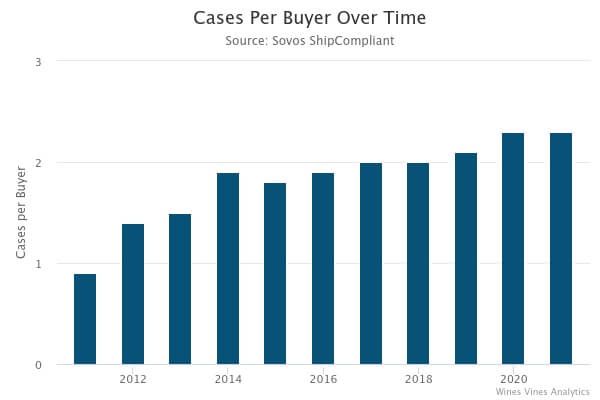
There are a wealth of new digital marketing strategies and techniques available to wineries to help them secure new customers, but using that same outreach to keep your most loyal consumers engaged could yield even better returns or balance marketing dollars spent trying to acquire new ones.
The behavior of established DtC consumers also shows the value of customer recommendations. Part of the reason why virtual tastings are likely to remain a key sales tactic this year and beyond is they help wineries leverage their existing customers by having them host virtual tastings in their homes. One assumes a new consumer brought in by a loyal one is likely to show the same purchasing patterns.
Andrew Adams is the editor of the Wine Analytics Report and a regular contributor to Wine Business Monthly magazine. Adams grew up in the city of Sonoma, Calif., and graduated from the University of Oregon with a degree in journalism. In addition to working at daily newspapers for more than a decade, Adams worked for more than two years (three harvests) in the cellar and lab at a winery in Napa Valley.
The three-tier system is the prevailing way that alcohol is distributed and sold in the United States, based on a clear cut distinction between different sectors (or “tiers”) of the beverage alcohol market. In the three-tier system, suppliers, such as producers and importers, are required to sell to wholesalers and distributors, who in turn sell to retail businesses, including liquor stores and restaurants, who then, finally, sell the products to consumers. Any supplier who wants to have their products sold and consumed in the U.S. must have at least a passing awareness of the three-tier system and its many regulatory requirements.
When a supplier wants to engage with a new state’s alcohol market, it is critical to first identify the legal paths established by that state for selling to local distributors. As with most arenas of the alcohol industry, DtC alcohol shipping included, this generally requires getting a license issued by the state, the rules and requirements for which vary among states.
Three-tier compliance requires adherence to detail, as everything from the licensing process to renewal deadlines could be different in different states. Additionally, variations can exist depending on the type of alcohol that is being produced and subsequently shipped. Beer distribution rules within the three-tier system are not necessarily going to be identical to wine distribution rules. Here are important takeaways when it comes to three-tier distribution.
With the enactment of the 21st Amendment at the end of Prohibition, each state established its own individual rules for the sale, production, transportation and consumption of alcohol. States enforce their rules on any business engaging in these activities within their jurisdictional borders.
The first step in distributing into a state is almost always to get licensed. This requires identifying the specific license the state requires for out-of-state suppliers to sell to distributors, which often varies between product types. A major supplier, selling beer, wine and spirits in every state could have dozens, even hundreds, of licenses.
Don’t assume that every state has the same regulations surrounding three-tier compliance. For every state you distribute into, there’s a whole new set of laws that must be followed. For example, each state has adopted rules that make it easier for in-state sales like free samples at an on-site tasting-room and self-distribution to local restaurants and retailers. In this scenario, a production license is required.
Suppliers should also be aware that not every state requires them to get a license to sell to local distributors. Alaska and D.C. do not have a license for out-of-state suppliers to engage with distributors. Florida and Rhode Island also do not mandate a specific license, though a supplier still needs to register with the state agencies as the Primary American Source of their brand/labels in order to sell them to distributors in those states. It is important to outline which products you plan to sell in each state to ensure compliance with all local laws.
It’s important to get licensing taken care of in a timely manner, as delayed licensing can halt sales. Selling outside of the permissions granted by a state is one of the most basic and clear violations of state law out there, and states will enforce this law strictly. Repeated violations can result in heavy fines and could even impact a supplier’s home state or federal licenses. Once those licenses are lost, then a supplier is effectively outcast in the beverage alcohol market and will find it nearly impossible to regain them.
Consider compliance with federal and state laws the baseline of success. Failure to follow beverage alcohol regulations can have a variety of consequences—most commonly monetary penalties, but in severe situations it can lead to a loss of license. As your organization expands its reach to more customers, regulations and compliance deadlines will increase. Working with the right partner can ensure visibility and accuracy across all aspects of your licensing compliance efforts.
Ready to take your three-tier distribution to the next level? Find out how Sovos ShipCompliant’s Market Ready solution can streamline your compliance processes.
On February 9, the Treasury Department issued a report on competition in the beverage alcohol industry, identifying several areas where possible reforms could foster a more level playing field for small businesses, craft producers and new market entrants. The report was part of Executive Order 14036, initiated by the Biden Administration to investigate ways to promote competition and support small businesses broadly in the U.S..
As might have been expected, the report does not itself resolve the many concerns that small businesses and consumers raised in their comments to Treasury; and some more extreme suggestions, like abolishing the three-tier system, were largely ignored. However, the report does address a number of concerns in the modern beverage alcohol industry and provides a variety of reforms that taken together could be a major benefit for the industry.
What does the report recommend?
On one of the more anticipated areas, direct-to-consumer (DtC) shipping of alcohol, the report was largely bullish. While it was far-fetched to believe that the Treasury would establish a national DtC shipping system in their report (as some commenters pleaded for), the positive stance on DtC shipping taken in the report should be seen as an overall win for its proponents and the industry at large.
As the report notes, the DtC market “offers distinct distribution opportunities for small producers, opportunities for innovation, and the possibility of serving small niches.” (Page 17.) This reflects a long-established view in the industry that small producers are often unable to capture the attention of distributors and so are prevented from accessing large parts of the national market. The report notes the ill-effects this has on consumers, citing a 2003 survey by the FTC that found that 15% of sample wine products for sale online were unavailable to consumers in McLean, Virginia in their local retail stores. The report adds that expanding DtC permissions provides the ability for small producers to engage with consumers where distributor indifference currently prevents that.
While the report does encourage state legislators to actively investigate expanding DtC permissions as a boon for small producers, it does stipulate that some commenters continue to have reservations about DtC shipping, particularly as it relates to increased availability of alcohol to minors.
Even though the report notes that there has been little to no credible findings of failures in the DtC wine shipping market related to sales to minors, it does accept that it’s possible that might change as DtC shipping expands to include beer and spirits products. However, increased vigilance by carriers and shippers regarding sales to minors does seem like a more effective path forward than continued prohibitions on legal DtC shipping of beer and spirits, which only pushes such sales into black markets.
One of the issues brought up by the report that could actually be addressed relatively soon by the Trade and Tax Bureau (TTB) is the complex processes new and small businesses need to go through to get their products to market, namely in preapproval of labels and permitting. The report recommends that the TTB reexamine its current practices in these areas to focus more on steps that protect consumer health and safety, while removing burdensome requirements that large businesses, with fleets of attorneys and compliance experts can manage, but hamper small producers.
Interestingly, the report also recommends reviewing federal alcohol taxes, and removing many of the discrepancies that exist between different product types and between domestic versus foreign products. Again, large businesses may be able to navigate the tangle of tax rates, reports, and other requirements, but this is an area where smaller producers continue to struggle.
Many of the recommendations in the report, from expanding DtC shipping and reviewing regulatory barriers to market entry, are ultimately more in the province of states to address and correct through legislation and rulemaking. But there are several long-lasting concerns the report mentions that federal agencies should take the reins on.
The report brings up trade practice enforcement as a key arena for the TTB to take action. Trade practice rules include a wide range of restrictions on how different tiers of the beverage alcohol industry—suppliers, distributors and retailers—can interact and were originally designed to prevent collusion and improper influence in the industry.
The report states, though, that many large businesses continue to act with impunity when it comes to trade practice violations. As such, the report recommends that the TTB moves forward with new rulemaking to modernize their approach on activity like category management (i.e., when suppliers as distributors can support retailers in stocking products) and to establish clear methods for enforcing existing rules. The report also recommends that the TTB use discretion in its enforcement authority and move to apply greater scrutiny on major players in the industry rather than on small producers who lack market power.
The trend towards market consolidation, with large producers and distributors engaging in a near free-for-all of mergers and acquisitions, also came up in the report. This trend has been a major concern in the industry for many years now, and despite lots of talk about its pernicious effect on smaller businesses, little has been done to address those concerns. As such, the report recommends that the TTB and the Department of Justice cooperate more closely to establish guidelines on consolidation and review more closely future mergers for their impact on the industry.
In all, the report is heartening to read and a welcome sign of the current Administration’s interest in expanding opportunities for small businesses to grow and compete in highly competitive markets like the beverage alcohol industry. Many of the concerns and recommendations the report addresses have been frequent talking points among alcohol producers and sellers for years, so to see the federal government taking a similar position and offering possible solutions is overall positive.
However, the report itself is just words, and while they are pleasant and welcome to read, as they say, the proof is in the eating of the pudding. Final judgment of its effect should wait until the TTB, state legislatures and other agencies actually dig their teeth into it.
Learn more about DtC compliant shipping, including how and where you can ship alcohol.
It’s hard to believe that the first month of 2022 is already in the rearview mirror, but the same way that time keeps moving along, the DtC wine shipping world continues to change. With more states implementing DtC shipping options — and some that took a step in the other direction — it can be difficult to keep pace with the latest compliance requirements. Here are some key areas to be keeping an eye on for a successful 2022 and beyond.
Audits are increasing for DtC wine shippers, with states going after licensees for alleged shipping issues, with a particular focus on preventing sales to minors. Carriers are the central player in that aim, as they must check IDs and gather an adult’s signature at the time of delivery, and as such are often themselves subject to state scrutiny. But wineries can also do their part by conducting point-of-sale age checks using public record data or receiving a facsimile of the purchaser’s ID. Even if a state doesn’t explicitly require these point-of-sale checks by their licensees, this is a best practice for DtC shippers on all their orders.
However, age checks are not the only area that state regulators are looking into. Many state audits also focus on ensuring all shippers are properly licensed and are shipping only products that they are authorized to sell and ship.
And of course, taxes are always a major concern for state regulators. It’s important to note that states are changing their reporting processes, with many adopting electronic filing options. This means that DtC shippers need to stay up on the latest filing trends and that states are receiving more data every day, so they can better review and scrutinize the DtC wine shipping market.
While the 2018 South Dakota v. Wayfair Supreme Court case did not result in too many changes for DtC wine shippers, the subsequent economic nexus changes have created new tax burdens for DtC shippers in some states. This has largely been in those few states that do not condition getting a DtC license on also registering as a sales tax collector.
In 2021, two of these states, Florida and Missouri, passed economic nexus laws imposing a sales tax liability on all remote sellers that meet the threshold of $100,000 in annual revenue in the state, including for DtC shippers. Florida’s law came into effect on July 1, 2021 and Missouri’s will become effective on January 1, 2023.
To manage possible tax liability coming from economic nexus, it’s critical for DtC wine shippers to carefully monitor how much revenue they get annually in each state. But they also need to recognize how each state defines “annual revenue.” Is it measured by all revenue or only taxable revenue? In the former case, wholesale sales could trigger the threshold well in advance of DtC sales alone. Further, economic nexus rules for online marketplaces could make sales tax management even more confusing for DtC shippers who use them. It’s important for DtC shippers to communicate with their marketplaces to understand who is collecting and remitting sales tax and where the DtC shipper needs to manage that themselves.
More states are adopting laws around how fulfillment houses can be used by DtC shippers for their sales into those states. Alabama, Kansas and Tennessee all adopted new regulations in 2021 (with Tennessee’s going into effect on January 1, 2022).
Fulfillment houses are essentially logistics centers where alcohol producers store their products until they’re ready to be sold. As such, many wineries use them to facilitate their DtC shipments, relying on their packaging services and existing relationships with carriers. However, as fulfillment houses expand their services, more states are requiring them to get licensed and file regular reports of the shipments they’ve supported. It is anticipated that additional states will adopt these requirements for fulfillment houses in the years to come.
When looking into working with a fulfillment house, it is important to make sure that they are aware of this trend in licensing and reporting requirements, and that they are keeping up with their own compliance requirements. If a winery uses an unlicensed fulfillment house to ship to a state that requires them to be licensed, the state will cite the winery for a compliance failure right along with the fulfillment house.
Shipping wine to consumers can be a great option for producers, but it must be done the right way. The rules for compliant DtC wine shipping rules can vary from one state to the next, and states are becoming increasingly strict about enforcing their regulations. Make sure that you obtain the proper license for each state you want to ship to, and ensure that your entire team understands the importance of compliance. States are aware of so-called “workarounds,” and non-compliance can lead to audits, fines or the loss of a license.
Remember that working with the right partner can simplify the DtC shipping process, keep you compliant and ensure your consumers stay happy.
Learn more about managing your DtC alcohol shipping compliance.
As the direct-to-consumer (DtC) beverage alcohol shipping market continues to grow, spurring more interest in the market, there has been a recent rise in, as it’s called, “three-tier DtC shipping” services.
In this arrangement, a beverage alcohol supplier—a winery, brewery, distillery, importer or other supplier who might be looking to establish their own DtC program—works with one of these services to fulfill DtC orders across the country. The supplier will distribute their products through a partner wholesaler to a retailer who will make and fulfill the sale, which is how the process gets called “three-tier compliant.” The supplier also will market their products themselves and allow consumers to enter in orders, making them also “DtC,” though the retailer is still the party responsible for the sale and fulfillment.
While this arrangement may seem advantageous—a ready means for a supplier looking to enter the DtC market to avoid the complicated business of getting licenses, policing orders and remitting taxes—there are some very real unanswered questions about these “three-tier DtC” programs, importantly, how compliant they are in the end. They have the sheen of compliance and the vouchsafes that because a distributor is involved, they must be compliant. Yet any supplier who signs up for one of these services without doing due diligence and investigating how they operate, and how they are legally fulfilling their DtC orders, remains at risk for being party to a potentially illegal operation.
Here are some of the key considerations suppliers should keep in mind as they look into these services.
DtC shipping of alcohol can be very complicated and require managing a number of compliance requirements. However, that doesn’t mean that three-tier distributions are free and easy from a regulatory perspective, particularly if it involves selling across state borders. Anyone signing up for a “three-tier DtC” program will need to make sure that they are in compliance with all relevant three-tier distribution laws (Read up on those laws for wine and beer).
This means getting any necessary licenses, meeting any brand/label registration requirements in the state, properly bringing products to distributors, and filing follow-up reports, even possibly paying excise taxes. Many “three-tier DtC” programs can make it seem as simple as signing on the dotted line, but suppliers should ensure they can legally bring their products to the distributors and retailers who will be making the final sale to consumers.
There is another major concern with “three-tier DtC” programs that have so far been wholly unaddressed by this developing industry. Namely, how do they manage the lingering tied-house concerns that may arise if a supplier is directing their consumers to purchase from a specific retailer?
Laws at both the state and federal level prohibit a wide range of cross-tier collusions, including the “provision of things of value” from a supplier to a retailer. While the laws vary depending on the state and product type at question, directing consumers to buy from a specific retailer is a fairly common thing of value in the eyes of regulators. If a supplier is privileging one particular retailer by signing up for their “three-tier DtC” program, which the supplier then advertises and offers to consumers, it is hard to see how that is three-tier compliant.
It is possible that these “three-tier DtC” programs have resolved these tied-house concerns, and a supplier using them only needs to worry about their own three-tier compliance obligations, but if they have, they do not publicly address tied-house laws.
The greatest value these programs advertise is that a supplier can avoid the bother of DtC regulations or logistics. The supplier, then, is relying on the retailer who will fulfill the orders to manage that bother, which does leave open the often unanswered question: how are the retailers themselves making the DtC shipments?
Some retailers may be relying on their ability to make local deliveries. However, those rights are not available in every state (if the retailer even has a licensed premises in every state), and often enough those local delivery options are more limited than those retailers may claim. For instance, in Texas, a retailer can only deliver within two miles of the corporate limits of their city or county, blocking statewide deliveries. And while many states have adopted more robust shipping and delivery options for retailers during the COVID crisis, they are far from universal.
More concerning, there are plenty of “three-tier DtC” programs that seem to operate from a single retail location, often based in a large state like California, Florida or New York. This retailer may be getting product properly through their local three-tier system, but how then do they ship an order to a consumer in a different state? While there are several states that do permit out-of-state retailers to make DtC shipments to their consumers, it is still rather restricted, and many of the largest states are not open for such shipments.
A supplier that signs up for a program to ship nationally from a retailer located in one state needs to ask themselves, what is three-tier compliant about a California retailer shipping to a consumer in Texas?
In the ongoing fights over direct-to-consumer shipping of alcohol, wholesalers are often the first to bring up potential compliance concerns. As such, the prospect of so-called “three-tier DtC” shipping, with the wholesaler imprimatur, may seem very attractive. That stamp of approval, though, hides a great number of questions and concerns about how compliant “three-tier DtC” actually is.
It is well established in beverage alcohol jurisprudence that the three-tier is “unquestionably legitimate.” (North Dakota v. United States, 495 U. S. 423, at 432.) That does not mean, though, that just because a sale involves the three-tier system, it is also inherently legitimate.
Suppliers looking to sign up for these services therefore need to thoroughly vet and understand both their own ongoing compliance liabilities and how the “three-tier DtC” program works to make sure it is actually legally permitted to make the sales it is making. Asking lots of questions, not taking the program’s word for it, and seriously considering the potential risks in signing up for one of these programs are all necessary steps a supplier needs to take.
Learn more about DtC compliant shipping, including how and where you can ship alcohol.
This January, Sovos ShipCompliant released the 2022 Direct-to-Consumer (DtC) Wine Shipping Report with our partner, Wines Vines Analytics. The report is the most comprehensive, complete and exclusive collection of data and insights on the state of the industry. Wine shipments to consumers reached a record $4.2 billion in 2021, meaning this is a fantastic time to delve into the DtC wine channel and learn more about the ever-evolving trends.
The Direct-to-Consumer Wine Shipping Report takes shipment data from more than 1,300 U.S. wineries’ shipments to consumers each month, totaling more than 42 million shipments over the course of 2021. As we gather information, each shipment is edited for submission for governmental tax and reporting requirements, and all elements are validated by standardized tables. The verified data is submitted to a proprietary model built on a database of 11,000+ wineries that is updated monthly by Wines Vines Analytics.
The report takes a deep dive into findings from 2021 including by winery region, winery size (production), varietal, destination of shipments and price to produce the most thorough analysis available of the DtC shiping channel. Here are some notable takeaways:
Tune in for our free webinar on February 17, where we will dive deeper into the report data and takeaways. Register here for the live discussion.
Download your free copy of the 2022 Direct-to-Consumer Wine Shipping Report for additional insights and analysis of DtC channel trends.
 By Zach Kamphuis, Vice President of Business Development at Commerce7
October, November and December represent the best direct-to-consumer (DtC) sales months for many wineries. With the 2021 holiday season now behind us, how can wineries capitalize on the new customers gained through the past months and avoid falling into a post-holiday sales slump for DtC wine?
Capitalizing on all the first-time customers created during the holiday season is one of the best ways to beat the post-holiday season slump. Through this article, I will talk about three ways you can drive more revenue from your newly created customers.
Now that you’ve created new first-time customers through the holiday season, it’s critical that you push for a second sale with these customers in Q1. In ecommerce, the second sale is the most important sale you’ll have with a customer. If you can convince a customer to purchase a second time, the chances they purchase a third, fourth or even fifth time increase dramatically, and their average lifetime value will increase to significantly higher than for a first-time buyer.
Aside from having an ever-increasing chance of purchasing again, repeat buyers also tend to have larger average order values and refer more customers to your brand. Thus, the second sale is very important to increasing a customer’s lifetime value, upping the chances they become a club member, and can even help with new acquisition by sending you more referrals.
The best time to push for the second sale is in Q1, as 60% of second purchases occur within 100 days of the first. After 100 days, the chances of a customer making a second purchase drop below 10%.
The first way to beat the post-holiday sales slump is to target all your newly acquired first time customers in Q1 (within that critical 100 day time period from their initial purchase) and push them to make a second purchase.
Now that you’re committed to pushing for the second sale, let’s talk about the best type of offers to encourage a second sale. A great offer is a personalized offer.
Because you’re targeting customers who have already made an initial purchase with you, when you push them to purchase a second time, you can personalize your offering to them based on the data you’ve collected in the first purchase.
Offering your customers personalized product recommendations based on what they previously purchased leads to a lot of great outcomes for your brand. For example, emails with a personalized offering have:
The results can be dramatic, with an average 760% increase in email revenue from personalized and segmented campaigns compared to generic campaigns.
Now that you’ve piqued your customer’s interest with a personalized offering, you need them to convert and actually purchase that offering. One of the easiest and most impactful ways to get more ecommerce conversions is to offer nearly-free or heavily discounted shipping.
When it comes to ecommerce orders, the #1 reason why a consumer abandons a cart and doesn’t complete an order is shipping costs. Forty-nine percent of consumers have said they’ve abandoned a shopping cart due to the price of shipping. If you want to push for the second sale, one of the best things you can do is offer nearly-free or included shipping in your promotions.
Ninety percent of consumers would shop online more often if given the option of free shipping, and 24% of consumers said they would spend more to qualify for free shipping. Shipping wine is expensive, but there are some ways you can offer low-cost or included shipping without breaking the bank.
If you typically sell your wine for $50 a bottle with $20 shipping, instead charge $70 a bottle online with $0.01 shipping. Countless ecommerce studies have shown that consumers value free shipping far greater than they value the equivalent dollar value in product discounts. If you build the cost of your shipping into the cost of your products and offer included shipping to the customer, you’ll sell more online.
Offer included shipping once customers reach a certain order value. This is a great way to motivate customers to increase their order value, and the larger orders help offset your shipping costs.
To summarize, many wineries see a slump in sales after the holidays, but there is a lot that can be done to offset this. One of the best things to do is to push for a second sale with all the new first-time customers created over the holiday season.
The second sale is the most important sale for ecommerce as it dramatically increases the average lifetime value of the customer, the chances they become a club member, and the chances they refer your brand to their network.
It’s best to push for the second sale within the first 100 days after a customer’s initial purchase, and offering personalized product recommendations along with included shipping will ensure you get as many second sales as possible.
—
Zach Kamphuis is the Vice President of Business Development at Commerce7 and works with wineries to assist in creating great customer shopping experiences through all direct-to-consumer sales channels. Zach believes that customer experience is the primary reason why a consumer chooses a brand, and that in order for wineries to meet consumer expectations, they must adopt a more customer-centric approach to selling direct to consumer.
Commerce7 is a certified Sovos ShipCompliant partner—one of the 60+ integrated partners that makes Sovos ShipCompliant a central hub of the direct-to-consumer and three-tier beverage alcohol ecosystem.
Sources:
https://blog.smile.io/repeat-customers-profitable/
https://www.forbes.com/sites/blakemorgan/2020/02/18/50-stats-showing-the-power-of-personalization/
https://baymard.com/lists/cart-abandonment-rate
Near Beer registrations have robust 55% growth from Q3 2021
The final months of 2021 saw some fluctuations from recent beverage alcohol brand registration patterns. This is not a complete surprise, as the industry is putting a cork in the second year of doing business and introducing new brands in a pandemic-influenced marketplace. For example, there was a 14% increase in Product Registration Online (PRO) new product registrations* from 2020 to 2021.
The fourth quarter of 2021 saw slower growth in new product registrations, though, when compared to Q3. However, this aligns with slower growth in Q4 2020 and Q4 2019. The first half of the year tends to be when the number of registrations truly takes off.
The following is a breakdown of new product registration data via PRO from the fourth quarter of 2021 (October, November, December) for beer, wine and spirits.
The beer/malt category saw decreases of just under 1% in product registrations compared to Q4 2020, but had a 6% increase from last quarter. The Near Beer category (non-alcoholic or NA beers) led the way, with a 55% increase in new product registrations since Q3 2021 and a 244% spike from Q4 2020. Ales also grew 50% compared to Q3 2021, with an 18% increase in new product registrations from Q4 2020.
When it comes to Malt Beverage Specialties – Flavored (FMBs), those new product registrations made up the largest share of total malt beverage registrations, at 47% of the total in malt beverage for Q4 2021. This category has made up the largest total registrations for seven straight quarters, but is up only 7% from the fourth quarter of last year.
Overall, the number of wine brand registrations across states was down more than 5% from Q4 2020 and down 29% from Q3 2021. Additionally, the Sparkling, White, Red and Rosé categories also saw decreases of over 25% since last quarter.
Among wine product registrations:
Overall, the number of spirits product registrations was down 26% from Q4 2020, and down 41% from Q3 2021. Whiskey continues to lead the way in the largest share of total registrations, at 31% of all spirit registrations, while vodka is the runner-up at 18%.
Year-over-year growth for Q4 shows registrations for tequila are up 28% since 2020, and vodka up 14% for the same period.
*Product Registration Online (PRO) data encompasses nationwide label/brand registrations by PRO users. Product Registration Online processes some 100,000 state registrations annually.
Learn how PRO enables fast, easy electronic brand filings for wine, spirits and beer brands in participating states.
As interest in the direct-to-consumer (DtC) alcohol shipping market has grown, a number of third-party servicers have popped up promising to support the market. These services range from marketing platforms to online storefronts to logistical support, everything that a winery, brewery, distillery or other prospective DtC shipper will need to deal with once they’ve come to grips with the myriad regulations they will need to abide by.
However, as sweet as the promises these services make sound, a DtC shipper can’t rely just on promises. It is critical for the DtC shipper to thoroughly vet and understand how their third-party services work so that they can avoid any undue risks and liabilities.
As the license holder for their DtC shipments, the DtC shipper is ultimately responsible for whatever happens in their name. If their third-party service acts (or fails to act!) in a way that violates a law, or the shipper interacts with the third-party in an impermissible way, the DtC shipper is at real risk of facing the consequences themselves, be that fines or loss of license.
Here are some key considerations for DtC shippers to keep in mind as they investigate a prospective third-party service.
Consumers can’t buy products they don’t know about, which is why many shippers look for support in advertising or marketing what they’re selling. At a basic level, this can simply be positive ratings, or perhaps paid advertising. But there are many online sites out there for DtC shippers to post their products on, and provide lists of new or favorite releases to entice consumers.
While there are some state laws that do specifically relate to advertising in relation to DtC shipping, they tend to be not too difficult to follow. Generally they are limited to listing the DtC shipper’s license number in fine print (Washington) or prohibiting direct marketing campaigns from sending anything to minors (Michigan).
However, a DtC shipper who focuses solely on DtC shipping-specific advertising laws is putting themselves at risk. This is because state regulators largely do not make distinctions between an online sale or a brick and mortar sale. Essentially, the principle many state regulators work on is if it’s not allowed in person, then it’s not allowed online.
That means that DtC shippers need to be aware of those generally applicable restrictions on advertising and marketing beverage alcohol (which do vary state by state). As such, DtC shippers should confirm with their third-party marketing services that they are in compliance with all applicable federal and state laws that govern how alcohol can be marketed and promoted.
Establishing and managing an online store can be a major challenge for anyone, so many DtC shippers will look for established ecommerce marketplaces to sell through. However, depending on how involved in the sales process these marketplaces are, using them can be very fraught for a DtC shipper.
There is a general prohibition on anyone who does not hold a valid, relevant license from collecting any money (even for fractions of a second) from a sale of alcohol. There are also widespread principles that the licensee must fully direct sales made in their name, controlling everything from pricing to what products are available to ownership and handling of the products.
As such, DtC shippers cannot rely on any old online marketplace to sell their products. Instead, they must make sure that the marketplace is aware of and is compliant with these laws. In effect, the marketplace should be mostly a blank platform that the licensed DtC shipper can use to facilitate sales, but won’t conduct any sales itself. Critically, any money that is processed through the marketplace must be sent directly from the consumer to the DtC shipper, and cannot be held by the marketplace even momentarily.
There is some slight controversy about this last point, as it contradicts some states’ sales tax rules for marketplaces, which have come into effect along with economic nexus laws. These rules place the responsibility for collecting and remitting sales tax on large marketplaces, to relieve their users of that burden. However, the question is open whether that would constitute an illegal realization of money from a sale of alcohol. So far, only the California ABC has issued any guidance on this matter (saying that it does not consider collecting sales tax money to be improper sharing of revenue), but other states may adopt a different position.
In the case that a state would look askance at a marketplace collecting sales tax money from a sale of alcohol but the marketplace is generally liable for remitting sales tax, then the DtC shipper needs to work through how to get the money to the state. One possibility is to reimburse the marketplace for remittances they make in the name of their users. The other would be for the DtC shipper to contract with the marketplace in a way that does place the remittance burden on the DtC shipper, as most states with marketplace collection and remittance rules allow.
Once the sale has been completed, there is the difficult process of getting the product ready to be shipped to the consumer. To manage this, many DtC shippers have come to rely on third-party logistics services, namely fulfillment houses.
In 2021, there was a tremendous surge in scrutiny on these fulfillment houses, and several states adopted licensing and reporting requirements for them. Suffice it to say, DtC shippers looking for support from fulfillment houses should be aware of these laws and make sure any such services they use are in compliance.
There’s no getting around that DtC shipping of alcohol can be complicated. But there are lots of services out there for DtC shippers to use to help relieve those complexities, from tax and compliance management, like Sovos ShipCompliant, to more generic ecommerce platforms.
As DtC shippers look around for support, they need to be aware of the potential risks that can come with these services. Understanding how a service works, recognizing what the third-party service will do and won’t do, and not assuming that something that works fine for selling t-shirts will work perfectly with selling alcohol, are all necessary actions for DtC shippers to take.
Learn more about managing your DtC alcohol shipping compliance.


Regulatory & other important content

Truly expert presenters

Fresh & familiar faces
Good use of your time

A boost outside of day-to-day thinking