 By Robert M. Tobiassen*
Ohio has announced a series of revised requirements for reporting W-2s and 1099s to the state for tax year 2021, reporting in 2022.
All filers issuing 10 or more Forms W-2 and/or 1099-R will now be required to remit those forms using the Ohio Business Gateway. Previously, the electronic filing threshold for Forms W-2 and 1099-R was 250 or more.
A new electronic specification will be provided for Form W-2, but Ohio will continue to accept filing in the EFW2 format. The new electronic specification has not yet been published but will use a comma-separated value format. Publication is expected later in 2021.
Forms W-2 and 1099-R will be due to Ohio by March 2, 2022 for tax year 2021. This extension will permit Ohio to update its Business Gateway to accommodate filing.
Note that Forms 1099-MISC and 1099-NEC will not be included in the filing extension to March nor will Ohio permit electronic filing of these forms. As in prior years, filing of these forms will be permitted either by paper or by email.
To review Ohio’s announcement regarding these changes, please follow this link.
The first step in bringing a new beverage alcohol product to market, whether for sale through the three-tier system or by direct-to-consumer (DtC) shipping, is registering it with the Alcohol and Tobacco Tax Bureau (TTB). This must happen to get a Certificate of Label Approval (COLA), which ensures that suppliers and producers comply with federal regulations when designing and marketing alcohol brand labels.
However, not all beverage alcohol producers may know that there is a better way to monitor brand labels, ensuring that brand and product name conflicts are avoided, the latest packaging trends are found and that the best unique package design can be created.
Sovos ShipCompliant’s LabelVision product can perform competitive analysis using numerous search options, including but not limited to product type (e.g., Brut wines, IPAs), company name and even by words or phrases that appear on the labels. Following are top reasons why it’s important to monitor brand labels in the beverage alcohol industry.
Reviewing trends prior to releasing new innovations will prevent a supplier from lagging behind the competition — or validate the idea as an exciting new movement. The right tool can ensure that managing product labels is easy and efficient.
For example, want to know what’s coming up next in the beer market? LabelVision can help you track how many other breweries recently dabbled in the latest IPA craze. Or perhaps a winery wants to ensure that it’s not doing what nearby competitors are doing. LabelVision can determine if the story you want to tell about your latest Cabernet Sauvignon is as unique as you had hoped.
LabelVision also utilizes Optical Character Recognition (OCR), which reads all of the text on labels, including words that are not necessarily part of a product’s title. Any text that can be read by the software on the label will be read as text. This can help determine if descriptors other than the title are being used in competitors’ products—say, keywords such as tart, funky or balanced.
Proper research can also help prevent costly trademark disputes. Returning to our IPA example, that brewery can also ensure that their name for that beer is truly unique. LabelVision can help ascertain if that name has already been used in interstate commerce, working to avoid legal action such as a cease and desist order from another brewery.
This approach can also be helpful for lawyers who are monitoring client trademarks. Regular searches can be set up ahead of time for particular terms, phrases, styles of product and more.
Brand label monitoring can also help importers that want to or need to be the exclusive importer of a certain brand in the U.S.. LabelVision can help determine that no other organizations are already bringing a particular brand into the country.
“You can quickly retrieve one or all of your company’s COLAs in a matter of seconds, see what products and innovations are trending in the industry, learn how others have navigated around complex federal labeling guidelines and keep an eye on competitor labeling and branding that may pose a trademark risk.
“LabelVision’s export feature allows you to capture all the cool things you found in your query and share them in a concise file that breaks the attributes into columns, including links to revert back to the COLAs and labels in just a click. All links shared through LabelVision are universal, so even its customers’ customers have access. It’s my favorite industry resource by far.” – Sara Barraza of Maison Ferrand, a boutique spirits producer and importer
Regardless of the types of alcohol beverage products you are looking to bring to market, LabelVision can better inform the process to ensure a successful product launch.
Learn more about how LabelVision can fuel your research for brand labels in beverage alcohol.
As 2021 comes to a close, perhaps there is small comfort in knowing that the old adage of “the only constant is change” remains true for beverage alcohol. Rules and regulations on direct-to-consumer (DtC) shipping are adjusted, more states are opening options for DtC shipping and economic nexus continues to impact how suppliers, shippers and producers approach tax.
Throughout the year, Sovos ShipCompliant worked to stay on top of the latest beverage alcohol regulatory changes and how they could potentially impact your business. Following is a review of some of the top regulatory highlights from the past year.
Wineries and other alcohol suppliers will sometimes utilize fulfillment houses to store their products and help bring products to purchasers when they are sold. As more fulfillment houses began to move beyond being storage facilities and started enabling shipments to consumers, more regulators began to impose restrictions on what fulfillment houses could and could not do.
In May, two states made changes on fulfillment house regulations that would impact DtC wine shipping. Tennessee Governor Bill Lee signed HB 742, which included new restrictions on the wines that a licensed DtC shipper may sell and ship DtC to Tennessee residents. Additionally, a bill provision discussed new record retention and quarterly reporting requirements on winery direct shipper licensees.
Kansas Governor Laura Kelly signed HB 2137, which included provisions that require both in-state and out-of-state fulfillment houses to register and receive a Fulfillment House License. With that, the licensee is allowed to handle all logistics on behalf of a special order shipping license holder, including packaging, warehousing, order fulfillment and shipping services.
Kentucky updated its DtC alcohol shipping laws in March, removing a requirement for licensed DtC shippers to register their brand/labels with the state before shipping those products. The bill also removed a provision that previously prohibited DtC alcohol shippers from using third-party fulfillment houses to help with their shipping logistics needs.
In May, Alabama became the latest state to legalize DtC shipping of wine, with the new law going into effect in August. Alabama’s changes also established several requirements for common carriers and fulfillment centers, which may be involved in facilitating DtC wine shipments.
Over the summer, Ohio Governor Mike DeWine signed a law allowing larger-scale wineries to also ship DtC. Previously, a DtC wine shipping license could only be issued to wine manufacturers that produced less than 250,000 gallons of wine annually. Now, smaller-scale wineries and beer manufacturers can operate under the existing DtC shipping license, while larger-scale wineries will require a new S-2 type license.
The debate continued on whether the U.S. Postal Service should be permitted to ship beverage alcohol directly to consumers over the age of 21. A bipartisan bill introduced in May would lift a Prohibition-era ban that prevents the USPS from shipping wine and other alcohol directly to consumers. Even with the new law in place, though, USPS and alcohol shippers would still have to comply with local and state laws.
Florida adopted economic nexus rules, imposing a sales tax liability on remote sellers, including DtC shippers of wine. Florida does not currently require DtC wine shippers to assume a sales tax obligation in the state to make sales. The new economic nexus rules will now require more DtC wine shippers to collect and remit Florida sales tax.
Kansas also adopted economic nexus rules, although there was no immediate guidance on how DtC wine shippers may be impacted by the change. As we explored in another post:
“Under the law as written, a DtC wine shipper would thus face a sales tax burden once they sell over $100,000 in wine into Kansas in a year. A DtC wine shipper reaching that threshold would be required to register with the Kansas Department of Revenue and file regular sales tax returns reporting their sales into the state. While they would be able to fully exempt their wine sales from their sales tax returns (providing that they are regularly filing and remitting their Beverage Occupational Taxes), they would still be required to file a return reporting their retail sales, and collect and remit sales tax on non-wine purchases made by Kansas customers.”
Both Oregon and Wyoming increased the permitted volume for DtC wine shippers. Oregon now allows for up to five cases of wine per Oregon resident per month, with a case not to exceed nine liters of wine. With a previous limit of just two nine-liter cases, the volume limit more than doubled. Wyoming now allows licensed DtC wine shippers to ship up to 108 liters (12 nine-liter cases) of wine per resident in a given 12-month period, up from 36 liters.
While not quite the same as shipping volume limit adjustments or economic nexus change, Texas revamped its alcohol license process and fees. The Lone Star State moved from 75 to 37 licenses and permits, including the elimination of 14 licenses/permits and 24 licenses/permits being consolidated into others.
While some states began to lift DtC wine shipping restrictions this past year, others took the opposite approach. The Idaho Alcohol Beverage Control (ABC) division’s legal team reviewed the state’s existing DtC laws and determined that out-of-state retailers have no permission to ship any beverage alcohol products DtC in Idaho. Previously Idaho’s laws had been interpreted to establish a “reciprocal” retail DtC relationship, permitting retailers to ship DtC to Idaho residents as long as those retailers were in a state that granted Idaho retailers similar shipping permissions.
A recently enacted Nevada law also restricted DtC alcohol shipping. Before the new law, Nevada had very open DtC regulations, allowing wineries, breweries, distilleries and retailers to sell and ship their products directly to Nevadans. Now, only wine from domestic wine producers may be shipped DtC into Nevada.
These were the top highlights that we followed through the year. We might not know what is coming for beverage alcohol in 2022, but we’ll work to keep you informed of changes as they unfold.
Tune into our ShipCompliant newsletter and subscribe to our blog for regular updates in beverage alcohol.
By Robert M. Tobiassen*
As I write this, we honored soldiers and veterans last month on November 11, Veterans Day in the United States and Armistice Day in much of Europe. It is fitting to focus on another type of devastating conflict—the trade war. First and foremost, however, please do not interpret this comparison to minimize the real pain to families of the soldiers who died in military service and all of the civilian casualties that come with military war.
Trade wars resemble military wars—they are easy to start and very hard to end; they reflect the personalities of the Heads of State involved; like a military arsenal they are equipped with many tools such as tariffs and quotas that are flexible tools that may be removed, revised, or enhanced quickly at any time; they can devastate an internal economy and employees similar to the bombing of a factory; there are always people who are collateral damage in both military and trade wars; allies may turn against allies depending on the winning direction of the wars; and like the United Nations (UN) is asked to mediate a peace in a military or civil war, the World Trade Organization (WTO) may be asked to resolve a trade war through the dispute settlement procedures.
Ambassador Robert Lighthizer, former United States Trade Representative (USTR) representing President Trump and Ambassador Katherine Tai, present USTR representing President Biden, are the two “generals,” with a Lt. General role held by Secretary of Commerce Gina Raimondo. The three trade wars are Airbus/Boeing under the WTO Agreements, Digital Services Taxes (DST) under Section 301 of the Trade Act of 1974, and Steel and Aluminum tariffs under Section 232 of the Trade Expansion Act of 1962 (also known as “national security” tariffs). Three very different legal authorities but, in reality, all wars are fought in like ways, regardless of the underlying cause of the war.[1]
Many people on both sides of the Atlantic Ocean are breathing some relief right now with the various resolutions of these three trade disputes. Yet all three are really armistices, the cessation of hostilities, and not permanent treaties of peace. They rest on foundations of good faith, assumptions, and adoption of collateral arrangements. Most people fail to recognize that these are temporary solutions that kicked the can down the road. Short-term, this feels successful, while long-term the final chapters are still unwritten.
So, let’s look at what happened and what may happen in each trade dispute moving forward.
Essentially, this trade dispute arose from government subsidies to Airbus by member states of the EU and to Boeing by Washington State to subsidize the development costs of newly designed civil airplanes. Overly simplified, France, Germany, Spain, and the United Kingdom gave “loans” to Airbus to develop new aircraft models and pay off the loans with proceeds from the sales of the aircraft. If the new aircraft was not profitable, the loans would never be paid, thus, a subsidy. For Boeing, Washington State provided state tax advantages.
After many years of negotiations between the U.S. and the EU, each entity initiated dispute settlement proceedings at the WTO asserting each party was acting inconsistent with its obligations under WTO agreements (The federal government is obligated to ensure the states do not act inconsistent with U.S. trade obligations). WTO proceedings spanned from 2004 to 2019, with the final decisions that both the U.S. and EU were in violation.
The U.S. was authorized to impose retaliatory tariffs (“additional duties”) on $7.5 billion in volume of trade in goods from the EU. The tariff rate could be 1% or 100%. For example, suppose the base year is 2018, and the U.S. imported $1 billion of still wine from France. The volume of trade is the $1 billion and the U.S. could impose the 25% tariff or a 50% tariff, and it could adjust these percentages up and down. The $7.5 billion figure is not the dollar amount of tariffs to be collected. Customs and Border Protection (CBP) has assessed $1,119,778,631 in Airbus duties.
USTR published two potential tariff lists of proposed EU goods for public comment and hearing and then published a final list of tariffed goods by the subheadings of the U.S.’s Harmonized Tariff Schedule. For enforcement purposes by CBP, the tariffed goods must be identified by these subheadings. The final list must be reviewed by USTR periodically (first at 120 days and then every 180 days). USTR may increase or decrease the tariff rate percentages and may delete or add a good, provided the added good was subject to public comments earlier. The retaliatory tariffs remain in place until both parties agree to a settlement that removes the improper trade practice, in this case the subsidies.
The EU was authorized by the WTO in Boeing to impose retaliatory tariffs on $3.9 billion in volume of trade. The EU also had a public comment opportunity before imposing the actual tariffs.
Ambassador Lighthizer was unable to negotiate a settlement and, at one point, wanted the EU to pay compensation to the U.S. in addition to removing the subsidies. As a departing volley, Ambassador (“General”) Lighthizer imposed additional tariffs on France and Germany that were effective on January 12, 2021, eight days before he left office.
Ambassador Tai was confirmed in March 2021 and announced a settlement “cooperative framework” on June 17, 2021 that resulted in a five-year suspension of both the Airbus and Boeing tariffs. A parallel settlement was reached with the UK, following Brexit.
Succinctly, the cooperative framework adopts principles that (1) future funding of R&D for civil aircraft development will be on “market terms” and carried out in an “open and transparent process…in a way that would [not] cause negative effects to the other side” and (2) cooperate in ways to address non-market economies (i.e., China) that are funding their domestic civil aircraft industry that would lead to undercutting the sustainability of the U.S. and EU civil aircraft industries. A working group is created to monitor implementation.
Clearly, this is not a peace treaty but a “principled understanding” with a high level of ambiguity. My sense is that it will hold for the five-year suspension unless France or Germany pushes the edges on future Airbus funding so far that Ambassador Tai would have to terminate the suspension, which would then undercut her so far successful efforts to rebuild the U.S. trade relationship with the EU and start cooperation to address non-market economies. France is rightly upset about the Australia-U.K.-U.S. (AUKUS) nuclear submarine deal, and in January 2022, France assumes the six-month rotating Presidency of the Council of Europe (the senior decision-making body in the EU structure), and President Macron faces a reelection campaign in Spring 2022. All three could adversely impact U.S. relationships with France. Finally, within the five-year suspension, there is some hope that the WTO will be reformed in a way that it can negotiate agreements on issues such as state subsidies for all WTO Members, including China, to adhere.
Bottom line, we are in a holding pattern and not a peace agreement.
Starting with France and eventually extending to Austria, Czech Republic, EU Commission level, India, Indonesia, Italy, Spain, Turkey and the UK, Ambassador Lighthizer opened Section 301 investigations on the Digital Services Tax (DST) imposed by each of the countries and commission asserting the DSTs targeted large U.S. companies and therefore discriminated against the U.S.. Retaliatory tariffs were imposed against French products but immediately suspended and USTR under Ambassador Tai has either closed investigation against certain countries or suspended the investigations and findings against other countries. I label this as a “unilateral Section 301” because there is no third-party arbitrator sanctioning the tariff action like the WTO in the Airbus matter.
Essentially, the USTR asserted that the DSTs (1) discriminated against U.S. companies and (2) were inconsistent with the established norms of international taxation, which are founded on physical presence in a country and calculated on income and not revenue generated in the taxing country.
The armistice here results from a multilateral negotiation at the Organization for Economic Cooperation and Development (OECD), a 38-country member entity with five key partner countries, for a new global framework for imposing taxes on companies doing international business. The OECD players represent approximately 80% of all global trade and investment. An agreed upon framework was announced in July 2021. These longstanding negotiations were relied on by USTR for suspension of the French DST tariffs and the USTR actions on the other DST countries. USTR is reaching agreement with various countries on the interim status of enacted DSTs pending implementation of the OECD framework.
Bottom line, this cease fire will hold as long as the U.S., EU member states, and other key economies make good faith efforts and hopefully succeed to enact the enabling domestic legislation required for the new framework. It behooves countries to act in a very transparent and open way about these efforts being undertaken. A peace agreement will be reached only when key countries have enacted the domestic legislation. Unfortunately, given the political divisions in your nation’s capital right now, political will and consensus here seems distant.
Acting on a recommendation by the Secretary of Commerce, in March 2018 the Administration imposed by proclamation tariffs of 25% on steel and 10% on aluminum imported from any country except Canada and Mexico (which were in pending negotiations with the U.S.) under Section 232 that authorizes trade remedies whenever imports of a good are of such magnitude that they threaten U.S. “national security.” The Department of Commerce (DOC) is the lead agency here and works in consultation with the Secretary of the Treasury and USTR, among other Executive Branch components.
The rationale here is the large volume of imported steel and aluminum results in diminished domestic capacity to produce steel and aluminum in a free trade market competition. These tariffs increased the price of steel and aluminum to make U.S. producers competitive. “National security” was invoked because the U.S. needs domestic sources of steel and aluminum in the time of war. Nevertheless, the EU took great umbrage to the notion that it was a threat to the U.S. national security, particularly in light of the NATO partnership. In turn, it imposed retaliatory tariffs against the U.S. and, in particular, against U.S. whiskies exported to the EU (including the UK).
This trade war is more challenging to end than the two previous ones discussed because the real party of interest is China and China is not at the negotiating table. China produces between 56 and 60% of the world’s supply of steel. Simply imposing the Section 232 tariffs on China is not effective because steel can be exported to third countries and processed so there is no agreed upon objective test to establish the true origin of the steel (kind of like a problem with transfers of bulk wine). So, the U.S. has taken a “managed trade” approach here and not a “free trade” one.
On October 31, 2021, the Secretary of Commerce and USTR announced a framework on the steel and aluminum tariffs with the EU under which tariff free entry of steel and aluminum is permitted at “historic levels.” This is a “tariff rate quota.” Any quantities above these levels would be tariffed. Presentation is everything. The framework highlights with greater text the agreement between the U.S. and EU to address the high level of emissions created in steel and aluminum production.
Bottom line, while not highlighted much, the EU views the framework as a temporary one to last two years. This type of voluntary quota may not be WTO consistent. Also, the European Commission must decide how to allocate the “historic levels” among the member states producing steel for export. So, no signed peace agreement yet, although on November 28, 2021, Ambassador Tai and Commerce Secretary Gina Raimondo published an op-ed touting the framework understanding.
During the past eight months, Ambassador Tai has performed miraculous steps in rebuilding trade relations with the traditional European trade partners of the United States. Ultimate success is contingent on good faith efforts by both sides of the Atlantic Ocean to fill in the gaps in the armistice documents and reach a peace agreement. These frameworks create a warmer relationship but one that is still fragile. The EU is balancing trade interests with the U.S. in conjunction with trade interests with China and Russia. The U.S. is doing the same in balancing its trade policies with China, as well as implementing the USMCA with Canada and Mexico. Simply put, there are a lot of moving parts here and, like a Rube Goldberg contraption, you do not always know how a piece will fall.
You may be asking yourself, why is the President leading here and where is Congress? The Constitution vest powers to make treaties, appoint U.S. ambassadors, and receive ambassadors from other Nations in the Executive Branch. Many foreign policy powers are implied from these short sections. For example, the power to receive Ambassadors implies the power to recognize nations. This is why President Truman could recognize the State of Israel only 11 minutes after it was established in May 1948. Congress has the power to regulate commerce with foreign nations and used this power to enact statutes giving greater trade authority to the Executive Branch. Recent wide-sweeping trade wars have raised the debate on whether Congress should pull back some of those statutory powers but that is a question for another blog.
The significant point here is that the final chapters on the Airbus/Boeing, DST, and steel and aluminum trade wars have not been written. The various timeframes explained above mean that final resolutions are years away. Thus, different occupants of the White House going forward will write, and perhaps rewrite, the final chapters. Recall, the World War I Armistice was signed on November 11, 1918, but the Treaty of Versailles ending the War was not signed until June 28, 1919. For the current trade wars, eight months will not cut it. But how long will cut it remains unclear.
[1] Other U.S. trade laws authorize unilateral sanctions such as Section 201 of the Trade Act of 1974, to allow U.S. industry to grow and adjust to being competitive and the International Economic Emergency Powers Act (1977) that President Trump threatened to use against Mexico if the latter did not undertake steps to mitigate the immigrants coming to the U.S. southern border. Neither of these legal authorities are examined here.
* Robert M. Tobiassen is the President of the National Association of Beverage Importers, Inc. (NABI), Washington, DC, since October 2018. Prior to that appointment, he was the Principal at Tobiassen Consulting Plus Solutions LLC, after a 34-year Federal service career with regulatory, taxation and administrative and judicial enforcement experience with the domestic and global alcohol industry and served in the career Senior Executive Service (SES) as Chief Counsel, Alcohol and Tobacco Tax and Trade Bureau (TTB), Department of the Treasury.
Mr. Tobiassen holds a B.A. in Political Science with distinction from the University of California, Berkeley, a J.D. from the Lewis and Clark College, Portland, Oregon where he served on law review, and a LL.M. in Taxation from the Georgetown University Law Center, Washington, DC. Among other awards, Mr. Tobiassen received the 2003 Presidential Rank Award for Meritorious SES Executives and the 2012 Distinguished Service Award from the Secretary of the Treasury.
The views expressed in this article are Mr. Tobiassen’s views and do not reflect those of NABI. For more information about NABI and membership options, please visit our website at bevimporters.org
Whether your organization is just starting out in the direct-to-consumer (DtC) wine shipping channel or you’ve been established for years and are looking to expand into new markets, it can be a challenge to know which states to enter. It’s important to have a sense of the potential return on investment (ROI) before selecting a new state for DtC shipping.
Here are key considerations that producers should examine when choosing a new state to enter for DtC wine shipping.
Getting the right DtC shipping license is one of the first things that producers or other shippers need to do when it comes to shipping alcohol into a state. State licensing processes can vary from one state to the next, along with renewal deadlines.
Some may also have varying requirements when it comes to the types of documentation needed to apply for a license. For example, a state may require a business to provide a full list of owners, corporate officers and managers, as well as their personal information, as part of the application process. Wineries should also consider whether a state has a paper versus electronic submission process, and if there are any bond requirements.
Additionally, different states can have various time frames for approving — or denying — a license application. The process could take several weeks to months to complete, meaning that some states could have a longer licensing process than others.
The type of license required and the accompanying license fee (if any) are also key aspects in evaluating new states to enter. Remember that just because you are permitted to ship wine DtC to consumers in, say, Ohio does not mean you can automatically do so for a neighboring state!
Different states impose a variety of associated licensing costs and parameters. For example, a Michigan DtC shipping license costs $100 and expires annually on April 30. But a Massachusetts Direct Wine Shipper License costs $300 and expires annually on December 31.
There are a handful of other factors that might render a state more appealing — with a potentially higher ROI — beyond the ease and costs of getting licensed. Wineries should also look at how much wine a particular state’s consumers are having shipped to get a sense of the potential market opportunity. Also looking at year-over-year growth can help better define a state’s market potential for DtC shipments. For example, Idaho may not represent as large a market as California or Oregon, but in 2020 Idaho saw a 48% increase in volume of DtC shipments from the previous year.
If a winery already has some kind of presence in a state, the potential ROI for entering that state might be higher. When a winery is distributed in the state by a wholesaler, that represents a head start on acquiring DtC customers. Or perhaps a winery has a database of tasting room visitors from a certain state, which could also be an argument in favor of opening that state. Even the presence of remote employees in a given state could be a tick mark in that state’s “pro” column.
The process of selecting a new state to open for DtC shipping means evaluating the ease of getting started there, the costs and complexities of getting licensed, and other factors, such as a presence in the state, that might make it a favorable choice. There’s also a handy set of interactive tools that can help make quick calculations for several of these factors. Overall, conducting research ahead of time to gauge a state’s ROI potential is important for wineries of all sizes as they look to expand their DtC shipping reach.
Learn more about managing your DtC alcohol shipping compliance.
Direct-to-consumer (DtC) shipping compliance has many nuanced regulations that shippers must be aware of as they look to expand their business reach. But what happens when you’re trying to integrate your ecommerce approach? Is there a way to streamline your DtC wine shipping compliance when using ecommerce solutions like Shopify?
The short answer is: yes! There are tools to enable DtC alcohol shippers to leverage compliance checks at the time of transaction. Wineries are rightfully investing in robust ecommerce platforms. DtC wine is a $3.7 billion market, with the pandemic fueling record growth in 2020 and all signs showing that growth continuing.
But as powerful as Shopify and other platforms are, they aren’t custom built for the complexities of selling wine and other beverage alcohol. An ecommerce platform with a compliance integration will help ensure that DtC shipping compliance is maintained regardless of necessary compliance checks at point-of-sale. For example, Bloom provides everything a growing winery needs to sell online and manage their club memberships. Built on top of Shopify’s platform, Bloom enables an integrated connection to compliance.
As you look to expand your ecommerce business, there are several DtC shipping compliance considerations to account for:
Before a shipper might even think about ecommerce best practices, remember that each of these areas of DtC shipping compliance comes with its own special considerations that can and do vary by state. Failure to pay attention to those details could lead to non-compliance issues, such as cease and desist letters, fines and monetary penalties, and revoked licenses or non-renewed licenses. Additionally, the loss of one license could affect others, such as a production license.
Integrating a robust ecommerce platform that syncs with an agile compliance solution helps wineries and producers ensure that everything from membership clubs, to subscription models and even the overall ability to sell and ship direct-to-consumer are strengthened.
For example, let’s say that a winery is beginning to ship DtC into a new state. All licensing is in place and it seems like all compliance considerations have been accounted for. But what if a customer lives in a dry community, where alcohol cannot be shipped? Or maybe they ordered more than the destination state’s volume limits. The winery needs an integrated real-time compliance solution with compliance checks to catch those issues before a sale is finalized. Essentially, it makes the winery’s ecommerce engine all the more powerful. It is better to decline a non-compliant sale at the point-of-sale (POS) rather than disappoint the customer after the fact should you realize that their order cannot be legally fulfilled. Additionally, companies can reduce the extra burden placed on customer support by avoiding refunding orders.
Digital purchases make it more difficult for wineries and producers to track compliance rules – especially when they are updated more frequently. However, those organizations can have immediate confirmation at the time of checkout whether or not an order complies with the destination state’s rules and regulations. It’s important to make the most of every DtC opportunity, which is why the integration of your business’ ecommerce with compliance is so valuable.
Having real-time compliance checks through an integrated ecommerce site, such as Shopify is an important step to meeting the ever-evolving complex requirements in DtC shipping. A centralized cloud-based platform integrated with major DtC ecommerce, POS and fulfillment systems will give you the peace of mind that you’re mitigating risk and staying compliant.
Ready to take your DtC shipping to the next level? ShipCompliant Direct can help with your DtC compliance processes, from license management to production requirements.
Like other alcohol producers, sake brewers are increasingly interested in the direct-to-consumer (DtC) shipping market to better connect with their consumers. While the laws governing DtC shipping of sake are fairly straightforward, broadly following the rules for shipping other product types, it is complicated depending on how each state defines sake itself.
No state’s DtC shipping laws specifically mention sake, instead only referring to permission to ship wine, beer, or spirits. As such, in order to be shipped DtC, sake must fit into one of those allowable product types. This is similar to other alcoholic beverages, such as cider, that can straddle definitional lines, and applies to other laws beyond DtC shipping.
Generally, a state will treat sake like a beer or a wine, meaning that sake brewers will have to ship their products under DtC shipping laws for those products. When states permit DtC shipping of all alcohol, sake clearly may also be shipped. But if a state limits DtC shipping to wine only, then DtC sake shipping would be allowed only if the state considers sake to be a “wine.”
Sake is brewed from grains, which makes it look like beer, but it’s sold and consumed like wine. However, wine is often defined by states as limited to fruit-based beverages whereas beer often requires malt and hops to be used in its production process. So while sake shares many characteristics with wine and beer, it doesn’t quite fit neatly into either the beer or wine category, creating definitional trickiness.
This definitional limbo for sake is not unique. There are many other beverage alcohol products out there that straddle the lines between beer, wine, and spirits, such as ciders, meads, and RTDs. But it does require additional care and research when beginning the journey into shipping sake, to verify right from the beginning whether your product is allowable under existing DtC shipping laws.
Currently, 40 states and the District of Columbia permit DtC sake shipping under their wine shipping laws.
This can provide flexibility in how a sake producer works. For example, an organization could produce as a brewer but sell as a winery. On the other hand, this can create some regulatory confusion. Statutes alone are not always clear on what is permissible for DtC shipping in a state, and there is always the risk that regulators will change their minds on interpreting the definition within a law.
However, knowing the definitional clarity makes it easier to understand the permissions and limitations that exist for your product. It can also reduce the chance that a regulator may one day determine that what you’re doing is improper.
Overall, sake shippers should know that the following general list of DtC alcohol shipping rules will apply:
As you work to begin or expand your DtC sake shipping, make sure that you properly interpret how each state’s rules apply to your individual circumstances. Working with your legal counsel, compliance software provider or team, and speaking with another sake producer can all help you work toward proper sake shipping compliance.
Want to learn more about DtC sake shipping compliance? Check out our recent webinar on-demand.
Retailer direct-to-consumer (DtC) shipping still has a way to go in terms of being as widely accepted as DtC wine shipping. However, there has been continued interest in making that a reality.
Sovos ShipCompliant keeps a close watch on the latest updates in the beverage alcohol industry, and we’ve gathered a few of the top recent headlines related to DtC retailer shipping.
Tom Wark, executive director at the National Association of Wine Retailers (NAWR) provided a rundown of current federal court cases debating the effort to open more states for interstate wine retailer-to-consumer shipments.
The Granholm v. Heald Supreme Court case made clear that a state’s alcohol laws may not pursue legitimate state interests through discrimination against out-of-state economic interests without demonstrating with concrete evidence that no alternative, non-discriminatory options exist. The Tennessee Wine v. Thomas decision confirmed that this principle applies to retailers in addition to producers.
In nearly every instance when these lawsuits are filed in federal court, the state’s wholesalers petition the court to “intervene” in the case, making them defendants along with the state. This means those challenging the law find themselves up against the state and the state’s wholesalers.
Wark noted that while it is not illegal in any state for consumers to purchase wine from an out-of-state retailer, it can be illegal for a buyer to have legally purchased wine shipped to them. There are currently eight states with lawsuits challenging the DtC retailer wine laws.
Read Wark’s full breakdown here.
Free shipping is no longer just a “nice to have” for consumers — it’s become an expectation. However, DtC wine shipping costs continue to creep upward. But why?
Larry Cormier, Sovos ShipCompliant vice president and general manager, spoke with Pix Wine about what alcohol producers and retailers are facing. It’s largely driven by the complicated compliance environment, pushing forward high out-of-pocket costs to pay for permits, licensing fees and paperwork.
Wine still accounts for about $500 million a year in revenue for FedEx and UPS, which means that those organizations are willing to continue managing the attendant paperwork, bureaucracy and regulation.
Read the full Pix Wine article here.
Alex Koral, Regulatory General Counsel at Sovos ShipCompliant, provided further detail on recent changes for retailers shipping DtC in a contribution for Wine Industry Advisor. For starters, Idaho and Nevada altered previous stances on residents receiving wine shipments from out-of-state retailers.
“These reversals in law come as retailers and advocates continue to fight in court, with limited success, to gain the right for DtC shipping in more states,” Koral wrote. “At the same time, retailers across the country have had to shut down shipping programs at the behest of carriers, who themselves face scrutiny for any and all improper shipments state regulators hear rumors of.”
Koral explains how the Supreme Court case Granholm v. Heald started to pave the way for DtC wine shipping, “as long as the wineries would agree to get licensed by the destination state and abide by a variety of regulatory requirements.” But does that apply to retailers? What can retailers do to also legally ship wine to consumers?
While of course it would be a great boon to have the Supreme Court eviscerate discriminatory state laws regarding DtC shipping by retailers, it will not be sufficient in itself.
Check out the full Wine Industry Advisor article here.
As always, stay tuned to Sovos ShipCompliant for the most up-to-date information on DtC alcohol shipping.
Learn more about managing your DtC alcohol shipping compliance.
BrewExpo America is the premier trade show for craft brewers. Sovos ShipCompliant will be there at booth #3339, showcasing how our cloud-based direct-to-consumer and three-tier compliance solutions reduce risk and lessen the burden of compliance.
Fall is here and the wine direct-to-consumer (DtC) shipments landscape has adapted to the “new normal” of the pandemic. Staying mindful of marketplace data will ensure the industry can properly adjust to any ebbs and flows, helping wine producers, retailers and consumers alike.
Nielsen is collaborating with Wines Vines Analytics and Sovos ShipCompliant to provide a much more comprehensive view of the U.S. off-premise wine category than ever previously available, with a data product that enables both separate and combined views of retail off-premise sales and DtC shipments.
Despite comparing numbers to the COVID hypered DtC shipment impacted months of last year, coupled with the return of tasting room visits and more carryout business, DtC shipment volume was still up 13% versus one year ago. With value rising faster than volume, the average bottle price shipped continues to be well above last years’ levels, and is almost back to where it was two years ago.
Here are some highlights from the most recent data, along with commentary from Nielsen consultant Danny Brager.


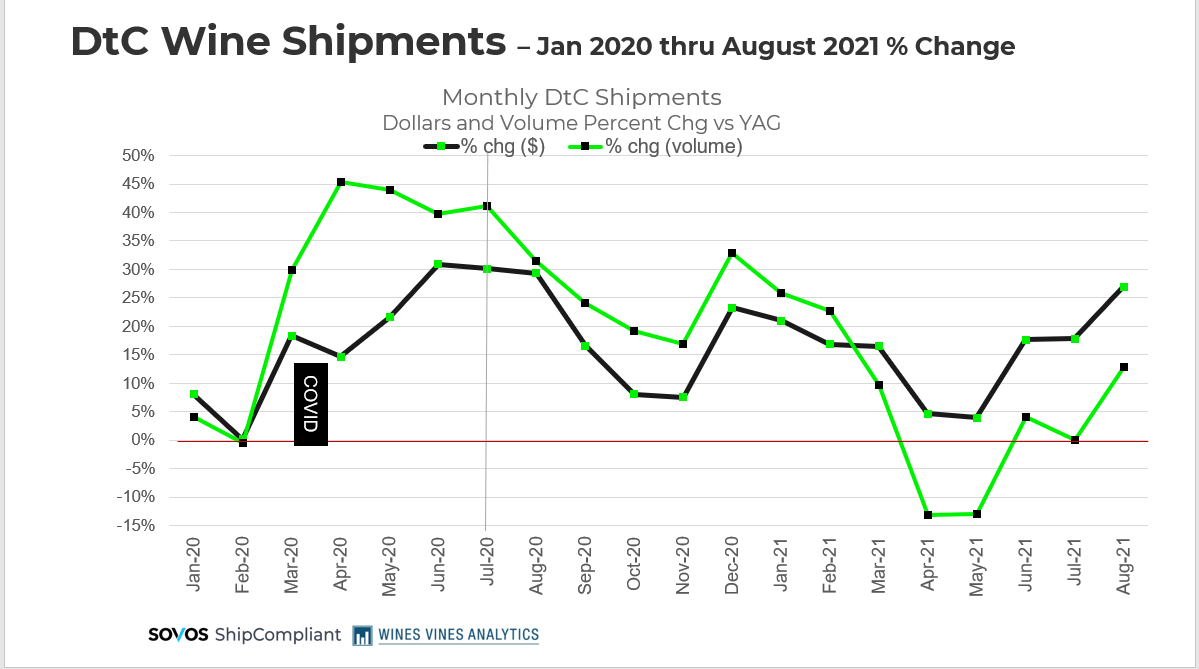


Interested in knowing more (e.g., by price tiers, varietals, origin, winery size, geography)? Contact Danny Brager at danny.brager@nielseniq.com.
Check out our 2021 Direct-to-Consumer Wine Shipping Mid-Year Report to learn about what happened in the DtC shipping channel between January and June 2021.
Sparkling product registrations leads the way, with 23% spike in Q3 2021
As the summer months wind down, beverage alcohol consumers are not halting their buying patterns. While the third quarter of 2021 saw decreases in new product registrations when compared to Q2, numerous categories show continued increases over the last year, largely in wine and spirits. Sovos ShipCompliant reviewed data from our Product Registration Online (PRO) tool to gauge how market conditions and consumer buying patterns influenced producers’ new product registrations.*
The following is a breakdown of the new product registration data via PRO from the third quarter of 2021 (July, August, September) for wine, spirits and beer.
Wine new product registrations were down by 8% last quarter, but up 9% over last year. Sparkling registrations led with a 23% increase over Q2 and a 58% surge over the same period last year. Red and Rosé wine registrations also saw modest increases over last quarter and last year, with 6% and 12% growth, respectively.
Fruit and Dessert wine registrations were down 82% over last quarter and also dropped 77% over the same period last year. Sake also dropped over last quarter (78%) and over the same period last year (83%).
White wine registrations had a 12% dip over last quarter but were up by 7% over the same time last year.
Overall, product registrations in the spirits category were down by 32% over last quarter, but up by 10% over last year. Vodka registrations grew both quarter-over-quarter (13% increase) and year-over-year (65% increase).
Among spirits product registrations:
The beer/malt category saw decreases in product registrations both quarter-over-quarter and year-over-year. However, Malt grew 9% over last quarter and had a 25% spike over last year. Beer was down 30% over last quarter and had a 34% drop over the third quarter of 2020.
*Product Registration Online (PRO) data encompasses nationwide label/brand registrations by PRO users. Product Registration Online processes some 100,000 state registrations annually.
Learn how PRO enables fast, easy electronic brand filings for wine, spirits and beer brands in participating states.
Find Sovos ShipCompliant at the 2022 OWS, March 8-9 in Portland, Ore. Booth info to come. We hope to see you there!
Direct-to-consumer (DtC) alcohol shipping laws vary from state to state, and that fact holds true for importers looking to enter the DtC business. While importers can be treated similarly to other members of the “supplier” tier (e.g., wineries, breweries), they are often treated differently in federal and state regulations.
Because of how DtC shipping laws tend to be written, there are few options for alcohol importer DtC shipping. This is especially true for businesses licensed solely as importers (only holding an Importer’s Basic Permit from the TTB and that have no state-issued production/manufacturing licenses).
Only a small handful of states (Kentucky, Nevada, New Hampshire, West Virginia and Wyoming) explicitly permit importers to ship alcohol DtC. Along with these licensing restrictions, “not of own production” (NOOP) laws make it extremely difficult for importers to ship DtC.
For example, importers that do not qualify as either a “producer” or a “retailer” on their own are almost entirely excluded from states’ alcohol DtC shipping laws. However, many domestic wine producers also act as importers for wines from around the world. This approach works well within the context of the three-tier system, but faces challenges in DtC shipping. A U.S.-based winery can get licensed in most states to ship their own products, but then must then contend with various states’ wine production and DtC shipping laws when it comes to shipping the wine brands they serve as an importer for. These laws can vary from one state to another, meaning the importing winery will need to pay close attention to ensure that they remain compliant.
Another option is for importers to get a retail license in addition to their importer license in the state they operate in. From there, importers can ship DtC to other states that permit DtC shipping by retailers. However, most states do impose trade practice restrictions that would prohibit an importer from also holding a retail license. Even where allowed, many states require retailer licensees to also open a physical store and sell inventory to customers that visit the location, which can be an expensive and cumbersome requirement.
For importers’ DtC alcohol shipping prospects to improve, states will need to change their DtC shipping laws to either extend more explicit permissions for importers or to remove some of the restrictions that limit the ability to DtC ship imported products. There will need to be more direct allowance for importers to get the necessary DtC shipping license. For example, New Hampshire’s law could serve as an example for other states, as it permits “any person currently licensed in its state of domicile as a wine manufacturer, beverage manufacturer, importer, wholesaler, or retailer [may] apply for a direct shipper permit.” Removing NOOP restrictions could also expand the number of imported products that could be shipped DtC.
Even with limited options for DtC alcohol shipping, importers looking to expand their business into a new area should consult with legal counsel or their compliance software provider to ensure that all compliance regulations are followed.
Learn more about managing your DtC alcohol shipping compliance.
By Tom Wark, Executive Director, National Association of Wine Retailers
The effort to open more states for interstate wine retailer-to-consumer shipments is multi-pronged. One prong—perhaps the most important—is the effort to overturn discriminatory state laws by using the federal courts to challenge state laws that violate the U.S. Constitution’s dormant commerce clause as well as the teachings of the 2005 Granholm v. Heald and the 2019 Tennessee Wine v. Thomas Supreme Court decisions.
Currently, there are eight states where lawsuits have been filed in federal court with another state’s laws set to be challenged in the near future. In each of these cases, the arguments being made are similar.
The Granholm v. Heald Supreme Court case made clear that a state’s alcohol laws may not pursue legitimate state interests through discrimination against out-of-state economic interests without demonstrating with concrete evidence that no alternative, non-discriminatory options exist. The Tennessee Wine v. Thomas decision confirmed that this principle applies to retailers in addition to producers.
In nearly every instance when these lawsuits are filed in federal court, the state’s wholesalers petition the court to “intervene” in the case, making them defendants along with the state. This means those challenging the law find themselves up against the state and the state’s wholesalers.
Both the state and the wholesalers argue that:
Wineries, beginning more than two decades ago, went through a very similar set of arguments in lawsuits challenging identical discriminatory laws aimed at out-of-state wineries. They prevailed in the Granholm v. Heald case. When states began to change their laws to accommodate the ruling, those laws were written to exclude and discriminate against out-of-state retailers. It was argued that Granholm only applied to producers, not to retailers. The Court answered this question in Tennessee Wine v. Thomas when it directly discredited that view.
The eight lawsuits working their way through various federal courts are aimed at overturning the discriminatory laws that keep consumers in a number of states from accessing wines they want by having them shipped from out-of-state retailers. It should be pointed out that in no state is it illegal for a consumer to purchase wine from an out-of-state retailer, but rather it is illegal for the consumer to have the wine they legally purchased be shipped to them. This is an important distinction as the state and wholesalers often argue that states’ three-tier system requires wine to only be sold by retailers that obtained their inventory from an in-state wholesaler. However, purchases from out-of-state retailers don’t implicate a state’s three-tier system since one state’s three-tier system does not govern another state’s licensees.
Below is a list of the various lawsuits that are currently working their way through the courts.
ARIZONA (9th Circuit)
TheWineToBuy.com v. Cocca
Status: Awaiting a response from the state to the suit filed by plaintiffs including an out-of-state retailer and Arizona consumers.
INDIANA (7th Circuit)
Chicago Wine Company v. Holcomb
Status: The case, brought by Illinois retailer Chicago Wine Company and Indiana consumers, was dismissed on summary judgment by the District Court and has been appealed to the 7th Circuit Court of Appeals.
KENTUCKY (6th Circuit)
Tannins v. Cameron
Status: Amended Complaint filed with District Court.
MISSOURI (8th Circuit)
Sarasota Wine Market v. Schmitt
Status: Appealed to the U.S. Supreme Court via a Petition for Certiorari after the case was dismissed by 8th Circuit Court of Appeals. Decision expected in October 2021.
NEW JERSEY (3rd Circuit)
Weg v. Graziano
Status: District Court briefing due by November 1. Decision expected in late Spring 2022.
NORTH CAROLINA (4th Circuit)
B-21 Wines v. Stein
Status: Dismissed by the District Court; currently on appeal to the 4th Circuit Court of Appeals.
OHIO (6th Circuit)
Block v. Canepa
Status: Discovery and summary judgment briefs due this fall. Decision expected in Spring 2022.
RHODE ISLAND (1st Circuit)
Anvar v. Tanner
Status: District Court considering a motion to add additional consumer plaintiffs.
It is generally agreed that in most cases, the U.S. Supreme Court waits to see different decisions on a single issue from two circuit courts before it takes a case. This was the strategy that brought Granholm to the Supreme Court, as well as the Tennessee Wine decision. It is the strategy being employed in the retailer shipping cases. This explains why retailer shipping suits have been filed in states belonging to seven different circuit courts of appeal.
Expect to continue to hear a great deal about these lawsuits going forward since their outcome is likely to have a significant impact on the structure of the alcohol beverage industry.
Earlier this year, SB 307 was enacted in Nevada, effectively eliminating the right for Nevada residents to receive direct-to-consumer (DtC) shipments of beer and spirits from producers, or any alcoholic beverage from out-of-state retailers.
Previously, Nevada DtC alcohol shipping permissions were among the most open, with the state allowing breweries, distilleries and retailers to sell and ship their products directly to Nevadans. In this move, however, the government has determined its residents should be denied access to broad swaths of the national beverage alcohol market.
Notably, though, the permissions for DtC shipping of wine by wine suppliers remain in effect, so Nevada residents can continue to enjoy that market.
Interpreting Nevada’s DtC alcohol shipping laws has never been that straightforward. The rules, found in NRS 369.490, are derived from the state’s personal importation laws, which set out when and how Nevada residents can carry in limited quantities of alcoholic beverages when they return home from out of state. Under those laws, there has historically been permission for the Nevada residents to both remotely submit an order for alcohol (e.g., online or through a club) and to have the alcohol shipped back to their home through a third-party carrier. Other chapters in the Nevada statutes then set out the broader compliance requirements that vendors selling and shipping under those provisions would have to abide by, including getting the necessary licenses and paying state taxes.
For years the statutes enabled DtC selling and shipping permissions for all “alcoholic beverages” and by all authorized “vendors” of alcohol. SB 307 diminishes this well-established framework by instead setting out that:
In effect, this means that only wine may be shipped DtC into the state, and only by domestic wine producers. Breweries, distilleries and retailers, who had been getting licensed and paying taxes on their sales for years, must now cease their DtC operations in the state.
This does align Nevada with most other states in allowing DtC shipping of wine only by wine producers. However, it is a disappointing reversal of recent trends to establish a broader market for DtC shipping of all alcoholic beverages. Surveys consistently find that consumers increasingly want greater access to DtC shipped alcohol and are frustrated with laws that restrict that access. That a state would reverse course and determine to shut down an existing market should be upsetting to those residents who had previously enjoyed its benefits.
Years of experience with the DtC wine shipping demonstrate that it is a healthy and safe market, with a broad commitment to compliance by those engaged in it, and which can be very lucrative to both the sellers and states (as they get lots of tax revenue from sales that otherwise would not occur). By providing an alternative route, DtC shipping enables consumers to access a vastly expanded list of available alcoholic beverages, primarily those small-batch or highly allocated products that generally cannot get the attention of wholesalers for distribution in a state’s three-tier system.
However, that safe, compliant market can only exist where states enable it to exist by enacting laws that establish a venue for legal DtC shipping. History—especially the so-called “great experiment” of Prohibition—shows that making sales does not eliminate those sales, but instead shoves them into dark corners where only those who are already happy to break laws can profit.
Nevada’s law change will not eliminate illegal or improper shipments of alcohol into the state, but will only prohibit those who want to do it right from being able to do so. In the end, Nevada residents will be the ones most harmed, as they now lose their direct access to breweries, distilleries and retailers around the country who had previously been able to sell and ship products that are otherwise unavailable for sale in the state. Meanwhile, brewers, distillers and retailers will continue to be able to ship into the other states that still grant them such permissions.
Nevada residents, though, should be heartened that their ability to have wine shipped to them DtC remains mostly in place. This would seem to be a great moment for them to reach out to their favorite domestic wineries and exercise their still existing rights.
Find out how ShipCompliant can help retailers, breweries, distillers and wineries manage DtC shipping.
Direct-to-consumer (DtC) shipping of alcohol requires producers, shippers and retailers to stay compliant with numerous rules and regulations. Tax determination and reporting is one of those key areas, and also presents a unique challenge to shippers.
Regulations on DtC shipping require shippers to recognize and manage a tax burden that is much broader than if sales were happening through a state’s three-tier system. This includes a state’s excise taxes, based on the volume of sales made, and a state’s sales taxes, based on the value of sales made.
When producers want to ship alcoholic beverages DtC to a particular state, they generally must obtain a shipping license or permit for that state. As a condition for getting a license or permit, states require the prospective shipper to assume a sales tax liability, regardless of the number of shipments or annual revenue they make in the state. A state will also require the applicant to agree to the jurisdictional authority of that state, meaning the shipper will have to abide by any notices or penalties issued by the state for failure to comply with their shipping laws.
DtC shippers, having agreed to abide by the jurisdiction of the states they ship into are also subject to generally applicable tax laws, which states amend frequently. For example, the 2018 South Dakota v. Wayfair, Inc. Supreme Court decision can present DtC shippers with additional tax liabilities in certain circumstances.
Each state can determine its own sales and excise tax rates, exemptions and remittance processes. With the 21st Amendment, states have even more power to tax and regulate alcohol at their discretion. Once sellers are registered for sales tax with a state, they must continue submitting returns indefinitely, even when no sales tax is due, until the seller shuts down their business operations in that state.
Depending on the state, wine may be taxed at a different rate than other items (e.g., food, general merchandise) or may even not be subject to sales tax. For example, Maryland taxes alcohol at 9%, while general merchandise is taxed at 6%. In Massachusetts, alcohol is exempted from sales tax when it has had excise tax paid on it. Imagine how increasingly complicated it becomes to remain compliant as wineries (or other producers) expand to more states and are managing sales tax manually.
Much of the complexity comes down to making numerous sales in a single state with lots of different, variable sales tax rates. Colorado is the prime example of this, as tax rates can vary depending on which side of the street you are on. Other states are more straightforward, with just one tax rate across the board.
Sales tax rates can also be set at the state, county, city or special district level. With over 12,000 jurisdictions in the U.S., this creates an extremely complicated sales tax burden. Additionally, from July 1, 2020 to July 2021, there have been 640 rate changes implemented by tax authorities.
Sellers are also required to remit all taxes they’ve collected to the state. Once a seller has calculated and collected the correct amount of sales tax from consumers, it is time to file the appropriate returns and remit all of the taxes they’ve collected to the state. This is where those numerous tax jurisdictions come into play again. Filing processes can vary from state to state.
As wineries, breweries, cideries and distillers all enter the DtC shipping market, recognizing their additional tax liability in each state they will ship into is an important first step. From there, it’s a matter of monitoring state excise tax burdens, and knowing when obligations exist for sales taxes on purchases in their tasting room or other physical shops. States have also adopted economic nexus laws, which may mean new tax burdens or altered existing ones for DtC shippers.
DtC shippers have unique tax obligations that typically would be managed by a wholesaler or retailer in a three-tier distribution system. While tax determination and reporting are unavoidable, they can be managed with the right tools.
Take your DtC shipping to the next level. See how ShipCompliant Direct can help with your DtC compliance processes, from license management to production requirements and tax determination and reporting.
DtC cider shipping can be complicated in that whether a state permits it often depends on how a state defines “cider.” Ciders are a general category of beverage alcohol products, made from fermented apples or pears, with a low to moderate alcohol content and often sold as an alternative to malt beverages.
In terms of legal definitions, though, ciders typically fall under the definition of “wine,” as generally wine is broadly defined to include the fermented products of all fruits, fruit juices, and other (non-malt) agricultural goods. However, some states do specifically exclude ciders from their definitions of wine, limiting wines to only grape-based products.
Currently, no state has a DtC law that specifically mentions ciders. As such, cider may only be shipped DtC if it is included among the types of beverage alcohol that are listed in a DtC statute. For the states that permit DtC shipping of all alcohol, it’s pretty easy to see that cider may also be shipped. For a state that limits DtC shipping to only wine, though, if that state treats cider and wine the same, only then may it be shipped under that state’s DtC wine shipping rules.
Similarly, if cider is defined to be regulated as a beer, then cider shipping would be permitted if that state allows for DtC beer shipping. Furthermore, some cider definitions depend on the alcoholic content of the cider, with higher ABV ciders falling under wine regulations and lower ABV ones being treated as beer, or even its own product type entirely.
Currently, 40 states and the District of Columbia permit DtC cider shipping under their wine shipping laws, as they define wines to be the product of fermenting any and all fruits and fruit juices, not just grapes. The other states, however, have specific restrictions on the shipping of cider.
Several states define ciders as a separate class of beverage alcohol depending on its ABV content. For example, New York defines “cider” as any apple or pear-based fermented beverage alcohol product with an ABV of 8.5% or less, and that is marketed as “cider.” Such products are distinguished from grape-based “wines,” and therefore are unable to be shipped DtC into New York as the state’s current DtC law is restricted only to “wine.” However, if a cidery does produce a cider with an ABV exceeding 8.5%, or they market their product as an “apple wine,” then it could be shipped DtC into New York.
Other states with similar restrictions on shipping ciders unless they exceed a certain ABV threshold include Georgia (6% ABV), Iowa (6.25% ABV), Maryland (8.5% ABV), South Dakota (10% ABV) and Tennessee (8.5% ABV).
It is also important to note that many of the states that permit DtC cider shipping require it be done by licensed manufacturers only under the state’s wine shipping rules.
As with other DtC alcohol shipping requirements, shippers should know that the following general list of rules will apply:
When looking to expand your DtC cider shipping reach, ensure that you properly interpret how each state’s rules apply to your individual circumstances. Complying with hard cider delivery requirements likely entails working with your legal counsel, compliance software provider or team, or even hearing about a state’s process firsthand from another cider producer.
Learn more about managing your DtC alcohol shipping compliance.
A recent review by the state of Idaho Alcohol Beverage Control (ABC) division’s legal team has conclusively determined that out-of-state retailers have no permission to ship any beverage alcohol products direct-to-consumer (DtC) in the state. This determination reverses previous interpretations of Idaho’s laws, which had been understood to permit such shipments
As the DtC wine shipping market continues to grow, interest in engaging in the market also grows. While it is well established that wine producers are now able to ship to 47 states plus the District of Columbia, there is still a lot of uncertainty about who else can engage in the DtC channel, with particular interest coming from off-premise retailers.
When researching who can ship what where, it is critical to thoroughly understand the rules of the destination state and apply the rules as determined by that state’s regulators. And it is important to understand that those determinations are subject to the reasonable interpretations of those regulators.
The basis for any state’s DtC laws comes from their statutes, the laws as established by their legislature. Idaho’s DtC laws are found in statute 23-1309A, which set out the licensing, tax and other compliance requirements for wineries to ship DtC into the Gem State.
Found within that statute is section 7, which reads:
“A licensee who holds a license for the retail sale of wine for consumption off the licensed premises may ship not more than two (2) cases of wine, containing not more than nine (9) liters per case, per shipment, for personal use and not for resale, directly to a resident of another state if the state to which the wine is sent allows residents of this state to receive wine sent from that state without payment of additional state tax, fees or charges. The sale shall be considered to have occurred in this state.”
This provision establishes when and how an off-premise retailer can ship wine to Idaho residents.
Historically, section 7 was interpreted to establish a “reciprocal” retail DtC relationship, wherein Idaho would permit retailers to ship DtC to their residents as long as those retailers were in a state that granted Idaho retailers similarly open shipping permissions. Essentially the only restrictions were that the retailer:
Under that interpretation, it was understood then that a reciprocal relationship existed among Idaho, California and New Mexico, as those states seemed to permit retail DtC shipping of wine without additional licensing and tax obligations. (See CA BPC 23661.2 and NM Code 60-7A-3(E).)
Admittedly, Idaho’s law was never 100% clear, and the right of out-of-state retailers to ship into Idaho had to be read backwards, starting with the line about, “if the state to which the wine is sent allows residents of this state to receive wine sent from that state,” and interpreting from there. Seemingly, this statute would only work if there was an existing right for Idaho residents to receive wine shipped by retailers in other states.
However, that is not the conclusion as determined by the Idaho ABC. After a thorough legal review made upon our request, they have ruled that statute 23-1309A only provides that Idaho residents may receive wine shipped from retailers located within Idaho, and any mention of shipments by retailers to another state are to establish Idaho as the venue where the sale occurs (even if that may contradict the laws of those other states, which generally do indicate that DtC shipments by licensed shippers are designated to occur in those states for legal and tax purposes).
There is also the broader question of whether it is constitutional for a state to permit local retailers to ship DtC while prohibiting out-of-state retailers from doing the same. However, the prevailing jurisprudence is that what may not be allowed regarding wine manufacturers may be permitted for wine retailers.
While it is unfortunate to see a state restrict the right of their residents to purchase wine from the national market of wine retailers, it is the duty of being in a highly regulated market to respect and comply with the rulings of regulatory authorities. We can hope that Idaho will amend its laws in the future to enable legal shipping of wine from out-of-state retailers. Until then, going forward the understanding is that Idaho is now closed for out-of-state retailers looking for further DtC shipping destination states.
Find out how ShipCompliant can help retailers manage DtC shipping.