Summer is winding down and the wine landscape continues to fluctuate in response to the pandemic. Staying mindful of marketplace data will ensure the industry can properly adjust to any ebbs and flows, helping wine producers, retailers and consumers alike.
Nielsen is collaborating with Wines Vines Analytics and Sovos ShipCompliant to provide a much more comprehensive view of the U.S. off-premise wine category than ever previously available, with a data product that enables both separate and combined views of retail off-premise sales and DtC shipments.
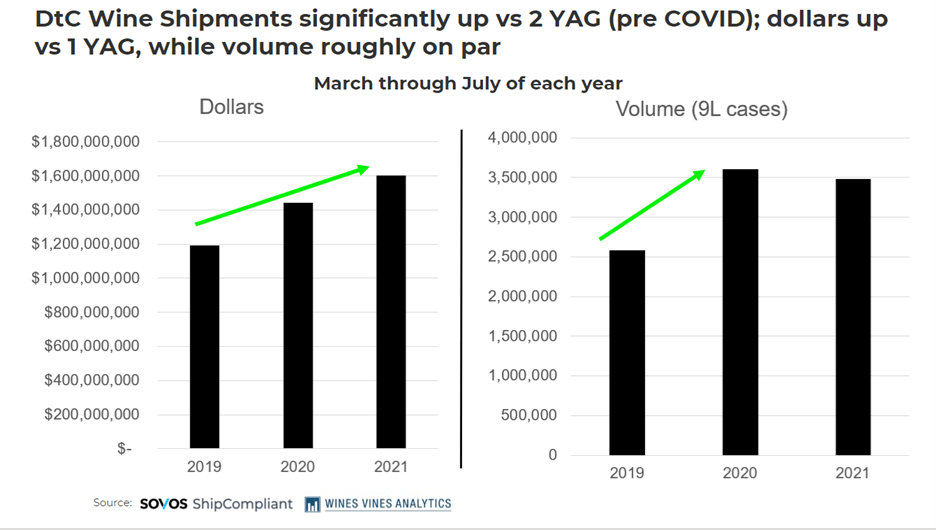
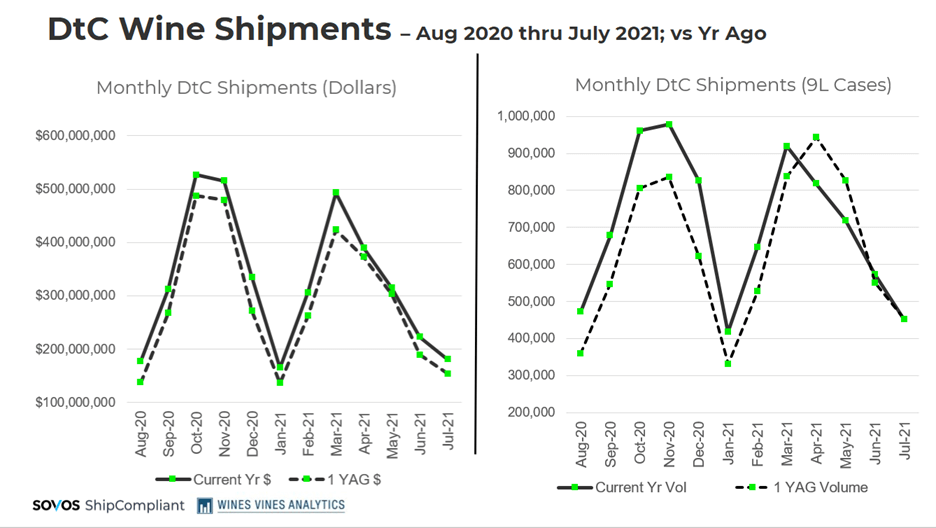
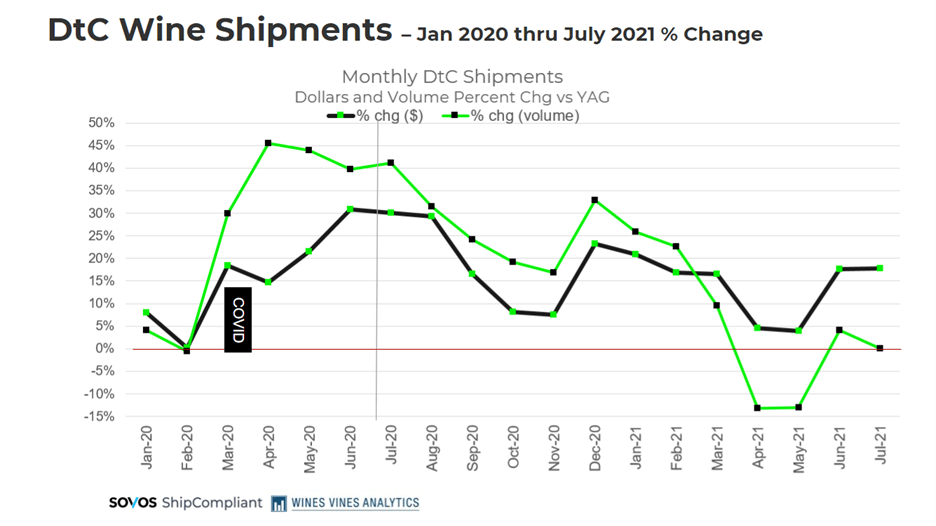
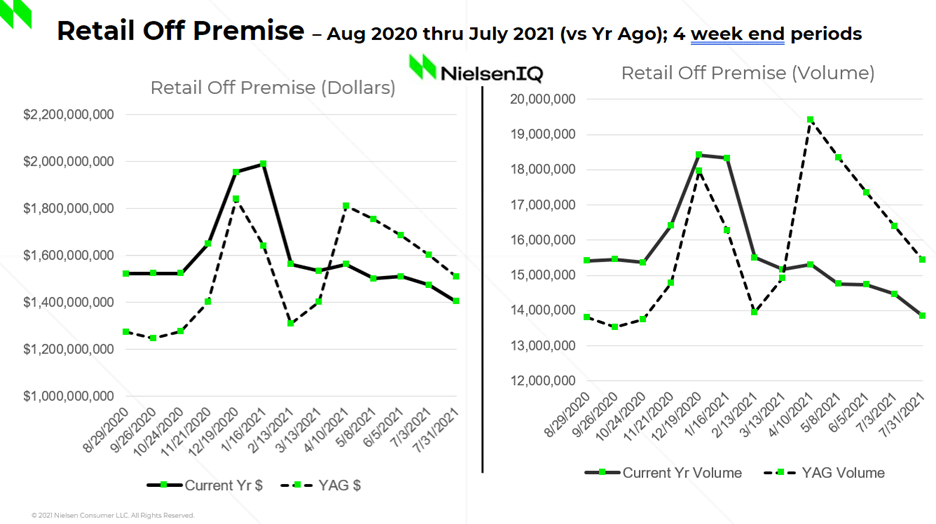
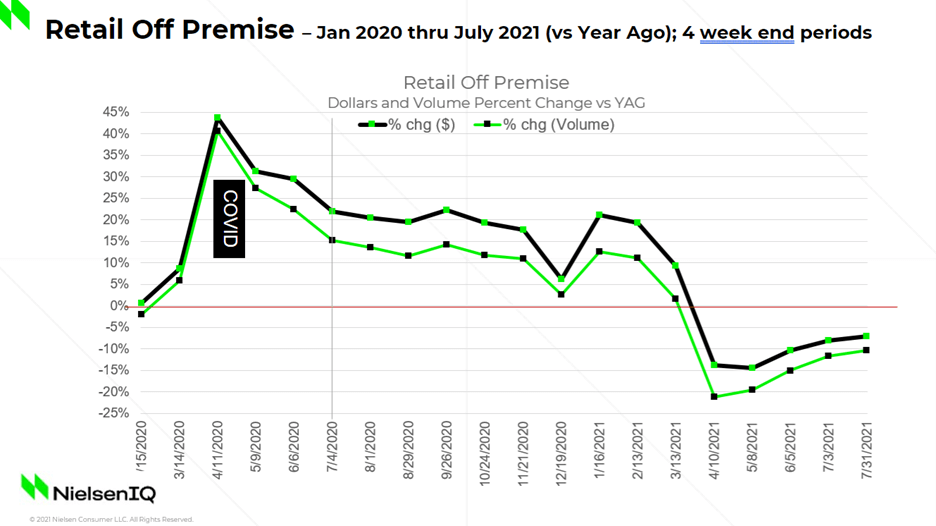
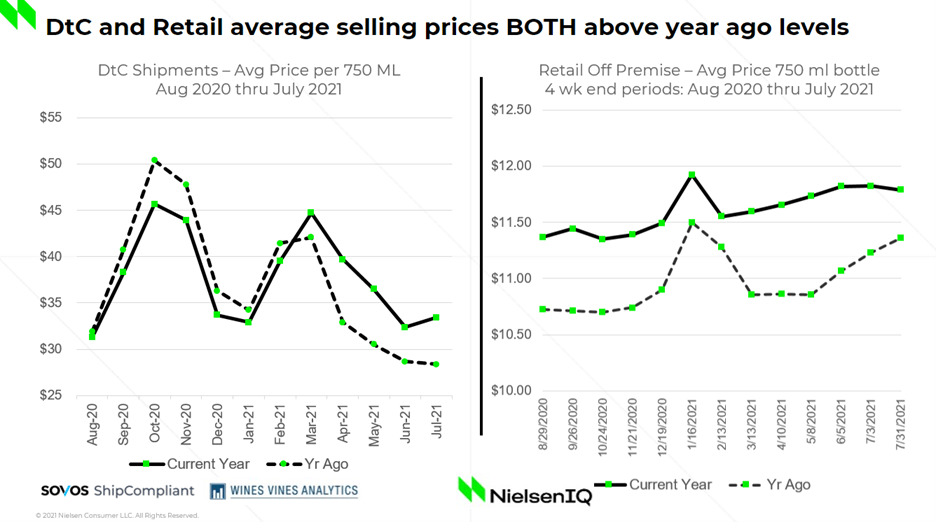
We are now comparing to COVID-impacted periods from last year, with the on-site tasting room business continuing to return. Volume growth fell double digits versus a year ago for the second consecutive month. The DtC shipment channel is proving to be considerably more resilient than wine sales in retail off-premise. The average bottle price shipped is well above the levels we saw one year ago (and is closer to the DtC average bottle prices of 2 years ago) – to almost $5 more than levels from one year ago.
Here are some highlights from the most recent data, along with commentary from Nielsen consultant Danny Brager.
DtC Shipments (H4)
Retail Off-premise (H4)
Interested in knowing more (e.g., by price tiers, varietals, origin, winery size, geography)? Contact Danny Brager at danny.brager@nielseniq.com.
Check out our 2021 Direct-to-Consumer Wine Shipping Mid-Year Report to learn about what happened in the DtC shipping channel between January and June 2021..
Understanding brand ownership and self-production requirements
We’ve previously discussed how direct-to-consumer (DtC) shipping of alcohol has numerous requirements and regulations for producers and retailers. Everything from getting licensed to brand label registration details to age verification protocols must be considered. But what happens when an alcohol producer (e.g., a winery, brewery, distillery or cidery) wants to ship alcohol that they did not produce? Many states limit the brands that a DtC shipper can sell, with these “not of own production” (NOOP) rules restricting shipping alcohol that a licensee does not own.
Generally, producers should only sell what they’re authorized to sell, whether that be brands they produce themselves or those that they act as authorized brand dealers for. However, many DtC wine shipping laws were designed with the intention of enabling small wineries to enter a state’s market even if they were unable to access the state’s three-tier system. As such, it was often seen that DtC shipments would be limited to the “own production” of a winery. If a winery produces the wine, then it could ship it DtC.
This quickly becomes complicated by the fact that many wineries are not one house production facilities. Wineries can be part of large and complicated companies that operate under lots of names and brand labels manners. Additionally, many act as importers for foreign wines. This then butts up against the roughly 20 states that do have some kind of NOOP rule limiting what brands may be shipped DtC.
While not every state limits the brands that a DtC licensee can ship to their residents, each state that does has its own nuanced definition of what qualifies as “not of own production,” and what brands a producer can legally ship. Tracking these rules requires following the clear chain of ownership established from the party that was actually manufacturing it.
A major concern with NOOP laws is recognizing what entity will hold the necessary DtC license. Often, states with NOOP laws will require licensees to identify a specific address or location tied to an individual license. In the most strict NOOP scenarios, that state will say that only products produced specifically at that licensed premises can be shipped DtC. Even if that premises is under the same ownership as other facilities, it can only ship DtC what it produces.
Let’s say a winery has a production facility in Modesto, California but has facilities in other cities. What is considered “produced” by that winery? In that most strict interpretation, it is just the wine made at the main production facility. But another state could have a more lax approach to its NOOP law, allowing the company to hold a single DtC license for all their facilities and to ship everything they produce. Because these rules vary in how states interpret them, it’s important for producers to understand that level of nuance for each state in which they want to operate.
Some states interpret these regulations more broadly, allowing that “anything you own” can be shipped DtC. Essentially, you don’t have to be producing the wine to sell it. A licensed DtC shipper could sell brands that they import or redistribute. However, they must be the primary American source, or at least an authorized brand owner. If that same winery in Modesto imports wine from Chile, but acts as the importer of record and has its name on the Certificate of Label Approval (COLA) documents, it potentially could still ship the imported wine DtC, depending on how the state’s NOOP laws are written.
While DtC shipping laws were first created for wine, we now have other product types entering the market. While most of the considerations for NOOP rules will apply equally to all wine, beer, spirits and cider, there are some unique scenarios for producing and distributing beer that could conflict with NOOP rules.
For example, beer collectives have become increasingly popular recently. In this scenario, brewers in different states will band together and agree to act as local distributors of each others’ beers. However well this might work for three-tier sales, it is very likely to be problematic if that collective begins to ship DtC as a single entity in states with NOOP laws. Brewers in a contract brewing relationship will need to watch out for similar NOOP considerations.
Overall, states wanted to ensure that alcohol producers are shipping only to the end consumer and are using the DtC model to shore up what that consumer might not be able to get through a state’s three-tier system. As such, many states do limit what you can ship to only what you produce. However, it is always important to understand each state’s individual reading of their NOOP laws so you know exactly which brands you can ship where.
Take your DtC shipping to the next level. See how ShipCompliant Direct can help with your DtC compliance processes, from license management to production requirements and tax determination and reporting.
A review of the passage of House Bill 1545, also known as the 2019 TABC Sunset Bill, has compelled the Texas Alcoholic Beverage Commission (TABC) to majorly revamp their alcohol license process and fees. The following changes are set to be effective September 1, 2021.
Texas is moving from 75 to 37 licenses and permits, which includes the elimination of 14 licenses/permits and 24 licenses/permits being consolidated into others. Going forward, a business should only need one license/permit to carry out all of their business activities in Texas, opposed to the several licenses/permits they may have needed in the past.
Additionally, these changes have led to a shift into a new Alcohol Industry Management System (AIMS). The new license structure and fees will be in the AIMS online system launching on September 1, and the eliminated licenses/permits will not exist in AIMS. Licensees should make sure they can access their accounts to prepare for any changes to their licenses that might occur during the next renewal period. Please note that all active licenses will remain active until their set expiration dates.
The following changes are occurring to specific licenses:
The TABC has published additional information regarding the consolidation of licenses and updated fees.
As always, Sovos ShipCompliant will continue to monitor for any further changes made by the Texas Alcoholic Beverage Commission.
Ready to learn more about your licensing requirements? Find out how ShipCompliant License Management can help you gain visibility into vital licensing and renewals information.
Direct-to-consumer (DtC) shipping continues to grow in popularity, something that has not gone unnoticed by retailers. While alcohol producers enjoy broad access to the DtC shipping market, there are nuanced alcohol retailer DtC shipping laws and regulatory rules for compliance.
A key consideration for retailers looking to ship alcohol DtC is recognizing the states that will permit them to ship in the first place. Next, it is important to note that the types of alcohol permitted for retailer DtC shipping vary by state. For example, Connecticut, Florida, West Virginia and Wyoming only permit retailer DtC shipping for wine sales. In Oregon and Virginia, DtC beer and wine sales are permitted.
Of course, there are many more rules and requirements imposed on retailers engaged in DtC shipping of alcohol. Retailers must take note of state-specific requirements as they look into either starting or expanding their DtC shipping operations.
We’ve outlined the basics of retailer DtC shipping laws below.
Twelve states and the District of Columbia currently allow for retailer DtC shipping.
However, each state and Washington, D.C. have their own compliance rules that govern the interstate shipping of alcohol directly to consumers. For example, 10 states require the retailer to receive a license, three operate under a “reciprocal” process and two states don’t require a specific license. Retailers must ensure they adhere to all rules and regulations as they look to expand into a new area.
The same way that state requirements vary in what types of alcohol can be shipped, there will also be state-by-state sales tax rates. Some states have a single state-wide sales tax rate while others have a combination of state, county, city and special district rates. Sales tax filing requirements can also be different from one state to the next. A state could require paper format, electronic filing or a combination of the two.
Retailers should also be aware of excise tax as they look into DtC shipping. Shippers are often required to remit the excise tax on a product that would have been levied had the product been sold through a distributor. Retailers must also meet this requirement when they are permitted for DtC alcohol shipping into a state.
As retailers explore out-of-state DtC shipping they should keep themselves informed of every detail, especially as the bev alc industry continues to evolve. Working with the right partner can help keep the retailer DtC shipping experience as seamless as possible.
Learn more about managing your DtC alcohol shipping compliance.
Brand label registration is an essential part of the process of selling alcohol. And while many suppliers are aware of these requirements for three-tier distribution, they can often overlook them when it comes to direct-to-consumer (DtC) shipping.
Alcohol labels, whether on a bottle, can or keg, have lots of information that is highly regulated, both at the federal level and within the individual states. There are rules about both what information is required on a label, such as the brand name and identification of the supplier, and information that is prohibited, such as specific health claims. To monitor whether an alcoholic beverage’s label is proper, state and federal regulations require each label to be approved and registered with the relevant regulatory agency for it to be sold.
Remember that DtC shipments are still a sale of alcohol, meaning that it is a type of sale that falls under the brand label registration requirements. Whether you are entering into DtC shipping for the first time or are expanding into new states, ensure that you abide by all applicable brand label registration requirements.
We’ve compiled the basics of brand label registration to help you understand how to best maintain compliance as you work in the DtC shipping world.
The Alcohol and Tobacco Tax and Trade Bureau (TTB) is the primary organization that polices beverage alcohol brand labels. The TTB designates what must be on a label and what cannot be on a label. With some notable exceptions, the TTB reviews every beverage alcohol label prior to sale.
Certificate of Label Approvals (COLAs) ensure that suppliers and producers comply with federal regulations when marketing and designing alcohol labels. Under the Federal law, most alcoholic products being distributed across state borders must first be registered with the TTB and receive a COLA before they can be sold.
There are some exceptions to COLA requirements. Wine products with an ABV of 7% or less are excluded entirely from the COLA process, and beers that are sold only in the states where they are produced are not required to get a COLA. However, since DtC shipments often are made into other states, that makes them subject to the COLA requirement. As such, it is important for DtC shippers to make sure they have all necessary COLAs for their products before they begin shipping.
Most states also have their own brand label registrations, which are often required for three-tier distribution. While most states require brand registration to sell to local wholesalers, many of them waive the requirement for DtC shippers. However, there are plenty of states that still do need a brand registration prior to shipping, so DtC shippers should make sure to look into any such requirement when they are entering a new state. State brand label registrations typically require providing a COLA (except of course when a COLA is unavailable) and paying a fee.
Often, an existing registration for three-tier distribution will count for a DtC registration. So generally, there is no need to double up. However, this is not the case in all states. DtC shippers should be particularly aware of Wyoming and Louisiana , both of which permit wineries to sell a product in either the DtC or wholesale channels but not both. In these states, if a product is registered for sale in the three-tier market (or the control market, in the case of Wyoming) then that product cannot also be shipped DtC.
Check out our full list of state-by-state rules for wine distribution within the three-tier system.
Retailers should note that they are generally exempt from brand registrations as they lack the proper ownership or authorization needed to register brand labels. However, there are some states that require retailers to have written authorization from the brand owner to ship a product direct to-consumer. Retailers shipping alcohol DtC should be aware of states that require them to get authorization from brand owners to conduct DtC shipping in that state. For example, Virginia requires retailers to have written permission from brand owners to ship their products DtC in Virginia.
Brand label registration requirements are just one more thing for a business to recognize and research into as they expand their DtC shipping presence.
Take your DtC shipping to the next level. Download our eBook, DtC Alcohol Shipping Essentials: Getting Started & Staying Compliant, for more insights.
Wine and beer new product registrations also see positive growth in Q2 2021
The beverage alcohol industry continues to fluctuate as it accounts for varying consumer buying patterns, due in large part to the COVID-19 pandemic. The second quarter of 2021 saw positive growth in new product registrations, with the spirit category leading the way. Sovos ShipCompliant reviewed data from our Product Registration Online (PRO) tool to gauge how market conditions and consumer buying patterns influenced producers’ new product registrations.
The following is a breakdown of the new product registration data via PRO from Q2 of 2021 (April, May, June) for spirits, beer and wine.
The spirits category also continues to spike in the wake of the pandemic, with product registrations surging 112% over last year and up 46% over last quarter. The huge year-over-year growth was largely driven by rum and vodka.
Whiskey registrations are up 78% over Q2 of last year and grew 68% over last quarter. Gin is still the smallest spirit category by number of registrations in Q2 but spiked 214% over last year and saw a more modest 12% increase in product registrations over last quarter.
Rum product registrations grew 82% over last year and 41% over last quarter, while tequila had the smallest registrations growth in the spirits category of 25% over last year and 9% from last quarter. Vodka registrations climbed 137% year-over-year and 36% over last quarter.
Overall, product registrations in the wine category were up 23% over last year, but down 12% versus last quarter. Only Sake and Sparkling registrations grew over last quarter; all categories except Red and Rosé grew over last year.
Fruit and dessert wine (the largest category by number of registrations in Q2) increased 64% over 2020, but were down 15% compared to Q1.
Red and Rosé were flat year-over-year and each decreased 19% quarter-over-quarter.
White, Sake and Sparkling product registrations saw year-over-year increases of 11%, 240% and 24%, respectively. White decreased 6% quarter-over-quarter, while Sake and Sparking had 70% and 25% quarter-over-quarter increases, respectively.
The second quarter of 2021 saw continued growth for product registrations in the beer/malt channel, with a 4% increase over last quarter and a 15% year-over-year climb. Beer was a key driver for that growth, up 31% over last quarter and 33% over last year. However, malt (hard seltzers, etc.) registrations were down by 15% over last quarter and are flat over last year.
Learn how PRO enables fast, easy electronic brand filings for beer, wine and spirits in participating states.
Following the January release of our annual Direct-to-Consumer Wine Shipping Report in partnership with Wines Vines Analytics, consumers continue to make changes in how they get their wine. With the economy still working to rebound in the wake of the COVID-19 pandemic, ecommerce sales have remained important. On-premise locations, including bars, restaurants and tasting rooms, are once again opening back up to full capacity, but consumers have realized that DtC shipping is a convenient, choice-filled option for purchasing wine.
Comparing numbers from January 1, 2021 to June 30, 2021 with the same six-month period in 2020, volume growth was minimal but both value and bottle price were up. This is largely due to the period in 2020 seeing unusually high growth, with demand driven by pandemic lockdowns. The DtC channel saw 4.09 million cases shipped in overall volume, an increase of 1.9%, with notable differences between months. The months before the vaccine was widely available (Q1) each realized double digit growth in volume over 2020. April and May both saw decreases of 13%, but June grew 4%. Again, this is mainly due to March, April and May 2020 seeing significant pandemic-driven growth, making it difficult to match and/or exceed those numbers.
Overall DtC shipment value increased by 12.2%, for a total of $1.89 billion. Every month showed an increase over last year, with January the strongest at 20.9%, followed by June, February and March (17.6%, 16.8%, and 16.5% respectively). April was slower at 4.6% and May was close behind at 4.0% year-over-year growth.
Average bottle price climbed 10.1%. By comparison, the first half of 2020 saw average price per bottle down 10.8% versus 2019. Specifically, the first half of 2020 average bottle price was $34.98, while in 2021 it was $38.50.
Following is a deeper dive on the DtC shipping channel since January.
The top five destination states for the first half of 2021, in descending volume order, were California, Texas, New York, Florida and Washington. All of those states saw volume growth over last year. Despite growing volume by 3.4% year-over-year, Washington dipped from fourth place to fifth. Florida’s volume increased by 10%, pushing its ranking from sixth to fourth. Pennsylvania experienced a year-over-year decrease in volume (-16.9%) and fell from the fifth spot to sixth.
Newly opened (as of December 2020) Kentucky is ramping up in 2021. The Bluegrass State received almost 2,200 cases in the first quarter and 4,100 cases in the second quarter. Kentucky ended the first half of the year with $1.9 million in value shipped to the state.
Notably, only Oregon increased volume shipped DtC every month for the first six months of 2021. While January and February were strong months across the board, all other regions saw decreases in April and May. However, value over all six months increased in every region, with especially strong growth in Oregon (21.3%), Central Coast (19.2%) and Napa (13.5%) regions, but there was not a consistent pattern across regions.
By volume, Sonoma County is the leading region, accounting for 2.8 million cases of wine in the past 12 months or 33% of the entire DtC channel. Sonoma County wineries also saw the largest volume increase, 20%, compared to last year.
The first half of 2021 saw the largest wineries (those producing 500,000 or more cases) with the largest volume growth at 9.7%, along with value growth of 10.9%. Medium-sized wineries (those in the 50,000-499,000 annual case production range) fared the worst in both value and volume: Volume decreased by 14.9% and value was flat year-over-year, a perhaps unsurprising retreat given the difficulty of sustaining the massive shipment levels driven by the pandemic during the same period in 2020. Other winery sizes saw between 10.9% and 16.6% value growth.
After large wineries, the biggest increase in volume was among small wineries, those in the 5,000-49,999 case production range, at 8.4%. This is followed by the very small wineries tier (1,000-4,999 case production), which increased by 5.6%. Finally, the very limited winery size category (<1,000 cases) decreased in volume by 4.1% (landing at 81,418 cases), but this segment is still leaps and bounds ahead of 2019 (55,012 cases).
For the first half of 2021, Red Blends, Cabernet Sauvignon, Chardonnay and Pinot Noir combined made up more than 50% of total wine volume shipped DtC, with $1.24 billion in value.
Sparkling enjoyed the largest year-over-year increase in both volume (up 30.3%) and value (up 41.1%), and accounted for 3.8% of total volume shipped. Cabernet Franc saw the second highest value growth at 28.7%, and Riesling was third at 24.9% year-over-year. Moscato and Pinot Grigio were the only varietals to decrease in value; they each decreased in volume as well.
Average bottle price grew 10.1% overall in the first half of 2021. Central Coast saw the biggest increase (39.1%, or an $11.13 increase) reaching $39.57. Napa regained lost ground on bottle price, landing at $66.58, which is a few cents above the 2019 average price per bottle. Sonoma was the only region with overall decreased bottle price, ending the first half of the year at $26.58, which is a few cents lower than the same period in 2020. Oregon crossed the $40 mark for the first time, hitting an average price per bottle of $41.15.
It’s impossible to precisely predict what will happen over the next six months and beyond with DtC wine shipping. The COVID-19 pandemic forced many wineries, producers, shippers and customers to pivot their approaches. Some of the changes will stick, while others will have only been temporary. Stay tuned for the full report on 2021 coming in January 2022. In the meantime, for a complete 2020 picture, download your complimentary copy of the 2021 Direct-to-Consumer Wine Shipping Report.
This data was compiled in partnership with Wines Vines Analytics, a leading source for wine industry data.
Our data partnership with Nielsen and Wines Vines Analytics makes possible the most complete category coverage, trends and insights with off-premise coverage, Nielsen retail sales and DtC shipments data all in one place. Learn more.
Want a comprehensive look at the DtC wine shipping channel in 2020? Download the 2021 DtC Wine Shipping Report today.
Most states have direct-to-consumer (DtC) wine shipping laws, but you must follow the rules of the destination state when doing it. States can have varying requirements and limitations when it comes to licensing, product restrictions, dry communities or even volume limits for how much a given customer can receive.
For example, Massachusetts restricts licensees from shipping no more than 12 cases per individual per calendar year, but Colorado has no such volume restriction limits on licensees. Businesses must ensure that they carefully adhere to the rules and regulations of each state that they want to ship wine to — if they assume that two states have the same requirements, they could incur hefty fines or even have their license revoked.
Following are the basics of DtC wine shipping and key rules that shippers must adhere to in order to stay compliant.
Currently, 48 states and the District of Columbia has laws for DtC wine shipping, although Delaware and Rhode Island both severely limit the DtC shipment of wine. Mississippi and Utah prohibit DtC sales of wine (Alabama is set to begin permitting DtC wine shipments in summer 2021).
There are universal package label requirements for direct-to-consumer wine shipping. Any packages being shipped must have a label clearly identifying that the box contains alcohol and that a signature of a person aged 21 years or older is required for delivery.
Wine producers must adhere to the state-specific requirements when it comes to shipping DtC. Since state-by-state requirements vary, shippers should ensure that they are aware of the specific rules of the state they are shipping into. While no two states are exactly the same, shippers can base their research on the following list of general rules:
These rules and regulations may be commonly applied in states that allow DtC wine shipping but they may not always be in effect in each state. It’s also important to remember that rules and regulations can be applied with varying levels of strictness. Wineries and other suppliers of wine that want to ship in a new state should consult with the right experts who can properly interpret how the rules apply to individual circumstances. Reach out to your compliance team, legal counsel or another winery to help determine what your next steps in DtC wine shipping might be.
Learn more about managing your DtC alcohol shipping compliance.
Direct-to-consumer (DtC) shipping has numerous rules and regulations that shippers must adhere to in order to stay compliant. Customer aggregate volume limits (CAVL) discern how much of a certain type of alcohol a single licensee can ship in each period of time to select individuals within a state. CAVL can seem like a straightforward requirement for DtC shippers, but it is still an important one to be mindful of as it has specific local parameters.
CAVL rules exist to regulate the DtC alcohol shipping market and maintain the integrity of state-controlled alcohol distribution systems. These limits cap the number of alcoholic beverages a consumer can receive within a specific timeframe, thus supporting two main goals. The first is to encourage consumers to continue purchasing from local retailers instead of solely relying on DtC shipments. By setting volume limits on DtC alcohol sales, states aim to drive traffic to physical stores and reduce its impact on traditional retail channels.
The second reason behind CAVL is to preserve the three-tier distribution system. Without these volume limits, individuals might exploit direct shipping to resell alcohol, avoiding excise sales taxes and other controls managed by the Department of Alcoholic Beverage Control. States want to ensure that all DtC shipments are for final sales to the consumer and never intended for resale, and these limitations safeguard against unauthorized distribution within a jurisdiction.
CAVL requirements differ significantly across states, with limits often based on cases per month or per year. Commonly, states allow one or two cases per month, or around 12 to 24 cases annually. However, each state may define “a case” differently, depending on the beverage category.
| Alcohol Type | Standard Case Definition | Common CAVL | Variations by State |
| Wine | 9 liters (12 bottles of 750 mL) | 1–2 cases per month or 12–24 cases per year | Commonly used in most states; requires strict volume tracking |
| Beer | 288 ounces / (24) 12 oz. bottles OR 9 liters |
1–2 cases per month OR state-defined annual limits |
Beer shippers must confirm standards according to the destination state |
| Spirits | 9 liters (12 bottles of 750 mL) | Often similar to wine; 1–2 cases per month | Requires separate licensing in many states for DtC shipping |
| Cider | Varies (9 liters or 288 oz) | Aligns with beer or wine limits depending on alcohol content | Some states categorize cider with beer; others with wine Special attention is needed for state-specific classification |
State regulations also vary on whether CAVL applies per individual or per household. In some states, every adult in a household may be entitled to the full CAVL. In others, the limit applies collectively to the household, regardless of the number of legal drinking-age residents. For instance, a married couple in State A may each receive one case per month, while in State B, they must share a single case.
States also have different tracking periods set to regulate the volume of alcohol consumers can receive directly. These periods can impact how frequently consumers can place orders and how licensees manage their shipments to maintain compliance.
In many states, CAVL regulations are monitored monthly, setting strict limits on the amount of alcohol that consumers can receive every 30 days. Some states extend the monitoring period to 60 days, offering consumers greater flexibility in receiving larger shipments less frequently. In states with annual volume caps, DtC shippers must monitor alcohol shipments over a 12-month period.
Because state-specific CAVL regulations vary widely, alcohol shipping compliance across jurisdictions becomes a moving target. Taxes add another layer of complexity, as each state has its own approach to excise taxes and sales tax. Compliance software simplifies all of this by centralizing these rules, ensuring shipments meet local requirements whether a state imposes strict monthly limits or more flexible annual caps.
Once the regulations are clear, real-time tracking ensures you’re always ahead of potential issues. This ensures that every transaction is accurate, every tax obligation is met, and that shipments are always aligned with local laws.
Also, when your business is ready to expand into new states, effective compliance software scales with you. Each state brings new regulations to navigate, but with a system in place that adapts to these changes, growth becomes a natural next step. Whether you’re shipping wine, beer, spirits, or cider compliance software ensures your operations remain consistent and compliant, no matter where your customers are.
By addressing each layer of complexity, compliance management software transforms the daunting task of multi-state shipping into a streamlined, efficient process. It ensures every shipment is compliant, every tax is accurate, and every customer interaction is seamless—allowing shippers to grow confidently despite the challenges of multi-state shipping.
Download our eBook, DtC Alcohol Shipping Essentials: Getting Started & Staying Compliant, for more insights.
As we enter into the summer months, wine direct-to-consumer (DtC) shipments are still shifting in response to a tumultuous year. While the industry has largely righted itself, it remains essential to pay attention to marketplace data to keep pulse on that continued change.
Nielsen is collaborating with Wines Vines Analytics and Sovos ShipCompliant to provide a much more comprehensive view of the U.S. off-premise wine category than ever previously available, with a data product that enables both separate and combined views of retail off-premise sales and DtC shipments.
Even with comparing COVID-impacted periods from last year and with the return of on-site tasting rooms, the DtC shipment channel volume increased, reversing a two-month decline. Dollar growth has also remained positive and ahead of volume gains. Consequently, the average bottle price shipped rose again, close to $4 more than levels of one year ago.
Here are some highlights from the most recent data, along with commentary from Nielsen consultant Danny Brager.


Interested in knowing more (e.g., by price tiers, varietals, origin, winery size, geography)? Contact Danny Brager at danny.brager@nielseniq.com.
Download the Direct-to-Consumer Wine Shipping Reporting for an in-depth look at the 2020 DtC wine shipping market.
 By Milton Cornwell, COO, Copper Peak Logistics — a ShipCompliant Platinum Certified Partner
Why should it matter if your direct-to-consumer (DtC) fulfillment partner has multiple shipping facilities? We at Copper Peak have found that the question of multiple shipping facilities is a very misunderstood concept in the wine fulfillment business, especially when it’s called many things: bifurcation, forward staging and splitting inventory. Some wineries assume that multiple facilities means that the vendor is too big for them, or the concept is possibly too complex to undertake. Others worry about tax and shipping compliance laws.
Here is the main thing to consider when talking to a fulfillment partner with more than one warehouse location: How will this help your winery achieve its goals of greater customer satisfaction, faster speed to market and better provenance for product shipments?
We have been making the case for two warehouse locations since our launch in 2007 and now more than ever with the continued growth of DtC sales across the United States.
Today’s customers are accustomed to Amazon and other retailers offering two-day shipping on just about anything. But if you have a winery in California, there’s no way to ground ship to the East Coast in that timeframe.
Enter bifurcation. With bifurcation, a proportion of your inventory is sent to a second location that is more centrally located in the middle of the country for storage. When orders are processed, they are packaged and shipped from the location that is closest to its end destination, thus achieving a faster delivery to market.
There are several key benefits to bifurcation:
Improve time in transit (TNT): A multiple location strategy allows you to greatly reduce the time in transit for packages, typically reducing East Coast orders from five days down to two days. That does a lot to keep your customer promise and increase customer satisfaction.
Cost savings potential: Of course, if you are already using next day or two-day air for east of the Rockies shipments, you will not improve TNT, but you can maintain the same performance by using ground service. This factor can generate big cost savings, sometimes as much as 30% to 35% on shipping cost (additional savings can be had as this does not account for fuel surcharges, which are historically charged at higher fees for air service versus ground service).
Better weather management: Forward staging at a second facility also minimizes some of the risk to your product due to weather issues and handling by the carriers. The less time on the road, the better for sensitive products like wine and some craft beverages.
Address supply chain bottlenecks: The explosion in ecommerce sales activity has created a strain on carriers. It is well documented that delivery performance issues have crept up, and by splitting the order flow to multiple facilities, there is an inherent benefit by spreading the activity. This is especially true during the holiday periods, when DtC shipping volume leaving Northern California hits its peak demand.
So, if you really are focusing on the customer delivery experience as part of your business model, it would be better to use forward staging with ground shipping everywhere in the country. We’ve had clients tell us that this enables them to offer promotions to increase brand loyalty, too. For example, it is much easier to throw in a reduced shipping offer, thus encouraging ecommerce sales.
All that said, using multiple shipping locations will require some additional planning ahead to make sure enough product is located in each location to prevent out-of-stock situations. But if you are willing to do that kind of planning with your wine fulfillment partner, the benefits are definitely worth it.
For example, here are some things to consider when contemplating multiple shipping locations:
Executing a multiple location strategy might be the smart move to get your chosen brands into the hands of your customers more quickly, more safely and at a more affordable rate that can encourage additional sales growth.
Since 2007, Copper Peak Logistics has been Northern California’s premier direct-to-consumer wine fulfillment service, offering craftsmanship fulfillment to small/medium sized wineries and craft beverage producers. They focus on the human touch, white glove service, and honoring commitments. The Copper Peak team helps develop creative solutions to enhance your brand and their proprietary software manages the complexities of direct-to-consumer shipping. With facilities in both the Napa Valley and St. Louis, your wine is never more than two days away from your customers and is delivered cost effectively and perfectly packaged. If you have any questions about a multiple facility strategy, or you would simply like to learn more about the new Copper Peak Logistics St. Louis facility and how it can reach most customers in two days, contact Copper Peak.
Last updated: November 19, 2024
When it comes to direct-to-consumer (DtC) liquor shipping laws by state, distilleries and other spirits producers must adhere to shipping laws of the destination state. It is also important to remember that just because a state allows DtC beer shipping or DtC wine shipping, it does not necessarily mean that it allows DtC liquor shipping.
For example, Ohio allows DtC beer shipping but DtC liquor shipping is currently illegal. A distillery might see that DtC beer or DtC wine shipping is allowed into a particular state, but that is not a guarantee that the same state will allow for DtC-shipped liquor.
Distilleries and spirit producers must also stay current on all federal and state laws, as they can change over time. In April 2020, Kentucky passed a statute enabling the DtC shipping of spirits. Then in 2021, Kentucky passed a bill removing a previous provision prohibiting DtC alcohol shippers from using third-party fulfillment houses to help with their shipping logistics needs.
We have outlined the basics of DtC liquor shipping and key rules that shippers must adhere to in order to stay compliant.
As of November 2024, nine states and the District of Columbia allow DtC liquor shipping.
It’s also universally required that any packages being shipped have a label clearly identifying that the box contains alcohol and that the signature of a person aged 21 years or older is required for delivery.
Similar to DtC beer shipping and DtC wine shipping, distilleries and spirit producers must adhere to the state-specific requirements when it comes to shipping DtC. Some of these requirements might vary from state-to-state, but shippers should ensure that they are aware of the following rules:
Remember that while these rules and regulations are commonly applied, they are not always in effect in every state that permits DtC shipping of spirits. They can also be applied with varying levels of strictness. When you are looking to ship in a new state, consult with experts who can properly interpret how the rules apply to your individual circumstances. Specifically, your compliance team, legal counsel or another distillery could help you determine your next steps in DtC spirits shipping.
Download our eBook, DtC Alcohol Shipping Essentials: Getting Started & Staying Compliant, for a comprehensive guide to understanding and navigating liquor shipping laws.
Preventing alcohol sales to minors is a fundamental responsibility for any business in the beverage alcohol industry. It is illegal in every state to sell alcohol to anyone under the age of 21, regardless of where or how the sale occurs. So, for direct-to-consumer (DtC) shipping of alcohol in the United States, implementing age verification protocols is crucial. Even accidentally provisioning a minor with alcohol can get a business into serious hot water.
Every state enforces some type of age verification requirement, ranging from at-delivery ID checks to point-of-sale (POS) verification. Failure to comply can result in significant fines or even the loss of your shipping license. To help you navigate these rules and ensure your age verification process is compliant, we’ve compiled the essential information you need to keep your brewery, cidery, distillery or winery operating within the law.
An age affirmation gate is a feature that prompts online visitors to confirm they are of legal drinking age before accessing your website, shopping cart or mobile app. By requiring users to verify their age before even before they attempt to purchase alcohol, you set the right tone for all interactions with potential customers. Although these gates are often criticized for being easy to bypass, they serve an important purpose for businesses in the beverage alcohol industry.
Age affirmation gates act as a clear reminder to consumers that your products are intended only for those of legal drinking age. They also demonstrate your commitment to complying with laws that prevent underage access to alcohol. While there are more robust methods of verifying a consumer’s age, which we’ll discuss further, every business selling or promoting beverage alcohol online should incorporate an age affirmation gate as a basic compliance tool.
For DtC shipments of alcohol, it is required by law that the carrier check the recipient’s ID and collect the signature of an adult over the age of 21 at the time of delivery. This rule applies to all alcohol shipments in the United States, with no exceptions.
While the responsibility for this process falls on the carrier, if the carrier fails to collect the signature or check the ID, the licensed shipper may still be held liable. Therefore, it’s critical to partner with a reliable alcohol shipping carrier that has a solid track record of adhering to DtC alcohol shipment regulations.
Packages containing alcoholic products must never be left unattended on a consumer’s doorstep or porch. Instead, they must be handed directly to an individual whose age has been verified by the carrier. Communication is key here—licensed DtC shippers should coordinate with consumers to ensure someone over 21 will be available to receive the package at the time of delivery.
Each state also has its own alcohol packaging label requirements and shipping laws for shipping directly to consumers. These regulations serve to alert carriers that they must follow strict protocols including age verification. It’s important to make sure your DtC shipments are properly labeled according to the state laws for the package destination.
When implementing an age affirmation tool on your website, online store or mobile app, it’s a best practice to also collect the date of birth (DOB) of the purchaser during the transaction process. This is often done when the customer adds alcoholic beverages to their shopping cart, ensuring compliance with age verification laws.
In the case of gift shipments, the purchaser may not always know the recipient’s DOB at the time of the transaction. While it’s not always necessary to collect this information immediately, businesses should have processes in place to follow up and obtain the recipient’s DOB before the shipment is sent. This ensures full compliance with age verification requirements while maintaining a smooth customer experience.
Many states including Hawaii, Michigan and Wisconsin require licensed shippers to submit detailed shipment reports, which may include the purchaser’s and/or recipient’s DOB. Others, like New York, may only require the purchaser’s DOB for audit purposes. Even in states with less stringent requirements, maintaining DOB records is crucial for ensuring compliance and avoiding legal issues during audits.
Most states require shippers to retain shipment records for at least two years, but it’s generally recommended to keep this data for three to four years to cover any potential audit period. Since DOBs are considered personally identifiable information (PII), businesses must securely store this data to comply with privacy regulations like the California Consumer Privacy Act (CCPA).
To further ensure that alcohol sales are restricted to adults, online age verification services offer an additional layer of protection. While common carriers will verify the recipient’s age upon delivery by checking their ID and obtaining a signature, businesses can go a step further by verifying the purchaser’s and recipient’s age (if different) at the time of purchase. This is especially valuable for gift orders, where the purchaser and recipient might be different individuals.
It is recommended that everyone selling alcohol, including licensed DtC shippers, make time-of-sale age checks standard practice. While online age verification for alcohol shipping is available across the country, it is currently only a requirement in the following states:
Remember that even if a sale to a minor happens inadvertently, it is still illegal, and the seller can be charged. Ignorance or oversight is not an acceptable defense—and state regulators take the sale of alcohol very seriously. In addition to facing fines and penalties, businesses that violate age verification laws may lose their alcohol distribution licenses, effectively shutting down their ability to operate within the industry.
For these reasons, it’s critical to implement strict age verification protocols at every stage of the transaction—from the point of sale to the moment of delivery. Businesses can confirm a purchaser’s age by requesting a valid ID through a trusted third-party age verification service.
Providers like LexisNexis and IDology use public records to cross-reference the purchaser’s name and address with data confirming that the individual is over 21. Comprehensive compliance platforms like ShipCompliant Direct incorporate age verification directly into their automated systems, simplifying the process for businesses to adhere to regulatory requirements. This integration helps ensure that age checks are seamlessly conducted, making it easier to stay compliant with legal standards and reducing the risk of costly penalties.
Download our eBook, DtC Alcohol Shipping Essentials: Getting Started & Staying Compliant, to get everything you need to navigate the complexities of shipping wine, beer, spirits, cider and sake.
Direct-to-consumer (DtC) beer shipping laws require abiding by the rules of the destination state. While those rules can be similar from one state to the next, there are always key differences between them that producers and other shippers should know. Two states can each allow DtC beer shipping but may have varying requirements and limitations when it comes to licensing, product restrictions or dry communities.
For example, Alaska allows DtC beer shipping but there are currently 78 dry cities and counties where the sale of alcohol is prohibited. A producer could ship beer into Alaska, but not to a customer who resides in one of those dry communities. Other states that allow DtC shipping of beer, though, have no dry areas, leaving the entire state open for sales.
We have outlined the basics of DtC beer shipping and key rules that shippers must adhere to in order to stay compliant.
Currently, 12 states and the District of Columbia allow DtC beer shipping:
It’s also universally required that any packages being shipped have a label clearly identifying that the box contains alcohol and that a signature of a person aged 21 years or older is required for delivery.
Under the principles of the 2005 Supreme Court decision Granholm v. Heald, any state that permits DtC shipping of alcohol by local suppliers must also extend that privilege to out-of-state suppliers. While Granholm specifically dealt with wineries, the same principles apply to the beer market. After Granholm, states developed a framework of rules under which they would enable out-of-state parties to make DtC shipments of alcohol. Generally, these rules require shippers to:
While this set of rules and regulations are commonly applied, note that they are not always in effect in every state that permits DtC shipping of beer, nor are they always applied with the same level of rigor. When you are looking to ship in a new state, consult with an expert who can properly interpret how the rules apply to your individual circumstances. For example, what is permissible under your brewery license doesn’t affect DtC shipping laws. Those laws are outside of and beyond the scope of your home state beer production/tasting room permissions. Your compliance team, legal counsel or even another brewer could help you determine your next steps in DtC beer shipping.
Learn more about managing your DtC alcohol shipping compliance.
As direct-to-consumer (DtC) shipping of alcohol has become an increasingly valuable market for suppliers and manufacturers over the last many years, regulatory restrictions in states have hampered the ability of certain parties to enjoy the same benefits. However, with the passage of HB 110 in Ohio, recently signed into law by Governor Mike DeWine, a key limitation on wine DtC shipping will soon go away.
Currently, Ohio will only issue a license for DtC shipping to wine manufacturers that produce less than 250,000 gallons of wine annually (and as we know, holding an active license is often a prerequisite for DtC shipping of alcoholic beverages). HB 110, though, contains a key provision establishing a new S-2 type DtC shipping license that will be available to wineries producing more than 250,000 gallons of wine per year. An S-2 type license will have an initial cost of $250, with an annual renewal fee of $100.
The changes in HB 110 are set to become effective on September 28, 2021.
This change will create a two-tier schema for DtC shipping of alcoholic beverages in Ohio, with smaller-scale wineries and beer manufacturers operating under the existing S-1 DtC shipping license, while larger-scale wineries will require a new S-2 type license. But the availability of this new license is very good news for the DtC wine shipping industry and Ohio consumers as many more wineries that were previously excluded from the Ohio market will soon be able to ship there.
Notably, the DtC compliance rules for S-1 permit holders are unchanged by HB 110, so wineries and breweries currently shipping DtC to Ohio consumers should not see any adjustments to their current regulations. Wineries that will soon ship under a S-2 license will also be required to abide by the established regulations on S-1 licensees, including making good faith efforts to verify the age of purchasers at the time of sale, selling only wines that they directly manufacture themselves, and collecting and remitting all applicable Ohio sales and excise taxes.
In addition to establishing the S-2 DtC shipping license for larger-scale wineries, HB 110 creates new provisions for fulfillment houses servicing shipments to the state. These new provisions echo similar new rules established recently in Tennessee and Kansas. Under these provisions, fulfillment houses are required to register with Ohio prior to fulfilling shipments of alcohol and must file an annual report of the shipments they serviced. Type S-2 licensees using fulfillment houses will be required to only use those fulfillment houses that abide by Ohio’s new regulations.
HB 110 also makes clear that the S-1 and S-2 type DtC shipping licenses are only available to wine or beer manufacturers, and not to businesses licensed as retailers in Ohio or other states. This provision is notable in light of action by Ohio over the last couple of years, under the 21st Amendment Enforcement Act, to crack down on apparent shipments by unlicensed businesses.
The change to Ohio’s DtC wine shipping laws to allow larger-scale wineries to join the market has been a long time coming, and reflects the ongoing efforts by groups such as Free the Grapes! and Wine Institute to effect positive change for the DtC shipping market. A similar restriction in New Jersey, restricting wineries that produce more than 250,000 gallons of wine annually from DtC shipping there, is also targeted for change. We all certainly hope that New Jersey will soon follow the lead of Ohio and remove this barrier on New Jersey residents’ ability to fully enjoy the benefits of an open, though regulated, DtC wine shipping market.
Find out how ShipCompliant Direct can help with your DtC compliance processes, from license management to real-time compliance checks and tax determination and reporting.
Entering the direct-to-consumer (DtC) alcohol shipping market is an exciting opportunity to expand your business’s reach and serve customers directly. However, shipping directly to consumers comes with a unique set of legal hurdles. Before a single bottle can legally cross state lines, the very first step is to secure the correct licenses.
But here’s the catch: licensing requirements vary significantly from state to state. This can make compliance a complex web to navigate. From paperwork to renewal deadlines and background checks, there are plenty of steps—and potential pitfalls—along the way. To make the journey smoother, we’ve outlined the essentials to get licensed and stay compliant, plus the risks of falling short.
If you’re seeking a DtC alcohol shipping license, you likely already have an alcohol-related license, such as a permit for operating as a winery or a retailer. However, to legally ship alcohol directly to consumers, you’ll need to ensure you’re complying with the specific requirements for DtC shipping in each state.
When preparing to obtain your DtC alcohol shipping license, start by asking yourself some key questions:
Pro tip: Since states may review dozens or even hundreds of applications at a time, completing the process can take several weeks or even months. Having all your documentation prepared ahead of time can help expedite the process and avoid unnecessary delays.
Holding a DtC alcohol shipping license allows you to legally ship alcohol to a state’s residents—whether you’re shipping beer to consumers in Ohio or shipping wine to a customer in California. Each license is state-specific, meaning that every state requires its own license for each type of alcohol. Additionally, each state has specific compliance rules, such as shipping limits, labeling requirements and tax obligations, that must be strictly followed to maintain compliance.
It’s important to remember that the consequences of non-compliance with DtC shipping requirements can be serious and will continue to grow the longer that you wait. These risks can include cease and desist orders, fines and extreme monetary penalties, and even refusal of renewal or complete revocation of your license.
States are increasingly cracking down on non-compliant DtC alcohol shipping, especially as demand surges. Many states are now leveraging the 21st Amendment Enforcement Act, which enables them to seek federal injunctions against out-of-state businesses that violate their laws. Additionally, any compliance failures by your DtC shipping partners may also reflect on your business, leading to potential legal consequences.
Choosing the right approach to manage licensing can make a significant difference in the efficiency and success of your alcohol shipping strategy. The process requires careful organization and an understanding of each state’s unique regulatory framework. To help you tackle these challenges, here are three popular ways to manage DtC licensing, each tailored to different business needs, resources, and compliance goals.
| Approach | Description | Pros | Cons |
| DIY | Self-managed approach where you handle all research, documentation and filing independently. | – No external costs involved – Direct control over the process – Ideal for limited-state DtC shipping |
– Time-consuming, especially for multi-state shipping – High risk of missing state-specific requirements – Requires ongoing tracking for renewals |
| Hire a Consultant | Outsourcing all licensing tasks to a professional compliance consultant who manages the entire process on your behalf. | – Saves time and reduces compliance workload – Access to expertise and regulatory insights – Reduced risk of errors in applications |
– Often more expensive than other options – Limited direct control over the process – May require ongoing consultant fees for renewals |
| Hybrid | A mix of hands-on work and automation using software like License Management to organize requirements and track progress. | – Balances efficiency with control – Software provides state-specific guidance – Simplifies tracking of documents and renewals |
– Some manual effort still required – Initial costs for software – May need additional support for complex compliance needs |
Given the complexity of DtC shipping laws and the risk of non-compliance, partnering with an experienced compliance provider can be invaluable. The right partner can guide you through licensing requirements from the start, helping you navigate the regulatory landscape and freeing you to focus on growing your business.
Gain all the insights you need to navigate the complexities of shipping wine, beer, spirits, cider and sake. Download our eBook, DtC Alcohol Shipping Essentials: Getting Started & Staying Compliant today.
When it comes to direct-to-consumer (DtC)-shipped alcohol boxes, there are requirements from all destination states to label all such boxes to announce that they contain alcohol and must be signed for by someone 21+. This has been the case for DtC wine shipments, and is also true for DtC beer shipments and DtC spirit shipments.
Both FedEx and UPS also have specific requirements for DtC shipping labels. FedEx states the following:
UPS also has specific requirements for shipping wine as described on their website:
UPS also states on its website that it “provides service for other alcoholic beverages (beer and spirits) on a contract basis only. For shipments containing beer or spirits, shippers must enter into an approved UPS agreement for the transportation of beer or spirits as applicable, must be licensed and authorized under applicable law to ship beer and spirits. UPS accepts shipments of beer or spirits only among and between selected states.”
Some companies use DtC-specific boxes pre-printed with the required information, while others use stickers. The overall requirement is that, however the notice is affixed to the package, it must be clear and prominent, in a manner that will inform the carrier of their duties to check ID at the time of delivery and get a signature from someone over the age of 21.
All states require the label on all DtC-shipped alcohol boxes to announce that they contain alcohol and must be signed for by someone 21+. For example, California’s shipping restrictions state that, “All packages containing wine must clearly have a label stating: ‘CONTAINS ALCOHOL: SIGNATURE OF PERSON AGE 21 YEARS OR OLDER REQUIRED FOR DELIVERY.’”
New York has similar requirements for wine specifically: “Packages containing wine should have a conspicuous label stating “CONTAINS WINE – SIGNATURE OF PERSON AGE 21 OR OLDER REQUIRED FOR DELIVERY – NOT FOR RESALE”
Fewer states allow DtC shipping of beer, but the requirements for having a label specifying the box’s contents are very similar to those shipping wine. Of the states that do allow DtC shipping of beer, it is typically similar to the following shipping restrictions:
The same is true for DtC shipping of spirits, requiring all packages of alcohol to be clearly labeled that they contain alcohol, requiring the signature of an individual who is 21+ and that only licensed carriers may deliver packages containing alcohol.
Remember that these rules are not a complete and definitive guide for DtC alcohol shipping, and are meant to help lead you in the right direction as your distribution expands. Consult with your compliance team, legal counsel, or even local alcohol producers and distributors in your state to properly interpret each state’s specific requirements.
Ready to take your DtC shipping to the next level? Find out what delivery management software can do for you.
Wine direct-to-consumer (DtC) shipments continue to shift as the marketplace works to regain stability after a difficult economic year. Staying mindful of marketplace data will ensure the industry can properly adjust to any ebbs and flows, helping wine producers, retailers and consumers alike.
Nielsen is collaborating with Wines Vines Analytics and Sovos ShipCompliant to provide a much more comprehensive view of the U.S. off-premise wine category than ever previously available, with a data product that enables both separate and combined views of retail off-premise sales and DtC shipments.
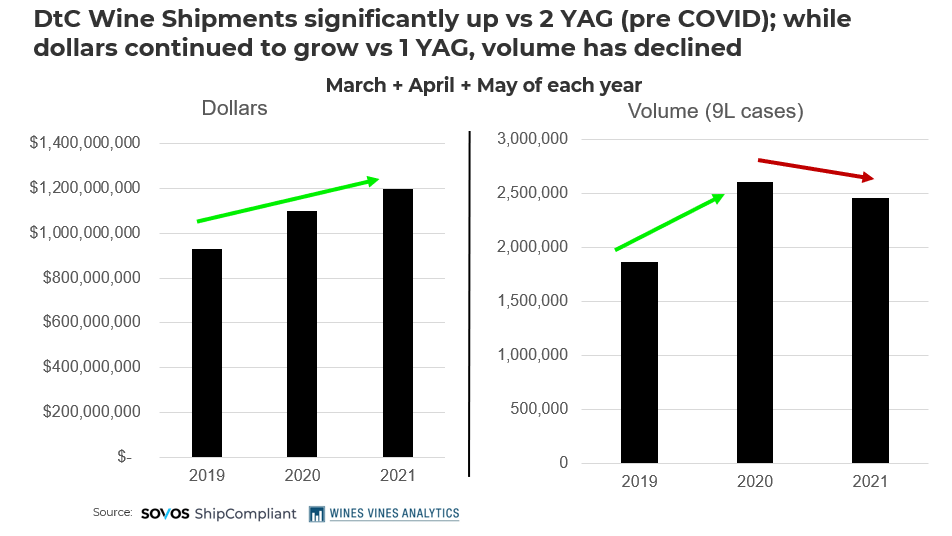
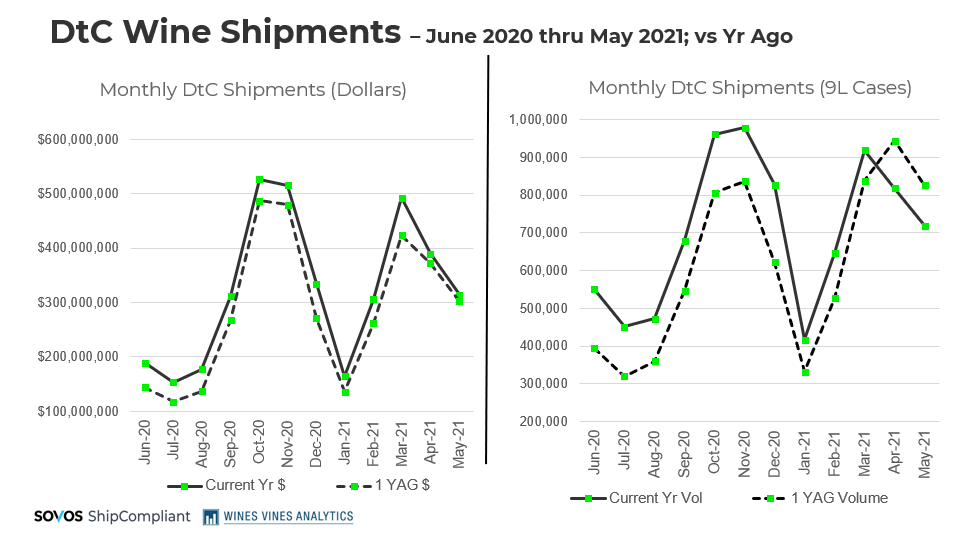
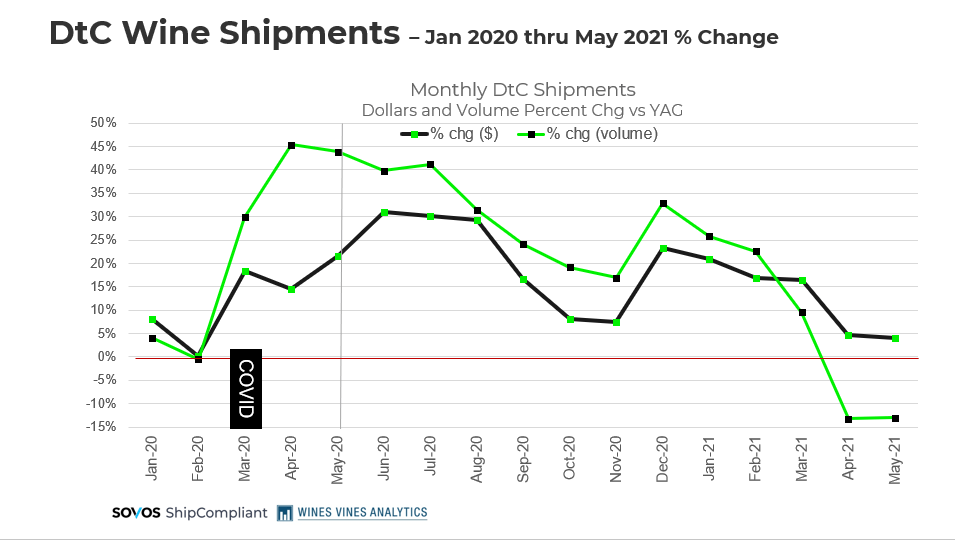
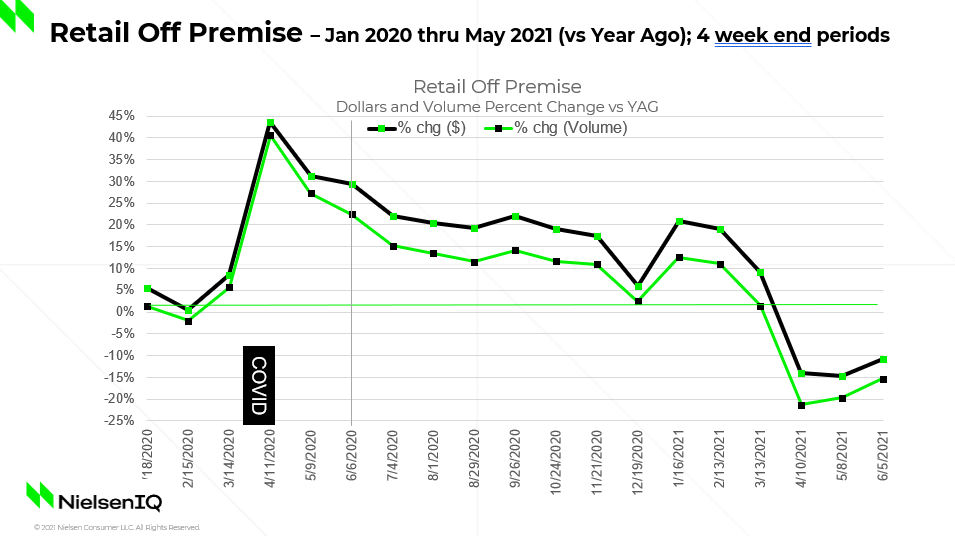
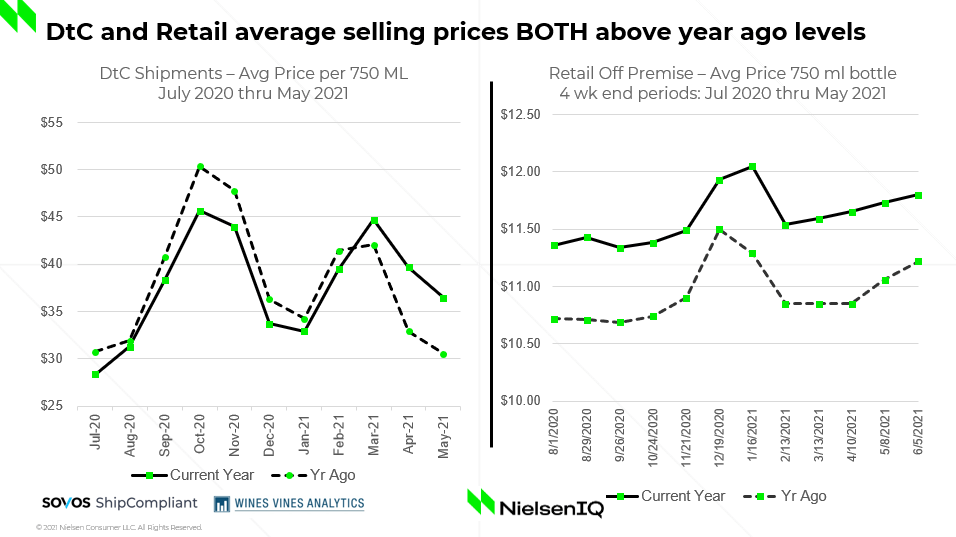
Similar to last month, we are now comparing to COVID-impacted periods from last year and the on-site tasting room business continues to return. Volume growth fell double digits versus a year ago for the second consecutive month. Like April though, May dollar growth was still positive. Consequently, the average bottle price shipped rose almost $6 versus levels from one year ago.
Here are some highlights from the most recent data, along with commentary from Nielsen consultant Danny Brager.
Interested in knowing more (e.g., by price tiers, varietals, origin, winery size, geography)? Contact Danny Brager at danny.brager@nielseniq.com.
Download the Direct-to-Consumer Wine Shipping Reporting for an in-depth look at the 2020 DtC wine shipping market.