 Can I really ship under your license?
The Louisiana Office of Alcohol and Tobacco Control (ATC) recently adopted new regulations governing the use of fulfillment houses by licensed direct-to-consumer (DtC) shippers of wine.
Fulfillment houses have become a central, and invaluable, part of the DtC wine shipping market by offering wineries with critical storage and logistical services. They provide climate-controlled warehouses to store wine until it is ready to be sold and have established packing and shipping facilities that many wineries, particularly smaller ones, may lack.
Fulfillment houses have become something of a bugbear for regulators of the DtC wine shipping channel. Because their address may be used as the deliver-from address on a packing label, it may appear as if they are they are the seller of record for the package, despite lacking the necessary licenses to ship into a state. This misapprehension (as fulfillment houses do not ever own or sell wine, they merely facilitate the shipping process for parties who are licensed to sell and ship wine DtC) has led several states to adopt restrictive licensing and reporting rules on fulfillment houses.
Louisiana, then, is merely the latest to adopt such regulations. Going forward, DtC wine shippers active in Louisiana will need to abide by these rules or face severe penalties.
The rules—as adopted into Louisiana Administrative Code, title 55, part VII, section 335—establish new notice and reporting requirements for DtC wine shippers and their fulfillment house partners.
Specifically, all new and renewing applicants for a Direct Ship Permit issued by the ATC will now be required to disclose all fulfillment houses they have authorized to handle shipments going to Louisiana.
This disclosure will occur during the application process using a specific form set out in the regulations. The applicant will need to list the name and address of any fulfillment houses that will ship wine on their behalf and swear under penalty of perjury that all of their shipments of wine to Louisiana will be done either in-house or by the appointed fulfillment house(s).
In addition, the applicant must provide a copy of a written appointment letter providing authorization for the fulfillment house(s) they have appointed to service shipments to Louisiana.
Louisiana has moved most of its licensing services online, and it is expected that this new form will be added to that platform in time for the annual renewal period for Direct Ship Permits, which expire annually on December 31.
The regulations also add a new reporting requirement for the fulfillment houses themselves. Each quarter, by the 15th of the month, every fulfillment house engaging in the shipping of wine to Louisiana will need to file a report to DTCReports@atc.la.gov detailing each shipment they have made in the previous quarter. As of this writing, the ATC has not yet published this report or otherwise provided information on what data the fulfillment houses will need to submit.
Importantly, the regulations set out that fulfillment houses will be deemed as agents acting on behalf of the DtC shippers they service. This means that any failures on the part of a fulfillment house (including failure to file the quarterly report) will be imputed onto the licensed DtC shipper. As with any violation of a state’s alcohol laws, that can lead to severe fines and penalties, including loss of license.
In 2021, several states adopted licensing and reporting requirements related to the use of fulfillment houses by DtC wine shippers. It was expected that many states would follow suit as opponents of DtC shipping continued to spread allegations about the role of fulfillment houses to state legislators. 2022, however, turned out to be quiet, with relatively little motion on DtC shipping laws either for establishing new permissions or adding new restrictions.
For its part, Louisiana had earlier this year attempted to prohibit all use of fulfillment houses in an effort that was, thankfully, defeated through the quick efforts of DtC shipping proponents. As such, these new rules may not necessarily be a revival of the broader effort to regulate fulfillment houses, but rather the conclusion of negotiations between the state and industry that arose from that earlier regulatory effort.
Unlike most of the rules on fulfillment houses adopted in 2021, Louisiana’s new regulations place most of the burden on the licensed wine shippers but do not require the fulfillment houses to be licensed themselves. Instead, they more resemble rules adopted by Illinois back in 2017, perhaps signaling multiple paths for possible future regulation of fulfillment houses by other states.
What this all means for the broad trend among regulators to more closely monitor and control the DtC wine shippers operating in their states remains to be seen. As a central part of the DtC wine shipping process, fulfillment houses are seen as a ripe target for regulation, but it is unclear how effective these rules are at combating the alleged concerns certain parties have with the DtC shipping market. Nevertheless, DtC wine shippers and fulfillment houses alike need to remain vigilant about any future rules and regulations adopted by states, and ready to meet the compliance challenges they represent.
Want to get a handle on DtC shipping compliance? Book a demo with the Sovos ShipCompliant team.
By Brandon Harvie, Product Marketing Coordinator at WineDirect
Just as the direct-to-consumer(DtC) wine industry is constantly evolving, so should the marketing strategies for your winery. Whether you are a small, family-owned winery or a massive multiple-brand enterprise, every winery needs to review how they are highlighting their business.
Marketing can be an exciting part of running a DtC wine shipping business, as it lets you be creative and uniquely highlight your brand. But before jumping into a fresh marketing strategy, it’s important to figure out your goals. Are you looking for more sales? More traffic to your website? Expanding awareness of your brand? Choosing your goals will help you decide which marketing strategy is the best fit for your business.
Following are four of the top marketing strategies to consider looking into.
While more than 319.6 billion emails are sent daily, email marketing is still one of the most effective marketing strategies for any business to promote your products, speak with your customers and reach your business goals. This is because it brings in the results and delivers the best marketing return on investment (ROI).
Here are some tips to help you master your email marketing initiatives:
Who doesn’t love a good loyalty program? Loyalty programs offer rewards, discounts and other special incentives to attract and keep customers. These programs encourage repeat business, offering people a reward for brand loyalty. Typically, the more often a customer shops—and the more they spend—the greater the reward. You can think of something like Starbucks Stars or Amazon Prime. These widely known programs offer incentives for customers to keep coming back and using them.
Here are some of the significant benefits of a well-thought-out loyalty program:
Due to how technical it can be, search engine optimization (SEO) is an often-overlooked marketing strategy, which is essential for any website to rank high in organic Google searches. But SEO work can be a fun and rewarding experience. But what is SEO? It is essentially the practice of using content principles and technical improvements to improve your online traffic and rankings on search engine result pages.
Here are some straightforward ways to start improving your SEO:
Reviews are an easily forgotten marketing strategy but are just as essential for wineries as for customers. When you look at going to a restaurant or making a big purchase, there is a good chance you will check out customer reviews to see what others think. Reviews set up stronger relationships with potential customers and allow companies to charge a premium price for their products. Studies have shown that customers will pay 22% more for some products if the company has a good reputation.
Spotlighting reviews will help create a positive shopping experience for your customers. Here are some of the top benefits that come with focusing on customer reviews:
These marketing strategies are just the beginning of what you can do. There is no one size fits all marketing approach for DtC shippers. Continually reviewing and evolving your plan will make you stand out from the rest. It helps to keep track of your marketing efforts to follow the most successful methods. See what works and what doesn’t and capitalize on what fits your business.
WineDirect provides everything your winery needs to start, manage, and grow your direct-to-consumer (DtC) business. WineDirect is a platinum-certified Sovos ShipCompliant partner—one of the 60+ integrated partners that makes Sovos ShipCompliant a central hub of the direct-to-consumer and three-tier beverage alcohol ecosystem.
Will we see you at the Colorado Brewers Guild Summit? Stop by our booth to say hello and find out how Sovos ShipCompliant helps craft brewers get a handle on their three-tier and direct-to-consumer shipping compliance.
One of the most important assets that a successful beverage alcohol producer has is their brand. A clear, readily identifiable brand is critical for bringing consumers in and making sure they will become repeat purchasers. But as the number of producers has exploded over the last few decades, the likelihood of consumer confusion around a brand has also ratcheted up.
Indeed, the news these days is full of stories of costly and drawn out litigation between alcohol producers who have allegedly stepped on each other’s toes. While it may be far from the minds of a producer more focused on making the best beer, wine or spirits they can, this potential for brand conflict does mean that everyone should pay attention to the all-important world of trademarks.
A trademark is the characteristics or features that an average consumer uses to identify a given product or business. It can be a word, an image, a sound, a smell, anything that makes something uniquely recognizable and distinctive from the competition. What makes Nike different from Adidas? Yes, devotees may note differences in quality or fit, but mostly it’s a swoosh versus three slanted lines.
This was borne out earlier this year when Keystone Light was found to have infringed on the trademark of Stone Brewing as an average consumer could be readily confused by a can with “STONE” printed in large letters alongside a diminutive “key.”
Distinguishing your brand from your competitors’ is important, but trademarks can also help to establish your broader brand identity among consumers. For instance, the name “Rolex” evokes a much different impression in the market than the name “Swatch,” and different consumers will choose one or the other based on that established image. While not exactly about preventing competition, this was the reason the estate of Prince sued to prevent the use of “Purple Rain” on a bottle of wine—to protect the singer’s image as a teetotaler.
Creating a unique identity is especially important in the beverage alcohol industry, where consumers are often faced with whole walls of different products to choose from. If a given consumer can readily spot your brand in a cooler and rely on the name and imagery they see, they will be that much more likely to buy your product than someone else’s.
As such, trademarks can be extremely valuable (anyone can make a tasty cola—only one company can make Coke) and so they are often the subject of fierce safeguarding that can quickly get downright nasty. To avoid future trouble and strife, craft alcohol producers need to take steps right away to ensure that 1) they do not infringe on anyone else’s trademark and 2) ensure that their own trademarks are safe and uninfringed upon.
The most important thing about a trademark is that it must be related to commerce. That is, a business must be actively (or, perhaps, imminently) using the name, image, etc., to identify something that consumers can go out and buy.
This does mean that a trademark can be created, essentially, all at once. Any distinctive and identifiable mark used in commerce is inherently a trademark and can be protected by the owner from future infringement. Know that there is no requirement to register your trademark or name with the United States Patent & Trademark Office (USPTO).
However, that doesn’t mean that registration is by any means not recommended. Indeed, it brings a variety of benefits, from automatic presumption of first use, national recognition of the mark, and the availability of statutory damages if infringement is found by a court. While a business may rely in the United States on being the first to use a mark in commerce to grant them some protection, it can often be small fry compared to what registration with the USPTO allows (see the “original” Burger King).
But make sure the benefits outweigh the costs. Registration with the USPTO can be costly ($250 per mark) and take over a year to complete. It’s also highly recommended to use an experienced trademark attorney to manage the complex registration process, which brings its own costs. That might mean that a given producer should perhaps focus on big marks—their name and maybe a flagship product or two—rather than register each and every item they sell.
Keep in mind that having a Certificate of Label Approval (COLA) does not have any implications on trademark. It neither means that your product is cleared from infringing on existing marks nor that it is clearly protected against future copycats.
As in so many things, prevention is the best medicine for trademark conflicts, whether you are the infringer or the infringed upon.
When you are developing your brand and when you bring out new products, it can be invaluable to conduct basic market research first and see what names and images have already been used. This doesn’t have to be a full review of the USPTO’s database but can be a simple Google search (though there are industry-specific brand search options, too). If something you want to use pops up, then it might ruin your marketing plan, but it did just save potential years of heartbreak. (Note, though, that trademarks generally apply to a select class or type of product and infringement only happens within that class or type—this is how Apple Records and Apple Computer could coexist. So, if you see your new brewery name is being used by a drycleaner across the country, that should be fine, though, again, it is always best to consult with your attorneys on specifics.)
Similarly, once you have an established trademark, it’s critical to monitor the market for anyone else who might try to use it. Allowing infringement to happen under your nose is one of the easiest ways to lose your rights to a trademark. This can lead some businesses to act a little aggressively in the face of perceived trademark infringement, but that doesn’t mean they are necessarily being nasty as opposed to just protecting their assets. Again, simple Google alerts and reading trade magazines can be invaluable here.
When you do see possible infringement, it might seem like the immediate next step is to sue. However, while it is always a good idea to consult an attorney before engaging, the beverage alcohol industry is replete with stories of businesses finding amicable solutions to trademark disputes. The infringer may not be aware of the existing trademark and a friendly heads up could be all that’s needed. Or you could work out a deal, such as limiting one product to being sold only in their home state.
Having a distinct brand and identity is invaluable in commerce, especially in crowded markets like beverage alcohol. Getting ahead of finding a unique brand and protecting it from infringement is the best way to retain that value.
Ready to learn more about trademark and label rules? See how LabelVision can help you stay compliant..
All alcohol is divided into three parts—beer, wine and spirits. At least, those are the primary product types of beverage alcohol recognized by popular perception and defined by state and federal statutes.
Determining what is in a bottle (or can or keg or firkin) is vital for anyone who manufactures, distributes or sells the product, as there are unique laws, from license requirements to tax rates, that govern each product type. Applying the wrong rules to a product, for instance, producing vodka under a wine-only production license, can have dire consequences.
In recent years, as consumer interest in novel and less common products has exploded, these age-old definitions have increasingly been stretched and tested in ways that cause headaches for regulators and compliance consultants alike. Let’s look into how to apply the standard definitions of different beverage alcohol products and, perhaps, how the laws can change to best meet the regulatory needs of the future.
On their face, “beer,” “wine” and “spirits” are standard terms that most people recognize and have a pretty good idea of what they include. That amateur understanding misses a world of technical detail, though, which is only available from scouring through the various statutes and regulations across the country.
Very broadly speaking—as each state has its own rules—beer, or “malt beverage,” is any alcoholic beverage (above 0.5% ABV) produced from the fermentation of grains, which, depending on the jurisdiction, may or may not need to be malted. Wine is any alcoholic beverage produced from the fermentation of fruits, vegetables and other (non-grain) agricultural products. Spirits are alcoholic beverages that have undergone an additional distillation process and then been treated (perhaps merely diluted) to be both consumable and palatable.
These definitions largely work, removing the need to add further details and distinguish (at least at a high level) vodkas from tequilas or stouts from pilsners.
But an astute observer might notice some gaps that raise the question, what about anything that doesn’t have “beer,” “wine” or “spirits” printed on the label. The answer is, barring any special circumstances in the jurisdiction at question, the product needs to be grouped into one of the existing categories.
This means that “wine” cannot be limited to the standard image of fermented grapes but must include all sorts of alternative fruits and vegetables, from tomatoes and peppers to apples and pears. Cider, therefore, is largely regulated as a wine, though it is often taxed at a lower rate than grape or strawberry wine.
Sake, then, might seem like it’s a “beer” as it is produced from rice grains. However, the federal definition of “beer” does require the grains to be malted, which does not occur in sake production. Therefore, the Trade and Tax Bureau (TTB) has determined that sake will be regulated as a wine, requiring wine-specific licenses and applying wine-based labeling and tax rules.
However, just because it works that way at the federal level doesn’t mean that those are universal definitions. Yes, many states do treat apple and pear-based beverages as a “wine,” but there are some—New York and Tennessee, for example—that regulate cider like beer, or even treat it as a unique product type. Sake, similarly, is usually deemed a “rice wine,” but there are a few states that say, no, rice is a grain and therefore sake is “beer.”
Care and proper review must be taken to understand what rules apply to each product in each state. If you’re selling cider in New York, it would not do to apply Texas’ definition of cider.
Over the last few years, hard seltzers and ready-to-drink cocktails (RTDs) have been the hot new products, capturing consumer and industry attention. But it has not always been clear how these products should be regulated for the simple reason that they don’t easily fit into the existing categories.
Looking at those definitions, the key factor is what is the source of the alcohol—where do the sugars that trigger fermentation come from? Hard seltzers and RTDs, though, can be derived from many sources. A brewery can brew up some neutral grains and mix the results with flavorings to create a lemony seltzer or even a faux margarita—but a distiller (and even a winery) could do the same thing with whatever they are using to source ethanol.
This has led to customer confusion (the, “this Moscow Mule in a can doesn’t have vodka?” reaction) and regulatory confusion, with some producers seeming to benefit from the variegated rules around licensing, distribution and taxation so that their malt-based seltzers appear cheaper and more available than spirits-based seltzers.
Some states, such as Ohio and Vermont have taken steps to address this by creating new product categories. Most states ,though, continue to rely on the standard big three, leaving it to consumers and industry members alike to sort things out.
Besides consumer confusion, the big risk with this current state of affairs is a lack of clarity for licensees. While cider makers and sake brewers have long managed to muddle through the various rules and figure out one-off solutions where needed, the newer product types of seltzers and RTDs can be very problematic for a given manufacturer or retailer.
Among the challenges: they need to understand that not all hard seltzers or RTDs are equal in terms of permissions or restrictions. For instance, grocery stores in many states can sell beer and wine, but not spirits. That means that plenty of malt-based seltzers (and malt-based RTDs) can appear on their shelves, but not any that are sourced from distilled spirits.
To the lay observer this may seem ridiculous (after all, in terms of flavor and ABV a malt seltzer and a spirits seltzer might seem identical), but for a heavily regulated industry the distinction is critical. Losing a license because they sold the wrong type of seltzer could be devastating to a given retailer.
Similarly, producers are looking to expand their offerings both by entering the market for seltzers and RTDs and by creating cross-tier mashups, which raises lots of concerns from what is permitted under their license to how to label and distribute such products.
This all should lead to the question, does this make sense? Certainly, there are reasons to distinguish between fermented and distilled products in terms of production safety, and there are arguments to be made that higher-ABV products should be taxed more than lower-ABV products (though the actual effects of “sin taxes” are very much in dispute, despite what neo-Prohibitionists might say).
But then why should we continue to base our legal understanding of different alcohol products merely on the source of their fermentable sugars? Can’t wines and beers and spirits be regulated more or less the same, with only a few extra rules to protect against methanol or tiered taxes based on ABV?
While distinguishing a porter from a Malbec from a schnapps is important for the consumer, it stands to reason that from a regulatory perspective, things could certainly be made clearer.
Want to keep clear on the evolving regulatory environment for beverage alcohol? Subscribe to our blog.
Managing beverage alcohol compliance and tax in a rapidly evolving regulatory environment takes expertise and a relentless attention to detail. Odds are, you didn’t get into the industry to spend countless hours each week pouring over mandate changes, tax laws and regulatory updates. Partnering with a compliance software company is an easy way to mitigate risk and ensure regulatory compliance.
The stakes have never been higher. Your business hasn’t come this far to be shut down due to choosing a faulty compliance partner. When looking for a compliance solution, ask these important questions.
Can I really ship under your license?The only compliant way for a third party to DtC ship your product on your behalf is for that third-party service to either be assigned as an authorized brand dealer or be a retailer licensed to make DtC shipments. There is no guarantee that your third-party’s contract meets legal standards, so do your due diligence.
 Is your technology easily integrated?
Selecting a solution provider with a robust network of technology partnerships will make your operations flow smoothly. Choose a partner who can eliminate the time-consuming process of manually transferring data from one system to another.
 How responsive is your support team?
From time to time, you’ll have a question or support need. When you call, your partner better answer – and at no extra cost to you.
 Are compliance checks done in real-time?
Real-time solutions that run compliance checks and tax determination at the moment of sale should be the standard. Focus on your business instead of tax remittance.
 Do your solutions span wholesale and DtC?
Enjoy the operational efficiency of partnering with a provider that offers compliance, tax, license management and reporting tools across your three-tier distribution and direct-to-consumer shipping operations.
If you’re hoping to find a compliance partner with all of these traits and more, we’d love to meet you too. Request a demo today.
In another blow to proponents of expanded direct-to-consumer (DtC) shipping of wine, a court in the Southern District of Ohio earlier this week ruled in favor of the state, rejecting plaintiff’s claims that Ohio’s DtC shipping laws for retailers were discriminatory and harmful to consumers.
The case, Block v. Capera (2:20-cv-03686, Southern District of Ohio), involved a Chicago-based wine retailer and an Ohio resident who alleged they were harmed by Ohio’s laws, which permit in-state retailers to ship wine while denying that permission to out-of-state retailers. The plaintiff’s argument noted the deleterious market effects of Ohio’s laws, which discriminate on their face against out-of-state interests, and the potential loss to the Ohio resident, who cannot access the many wines that are sold somewhere in the U.S. but not in Ohio.
However, the Ohio court rejected these claims, granting the state’s motion for summary judgment, putting an abrupt stop to the case. Summary judgment is an action commonly taken by courts on a finding that there is “no genuine dispute of fact” so that a judgment can instead be made on a “matter of law.” That is, because the disputants do not disagree as to what happened to cause the case to be brought in the first place, the judge needs only to look at what the law says to make a ruling. In this case, the judge determined that the law indeed does support Ohio’s ability to discriminate against out-of-state retailers.
Notably, the summary judgment motion in this case did not include much of a discussion about Ohio’s law or its constitutionality. Instead, the motion essentially decided that this argument had already been decided by the Sixth Circuit Court of Appeals, which found in favor of a similar discriminatory retailer DtC wine shipping law in Michigan in the 2021 Lebamoff v. Whitmer case.
As a subordinate court to the Sixth Circuit, the court in this latest case was probably judicially correct in adopting the previous ruling. It is still disappointing, though, that this court almost entirely refrained from taking the plaintiff’s arguments seriously, instead cursorily adopting the position that under the 21st Amendment, any laws that states enact regarding their alcohol markets is valid. This is especially disheartening as the original Sixth Circuit ruling that this court takes as granted similarly failed to address the actual concerns of the consumers and retailers who sued to begin with.
The summary judgment motion does point out the rigorous licensing and auditing that Ohio retailers must undertake to operate in the state. Unfortunately, it then assumes as truth that, with out-of-state delivery of alcohol, “ ‘the least regulated (and thus the cheapest) alcohol will win.’ ” (Baker, p. 24, quoting Lebamoff, 956 F.3d at 872).
This assumption ignores the fact that no state has an unregulated alcohol market—retailers everywhere must be licensed and submit to local audits. While Ohio does have price controls that might make a given bottle of wine slightly more expensive on the shelf in Cincinatti than in Chicago, this claim also ignores the costs associated with a Chicago retailer shipping their products to Ohio residents, including freight and the costs of getting licensed by Ohio and paying taxes to Ohio (if Ohio were to follow its practice for how out-of-state wineries and breweries can ship DtC into the state).
Further, it ignores the fact that the current DtC wine market is dominated by more expensive products (the average bottle price of a DtC shipped wine hovers around $40 versus around $11 for wine purchased in retail stores) and by products that are not widely distributed. An Ohio resident is not going to pay shipping and handling and wait a week to save a couple bucks on a bottle of Yellowtail they can easily find down the street—they are looking to find the rare 100-point Burgundy that may be purchased in a few select import stores in the largest of markets but is not available in Ohio.
Nevertheless, the court’s ruling here is determinative in its support for Ohio’s current laws. While this is only one case among many active across the country, and the plaintiffs may appeal the ruling to a higher court, admittedly proponents of retailer DtC shipping of wine have not had much success in these cases.
At a certain point, it seems that if states will keep winning these cases as a matter of law, the better course of action would be to change the laws and grant retailers similar DtC shipping permissions as are available to manufacturers. The market for DtC shipping by wineries has proved time and again to be popular, profitable and fully capable of adhering to state regulations, like licensing, preventing sales to minors and paying taxes, and there is ultimately little to the argument that retailers cannot also meet these standards if given the chance.
Download our complimentary ebook to learn more about DtC alcohol shipping essentials.
Among the numerous rules and regulations that suppliers of beverage alcohol have to deal with, those governing the advertising and marketing of their products may not always be top of mind. However, both federal and various state regulators have signaled their intent to ramp up policing of this area of alcohol regulation, particularly when it comes to advertising on the internet.
Indeed, as suppliers increasingly move online, both in terms of direct-to-consumer (DtC) shipping and using social media to get their message out, it is critical for them to remember that these rules do matter and need to be followed.
We look here then at some of the basic rules that dictate how suppliers can advertise their products and the various trade practice rules that restrict how they can advertise sales made through third parties.
Advertising and marketing beverage alcohol products is primarily regulated at the federal level. The Federal Alcohol Administration Act (FAAA) sets out that advertising of alcohol may not be misleading or otherwise deceptive to consumers, but also must include adequate information as to the brand and contents of the alcohol being advertised.
Through the FAAA, the Tax and Trade Bureau (TTB) is enabled to propose and establish further regulations restricting advertising of alcohol advertising on a more minute level. These regulations can be found in chapter 27 of the Code of Federal Regulations: part 4 (for wine), part 5 (for distilled spirits), and part 7 (for malt beverages).
These regulations articulate what the TTB considers to be necessary information and what is deemed inappropriate. Alcohol advertisements must clearly display the name, city and state of the advertiser along with the class or type of product, and, for distilled spirits, the alcohol content at bottling.
There are also items that the TTB prohibits from appearing in advertising, including:
In 2013, the TTB issued an Industry Circular that makes it very clear that these restrictions apply to more or less all forms of social media.
This can seem daunting to manage, but support is available through the TTB’s Market Compliance Office, which provides helpful resources and guides for the industry. While advertisements are not required to be approved, the TTB does provide an optional pre-clearance review to ensure compliance.
Beyond these legal restrictions on advertising, there are a variety of conventions within the industry limiting when, where and how alcoholic products are marketed. These include strictly avoiding markets and media targeted to minors and not depicting people consuming alcohol (though fun times are always to be had).
Beyond the restrictions on what can appear in ads, there are rules governing how suppliers and manufacturers can reference retail locations and other places consumers can find their products. These rules are not really about advertising per se, but instead come from trade practice laws at both the federal and state levels that prevent suppliers from providing retailers with anything of value.
As such, it can be illegal for a supplier to share the costs of advertising with a retailer or note anything more than a basic reference to available retail locations. Suppliers should also refrain from listing only one retailer in their advertising, as that can be evidence of an exclusive deal.
One perhaps unexpected area where these rules can catch suppliers unaware is on social media when advertising of festivals or other tasting events. While it can be permissible to provide very basic pertinent information, such as time and place, anything lavish or laudatory of the event could bring scrutiny by regulators.
These trade practice restrictions should also apply to certain online sales, particularly so-called “three-tier DtC” sales where a supplier advertises their own products but then directs customers to a select retailer to fulfill the sale. If it is illegal for a supplier to privilege a single retailer in their advertisements, it seems a clear provision of something of value for them to offer “nationwide” availability by a select retail partner.
That these restrictions apply to online advertising is not an idle or toothless thought. Earlier this year, the Texas Alcoholic Beverage Control (TABC) circulated a draft advisory on marketing practices related to online marketplaces. While this is just a draft so far, the TABC was clear that it considers the online environment to be well within its jurisdiction and that it intends to police ecommerce as vigilantly as it does brick and mortar stores.
This is all a good reminder to beverage alcohol suppliers that many things that might seem like “normal” behavior online may not be permitted for them. From selling merchandise online to using social media, caution must be paid. A good rule of thumb for the alcohol industry is that “because internet” is no excuse for breaking the law.
Learn more about the intricacies of beverage alcohol rules and regulations.
Direct-to-consumer (DtC) alcohol shipping can at times seem convoluted and increasingly complicated. States continue to evolve their DtC shipping requirements, which can understandably create some confusion over what is and is not allowed. However, working with the right partner can help to clear up some of that confusion.
Here are some of the top misconceptions – and their corresponding truths – surrounding DtC shipping of beverage alcohol.
 I can ship DtC anywhere
• Absolutely not. When DtC shipments occur – whether for beer, wine, spirits or cider – those shipping products need to adhere to the rules of the state where the consumer is located and will receive the shipment.
• Rules differ by state and by product type. Just because you can ship wine DtC in one state does not mean that you can automatically ship beer to a consumer in the same location.

• Yes. It is illegal in every state to sell or provide alcohol to minors, even accidentally. Proper age verification protocols, including obtaining the signature of an adult who is over the age of 21 at the time of delivery, ensure that you stay compliant and show you are a positive member of the beverage alcohol community.
• Every state requires some level of action, whether it’s requiring at-delivery ID checks, collecting recipient signatures or both. Additionally, some states have stricter requirements, such as point-of-sale (POS) age checks. Check the rules of every state in which you want to ship.
 After I ship, it’s not my problem
• Even after you have shipped a product to the customer, the responsibility is not automatically shifted entirely onto the carrier or to the customer. Your DtC shipping license will be on the line should anything illegal occur (e.g., a minor receiving alcohol, a customer receiving a product in a state that does not allow DtC shipping of that product).
• You must use a compliant delivery service that abides with all licensing and reporting requirements imposed on them by the states. Currently, the USPS is prohibited from delivering alcohol in the country.
 I don’t need to worry about sales tax
• You absolutely need to worry about taxes for DtC shipping of beverage alcohol. Know the rules for each state in which you are shipping because that establishes where you must remit sales taxes and which tax rules apply.
• If you are working with a marketplace, do not assume that they will automatically handle applicable sales taxes.
 Vendor contracts are never too good to be true
• If it seems too good to be true, it probably is. DtC alcohol shipping often needs the support of third-party services, but it’s essential to ensure that all state laws are being followed.
• Make sure you know how a service works, what a third-party service will and won’t do, and that they understand how laws vary from one state to the next.
• At the end of the day, it’s your name on the bottle and your business that’s at risk. If a state finds your products are being shipped improperly, they’re going to have questions and will not accept “we were told it was fine” as an excuse.
Learn more about the DtC shipping process and why compliance is critical. Contact our team and see how Sovos ShipCompliant can help.
The summer months can be ideal for enjoying a hard cider, but it’s always a good time for cider producers to brush up on three-tier compliance rules. Before expanding into new markets, you must be familiar with the specific rules of each state.
In this blog, we will cover the major regulatory and tax rules that cider producers should keep in mind as they plan to expand into different states.
A good starting point is to determine each state’s definition of cider. Because ciders are made from fermented apples or pears, they usually fall under the legal definition of “wines.” But there are places in the country where ciders are instead regulated as “beer” or are even their own distinct product type. Even where they are deemed a “wine,” ciders often receive a reduced excise tax rate based on their ABV.
The typical first step when selling into a new state is to get licensed. A license allows the holder to sell to in-state wholesalers, but make sure to apply for the appropriate license as an out-of-state supplier of cider. The cost for a license can range from free to $1,500 and often needs to be renewed annually. Some states also require the supplier to hold a bond up to $100,000 in the state before they can apply for a license.
Labels contain critical information that identifies the contents and producers of the product, and because of this they are highly regulated by the federal and state governments. While only ciders with an ABV exceeding 7% are required to get a COLA from the TTB, all ciders must still follow each state’s individual labeling and registration requirements to be sold there. Many states also use their label registration process to govern their franchise and other wholesaler protectionist rules. As such, they may require copies of distributor agreements territory assignments to be provided during a label registration.
In the three-tier system, there may not be a more important partnership than that between suppliers and distributors. Many states have rules regarding the relationship between suppliers and distributors, including restricting the termination or even renegotiation of distributor agreements. This makes choosing the right partner a crucial decision from the get-go.
The best advice when it comes to looking for a distributor is to talk with your attorney. Direct, specific legal guidance is the best way to know your obligations as well as your distributor’s restrictions. By setting up your wholesaler agreement correctly the first time, you’re avoiding future problems that can seriously affect your business’ bottom line.
Due to the varying definitions of cider, the excise tax rate of your product may vary in some states based on the ABV. In most states, it is the responsibility of the wholesaler and not the supplier to remit the excise tax, though Maryland, Wisconsin, Pennsylvania and West Virginia are notable exceptions where it is out-of-state suppliers that remit excise taxes on cider.
Even where wholesalers remit the tax due, states stay up to date on the sales within their jurisdiction by requiring follow-up shipping reports from licensed suppliers. As with most beverage alcohol regulation, the schedules and information required varies between states. Some require a monthly occurrence and copies of all invoices sent to wholesalers in the state, others only require information regarding shipments made to military bases and a few states don’t require any follow-up reporting.
Take your three-tier cider distribution knowledge to the next level. Discover state-by-state specifics in our Cider Distribution Rules guide.
A lot has changed in the direct-to-consumer (DtC) wine shipping channel since the January release of our Direct-to-Consumer Wine Shipping Report—changes in volume and value that have the market resembling pre-pandemic patterns.
Note: The proprietary data featured in this mid-year report is compiled from an algorithm measuring total DtC shipments based on millions of anonymous direct shipping transactions filtered through the ShipCompliant system and paired with Wines Vines Analytics’ comprehensive data on U.S. wineries, resulting in the most accurate depiction of the DtC wine shipping channel.
As the market continues to evolve from unprecedented numbers due to the lockdowns of 2020, we’re seeing a return to normalcy. This new normal is one that includes new buyers who recently entered the DtC channel, as well as a return to buying patterns seen in previous years.
While the overall volume of wine shipped across the country so far this year is down 9% from the same period in 2021, at 3.7M cases, the total value is up 3%, at $1.95B. But again, this reflects a return to normal trends after a 2020 that saw a tremendous 27% increase in volume.
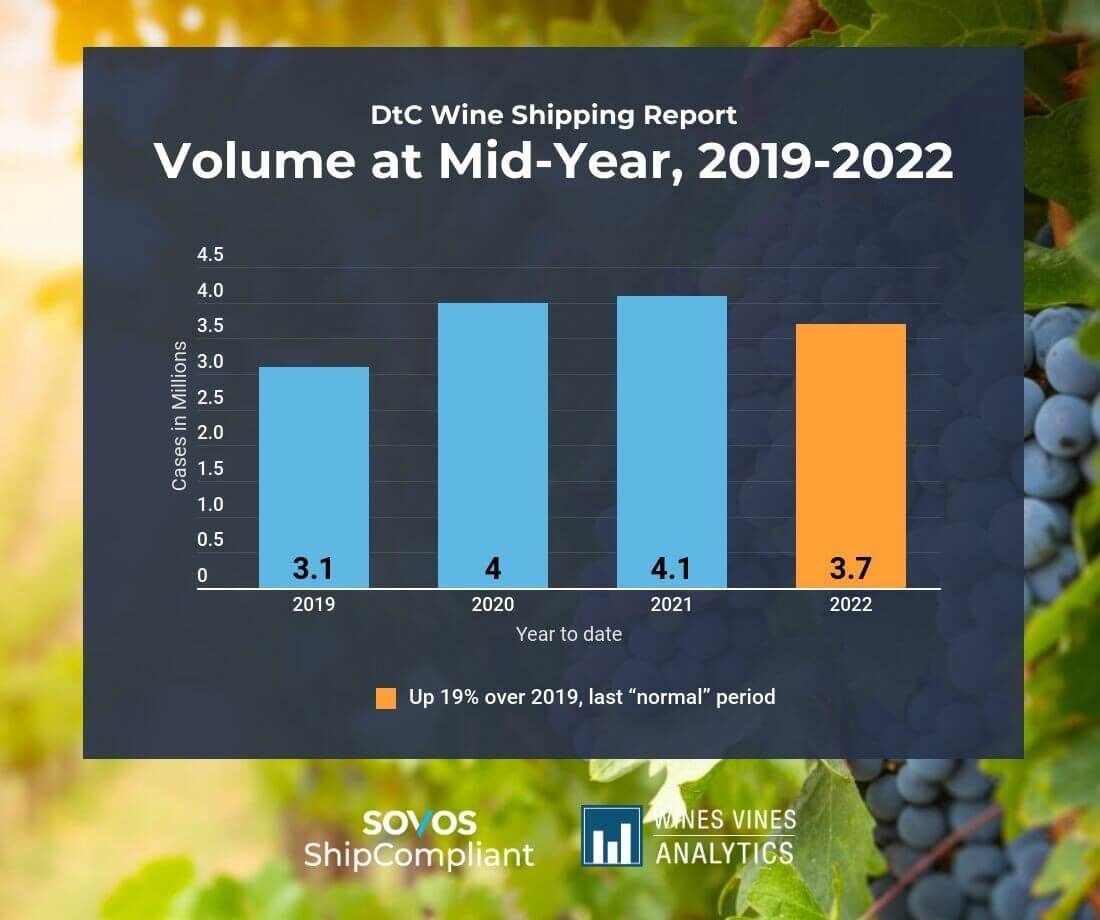
“The decline in volume is not that unexpected considering the record highs of the previous two years, seasonal patterns and the recovery of the on-premise sector where consumers are back to buying wines they may have been purchasing via DtC,” said Andrew Adams with Wines Vines Analytics. “And while it’s very encouraging to see shipment value remain positive, there is growing concern among wineries that challenges in the wider U.S. economy may hinder value growth through the second half of the year.”
Here is a deeper look at the changes in the DtC shipping channel between January and the end of June, 2022.
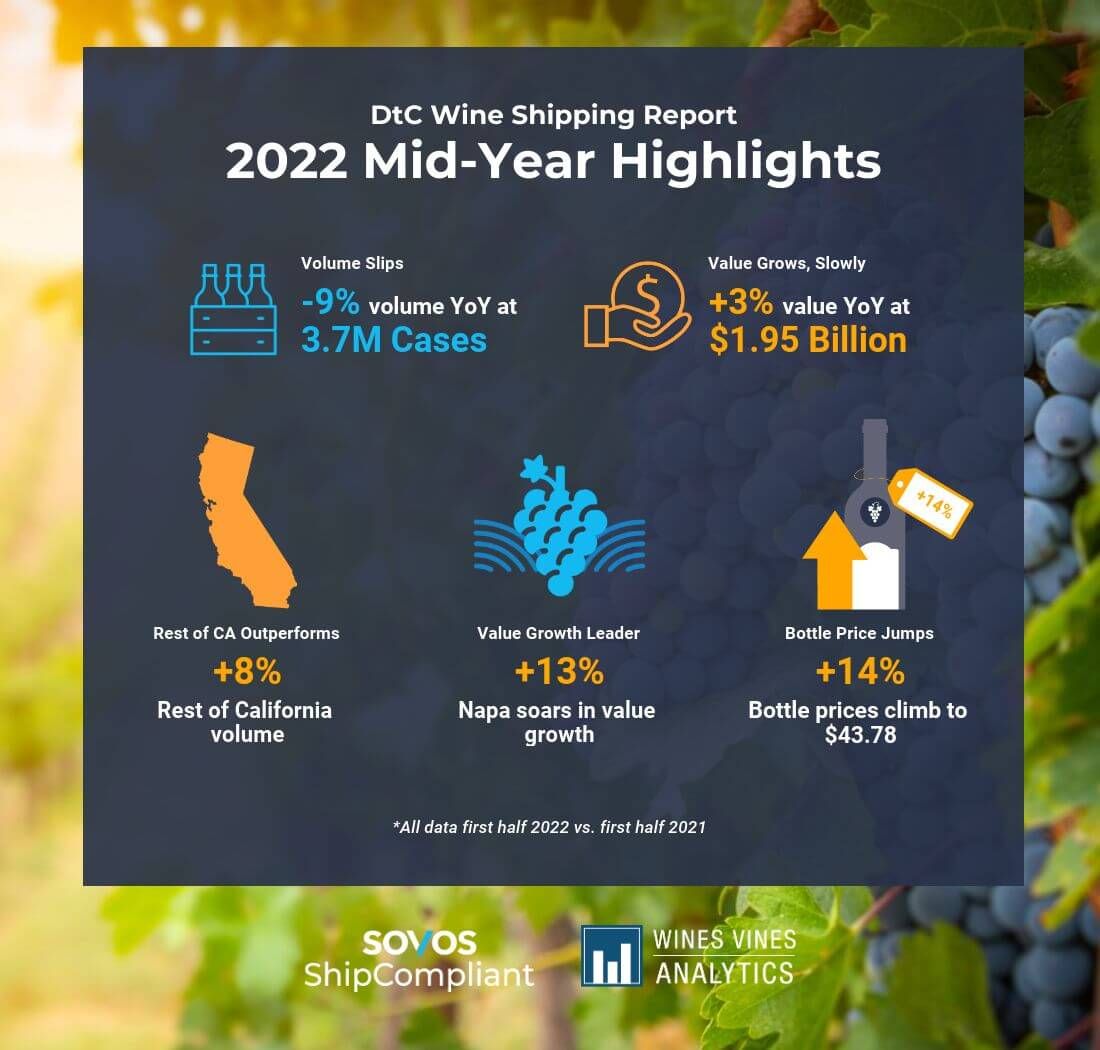
Average bottle price has climbed to $43.78, an impressive 14% increase. Interestingly, the regions with the highest priced bottles also showed the biggest increases in price from 2021 to 2022. The average price of a bottle from Napa is now $79.74, an increase of 20%. Sonoma, Oregon, the Central Coast, Washington and the Rest of California also saw an increase in bottle prices. The average bottle price from wineries in the remainder of the U.S. was down 3% from the first half of 2021, averaging $21.78.
California is once again the top destination state, producing and shipping the most wine. The top destination states in descending order are California, Texas, Florida, New York and Washington. The top five destination states have remained the same since Pennsylvania fell from the fifth spot last year. Of the states listed, Florida saw the largest value change in wine shipped, with an increase of 13%.
Aside from California, the remaining top four states each averaged 6% of total market share.
California wineries outside of Napa, Sonoma or the Central Coast experienced an 8% increase in volume shipped, with the rest of the country seeing a reduction in volume growth. This area has shown consistent growth since 2019 and now makes up nearly 12% of the total volume of wine shipped in the country. When comparing the first half of 2022 to the same six-month period in 2019, the Central Coast is the only region with flat shipment volume.
Reflecting a return to more in-person and carry-out sales, wineries of all sizes experienced a drop in volume from 2021 to 2022 at the mid-year. Volume dropped the most among wineries producing under 1,000 cases per year (down 15%), followed closely by wineries producing 5,000 to 50,000 cases per year. The smallest drop was among wineries producing 1,000 to 5,000 cases.
Cabernet Sauvignon, holding the largest share of overall sales by varietal (29%), saw a 1% decrease in volume from 2021 to 2022 at the mid-year, but a 17% increase in value. Red Blends, with the second largest share, saw an 11% decrease in volume and a 7% increase in value. The varietals leading the way with average bottle price growth are Red Blends (21%), Cabernet Sauvignon (19%) and Merlot (16%). Only Pinot Gris saw negative bottle price performance (-8%).
Moscato saw impressive growth in volume (48%) and value (57%) compared to last year—though notably, Moscato is growing on a small sales base, with the lowest overall sales among varietals tracked. The only other varietal group with growth in volume has been Syrah/Shiraz, with a 3% increase.
The largest decrease in volume growth were White Blends (down 22%), Petite Sirah (down 20%) and Rosé (down 19%), with Sangiovese, Riesling and Merlot following closely behind.
Wine consumers who found their way to the DtC channel in the last two years appear to be staying put, and wineries are once again benefiting from a reversion to pre-pandemic buying patterns, reflected in increased volumes of higher-priced wine sales. Though the future remains uncertain, we will be here to provide commentary on the market. In a few months, our full report on 2022 will be released in January 2023. Until then, discover our 2021 findings by downloading your complimentary copy of the 2022 Direct-to-Consumer Wine Shipping Report.
This data was compiled in partnership with Wines Vines Analytics, a leading source for wine industry data.
Want a comprehensive look at the DtC wine shipping channel in 2021? Download the 2022 DtC Wine Shipping Report today.
The legal landscape for direct-to-consumer (DtC) shipping of alcohol is a hodgepodge of rules and regulations that vary from state to state. This follows the broad principle set out in the 21st Amendment that each state shall govern the “transportation or importation . . . therein of intoxicating liquors.” As such, New Hampshire can permit the DtC shipping of all alcoholic beverages, Oklahoma can limit its residents to receive only six cases of wine from any given domestic winery, and Utah can prohibit all incoming DtC shipments of any alcohol from any source.
However, some states appear to be taking a further step in restricting domestic manufacturers from accessing the DtC market: prohibiting DtC shipping to consumers in other states.
To be clear, claims of such a prohibition do not seem to be widespread, and they are largely anecdotal (though various manufacturers have related to the author that they have directly been told by state officials they cannot ship to consumers in other states).
This claim that state officials could prohibit their local licensees from shipping to consumers in another state, if such shipments were in full compliance of the laws of that other state, is extremely dubious constitutionally. But it is still a major potential threat to the DtC alcohol shipping market as the claim alone has had a chilling effect among several manufacturers who had planned to enter the DtC alcohol shipping market.
Under the U.S. Constitution, only Congress is authorized to regulate interstate commerce (the “Commerce Clause”). States are permitted to manage commerce within their borders, but they are, with some exceptions, restricted from passing any laws that interfere with or restrict trade with other states.
One of those exceptions is, naturally, the alcohol market. Coming out of Prohibition, the idea was that local communities needed the authority to impose local rules and standards on how alcohol should be produced, sold and consumed. Hence Section 2 of the 21st Amendment, which abrogates Commerce Clause principles for sales of alcohol.
With this power, states can impose restrictions on activities like DtC shipping of alcohol but cannot do so in other markets. And states do impose a lot of restrictions on the DtC shipping of alcohol, primarily regarding who can ship alcohol and what alcoholic products can be shipped DtC. Currently, 47 states and D.C. permit the DtC shipping of wine, but only around 11 permit shipping of beer and seven permit shipping of spirits.
Following those laws, some states are alleging that, because DtC shipping of beer or spirits to their residents is prohibited, their local beer and spirits manufacturers are also prohibited from shipping beer or spirits into other states—even if those other states fully legalize DtC shipping of beer or spirits and the manufacturer is fully compliant with the laws of that other state. That is, because DtC imports are illegal in a state, therefore DtC exports must also be illegal.
The author has heard manufacturers in Wisconsin (for beer) and Virginia (for spirits) say that they have been told in no uncertain terms by their local regulators that they may not DtC ship their products into states that allow such DtC shipments. While this is a limited number of states, and is largely anecdotal, the potential threat that this claim could have on the DtC market is very real.
The big question is, can states do this? Can they assert under the 21st Amendment the authority to prohibit not merely the importation of alcohol, but also its exportation? Unfortunately, the answer is maybe (though there are assuredly many alcohol attorneys out there who would forcefully say no).
Alcohol manufacturers rely on the rights granted to them as licensees in the states where they operate. As such, they must look to the local statutes to identify what they are permitted to do—and prohibited from doing.
Generally, state statutes do authorize locally licensed manufacturers to export their products freely, as long as it complies with the laws of the destination state. However, that is not always clearly stated—or stated in a way that explicitly includes DtC shipping. For example, Wisconsin’s statutes for brewers (WRS § 125.29) allows them to sell and ship product to wholesalers, and to sell to consumers for off-premises consumption from licensed premises, but it does not set out how and where (or technically, if) brewers can sell to parties in other states. A Wisconsin regulator might then argue that, without that explicit permission, a DtC shipment to a consumer in a different state is not authorized.
But it is also not clear at all whether that Wisconsin regulator’s claim would hold up in court. While the 21st Amendment does not use the word “exports,” it does authorize states to control how alcohol is transported in their borders, which might give some merit to the argument they can prohibit local manufacturers to avail themselves of the third-party carriers who make DtC shipping possible.
It is a shaky argument to make, though, particularly in light of the 2019 Tennessee Wine & Spirits case, in which the Supreme Court set out that state laws that impose restrictions on the interstate commerce of alcohol must be clearly and demonstrably tied to the state’s interests in fostering the health and safety of its residents. It is very hard to see why Wisconsin prohibiting its brewers to ship to Nebraskans, in full compliance with the laws of Nebraska, is in any way related to the health and safety of Wisconsinites.
At least until it is resolved by courts, though, this remains an open question. And manufacturers are right to be wary of crossing any lines set out by their local regulators—it’s little solace to be right in principle at the cost of your manufacturing license. What we should hope for, then, is that state regulators will back down from this argument and make it clear that their licensees are entirely within their rights to sell and ship their products DtC anywhere they want—as long as it is in compliance with laws of the destination state.
Download our ebook to learn more about the ins and outs of DtC alcohol shipping.
The Alcoholic Beverages Control Commission in Massachusetts recently announced that they will be conducting Minimum Purchase Age Compliance Checks in retail stores and aimed at direct-to-consumer (DtC) wine shippers through December 31, 2022. With this information in mind, now is a great time to refresh your age verification knowledge and company policy.
Bars, liquor stores and tasting rooms check IDs for each purchase, and online sellers should be doing the same. By conducting age checks at the time of online purchase, you’re ensuring that all laws are being followed. Online age verifications can include requiring a scanned image of the purchaser’s ID or can be done through a third-party service like LexisNexis or IDology. Both services use public data to corroborate that the purchaser’s name and address matches with someone over the age of 21.
Not all states require DtC shippers to conduct age verifications, but by making them standard practice, you can ensure compliance with all sales in all states (where permitted). When it comes to the possibility of minors obtaining alcohol, it’s better to err on the side of caution and conduct thorough age checks for each sale, no matter which jurisdiction you’re shipping to. (Of course, an automated compliance solution can help run age verification along with other DtC shipping compliance check.)
All alcohol shipments require the carrier to check the ID of the recipient and obtain the signature of an adult who is of legal drinking age. Though the burden falls to the carriers, noncompliance can result in the loss of your DtC license. Both FedEx and UPS require that delivery of wine can only be made to someone who is present at the time of delivery, who will sign for the package and who will present identification verifying they are of legal age to possess alcohol.
Though states may differ in their age verification requirements, best practice dictates that DtC shippers should cover all bases by conducting them for each sale. By implementing point-of-sale checks, delivery ID checks, and requiring recipient signatures, you’re protecting against underage drinking, as well as protecting your business from penalties or lost licenses.
See for yourself how ShipCompliant can help you tackle age verification. Request a demo today.
Smaller product categories in wine and beer/malt lead the way
Summer has officially arrived, and with rising temperatures also come rising beverage alcohol product registrations. While the industry is not seeing the same spikes as during the height of the COVID-19 pandemic, there are still signs of positive growth. There were increases in Product Registration Online (PRO) new product registrations* in the beer/malt category, while both wine and spirits had individual categories with year-over-year or quarter-over-quarter gains.
The following is a breakdown of new product registration data via PRO from the second quarter of 2022 (April, May, June) for wine, beer and spirits.
The beer/malt category saw new product registrations tick up 1% from last quarter, while yearly growth is down 20%. Separating those two definitions out, malt new product registrations grew 4% from last quarter, with yearly growth dipping 15%. Beer also saw decreases, with a 2% drop quarter-over-quarter and down 25% from this time last year. Malt beverage specialties (flavored) or FMB new product registrations had 13% growth over the last quarter, while porter new product registrations saw a 33% increase in the same time frame.
Overall, the number of wine brand registrations in Q2 2022 dropped 18% from Q1, and also saw a 22% decrease from Q2 2021. Saké new product registrations increased 10% from Q1 but dipped 35% compared to last year. Additionally, honey-based dessert wine increased from Q1, with apple-based flavored wine increasing in quarter-over-quarter and year-over-year growth. While it’s too early to definitively say, this could be a sign of greater focus on non-traditional wines in general.
Among wine product registrations:
Overall, spirits new product registrations are down 23% from last quarter and are down 36% from this time last year. Additionally, the only category to see a quarterly increase was whiskey, with an 8% rise from Q1. Tequila is the only category to show year-over-year growth, with an 8% increase as well.
*Product Registration Online (PRO) data encompasses nationwide label/brand registrations by PRO users. Product Registration Online processes some 100,000 state registrations annually.
Learn how PRO enables fast, easy electronic brand filings for wine, spirits and beer brands in participating states.
The three-tier system is the most prevalent way that spirits are sold in the United States. We have compiled a comprehensive state-by-state guide that outlines the complex requirements distillers must keep in mind when expanding into a new state. In this blog, we will break down the main regulatory and tax rules that distillers distributing in different states have to comply with.
When entering a new state, the first step is almost always to get licensed to sell to in-state wholesalers or approved to sell to the state’s control board. It’s important to pay attention to the specific requirements needed for a supplier license, as they vary. The price to obtain a supplier license can range from free to thousands of dollars per year. In addition, some states also require spirits suppliers to have $100,000 held in a bond.
Liquor labels contain critical information that identifies the contents and producers of the product, and because of this they are highly regulated by the federal and state governments. After obtaining a COLA, it’s time to get state specific, as nearly 40 states have their own product registration requirements with some requiring yearly renewal. Many states also collect distributor information to manage franchise restrictions, such as documenting the approved territories for distributors or establishing a record of existing relationships in case a party wants to adjust their agreements in the future.
In control states, government agencies take over one of the standard “tiers” of the three-tier system. Most often, state agencies will act as the wholesaler. In 13 jurisdictions, the state also manages or operates retail stores. All states that utilize the control system apply it to sales and distribution of spirits products.
There are some key differences between selling to a private business and selling your product to the local government. A license may not be necessary when selling to control boards, though you must still be recognized as a potential supplier by the state.
The key difference is that you must “list” your products with the state, convincing them of the value and marketability of your products, much like you might otherwise do with a private wholesaler in other states. This listing process can be complicated and involve additional steps to accomplish. As part of listing, you may need to use a registered in-state representative when submitting quotes to the state. States will only accept quotes during specific time periods, and each product category will need to meet specific criteria.
Selling into a control state may seem like a headache but interacting directly with a state agency can have its perks. Because a supplier will list their products directly with the state, they will not need to file a brand/label registration for those products beyond the listing process. Further, the state does not need to receive regular shipping reports on those distributions because sales are already distributed directly by the state agency.
Each state has their own excise tax requirements, reporting and deadlines. Excise taxes are calculated using the volume of alcohol being sold and are levied at both the federal and state levels, meaning that high ABV spirits are taxed more heavily than say, a hazy IPA. By knowing your excise tax, you can properly set prices in the state.
Generally, excise taxes are paid by the “first party to own the product in a state,” which typically implies the distributor. But that is not a universal rule, so spirits producers distributing interstate should be aware of any situation where they would be required to remit excise tax themselves.
Many states require suppliers to file follow-up reports that outline their sales to in-state wholesalers. These reports outline what was sold, when and to whom on a monthly basis. Some states require copies of all invoices, while others simply want to know the total volume sold. By keeping tabs on the specific requirements in each territory you do business, compliance doesn’t have to be a behemoth.
For more information on the common distribution rules – and how each state applies them, check out our Distribution Rules By State page.
On July 13, the Uniform Law Commission (ULC) voted to approve a model act that could impose significant burdens on businesses engaged in direct-to-consumer (DtC) shipping of beverage alcohol. (Read on to find out just who the ULC is, anyway.)
While the model bill has not garnered a lot of attention yet, what attention it has gotten has largely been negative, pointing out its questionable legitimacy or the potential damage it could cause the DtC alcohol shipping market.
As drafted, the model act establishes new rules on DtC shipping of alcohol that would both increase the regulatory burdens and risks for legal DtC shippers. However, what effects it actually will have on the DtC alcohol shipping market will only be apparent if and when it is adopted by any state. There is the chance that this won’t go anywhere or will prove to be a toothless law.
But anyone active or interested in the DtC alcohol shipping market should be well aware of the model bill and wary of the threat it could pose.
The Uniform Law Commission is an organization of lawyers and legal professionals that, according to its website, works to provide “states with non-partisan, well-conceived and well-drafted legislation” on various areas of state law. Since 1892, the ULC has drafted hundreds of uniform acts that states can use as a template when writing their own legislation. These model acts aim to provide a more standardized approach to everything from commercial law to family law to alternate dispute resolution, ideally decreasing the complexity of dealing with 50 states with their own ideas on how to draft statutes.
The ULC itself, though, has no official status and cannot enact or enforce the model acts it drafts. Instead, it is merely a resource that state legislators and statutory drafters can look to when they want to adopt a new law. That said, the ULC does have a lot of credibility, and some of its model acts have been widely adopted across the country (for instance, the Uniform Commercial Code, a set of laws governing commercial practices in place, with some tweaks, in each state).
The model DtC shipping act is thus part of this legacy, an attempt to create a clear, unified law that could resolve the confusion around DtC shipping of alcohol that exists today.
When the ULC established a drafting committee to look into DtC shipping of alcohol back in 2019, its original mandate was to create a model act for the legal DtC shipping of beer and spirits. DtC shipping of wine had been firmly established in, at the time, 45 states (Kentucky and Alabama joined the party in the following years), but the interest in expanding those provisions to beer and spirits was clear. To stave off years of legislative wrangling and the enactment of a mishmash of laws, the ULC set out to create a single, uniform act that states could readily adopt and create legal, effective markets for DtC shipping of beer and spirits.
In the intervening years, however, that original mandate was thrown completely out of the window. Instead, the usual suspects who are staunchly opposed to any DtC shipping of alcohol convinced the ULC commission that before anyone adopts what is, by all accounts, an extremely popular idea, they must first fix all problems, real or perceived, within the existing DtC shipping market. In turn, the focus of the commission shifted from DtC shipping of beer and spirits to imposing new regulations on current shippers.
What was ultimately adopted (after months and months of negotiations and Zoom meetings, including educating the ULC commissioners on the particularities of the beverage alcohol industry; not a few admitted to having received illegal DtC shipments themselves in the past) is an act with two main functions:
There are no other major provisions in the model act, and certainly nothing on creating legal paths for direct-to-consumer shipping of beer and spirits.
The fulfillment house regulations largely follow the pattern adopted by other states in recent years, requiring any business that services DtC shipments on behalf of a licensed shipper (i.e., a winery or other seller) to get licensed themselves, to accede to the jurisdiction of the states they get licensed in, and to file regular reports on the shipments they facilitate to those states. While imposing regulations on out-of-state fulfillment houses is somewhat controversial, the real concern here is how unnecessary it is.
Fulfillment houses are seen as a soft target by those who don’t like any DtC shipping of alcohol. By imposing onerous burdens on them, the intention is to make it difficult for enough licensees to ship their products to severely disable the whole market. Fulfillment houses are vital for many DtC shippers, who are often small manufacturers without the large warehouses and shipping departments needed to manage a national shipping program.
While there are some legitimate concerns around the use of fulfillment houses (for one, fulfillment houses can appear to be unlicensed shippers, when in fact they are only acting as agents for licensed sellers), there are easier ways to regulate the DtC shipments they manage than adopting the ticky-tacky regulations provided in the ULC’s model act.
The other main provision, creating cause of actions against local businesses for violating foreign laws, presents a potentially profound constitutional challenge. Currently, state regulators are stymied when they try to take action against unlicensed DtC shippers. If a retailer in Florida is shipping tequila to Iowa, in clear violation of Iowa law, there is little that Iowa can do about it besides send a cease-and-desist letter. Florida, in turn, has no real cause to pursue the retailer.
This is a potential problem with the DtC market, in that some illegal shippers appear to act with impunity. We at Sovos ShipCompliant are clearly on the side of abiding by state laws and do not advocate this kind of action. The problem here, though, is ultimately one of federalism.
Under the Constitution, each state is—to greater and lesser degrees—sovereign. We do not want Texas police traveling across state lines to arrest California residents for violating Texas law, and we do not want California interpreting and applying Texas law.
However, this is potentially what the ULC model act is setting up for the DtC alcohol shipping market. Under its provisions, a state can (and potentially must) investigate its own citizens, and revoke their licenses to locally sell, manufacture or distribute alcohol if they appear to violate the laws of a different state. While this could resolve some lingering issues in the DtC market (namely those Florida retailers shipping tequila into Iowa), any regulator charged with this power should be very leery about using it. Indeed, state regulators have expressed derision at the idea of prosecuting their licensees for violating other state’s laws.
This is mostly a problem because often state regulators are ignorant of other state’s DtC shipping laws. They may not understand the nuances of how the other state interprets and applies those laws, and if they act on the mere appearance of a violation, they could cause irreparable harm to a law-abiding licensee. There are provisions in the model act requiring state regulators to conduct “evidentiary hearings” and only act on “good cause,” but what that would look like in practice is unclear. A winery that loses its production license, even temporarily, for an invalid reason could suffer greatly waiting for their state regulators to clear the dust.
Ultimately, the concern with the ULC model act is its uncertainty.
First, it is completely unknown if any state will actually adopt it (though we should expect the usual suspects to trot it out in front of every state legislature as a panacea to all the alleged ills of DtC shipping). One possible outcome here is that it just quietly goes away.
Second, a model act is merely a model, and state legislatures are free to add and amend as much as they want. Indeed, this might be part of the plan. Once they begin discussing ways to “fix” the DtC shipping market, other more pernicious provisions (even prohibitions) could be slipped in as well. Along that line, statutes themselves are subject to a range of rulemaking and interpretations that could take a burdensome, but acceptable, requirement and make it an outright barrier (see Alabama, which adopted such a restrictive licensing process for DtC shippers and fulfillment houses that many have decided to opt out of shipping there).
There is also the big question of why. What really will be solved by this model act? Will state regulators actually prosecute their constituents for violating foreign laws? Or will this end up a toothless bill, resulting in the usual suspects coming back in a few years saying, “I guess that didn’t work, so the only solution is to prohibit it all”?
It’s truly unfortunate that a model bill that started out with such a positive aim—expanding a legal process for a practice that is widely popular —ended up so thoroughly cleaving to protectionist special interests.
In the end, the proof of the model act will be in the eating. For active and prospective DtC alcohol shippers, though, the bite might prove poisonous.
Download our ebook to learn more about the intricacies of DtC shipping of beverage alcohol.
More consumers than ever are looking to avail themselves of the market for direct-to-consumer (DtC) shipped beverage alcohol. What was once more a niche market for prized domestically produced wines has gone on to pique consumer interest in accessing the broad range of alcoholic products made within the United States that are not also widely distributed.
However, most state laws prevent consumers from fully accessing that market by restricting the shipping of select product types. Currently, 47 states and the District of Columbia permit some amount of DtC shipping of alcohol, but most restrict it to shipping of wine (largely by wine producers only), though there are efforts to expand access for shipping beer and spirits. A lay consumer may struggle to identify which alcoholic beverages they can actually have shipped to their doorsteps.
Unless you have spent years steeping in alcohol regulatory law, you may not realize that there even are laws on DtC shipping of alcohol. But even then, understanding what specific products may be DtC shipped can require some complex statutory analysis.
To help we provide some advice on how to read a DtC law and understand what products it applies to.
The first, and most important, rule about DtC shipping of alcohol is that it may only be done by approved entities and persons. Most states that do permit DtC shipping of alcohol require the shipper (meaning the party who is responsible for the sale and ensuring the package is sent through a carrier) to be licensed. This party will also be responsible for managing the compliance burden related to their shipments, from preventing sales to minors to remitting all due taxes.
But before applying for a DtC license, a prospective shipper should ensure that their products can legally be shipped into the state, which requires parsing the state’s laws.
This generally means starting with the state’s DtC statutes and simply reading what it says. This can be a high hurdle in itself as it’s not always intuitive to find those statutes. In some states, the beverage alcohol laws are their own chapter; in others, they are hidden within a chapter for taxation or public health. Even then, the specific provisions for DtC shipping are not always clearly identified by the name or heading of a statute.
But once you have found the statute, it should identify in the first few paragraphs which products it allows to be shipped. Some states (like New Hampshire) make it rather obvious by permitting the shipping of all alcoholic beverages—simply by using a catchall term like that, they open their market up completely. There may be further specific rules for different products (such as different tax rates), but a producer can be assured that their products may be shipped DtC in the state.
Most states, though, limit their DtC permissions to only wine. On its face, it may be clear from that language that certain products could not be shipped—if only wine may be shipped, then stouts and vodkas would be excluded. But it is not always so obvious. How should a cidery or saké brewer react to that language? Or what if a product is made from a combination of wine and spirits? To fully grok these scenarios, it’s necessary to go beyond the DtC statutes and seek out the specific definitions states apply to the different product types.
For most states (and the federal government), all alcohol is divided into three parts: malt beverages, vinous beverages and distilled spirits beverages. Malt beverages are those that are produced from fermented grains and cereals; vinous beverages are produced from fermented fruits, vegetables and other agricultural products; and distilled beverages are the product of, naturally, distillation.
However, these are not hard and fast rules. New York, for one, sets out cider under 8.5% ABV and mead as distinct product types. Several states classify ciders under a certain ABV as a type of “malt beverage,” and most states include sakés with wines, largely because of their alcoholic content and how they are sold.
These distinctions matter as different rules apply to different product types. Beer products are universally taxed at a lower rate than spirits, but franchise rules are also more common when distributing beer than spirits. The same consideration applies to DtC shipping rules.
If you are a cidery, you stand a good chance that your products will be considered a wine, and therefore are, literally by definition, included in that state’s DtC laws. But that would not work in a state like New York, so you need to be careful about how the state defines and regulates your products specifically, and not just assume that your products are good to ship.
The rise of the ready-to-drink (RTD) cocktails market also provides opportunity for confusion, since they can derive their alcoholic content from almost any source. A “margarita” could include tequila proper, or it could be made with fermented neutral grains (so a “beer”), or, perhaps, even with fermented limes (so a “wine”), each regulated differently. Depending on how a state defines a given RTD, whether or not it could be shipped DtC varies widely.
Through all of this, it is critical to recognize the specific way each individual state defines and regulates the different alcoholic products sold within its borders. What works in one state is never guaranteed to work in a different state.
As more products that straddle the divides between different product categories enter the market, these distinctions are becoming more important to recognize. Some may question whether the definitions and product categories as applied today will necessarily work in the future—would perhaps a system based on the alcoholic content of a product rather than what it’s made out of make more sense? But these definitions and regulations do still matter today, and shippers and consumers alike should make sure to apply them properly to avoid any improper shipments, along with the scrutiny, fines and other consequences those improper shipments can entail.
Download our free ebook to learn more about the ins and outs of DtC shipping and how Sovos ShipCompliant can help.
On July 1, 2022, Vermont Act 177 takes effect, creating new ways to sell Ready-to-Drink (RTD) spirits in the state, including permission for distillers to ship these products direct-to-consumer (DtC).
As defined in the act, “RTD Spirits Beverages” are alcoholic beverages obtained from distillation that contain no more than 12% ABV and are packaged in containers no greater than 24 fluid ounces. Additional water and flavoring from fruit juices, sugars and other ingredients are permitted. More generally, the category of RTD spirits is a developing area for the beverage alcohol industry, full of enticing products marketed as margaritas or Moscow mules in a can.
Act 177 also creates a new definition of cider products, as a type of vinous beverage made solely from fermented apples or pears and containing no more than 16% ABV. Further, the law establishes two different tax rates for ciders: those with an ABV less than 7% will be taxed at the beer rate of 26.5-cents per gallon, and those with an ABV of 7% or greater will continue to be taxed at the wine rate of 55-cents per gallon. The new, reduced tax rate for lower-ABV ciders does not become effective until July 1, 2023.
As a control state, the Vermont Department of Liquor Control (DLC) has historically played a direct role in the distribution and sale of spirits in the state. However, with Act 177, the state has recognized that RTD spirits do not readily resemble traditional spirits products, and so has established a more liberal system for how these specific products can be sold in the state.
Under Act 177, RTD Spirits Beverages:
Additionally, Act 177 extends Vermont’s existing DtC shipping laws to RTD Spirits Beverages. Under these rules in-state and out-of-state distillers with a Basic Permit can apply for a Direct Ship license to ship their products directly to Vermont consumers. Current Direct Ship licensees will also be able to ship their RTD Spirits Beverages under their existing license. This license costs $330 and must be renewed annually by April 30.
Licensed Direct Shippers in Vermont:
RTD Spirits Beverages may not be self-distributed to Vermont retailers, even with a Direct Ship license; that privilege will remain only available for wine products.
In all, the steps taken by Vermont in Act 177 are a positive sign of states recognizing spirits-based RTDs as a new product type, one that does not fit easily into existing categories. Even though they often contain distilled alcohol, they have a lower ABV per serving and are often intended to be consumed more like a beer or wine cooler. As such, the existing stringent rules that most states impose on spirits products, as compared to rules on wine and beer, do not always make sense for spirits-based RTDs.
By reducing the tax burden, and by creating equal processes for distributing and selling RTD spirits within the state, Vermont has done a service to the industry and its residents who want greater access to these products.
Check out our free ebook to learn more about the DtC alcohol shipping essentials.