 Accidents aren’t an excuse
Just about a year ago, the Treasury Department published a report on competition in the beverage alcohol industry, which posited several ways to reform federal and state regulations to help create a more even playing field for smaller producers.
Among the many ideas proffered, changing how the Tax and Trade Bureau (TTB) approaches and policies trade practice rules in the industry was highlighted. And sure enough, the TTB is currently putting its money where its mouth is by undertaking a proposed rulemaking to determine how exactly it should adjust its trade practice rules.
Federal rulemaking can be a long and potentially fraught process, requiring the solicitation of public comments, lengthy review by agency lawyers and finally a (hopefully) reasoned publication of what the new rules will be. As part of that, the TTB actively encourages interested members of the industry and public to submit their thoughts and opinions on the subject (public comments are open until March 9, 2023).
Because rulemaking can be a confusing and drawn-out process, it may be helpful to reflect on what the TTB is specifically looking into to understand what might come from this current effort.
“Trade practice” is one of the harder-to-pin-down aspects of beverage alcohol regulation. Broadly, it refers to a set of laws that govern how industry members can interact, prohibiting certain practices that might undermine retailer independence or unfairly advantage some businesses over others. For anyone with an eye to dense legalese or with time on their hands, federal trade practice rules are set out in the Federal Alcohol Administration Act (FAAA, 27 U.S.C. 205).
The current rulemaking is not designed to rewrite U.S. code but is instead intended to restructure how the TTB interprets those broad laws and how it can apply them more specifically to the current alcohol market.
Trade practice laws involve the regulation of a select set of business activities, built around the goal of restricting any undue influence on the wholesaler and retailer tiers that might cause them to purchase from one supplier in exclusion, in part or in whole, to other suppliers. Each of these rules prohibit exclusion in different ways, from outright prohibiting it (Exclusive Outlet), to restricting cross-tier ownership and furnishing things of value (Tied House), to banning money in exchange for purchasing alcohol (Commercial Bribery), to disallowing conditional sales and promises for returns of unsold products (Consignment Sale).
In its rulemaking, the TTB recognizes that these trade practice laws were originally written in the 1930s, when the U.S. was moving out of the Prohibition Era. While the TTB has revised its trade practice regulations in the decades since the FAAA was first enacted, it has been quite a while since the last update.
As such, the rulemaking sets out three general questions the TTB wants to address: 1) how to modernize its trade practice regulations so they suit today’s beverage alcohol market; 2) how to authorize more standard business practices in ways that do not result in exclusion or threaten retailer independence; and 3) how to account for the digital marketplaces, where more and more often alcohol is being sold.
This may seem like a wildly expansive set of issues to address, potentially affecting all aspects of the beverage alcohol market. To help focus things, the TTB’s rulemaking sets out 16 specific areas of interest to address. These range from topics like category management and slotting fees, to private labels, to who can hold interest in retail shops, to third-party involvement in advertising and delivery of alcohol. The complete list of topics the TTB is seeking to address can be found on the Federal Register site, and interested parties are encouraged to provide their thoughts (either independently or perhaps through trade groups they may be members of).
From the comments that have come in so far, it seems likely there will be a lot of disappointment among the public when the TTB issues its final rules—driven, perhaps, by misunderstandings about the scope of the rulemaking.
Indeed, several of the comments call on the TTB to make rule changes that are completely out of its control, such as establishing nationwide self-distribution rights for producers or outright eliminating the three-tier system. As worthy (or not) as some of these proposals may be, many of them would be better addressed to state legislatures, which govern things like from whom retailers can buy and what parties can participate in direct-to-consumer shipping of alcohol.
Instead, the TTB’s rulemaking will necessarily be directed at aspects of the alcohol industry that the federal government has jurisdiction over, namely how suppliers and wholesalers operate and interact with members of the other tiers, but not more mundane issues like when, where and how a consumer can buy a bottle of wine or gin.
That said, the rulemaking’s primary goal is to foster greater competition in the market, especially by making it easier for smaller craft producers to gain a foothold and have the chance to grow. Trade practice reform is central to that effort, not only because that is an area the federal government has explicit jurisdiction over, but because the original intent of creating rules around trade practice was to minimize undue influence and market capture by the big players.
By prohibiting exclusive dealings and limiting giant corporations from engaging in practices that are common in other industries (look at how Cheerios are placed on any given cereal aisle, as opposed to generic-o’s, for an example of monopolistic category management and shelving practices), trade practice laws have always aimed to create a more even playing field.
The FAAA was drafted nearly 90 years ago, for a beverage alcohol market that is very different than what exists today. This update, then, is a welcome opportunity to make trade practice regulations work for the modern market and to help build out a better future for alcohol businesses of all sizes.
Keep up with evolving trade practice rules and other regulations by subscribing to our blog.
Find Sovos ShipCompliant in booth #2034 at CBC. We’ll be showcasing our cloud-based wholesale distribution and direct-to-consumer compliance solutions that reduce risk and lessen the burden of compliance. We look forward to meeting friends both new and old!
Sovos ShipCompliant recently released the 2023 Direct-to-Consumer (DtC) Wine Shipping Report with our partner, Wines Vines Analytics. This look-back at 2022 is the most comprehensive, complete and exclusive collection of data and insights on the state of the channel. While 2022 saw the first-ever decline in either—let alone both—value and volume of shipments, the DtC channel still retained 12% of total off-premise sales value of domestic wine, showing a maintained share from 2021.
About the data
The Direct-to-Consumer Wine Shipping Report takes shipment data from more than 1,300 U.S. wineries’ shipments to consumers each month, totaling more than 41 million shipments over the course of 2022. As we gather information, each shipment is edited for submission for governmental tax and reporting requirements, and all elements are validated by standardized tables. The verified data is submitted to a proprietary model built on a database of 11,000+ wineries that is updated monthly by Wines Vines Analytics.
Taking a deep dive into findings from 2022 value, volume, shipments by month, average bottle price, winery region, production tiers and varietal, the 2023 Direct-to-Consumer Wine Shipping Report finds outcomes both surprising and anticipated. Here are some notable takeaways:
Tune in for our free webinar on February 23, where we will dive deeper into data and takeaways from the 2023 Direct-to-Consumer Wine Shipping Report. Register here for the live discussion.
Download your free copy of the 2023 Direct-to-Consumer Wine Shipping Report for additional insights and analysis of DtC channel trends.
On Monday, January 9, the U.S. Supreme Court rejected a petition to hear an appeal of B-21 v. Bauer, a case revolving around the issue of interstate direct-to-consumer (DtC) shipping by alcohol retailers.
B-21 stemmed from a challenge to a North Carolina law that allows in-state retailers to ship wine through third-party carriers to North Carolina residents while prohibiting out-of-state retailers from doing the same. Lower courts, including the 4th Circuit Court of Appeals, had ruled that the apparently discriminatory law is justified under North Carolina’s 21st Amendment rights. The challengers of that law disagreed and had asked the Supreme Court to reverse that ruling.
The refusal to hear the case, or “denial of certiorari,” as lawyers call it, is the latest blow against their efforts to further interstate DtC wine shipping by retailers. Currently, 12 states and D.C. permit out-of-state retailers to DtC ship wine, but there is still an open controversy about the constitutionality of other states that only allow in-state retailers to DtC ship.
However, even if the Court has signaled a lack of interest in this one case, that does not mean that the efforts to create a national shipping model open to all legitimate sellers of wine are over, though it may lead some to question the apparent “try, try again” attitude of the proponents where it comes to litigation. Indeed, even if they had been successful before the Supreme Court, there would still be a great deal of work to do.
In the immediate moment, the Supreme Court’s decision to not hear the case means that effectively nothing has changed. The ruling by the 4th Circuit, that North Carolina’s laws are valid, stands and so the law will continue to control from whom North Carolina residents can purchase wine.
However, the denial of cert, issued without comment by the Supreme Court (which is standard), means that the broader issue of whether states can discriminate against out-of-state interests regarding alcohol laws remains unsettled. Indeed, it could be argued that the Court is signaling that such discrimination is valid, or at least that it is uninterested in upsetting the status quo by stepping into the middle of things.
For those who support interstate shipping of wine by retailers (or by producers, too), this is a chilling prospect. Many states have moved, like North Carolina, to privilege local interests over remote businesses in a way that would be utterly unconstitutional if this were any other market but alcohol. While states might say that they are benefitting their residents by allowing local retailers to do DtC shipping, by not allowing out-of-state retailers to do the same, they are continuing to restrict consumers from accessing the full range of alcoholic products sold nationally. By keeping this state of affairs intact, the Supreme Court is in effect limiting consumer choice to only those products that in-state distributors are willing to carry.
Part of the petitioner’s request in B-21 was asking the Supreme Court to weigh in on whether the North Carolina district court that first heard the case did so properly. Specifically, the petitioners wanted to settle what kind of evidence should a court look at when it hears this kind of challenge? This question is critical as it gets at an all-important aspect of reviewing state laws for their constitutionality: what is the proper standard of review?
In a nutshell, the standard of review gets at how much deference a court should give a state when it is hearing a challenge on a law that implicates constitutional rights. In U.S. jurisprudence, there are three broad standards that can be applied: strict scrutiny, which requires a law to be “narrowly tailored” to a “compelling state interest”; rational basis, which merely requires a law to be reasonably related to a legitimate state interest; and intermediate scrutiny, which is somewhere in between.
Which standard to apply is a critical question, which the Supreme Court has weighed in on many times in its history. Generally, strict scrutiny is used only when a fundamental right is implicated (like religious freedom) or if a law targets a specific group of people based on an inalienable part of their identity (such as race). For B-21 then, the question was more around whether courts should apply rational basis or intermediate scrutiny.
While this may seem like a technical consideration, a decisive ruling on this question would have profound implications for B-21 and future such litigation. In the last few years, most courts hearing cases on interstate retailer DtC shipping have applied rational basis scrutiny. As such, states have consistently won these cases after trotting out the barest bones statements about the “health and safety” of their residents and references to the “unquestionable legitimacy” of the three-tier system. Courts have accepted those arguments uncritically and more or less rolled over any arguments contrary to the states’ positions.
However, the petitioners in B-21 pointed out that in Tennessee Wine & Spirits, the last alcohol-related case the Supreme Court heard, the Court indicated that states must provide clear, convincing evidence that their laws actually are directly related and tailored to supporting the health and safety of their residents (the purpose of Section 2 of the 21st Amendment, which grants states authority to regulate their own alcohol markets). That is, the petitioners were arguing that the lower courts have improperly been applying rational basis scrutiny, even though the Supreme Court had ruled in Tennessee Wine & Spirits that something like intermediate scrutiny should be used instead. If nothing else, the petitioners were saying that states need to support their arguments with actual facts and statistics and should not be given the deference they have received so far.
Again, by denying cert, the Supreme Court leaves this question unsettled, though it may be implicating that it didn’t really mean what is said in Tennessee Wine & Spirits, and that states can justify their alcohol laws with essentially the wave of a hand.
As noted, the denial brings no immediate change. States seemingly can continue to discriminate against out-of-state alcohol retailers, and already active litigation on this issue in other states will go on.
Proponents of retailer DtC shipping are firmly committed to keeping fighting with ongoing litigation, but one might wonder if, after a certain point, it may make sense to look beyond the courts for succor.
After all, while the 2005 Granholm case, which established the non-discriminatory policy for interstate DtC shipping by wine producers, was a key part of making that market nearly ubiquitous—wine producers can now DtC ship into all but three states—that still required years and years of legislation to bring to fruition. So, even if the Supreme Court ruled in favor of interstate retailer DtC shipping, there would still be a tremendous amount of work to enact the relevant laws across the country.
Yes, extending the anti-discriminatory principles of Granholm to retailers and ensuring that retailers across the country would operate on a more even playing field would be extremely beneficial. But such a ruling is neither sufficient nor necessary on its own—and it might not even lead some states to simply retrench and prohibit all DtC shipping by retailers; if no one can ship, then there’s no discrimination to be had.
Indeed, 12 states and D.C. currently allow interstate retailer DtC shipping without a constitutional rule (and also without creating a morass of overconsumption, teenage drinking and missed taxes—by creating a regulated market for out-of-state retailers to access, those states instead ensure they can police such concerns directly). Instead, those permissions came simply from working with state legislatures to enact effective, pro-consumer, pro-industry laws.
To that, it is heartening to see efforts to change state laws are going on even as court battles rage on. There is convincing support among consumers for greater access to alcoholic beverages, particularly ones that are not distributed in most states; it is also clear that shippers want to meet that demand and are more than willing to do so in safe, legally compliant ways. All that we need is for states to change their laws and remove the regulatory barriers in our way.
Ready to learn more about the DtC shipping process and why compliance is critical? Contact our team and see how Sovos ShipCompliant can help.
States have recently announced an uptick in age verification checks, including Massachusetts, which will be focusing on direct-to-consumer (DtC) wine shippers through the end of the year. At the same time, wine, beer and spirits drinkers are more willing than ever to receive their favorite beverages via DtC shipping, which makes now a great time to review your age verification processes.
The most important alcohol regulation in the United States is that it is illegal to provide alcohol to anyone under the age of 21. In every state, minors are prohibited from purchasing, possessing or consuming any beverage alcohol. Following age verification protocols is an essential way to prevent underage drinking and to protect your business. Here are three age verification reminders to ensure that your brewery, cidery, distillery or winery remains compliant.
Accidents aren’t an excuseSales to minors are always illegal; even accidentally providing a minor with alcohol can bring serious consequences. Even if the sale happened inadvertently, the seller can be charged. State regulators are ready to take action against anyone who flagrantly violates the law.
 Consider an online verification service
Arizona, Georgia, Indiana, Kansas, Michigan, Ohio and South Dakota require licensed DtC shippers to take specific action prescribed by statute, including using online verification services (like LexisNexis or IDology, or a solution that leverages those services, such as ShipCompliant Direct), seeing the consumer’s ID in person or getting a facsimile of the ID at the time of purchase. Even in states where it’s not required by law, it’s always best practice to do point of sale age verification.
 Carriers are your last line of defense
Alcohol shipments always require ID verification and an adult’s signature, so work with carriers that fully commit to following the law. While the burden is levied on the carriers, your shipping license is the one on the line.
States see age verification as a perennial issue, so even if they don’t announce compliance checks, they’re always vigilant when it comes to enforcement. By ensuring that you properly verify the age of each customer for each purchase, you are protecting against underage drinking, as well as protecting your business.
Ready to see how simple real-time compliance can be? Request a demo today.
Sovos ShipCompliant recently released the first annual Direct-to-Consumer Spirits Shipping Report, in partnership with the American Craft Spirits Association (ACSA). The report features in-depth analysis of the craft spirits direct-to-consumer (DtC) channel through a consumer poll, as well as ACSA’s perspective on how the market can continue to make strides.
Here are five key findings from the report that show the current – and potential future – state of the DtC craft spirits channel.
While there is increasing consumer interest in DtC spirits shipping, state legislators as a whole are not moving quickly to help enable these types of sales. Just eight states and Washington, D.C. allow interstate DtC spirits shipping. However, there is lost opportunity for state tax revenue, as 47% of craft spirits drinkers who are likely to purchase craft spirits DtC say they would spend $100 or more a month.
Additionally, ACSA’s data project found that the number of craft spirits producers has grown by 14% over the last five years. Craft spirits sales have also grown, measured by volume (7%) and retail value (10%) during the same time. However, craft spirits only comprise about 5% of the total amount of spirits sold on a volume basis, and about 7% on a retail value basis.
Expanding DtC spirits shipping permissions is a needed and logical next step for the industry, especially as three-tier distribution faces increased constraints. There were 13,254 new approved TTB spirits brand registrations in 2020, increasing to 15,460 in 2021. For 2022, that number is on track to approximately 16,400 new spirits brand registrations. DtC shipping helps producers get their product to market and will meet consumer demand.
These surveys were conducted online within the United States by The Harris Poll on behalf of Sovos ShipCompliant between October 20-25, 2022 among 1,958 adults ages 21+, among whom 618 drink craft spirits/liquor at least once per month, and October 27-31, 2022 among 1,942 adults ages 21+, among whom 588 drink craft spirits/liquor at least once per month.
For additional data and insights into the DtC spirits channel, download the 2022 Direct-to-Consumer Spirits Shipping Report.
The results are in—Coloradoans will soon be able to purchase wine in more stores than ever before. Proposition 125 allows for “grocery stores, convenience stores and other businesses currently licensed to sell beer to also sell wine.” This follows the expansion of full-strength beer sales in grocery stores, which took effect January 1, 2019. Any store that is licensed to sell full-strength (3.2% ABV) beer can also sell wine starting March 1, 2023. It’s worth noting that this initiative only affects wine, and liquor can exclusively be purchased at licensed liquor stores across the Centennial State.
Though wine is now more accessible, the typical beverage alcohol laws apply. Sales are prohibited between midnight and 8:00 a.m. and of course, it is always illegal to sell alcohol of any kind to anyone under 21.
Proposition 125 wasn’t the only beverage alcohol initiative on the ballot this year. Two other measures failed to receive enough votes on election day. One was to allow off-premise liquor stores to operate multiple locations in the state and the other was focused on allowing the delivery of alcohol by third party services, like DoorDash.
Currently, liquor retailers can operate in up to three locations in Colorado. Proposition 124 was focused solely on liquor store licenses, and not the licenses that cover grocery and convenience stores that can only sell beer and wine. The number of retail liquor licenses one person may hold would have gradually increased until limits were phased out completely in 2037. Though this measure did not pass, in 2027 liquor store chains may operate in up to four locations.
Another close call was Proposition 126, which lost by only 2.2% of votes, and was aimed at allowing retailers to offer third-party alcohol delivery and would permanently allow restaurants and bars to offer alcohol takeout and delivery. The measure failed to reach a simple majority, and the current bill extending to-go restaurant alcohol sales is set to expire in July 2025.
Learn more about streamlining your three-tier compliance processes with ShipCompliant Market Ready.
Delaware State Rep. Mike Smith (R-Pike Creek Valley) plans to introduce legislation that will open up direct-to-consumer (DtC) wine shipping to Delawareans. Currently, state residents can legally purchase wine through the three-tier system but are not able to purchase directly from a winery and have the product shipped to their front door. Smith’s bill would change that.
“In the state of Delaware, you still cannot have wine shipped directly to your homes,” Smith said in a statement posted to the Delaware State House of Representatives – Republican Caucus Facebook page. “Around the holiday season, one of the things people like to do most is ship a bottle of wine to their friends. Whether that’s through a wine club, through a winery…they want to get their friend, their family that bottle of wine that they’ve been wanting all year round. And in Delaware, you still can’t do that.”
Smith added that the three-tier system is old, antiquated and dates back to Prohibition. It is the main reason people “don’t want to move the needle in Delaware” toward DtC wine shipping, he said.
State Rep. Jeff Spiegelman (R-Clayton) is expected to be a co-prime sponsor of the new bill, according to the statement. Spiegelman said state residents can have prescription drugs delivered to their front doors, and the state is dragging its feet on the issue of shipping wine DtC, as consumers deserve greater choice and the state could benefit from increased tax revenue.
House Bill 210, which would have granted limited DtC wine shipping permissions in the state, was previously introduced in 2021 but did not advance in the legislative session. Smith explained that his latest iteration of the bill would include some of the following elements:
“In Delaware, we always pride ourselves on being first,” Smith said. “But in this case, let’s not be last. Happy holidays and let’s get this done for Delawareans.”
Want to stay current on the latest DtC wine shipping legislation? Subscribe to our blog and never miss an update.
As 2022 draws to a close, it’s time to look back and reflect on the year that was. For beverage alcohol regulation, 2022 saw an interesting mix of big changes on one hand and stagnation on the other.
On the direct-to-consumer (DtC) shipping front, there was little overall change, at least compared to the admittedly brash predictions some had bandied about in 2021. Efforts to expand DtC shipping permission to distillers, brewers and retailers largely failed, with the collapse of legislation in California being perhaps the most disappointing. Only Vermont ended up expanding DtC shipping permissions in 2022, and only for limited spirits products. Otherwise, changes around DtC were mostly on the edges, removing some minor barriers and adding others, but largely keeping things the same.
However, that does not mean that states were quiet when it came to alcohol related legislation. Instead, their work was much more related to local issues, including making to-go cocktails permanent and establishing regulations on third-party local delivery services like Uber Eats.
The federal government was also very busy when it came to beverage alcohol regulations this year. Following the publication of the Treasury Department’s report on competition, the Tax and Trade Bureau (TTB) has issued several calls for notice and comment rulemaking to amend their policies on, among other things, label regulations and trade practice enforcement. In addition, the TTB has stepped up its overall enforcement activities.
Following is a quick review of some of the bigger news stories from 2022.
The Tax and Trade Bureau of the Treasury Department was very busy in 2022. Early, in February, the TTB published a report on competition in the beverage alcohol industry, following a request from the Biden Administration in late 2021. The report noted numerous ways to expand competitive opportunities and create room for smaller parties in the industry.
Among the suggestions offered by the TTB were:
To affect these policies, the TTB has also issued several requests for notice and comment rulemaking asking the industry to opine on what updates to make with label regulations and what direction the agency should take with trade practice reform.
In recent weeks, the TTB was sued to act on ingredient labeling for alcoholic beverages. The measure, which proposes to add standard dietary information and lists of ingredients to all alcohol labels, has been controversial within the industry. While there is clear interest among the public for calorie counts and disclosure of additives, many producers have pushed back, noting that alcoholic beverages are unlike processed foods and that adding such information to labels would have limited benefit. The TTB has issued proposed rulemaking on this issue and is actively soliciting public comments on what should—and should not—be part of such a requirement.
In October, the TTB also launched new support for importers for filing their federal excess taxes under the Craft Beverage Modernization Act. Starting January 1, 2023, the TTB will take over management of taxes for foreign produced products from Customs. To handle this, the myTTB system was expanded to enable easier submission of reports and taxes by importers.
In ways, 2022 seems to be setting 2023 up to be a big year. The rulemaking initiatives launched by the TTB in 2022 will need to be resolved, with lots of potential for the TTB to radically change current policies—or decide that things are working fine as is. Efforts to expand DtC shipping will continue apace, with lessons learned from what did and didn’t work in 2022. And more states will consider making their COVID emergency relief policies permanent.
How any of this will go—what the story of 2023 will be, one of bold reform or retrenchment and torpor—will only be clear when the dust settles.
Want to stay up to date on the latest industry news in 2023? Subscribe to our blog to stay in the loop.
Find Sovos ShipCompliant at the 2023 Oregon Wine Symposium, February 14-15 in Portland, Oregon, in booth #110. We hope to see you there!
Will we see you at the ACSA Convention in Portland, Oregon? Stop by our booth (#802) to say hello and find out how Sovos ShipCompliant helps distilleries of all sizes get a handle on their three-tier distribution management and direct-to-consumer shipping compliance.
Historically, the three-tier and direct-to-consumer (DtC) channels for beverage alcohol have operated independently, sometimes even viewing the other as competition. But in reality, there are many opportunities for a symbiotic relationship between these business units. For beverage alcohol producers that depend on both, a collaborative approach is imperative.
First, some quick definitions. DtC alcohol shipping is when consumers purchase products directly from a supplier such as a winery (either online or in-person) and have the items shipped to them. A third-party carrier (e.g., FedEx, UPS) fulfills the order, which often involves the shipment crossing state borders.
The three-tier system has suppliers sell to wholesalers, who then sell to retail businesses (e.g., liquor stores, bars and restaurants). Consumers can then purchase products from the retail businesses.
Why is it so important for these two methods of selling to appreciate the potential opportunity for an abundant co-existence?
Sovos ShipCompliant has long held that the three-tier and DtC channels have a positive symbiosis that can build on one other (and also be a boon to states). Of course, there are numerous ways for wineries, distilleries and breweries to succeed. However, a model that focuses solely on one market and ignores the other may be missing out on a significant potential revenue stream.
We estimate that some 50% of our winery clients do go to market via three-tier distribution and DtC shipping, and many can use the one market to further their sales in the other. A producer can show clear value to distributors by demonstrating a robust DtC market in a state. Additionally, a producer can drive business to their DtC channel by expanding its presence in a state’s three-tier market, specifically when customers seek products not available in stores.
Another key consideration when collaborating with wholesalers is the fact that different products are sold in the different channels. Producers generally reserve certain products for DtC (e.g., higher-end selections, limited releases, certain vintage bottles) that are not available in stores/restaurants/bars. This serves to increase consumer choice while at the same time, the products wholesalers bring to market typically are not in direct competition with products available via the DtC channel.
It’s important to remember that operating such a model requires a keen eye on trends and outcomes in each channel, allowing one to be leveraged for success in the other. Suppliers need to gather, process and act on the information gleaned from their three-tier and DtC sales so they can thrive in both environments.
At the end of the day, your DtC and three-tier channels do not need to compete. Remember, a robust DtC market can demonstrate to distributors that you have a ready and established customer base in a given market, showing that they would benefit from picking up your products. Furthermore, valuable repeat three-tier customers can become club subscribers as they recognize that they can purchase more of your products than what is available in stores.
It can be possible to have the best of both worlds—but knowing the details of each will help us get there.
Want to stay up to date on the latest DtC and three-tier news? Subscribe to our blog.
By Robert M. Tobiassen, President of the National Association of Beverage Importers, Inc. (NABI)
QR codes are not new to beverage alcohol labeling, but they’re seeing a rise in popularity as consumers become savvier to the technology. Once bars are restaurants reopened in the summer of 2022, QR codes became the virtual menu tool of choice. Walk around a major city today and you’re bound to see a black and white code on bus stops, store fronts and product packing. So, what considerations must you keep in mind when including a QR code on your label?
The major European trade association “spirits EUROPE” released survey results on the widespread consumer’s acceptance and use of QR codes. Digital labels are becoming a popular way to access a large volume of product information for consumers in Europe. Eight in 10 respondents are now used to scanning QR codes and over 95% of those who have used them on food and drink products find that they offer a useful way to get detailed product information. The findings are the result of a representative consumer survey conducted by market research firm Appinio on behalf of spiritsEUROPE across five European countries (Czech Republic, France, Germany, Italy and Spain) and demonstrate the need for policymakers to accept that we have to modernize and re-think the way we share product information with consumers.
In the U.S., the Alcohol and Tobacco Tax and Trade Bureau’s (TTB) guidance on QR codes dates from a 2013 Industry Circular on Social Media section on “Links and Quick Response Codes.” In whole, TTB advised:
“Industry members may also enable consumers to access content by including a quick response code (or QR Code) on a label or advertisement. Consumers can scan the QR Code with their mobile device to access the additional content. Depending on the type of media that is linked to by the QR Code (such as the industry member’s webpage, mobile application, or blog), the relevant regulations and TTB public guidance documents will apply. If, for example, the QR code links to a document, such as a drink recipe using an industry member’s product, the recipe will be considered an advertisement because it is a written or verbal statement, illustration, or depiction that is in, or calculated to induce sales in interstate or foreign commerce. The regulations regarding prohibited practices or statements (in §§ 4.64, 5.65, and 7.54) also would apply to the additional content obtained by scanning the QR Code as they would for any other advertisement.”
(Note: since this blog was first published, the TTB issued a new industry circular (IC) 2022-2 on social media including QR codes, which supersedes IC 2013-1. Concerning QR codes, the new circular maintains the existing policy first announced in 2013. The new IC is valuable in confirming that this is still the position followed by TTB.)
Essentially, TTB evaluates it as a form of advertising. Additionally, allowable revisions to existing COLAs without requiring a new COLA application include the ability to “Add, delete, or change UPC barcodes and/or 2D mobile barcodes, e.g., QR codes or Microsoft Tags.”
Some NABI observations on QR codes:
QR codes are a solid line of communication with consumers and even if consumers decide they do not like the product or agree with the information, at least they had the good intention of seeking it out and evaluating it. In Dr. Frankl’s view, the QR code is a stimulus that consumers, in turn, respond to in making their decisions. It expands their freedom of choice.
Robert M. Tobiassen is the President of the National Association of Beverage Importers, Inc. (NABI), Washington, DC, since October 2018. Prior to that appointment, he was the Principal at Tobiassen Consulting Plus Solutions LLC, after a 34-year Federal service career with regulatory, taxation and administrative and judicial enforcement experience with the domestic and global alcohol industry and served in the career Senior Executive Service (SES) as Chief Counsel, Alcohol and Tobacco Tax and Trade Bureau (TTB), Department of the Treasury.
Mr. Tobiassen holds a B.A. in Political Science with distinction from the University of California, Berkeley, a J.D. from the Lewis and Clark College, Portland, Oregon where he served on law review, and a LL.M. in Taxation from the Georgetown University Law Center, Washington, DC. Among other awards, Mr. Tobiassen received the 2003 Presidential Rank Award for Meritorious SES Executives and the 2012 Distinguished Service Award from the Secretary of the Treasury.
The views expressed in this article are Mr. Tobiassen’s views and do not reflect those of NABI. For more information about NABI and membership options, please visit bevimporters.org
Everywhere you look these days, it feels like there’s a new ready-to-drink (RTD) cocktail on the market. These products have taken the beverage alcohol market by storm over the last few years, with seemingly everyone and their brewer now making their own margarita in a can.
Consumers are clearly happy about this—RTD cocktails are now a billion-dollar market, and all forecasts predict explosive growth over the next decade. The ability to have one’s favorite mixed drinks, which normally would require a well-stocked bar, in a convenient and easily transportable container meets a lot of modern wants.
But as ubiquitous as they are, not all RTD cocktails are equal—at least from a regulatory perspective. From where they can be sold to how they are taxed, one Moscow mule in a can may be treated very differently from another.
This is because, for both federal and state alcohol laws, what matters most about a given product is how it derives its alcoholic content. Depending on what the RTD cocktail is made of, there will be different rules for how it can be produced, sold and consumed.
While this may cause some consumer confusion—why they can find one brand of daiquiri in gas stations but not others—this regulatory disparity can make things very complicated for the suppliers making these products. A supplier can minimize that confusion and even recognize novel ways for them to sell their creations by understanding what rules may apply to a given RTD cocktail.
It’s a joke among attorneys that the answer to every question is, “it depends.” But when it comes to how a given RTD cocktail can be sold, the joke becomes a truism. What matters with regulating RTD cocktails is not that it is a cocktail or that it’s in a can, but what it is made of. This is because most alcohol laws are based on a three-part breakdown of alcoholic products: all alcohol is a beer/malt beverage, a wine or a spirit (though in a couple states, it’s a tetrad, with cider being its own category).
There are different rules for each product type. A given product will need to be fit into an established category of alcohol to understand who can produce it, who can sell it, how it is taxed and where it can be consumed.
Since an RTD cocktail can be made effectively sourced from any alcoholic sugars (at least with enough flavoring agents), it’s critical then to recognize how it is produced, as a mojito made from a neutral grain or sugar base (a “malt beverage”) will be regulated differently than a mojito sourced from rum.
The primary concern when it comes to regulating an RTD cocktail is recognizing who can even produce it. Both federally and at the state level, there are separate manufacturing licenses for the different product types—a brewer cannot just turn around one day and start making spirits or wine. So, when a producer wants to begin making RTD cocktails, they need to stay in their lane and limit themselves to sourcing the alcoholic content from the category type designated for the license they already have.
There are also different rules for distributing each product type that can affect how an RTD cocktail can get into a given market. For instance, in control states, spiritous beverages are treated very differently from malt beverages. Where a malt-based RTD cocktail would be sold in the private sector (except for in Utah), a nearly identical spirits-based RTD cocktail would need to go through the control board and perhaps be sold only in state-run package stores.
Even in open states, franchise rules, which restrict how alcohol suppliers can establish and manage contracts with their distributors, could lead to distinct go-to-market routes for a malt-based old fashioned versus one made with whisky.
Divergent rules on what certain retailers can sell can also affect where a consumer can find their favorite RTD cocktails. If a cosmo in a can is made from malt sugars, it can often benefit from permissions that allow convenience and grocery stores to sell beer, whereas a cosmo produced with vodka may be restricted to liquor stores.
Taxes are perhaps the highest profile way that RTD cocktails are treated differently. Malt beverages are almost always taxed at a much lower rate than wines, which are in turn taxed less than spirits. This again creates disparity between similarly situated products and can lead to some RTD cocktails being more expensive (or at least less profitable) than others.
And then there is the case of direct-to-consumer (DtC) shipping. Again, state laws depend on specific product definitions to determine how a rule applies. So, if a state does permit DtC shipping of wine, then as long as the product otherwise meets the definition of “wine” (usually, a fruit or vegetable-based alcoholic beverage), then it should be able to be shipped under the state’s DtC laws. This is a key consideration, as most states prohibit DtC shipping of malt beverages and spirits, while wine DtC shipping is nearly ubiquitous. That would be a huge benefit for wine-based RTDs over other ones, though overall most RTD cocktails do seem to be derived from malt sugars or spirits.
Beyond consumer confusion, this state of regulatory affairs leads to some clear unfairness in the market. After all, why should seemingly identical products be taxed and sold differently?
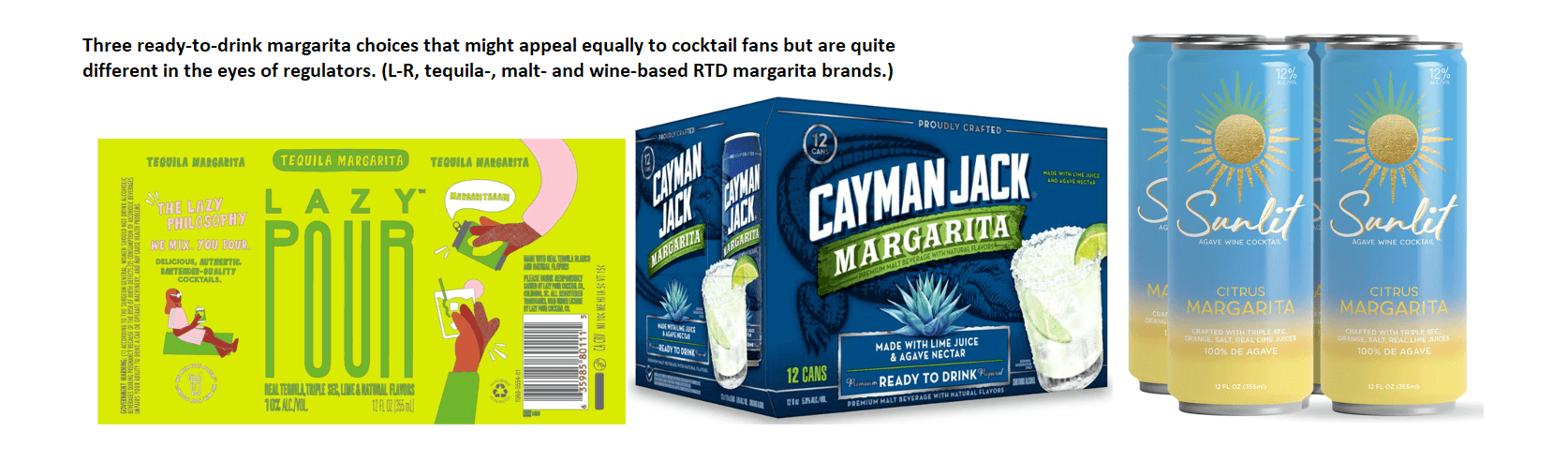
Some states have taken efforts to address this, mostly by distinguishing RTD spirits from other spirits in their statutes. For instance, Vermont earlier this year established that spirits-based RTD cocktails may be sold much like malt beverages in the state. That means they do not have to be distributed through the control board, can appear in grocery stores, will be taxed less and can be DtC shipped by licensed suppliers. Michigan and Ohio have different rules for lower-ABV spirits. While much of these changes have happened in control states, even open states like Arkansas have altered their policies to create parity within how RTD cocktails can be sold, regardless of their origin.
It is very likely that we will see similar changes in more states in the coming years. And perhaps the time has come for a broader rethinking of how different alcoholic products are defined and regulated. But until that happens, it will be critical for everyone involved in the production and sale of alcohol to recognize that, when it comes to RTD cocktails, it matters more what’s in the can than what it’s called.
Keep up with evolving RTD and other regulations by subscribing to our blog.
Find Sovos ShipCompliant at the 2023 Unified Symposium in Sacramento, California. We’ll be showcasing our cloud-based direct-to-consumer and three-tier compliance solutions that reduce risk and lessen the burden of compliance. We look forward to meeting friends both new and old at our booth #318.
Sovos ShipCompliant will once again exhibit at and sponsor the Direct To Consumer Wine Symposium. Please visit our booth to learn more about our cloud-based, real-time compliance solutions for wineries of all sizes. And keep an eye out for our conference session previewing the findings of the 2023 Direct-to-Consumer Wine Shipping Report.
While beer brand labels are a great way to set your product apart with clever marketing and design, there are rules brewers must follow while designing them. Beer labels, whether on a bottle, can or keg, have lots of information that is highly regulated, both at the federal level and by individual states. We’ve compiled the basic information required by both the federal and state levels to help maintain compliance as you begin the label design process.
Beer labels are regulated by federal law under both the Internal Revenue Code and the Federal Alcohol Administration Act. These rules on what must be included and what is prohibited from being on a label are in turn managed by the Alcohol and Tobacco Tax and Trade Bureau (TTB). By law, beer labels must contain the following information:
All of this information must be formatted to match the TTB’s standards.
What information can a label not provide? There are a few hard-and-fast rules. Beer labels are prohibited from containing the following content:
Certificate of Label Approvals (COLAs) ensure that suppliers and producers comply with federal regulations when marketing and designing alcohol labels. Under federal law, most alcoholic products must first be registered with the TTB and receive a COLA before they can be sold. For beer products, though, a COLA is only required when they are sold in interstate commerce.
Obtaining a COLA is a relatively straightforward process. Perform a self-review of your label to ensure it meets all the TTB’s Beverage Alcohol Manual (BAM) guidelines, then submit your COLA through COLAs Online and wait up to two weeks for a response. It’s important to note that your COLA will not be “rejected” per se, but if it’s not approved immediately, it will be sent back to give you the opportunity to correct any errors before reapplying. The top reasons for a returned COLA are missing or improperly formatted required information, discrepancies between license information listed on the label and what is in the TTB’s records, and missing formulas.
If at any point you make changes to your label, you may be required to apply for a new COLA. The TTB has allowable revisions that can be completed without getting a new COLA, so be sure to double check before re-applying to save you time and effort.
In addition to the federal label requirements, most states have their own brand label registrations. State brand label registrations typically require providing a COLA and paying a fee. Even if you don’t sell interstate, your beer must meet the requirements of the Internal Revenue Code. States require registrations for several reasons, including to better monitor franchise rules, to identify what’s on store shelves and to verify proper labelling.
Taking the time to understand federal and state-level beer labeling requirements is critical to compliance. Planning ahead and strictly adhering to TTB guidelines is the best way to start your beer labeling process.
Ready to start the process for certificate of label approvals (COLAs)? Find out how Sovos ShipCompliant can help.
Wine has strong quarter, with 28% increase from Q2 and 8% year-over-year increase in registrations
The temperatures may be starting to dip with the outset of autumn, but beverage alcohol new product registrations are seeing increases across spirits, wine and beer. Similar to this time last year, wine new product registrations had a strong showing. However, the true champion was the spirits category for Product Registration Online (PRO) new product registrations*, with every area showing year-over-year growth and/or quarter-over-quarter growth.
The following is a breakdown of new product registration data via PRO from the third quarter of 2022 (July, August, September) for spirits, wine and beer.
Overall, spirits new product registrations increased 13% from this time last year and 20% over Q2 2022. Tequila saw 68% year-over-year growth and a 25% rise from last quarter. Rum registrations also saw positive jumps from Q3 2021 and from Q2 this year, with a 54% increase and 41% increase, respectively. Among other liquor new product registrations:
Wine brand registrations had increases in nearly every category for both yearly growth and quarterly growth. Fruit and dessert wines saw 13% year-over-year growth, with a 50% jump from Q2. Red and rosé registrations grew 6% from this same time last year, and also had a 22% increase from last quarter. White wine also saw yearly and quarterly growth, with an 11% and 18% increase, respectively. The sparkling category had a 7% drop from Q3 2021, but saw a 25% jump over Q2. Saké was the only major wine category that dropped in both areas, with a 5% dip year-over-year and a 67% decrease quarter-over-quarter in new label registrations.
Overall, beer/malt new product registrations are up nearly 5% from this time last year, while quarterly growth is up 17%. Specifically, the ale/beer categories had 15% year-over-year growth and a 7% quarter-over-quarter increase in registrations. Malt new product registrations saw a 3% drop from Q3 2021 but also grew 26% over last quarter.
*Product Registration Online (PRO) data encompasses nationwide label/brand registrations by PRO users. Product Registration Online processes some 100,000 state registrations annually.
Learn how PRO enables fast, easy electronic brand filings for wine, spirits and beer brands in participating states.