 True DtC compliance help
Congratulations, your winery has grown to a point where shipping under someone else’s license has become too great of a risk, and you’ve decided to search for a direct-to-consumer (DtC) shipping compliance partner. There are choices in the marketplace, so how do you know which company to work with? As you conduct your due diligence take the following considerations into account.
True DtC compliance helpIf you’re looking to do business above board, your winery must ship under its own license. Look for a software solution that can ensure compliance when dealing with the maze of state-by-state rules around brand registrations, age verifications, customer volume limits, and tax determination and reporting.
 Experts at your fingertips
Your expertise likely lies in your recipes, vines or tasting room, not in tracking regulatory updates. Choose a DtC compliance partner with a team of regulatory experts who backs their product by keeping track of changing rules, so you don’t have to.
 No hidden costs
Look for a partner with a clear pricing structure that doesn’t nickel-and-dime or surprise you with unclear fees. Compliance solutions should be a predictable price each pay cycle. When it comes to something as important as a compliance provider, consider unpredictability to be a red flag.
 Support without limits
Choose a partner that won’t leave you at sea once your DtC compliance solution is up and running. Whether new team members need to be trained or state requirements have left you scratching your head, your emails and phone calls deserve to be answered. Unlimited product and user support should come at no additional cost.
Coming to the realization that it’s time to hold your own DtC shipping licenses is a great step in the right direction. Working with a compliance solution that offers true compliance help, the knowledge of industry experts, has a clear pricing structure and offers unlimited free support will set you up for success.
Learn more about managing your DtC wine shipping compliance.
Effective January 1, 2024, wine and spirits products will be subject to the California Beverage Container Recycling Program (BCRP). This change follows the passage of SB 1013 in September last year and reflects efforts by the state to help manage and reduce waste from beverage containers by extending the BCRP to a class of products that has so far been exempt.
The BCRP is designed to encourage recycling in California by requiring beverage companies to remit a deposit to the state that can be returned to the consumer when they bring their bottles back to a designated recycling location. These programs, also known as “bottle bills,” are active in several other states besides California, but as always in the beverage alcohol industry, each state’s specific rules and procedures are different.
Companies selling beverages in California may be subject to the BCRP either as a “manufacturer” or as a “distributor.” Recognizing whether you are considered one of these parties—or both or neither—is critical to understanding what you will need to do to remain compliant with the BCRP. Note that the terms “manufacturer” and “distributor” have different definitions under the BCRP than they traditionally have in the beverage alcohol industry and are not reflected by any California licenses you may hold.
Under the BCRP, a “beverage manufacturer” is any party that:
California has amended its law in the case of alcoholic beverages to explicitly state that for the bottle bill, the “beverage manufacturer” is the party licensed by the California ABC. Even in cases of custom crush or third-party bottling, the brand owner is responsible for managing the BCRP requirements.
All beverage manufacturers subject to the BCRP are required to:
Processing fees are based solely on the container material, not size, and are subject to change every calendar year. In 2023, the processing fee for glass is $0.00452 per container, but manufacturers should make sure to check with CalRecycle near the end of the year for any changes.
Beverage manufacturers must file a report on their sales and remit their processing fees monthly, with the report due on the 10th of the second month after sales have been made (so sales made in January 2024 will need to be reported by March 10, 2024). If a beverage manufacturer demonstrates compliance with these requirements, they can petition CalRecycle to report their sales annually.
Manufacturers must also ensure that their products are properly labeled in accordance with BCRP rules, discussed below.
Under the BCRP, a “distributor” is any entity that:
As such, most California wineries and any out-of-state DtC wine shipper will likely be considered both a manufacturer and distributor under the BCRP and need to comply with both requirements. Notably, SB 1013 specifically included Wine Direct Shippers Permit holders, making California the only state to make out-of-state DtC shippers subject to its bottle bill. (In every other state with a recycling redemption program, either wine is not an included party or DtC wine shippers are specifically made exempt.)
Distributors subject to the BCRP are required to:
Currently, the CRV for glass, plastic and aluminum containers is $0.05 if under 24 ounces, or $0.10 if 24 ounces or greater. Wine and spirits products that are sold in boxes, bladders, pouches or other non-standard container types have a CRV of $0.25.
Beverage distributors must file a report on their sales and remit their CRV collections monthly, with the report due by the end of the month after sales have been made (so sales made in January 2024 will need to be reported by February 29, 2024). Like beverage manufacturers, distributors can petition for annual reporting once they demonstrate compliance with these requirements.
The process for registering with CalRecycle is the same for both beverage manufacturers and distributors, and a business can register as both at the same time. A manufacturer and/or distributor will need to fill out the online form, or mail in a copy of the PDF form, identifying the products they sell, the container types they use and how they sell in California.
The registration form asks when the company began selling in California, however wine and spirits producers should instead select the date when they will be subject to the BCRP, namely January 1, 2024.
Wine and spirits producers will not be subject to any of the collection or reporting requirements until 2024, but they are highly encouraged to register with CalRecycle as soon as possible to make sure their accounts are active and in order by the January 1 effective date.
Products subject to the California BCRP must be properly labeled with one of these five allowable CRV messages clearly visible on the container:
There are further rules about spacing, font size and placement of these messages that must also be met. While there is no requirement to get a label approved before it is sold in the state, CalRecycle will review labels upon request to confirm whether or not they are in compliance.
Importantly, these labeling requirements will be optional for wine and spirits products until July 1, 2025, though wine and spirits producers are encouraged not to wait until the last minute to get their labels in order. No wine or spirits products sold before January 1, 2024 may have the CRV labeling on it.
This extended timeline should give everyone plenty of time to prepare, including figuring out some lingering issues, such as labeling for vintage products and whether alternatives like QR codes will be allowed.
In all, the expansion of the California BCRP to include wine and spirits products is a major undertaking for both the state and the industry, and it can only be hoped that it will be worth it and foster greater waste management and recycling in the state. For wine and spirits producers, there is a lot to take in and prepare for, and they should take time now to understand what their responsibilities will be going forward.
To that, CalRecycle has made several resources available to help explain the changes, including this informative webinar. As we get closer to the effective date and as more information becomes available, we at Sovos ShipCompliant will also do our part to help inform the industry and support our users in their compliance needs.
Subscribe to the Sovos ShipCompliant blog for the latest updates and insights into beverage alcohol compliance.
 By Jeff Carroll, WineDirect
Wineries in the United States can ship to 97% of the U.S. population for direct-to-consumer (DtC) shipping, right? Not exactly. Most people think of states as either open to direct shipping or closed, but the reality is more nuanced. Although 47 states, representing 97% of the population, allow some form of DtC shipping, many of those states have major restrictions that impede full DtC adoption. The wine industry has been working for almost three decades now to gain (and also improve and defend) access to these states, but the work is not quite yet done.
Most wineries choose not to ship to all of the available DtC states. Tablas Creek Vineyard, for example, ships to 41 states, according to this extraordinarily helpful blog post by Jason Haas. The states they choose not to ship to are either too expensive and burdensome for Tablas Creek to justify applying for a permit, or are entirely prohibited. Wineries across the country make similar calculations about ROI for each state they choose to enter.
Wine Institute has recently begun indicating the states that have “major restrictions” on their compliance maps. These eights states are technically allowed for DTC, but are severely limited in practice because they place burdens on wineries that want to sell their wines to customers there. Updating these restrictive laws and opening the remaining two states that are entirely prohibited would have a meaningful impact on DtC access and ROI for wineries.
The states below will be the focus in the coming months and years as wineries and the organizations that represent them look to expand their market reach.
Open Mississippi and Utah. This is obvious as these are the only two remaining states that are completely closed for DtC access. +1.86% of U.S. population.
Add offsite access to Arkansas, Rhode Island and Delaware. Arkansas has an existing DtC license, but it only allows shipments to customers who made their purchases while physically present at the winery (onsite shipping). Wine club, e-commerce, phone and marketplace orders (offsite shipping) are not allowed today. Provisions technically exist in both Delaware and Rhode Island that allow onsite shipping, although many classify Delaware as an entirely prohibited state because of the convoluted nature of the “federal on-site” law. Efforts are underway to create licensing schemes in all three states to allow full DtC access for wineries. +1.52% of U.S. population.
Remove New Jersey capacity cap. After Ohio removed the 250,000 gallon “capacity cap” in 2021, New Jersey is the only remaining state that limits the size of wineries that are eligible for a license (wineries with production greater than 250,000 gallons per year, or owned by a group of wineries that together compromise more than 250,000 gallons per year, cannot receive a direct shipping license). On top of that, Jason Haas makes the case that New Jersey has the most expensive license ($938) plus significant complexities around registration and corporate income tax. +2.77% of U.S. population.
Allow fulfillment house shipping in Oklahoma. The vast majority of DtC shipments are shipped on behalf of wineries by licensed fulfillment houses. Several states are evaluating whether they want to create DtC licenses for fulfillment houses that are shipping on behalf of licensed wineries. Oklahoma currently does not allow fulfillment house shipments, and correcting this issue to be in line with the rest of the states would open up substantial volume there. +1.18% of U.S. population.
Remove wholesale restrictions in Louisiana, Wyoming and Indiana. Three states have restrictions on what wineries can do based on their sales to wholesalers in the state. In Louisiana and Wyoming, you can ship DtC if you sell through the wholesale channel, but you can only ship products that are not available in wholesale distribution. Wyoming also has a strange tax law where if you are over the economic nexus threshold of $100,000 or 200 transactions, you have to pay both sales tax and the direct ship “markup” tax, which was meant to be a combined sales and excise tax. In Indiana, you simply cannot ship DtC if you are selling to wholesalers in the state. +3.59% of U.S. population.
Many wineries choose not to ship to the states discussed here. If all of the issues above were resolved, these wineries could see a nearly 11% boost to their DtC programs if the ROI justified applying for the requisite licenses. Winery DtC got a healthy boost during the pandemic, but the growth has since slowed. While wineries continue the work to improve their DtC marketing programs, wine advocacy groups like Wine Institute, WineAmerica and Free the Grapes! continue the decades-long fight for better access on the regulatory front.
About Jeff Carroll
Jeff Carroll is Vice President, Partners and Compliance, at WineDirect, a Sovos ShipCompliant Platinum Certified Partner. He is also a board member of Free the Grapes!, a national grassroots coalition of wine lovers and wineries who seek to improve consumer choice in wine.
All categories saw growth January to June in 2023, compared to that same time in 2022
The first half of 2023 has come and gone, with new product registrations showing positive growth across categories. Spirits new product registrations increased 20% from January to June 2023, followed by wine (+10%) and beer/malt (+1%). Overall, Product Registration Online (PRO) new product registrations* saw 12% growth from the first two quarters of 2023 over the same time period in 2022.
However, there was a 3% dip from half-over-half growth (January to June 2023 over July to December 2022).
The following is a breakdown of new product registration data via PRO from the first half of 2023 (January to June) for spirits, wine and beer/malt.
Along with its 20% increase in the first half of the year, spirits new product registrations increased also experienced a 13% increase over July to December 2022. With whiskey accounting for the highest share (32%) of spirit registrations, the category also saw moderate growth (+17%) for January to June 2023 over the first half of 2022. Whiskey also saw a 3% increase compared to July to December 2022. Among other liquor new product registrations:
While saké accounts for just 1% of total wine registrations, it saw the largest increase for both the first half of 2023 compared to the first half of 2022 (84%) and from July to December 2022 to January to June 2023 (130%). Sparkling (23%), fruit and dessert wine (10%), red and rosé (8%) and white (7%) all saw growth from the first half of 2023 compared to the same time last year. However, just sparkling saw an increase (8%) from January to June of this year over the second half of 2022.
Looking at the beer/malt category, beer saw a 16% increase for January to June 2023 over the same time in 2022. Comparatively, malt saw negative growth (-14%). When looking at July to December 2022 and then January to June 2023, beer and malt each saw decreases at -9% and -38%, respectively.
*Product Registration Online (PRO) data encompasses nationwide label/brand registrations by PRO users. Product Registration Online processes some 100,000 state registrations annually.
Learn how PRO enables fast, easy electronic brand filings for wine, spirits and beer/malt brands in participating states.
The direct-to-consumer (DtC) wine shipping channel has seen a continuation of movement tracked in the January release of our Direct-to-Consumer Wine Shipping Report, with dips once again occurring in overall volume and value.
Note: The proprietary data featured in this mid-year report is compiled from an algorithm measuring total DtC shipments based on millions of anonymized direct shipping transactions filtered through the ShipCompliant system and paired with WineBusiness Analytics’ comprehensive data on U.S. wineries, resulting in the most accurate depiction of the DtC wine shipping channel.
Following the height of the COVID-19 pandemic in 2020, the market is still working its way back to relative normalcy – or at least towards a new normal. Similar to this time last year, the overall volume of wine shipped across the country in the first half of 2023 dipped (-7%) for a total of 3.4M cases. The overall value of shipments also dropped 2% to $1.9B.

“At the midway point of 2023, the DtC shipment channel may not be hitting the highs of previous years but it’s far ahead of where it was pre-pandemic and remains a dynamic and vital sector of the overall U.S. wine market,” said Andrew Adams, an editor with WineBusiness Analytics. “And while wineries continue to contend with inflation, the DtC market remains the most effective way to engage with their best customers and create new ones in the intensely competitive total beverage alcohol market.”
Here are more details about DtC shipping channel changes between January and the end of June, 2023.
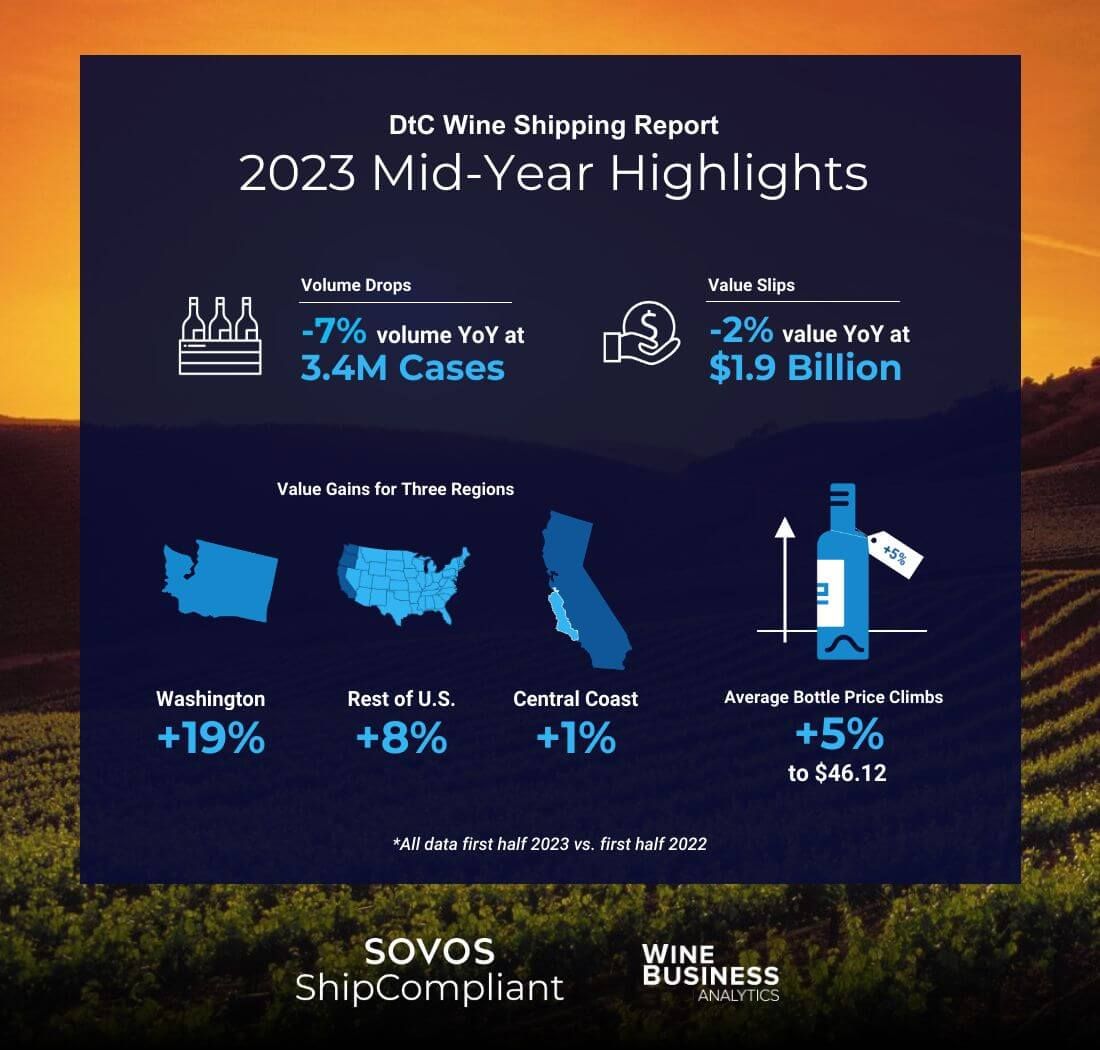
Average bottle price rose to $46.12, a moderate 5% increase compared to the first half of 2022 that reflects the average across all regions. Napa average bottle price is now $80.79 but had the lowest increase at 1%. Washington had the largest rise in average bottle price (11%), followed by Sonoma (10%) and the Central Coast (9%).
California maintains its position as the top destination state, with a 29% share. However, it also had a 14% drop for volume growth YoY for the first half.
Of the top 10 destination states in terms of volume, the top three for volume changes were Virginia (13%), Texas (-2%) and Washington (-3%). In terms of the top 10 destination states by value, the top three for value growth were Arizona (12%), Washington (7%) and Colorado (5%).
Of note: While also a top 10 destination state, Oregon experienced the largest dip in deliveries in both volume (-17%) and value (-18%). Alabama saw a 25% spike in value, which was the highest of any state, but is growing on a very small base. This increase, along with a 26% growth in volume, was also likely due to the continued effect of laws passed in 2021 that allowed for DtC shipments of wine in the state.
Washington wineries lead all other regions with a 7% increase in volume growth YoY in the first half of 2023. Washington also enjoyed a 19% increase in value growth. The Rest of the U.S. category* was the second-place finisher for both volume (flat at -0%) and value (+8%). Comparatively, the Rest of California** category saw the largest retreats in both volume (-13%) and value (-9%).
*Wineries in every other state aside from California, Washington and Oregon.
**Wineries in Mendocino, Lake, Livermore and Temecula counties and the Sierra Nevada region, plus all other areas outside the Central Coast, Napa County and Sonoma County.
The largest wineries – those producing 500,000+ cases per year – increased their average bottle price the most (12%) to $19.45. Those wineries also had an 11% drop for volume growth. The smallest wineries (under 1,000 cases produced per year) saw the second-highest increase of average bottle price at 10%, topping off at $88.86. Those wineries also had the only reported increase in volume growth at 1%. Wineries producing 1,000 to 4,999 cases per year saw the biggest drop in average bottle price, dipping 7% to $60.53. Additionally, those wineries had the largest decline for value shipped (-13%).
Of the top four wine types (Cabernet Sauvignon, Pinot Noir, Chardonnay, Red Blend), which account for 53% of the total share of the volume of all wine shipped DtC, each saw average bottle price growth (2% to 12%) and little to negative value growth (-7% to 2%).
The Other White category had the biggest gains in both average bottle price (17%) and value (10%). The next top varietal categories in terms of value growth were Zinfandel (7%), Chardonnay (2%), Riesling (1%), Merlot (1%) and Pinot Noir (1%).
No varietals saw an increase in volume shipped. Merlot and Riesling had the smallest dip for volume shipped, each with a 2% drop. Petite Sirah and Zinfandel followed at a 3% decrease year over year. The Other category had the largest drop in this category at –21%, followed by Moscato (-19%) and Sangiovese (-19%).
Both consumers and wineries have continued to respond to pandemic- and inflation-driven market conditions over the last few years, typically through an increase of on-premise purchases and higher bottle prices. Paired with an unpredictable economy and other trends in consumer beverage alcohol preferences, it’s difficult to forecast how the DtC wine shipping channel will evolve. Remember, however the market may adjust, we will be here to provide observations and insights. Our full report on 2023 will be released next January. Until then, discover our 2022 findings by downloading your complimentary copy of the 2023 Direct-to-Consumer Wine Shipping Report.
This data was compiled in partnership with WineBusiness Analytics, a leading source for wine industry data.
Ready to learn more about the DtC wine shipping channel in 2022? Download the 2023 DtC Wine Shipping Report today.
Small wineries breaking in to the direct-to-consumer (DtC) wine business sometimes choose to partner with third-party services that make big promises about handling compliance and licensing needs. Of course, there are numerous partners that can provide excellent help with managing these needs. But caution is in order when a third-party service makes sweeping claims, for example about providing all licenses a winery would need in order to ship, or that a winery needn’t worry about paying taxes itself. As businesses grow and states become more focused on license enforcement, there comes a time when the cost of proper licensure outweighs the risk and penalties associated with operating without them.
If you’re experiencing any of the following scenarios, it’s probably time to obtain your own DtC shipping licenses.
 Your small winery is growing
Many small wineries opt for a third-party service to skirt the upfront costs of obtaining multiple licenses in the infancy of their DtC shipping. Partners offer deals that take a percentage or flat fee per bottle shipped. As a winery’s footprint grows, so does the likelihood of penalties or loss of a production license when products are found to be violating “not of own production“ rules.
You should be able to celebrate the growth of your business, and not worry that it’s attracting unwanted scrutiny from state agencies.
 Your monthly transaction fee is unpredictable, with a yearly total above $3,000
Shipping under someone else’s license is not just legally dicey, it can be expensive as well. Pricing structures based around shipments, reports or transactions can lead to surprise costs during busier seasons. A predictable fee structure can save you more than just money in the long run.
 You’re shipping more than 200 cases to your top five states per year
If you were to compare the cost of obtaining DtC licenses in your five most profitable states to the amount you’re paying a third party, you may be surprised at the results. If you have proven growth and sales in even a few states, it’s worth doing the math to determine your return on investment.
Working with third-party shipping services may initially seem convenient and cost effective, but it comes with a host of challenges that you’re better off avoiding. When you begin to notice the limitations of relying on third-party shipping partners, it’s time to consider getting your own DtC licenses.
Considering working with a third-party shipper? Consider these factors.
Some promising direct-to-consumer (DtC) happenings have occurred in both Alabama and Delaware in the last few weeks. The DtC application process in Alabama has been made easier, with less information required. And there’s a clear sign that Delaware might open up to allow DtC wine shipping. We share the details below.
The Alabama Alcoholic Beverage Control (ABC) Board published a new direct wine shipper and Fulfillment House pre-application and required document checklist. The new forms require less information than before, simplifying the application process.
Updates include the removal of the requirement to provide both bond and proof of liquor liability insurance. Additionally, the amount of personal information given to the state now depends on the equity in ownership of each individual. Information like residences and driver’s licenses will only be required from those with 10% or more ownership interest in the applying entity. Anyone with less than 10% stake in the company simply must provide a notarized affidavit. Alabama’s ABC Board also removed the requirement of out-of-state entities needing to register with the Secretary of State.
These updates make the application process easier than ever, helping strengthen the DtC channel in Alabama.
Delaware is one of only three states where all forms of DtC wine shipping is prohibited. But for how much longer will this apply? We’ve been tracking bills aimed at opening up the state, and while nothing was decided before the legislature’s adjournment on June 30, there’s still hope for DtC shipping next year. HB 262 was pre-filed this month for consideration in 2024. Things are looking up, as the bill already has eight sponsors.
While we don’t have a crystal ball to predict the future of DtC shipping, there are clear signs that good things are coming to the DtC market. Our compliance experts will be monitoring these situations and provide updates as they occur, so check back often.
Subscribe to the Sovos ShipCompliant blog to stay up to date on the latest insights on beverage alcohol compliance and government reporting.
Among those who, for whatever reasons, oppose direct-to-consumer (DtC) shipping of alcohol, one argument that keeps coming up is that consumers should not be able to have alcohol shipped to their homes because of the risk of counterfeits. That is, there is apparently a belief that if an alcohol product is sold without the involvement of a distributor (even if the distributor never actually handles the product) then it is inherently suspect and is likely fake or even dangerous. And therefore, all DtC shipping must be prohibited and ruthlessly policed.
If this argument is subject to even the slightest scrutiny, however, it quickly falls flat. And indeed, the DtC shipping market, if expanded, could prove a ready fix for many counterfeiting concerns.
Now, no one here is arguing that counterfeiting in the beverage alcohol industry is not an issue. Just as with other luxury goods, there are numerous alcoholic brands that command customer interest and thus also high prices. An unscrupulous person who gets their hands on an empty bottle of Pappy Van Winkle might readily fill it with any old brown liquid in the hope of earning a quick few hundred dollars.
When it comes to beverage alcohol, the risk from such fakes is compounded by the real potential for actual harm to the consumer if the product is substandard. If that fake bottle of Pappy Van Winkle is filled with a lower-grade whisky, the consumer will only lose out on their money; if that bottle is filled instead with a bootleg whisky or worse, the consequences could be devastating. (The regular reports of mass alcohol poisonings in countries with such restrictive alcohol laws that consumers are forced to go to the black market should make us grateful for our open and well-managed alcohol industry.)
And certainly, there are plenty of cases of alcohol counterfeiting in the U.S. that should be investigated and prosecuted to ensure that consumers can remain assured of the safety and fidelity of the products they purchase. It is just unclear why the DtC shipping market should be specially targeted because of this (industry-wide) issue.
When opponents of DtC shipping bring up their concerns around counterfeiting, the examples that are brought up usually involve either eBay or Craigslist. And frankly, in that context, there is a point. While these sites may be great for cleaning out your garage or selling decades-old memorabilia, they are largely unsuitable for the sale of alcohol. For one, it can be very difficult to know who you are buying from, and that’s giving the seller the benefit of the doubt that they are licensed to sell the alcohol listed on their page (a dubious assumption).
But focusing on cases that involve such obvious improper behavior that the shipping aspect is really the least of the problems is at best a distraction and more likely is an attempt to defame the entire DtC shipping market. Instead, a robust—and robustly regulated—DtC shipping market provides ample chances to combat counterfeiting.
Indeed, often enough counterfeiting is impossible in a DtC shipment. Most DtC shipments these days are sourced directly from alcohol producers, primarily wineries. As such, recipients of DtC shipments are largely purchasing directly from the source, the brand owner themselves. Almost by definition, brand owners cannot counterfeit their own brands—they may sell a product that the consumer finds doesn’t meet their expectations, but it cannot be a fake.
This then becomes an argument for why DtC shipping permissions should be expanded not contracted. Currently, 47 states plus D.C. permit DtC shipping of wine, whereas only about eight states allow some form of DtC spirits shipping. So, for roughly 95% of American wine connoisseurs, when they read about a new, limited-distribution 99-point Napa cab, they can connect with the producer and buy an otherwise unavailable product.
However, if that same consumer wants to get a similarly highly rated and inaccessible whisky (and over 80% of them do), they are largely out of luck. Rather than accepting the vagaries of the alcohol market for what they are, they might be convinced then to seek out the “back alley” seller on eBay and take the risk. If they could reach out to the distiller directly, though, they could ensure the authenticity and safety of the product.
When it comes to product safety, there is no evidence that the DtC market is, or would be, any riskier than the existing three-tier market. When a producer DtC ships a package of alcohol, it should be of no-less quality than anything else that producer would sell at their tasting rooms or have distributed to retail stores. Production facilities are subject to state and federal scrutiny on their cleanliness and quality control. If a producer is found to be selling substandard alcohol, they would be vigorously prosecuted regardless of how the product was sold.
Even when it comes to DtC shipping by retailers, a more limited but developing market, consumers should feel confident in the safety of the products sold. This is because almost all alcohol sold by retailers across the country has been distributed by a local wholesaler, which is supposed to be guaranteeing the safety of the products they handle. (It is somewhat ironic, then, that many wholesalers argue against DtC shipping by retailers on the grounds that you can’t trust what is being sold.)
Any retailer that is willing to sell counterfeit products will do so whether they can DtC ship or not, and there are already ample state laws available for local regulators to go after such actors when they are found out.
By and large the arguments against DtC shipping are mostly hot air. Repeated claims of sales to minors, lost tax revenue or the hollowing out of the three-tier market fail to be supported by more than anecdotal evidence. But the scary language around the risk of counterfeits is particularly disingenuous.
Certainly no one is going to argue for the legitimacy of Ray’s Discount Liquors on eBay. But there is a proven model for how DtC shipping can work safely and effectively, in a way that provides benefits to all parties (including increased three-tier sales). Indeed, if a whisky lover could buy directly from Buffalo Trace and not have to seek out shadier sources for their Pappy Van Winkles, that could end up shutting down a lot of the businesses that DtC shipping opponents claim to be so worried about.
Learn more about how ShipCompliant Direct can help navigate the world of DtC shipping compliance.
A Q&A with Arun Kurichety, COO & General Counsel, Petalfast
In an effort to better understand potential cannabis concerns in the beverage alcohol industry, I sat down with Petalfast’s Arun Kurichety. Further expanding on Arun’s keynote address at the 2023 Sovos ShipCompliant Wine Summit, we discussed trends in the cannabis industry and what alcohol producers should know.
As the legal cannabis market has grown over the past decade, there has been a great deal of interest in predicting how consumption patterns will change and how much—not whether—displacement there will be among consumers moving to cannabis away from beverage alcohol. And we certainly have seen this play out with as many as a third of consumers reporting drinking less with the arrival of legal cannabis options. However, this needs to be taken in the context of longer-term patterns, as alcohol consumption has been in decline overall since the 1980s with younger generations in particular choosing to drink less, if they drink at all. And similarly, the cannabis-curious consumer, who might once have shied away, is now freer to test out the market across a wider range of products, driving what could turn out to be a transitory surge that evens out as the novelty of cannabis recedes.
One of the strengths of the cannabis market is the wide variety of ways that consumers can enjoy it, and the beverage format is one of the areas that we see some of the greatest future potential. Currently, beverages only make up 1% to 3% of the total cannabis market. However, there has been nearly 40% growth in cannabis beverage sales since 2021 and that is only expected to keep growing. As the alcohol industry knows very well, beverages are an extremely inviting way to consume a product that can lend themselves to social events and a more convivial atmosphere all around. With more cannabis beverages coming into the market, there comes the potential for more competition with alcohol consumption but also a lot of opportunities for cooperation as social lubricants. Indeed, alcohol companies, with their experience in producing, marketing and selling beverages may themselves look to produce cannabis beverages—however, they should be very careful about keeping their product lines strictly separated.
There is certainly much more to the cannabis and alcohol story than competition and worries about lost consumers. Indeed, as highly regulated products that are both consumed recreationally for pleasure but come with potential health risks, there is much the two industries can collaborate on in spreading the message around effective laws and safe consumption habits. And we have happily seen this happening already, with Wine & Spirits of Wholesalers of America giving broad support for federal cannabis legalization. As legal cannabis spreads into more states, the alcohol industry can—and should—lend its voice to how to best monitor and control the production, distribution and sale of cannabis. Similarly, the cannabis industry can then teach alcohol businesses about new technologies and systems they use to track cannabis products through the supply chain. With greater collaboration, then, the two industries can also work to relieve potential areas of conflict, such as cannabis farms operating next to vineyards.
While there are a lot of ways for members of the beverage alcohol industry to get into cannabis, it is very important for them to keep in mind that, currently, cannabis and alcohol cannot mix. This is absolutely true in terms of the products themselves—federally and in every state with a legal cannabis market, active THC or other cannabinoids may not be present in any product that has any alcoholic content—and where they can be consumed. For instance, California prohibits the use of cannabis products on any premises that has an alcohol license, with severe penalties for violations. Beverage alcohol companies should also be aware that there are still many barriers for cannabis businesses to operate like other businesses, such as not having access to the federal banking market. So some more established or alcohol producers may decide the potential benefits of engaging with the cannabis market are not at this juncture worth the risks to their alcohol licenses or overall business.
There is a perception that alcohol is failing and doomed for irrelevance, as consumers choose to either abstain from all intoxicants or to switch to new products like cannabis. As such, it is said that alcohol must revamp its image, especially by co-opting whatever it is that cannabis is doing to attract new consumers. While there are clear data showing a decline in overall alcohol consumption and increases in cannabis users, this effort to “become cool again” largely misses the point of what consumers are looking for and underrates the players in the alcohol industry that are succeeding in keeping up demand. When you ask contemporary consumers what they want, words like “authenticity” and “experiential” come up over and over again, regardless of what the product is. Cannabis certainly benefits from its novelty and newness for many consumers looking for new experiences, which is not something that most alcohol producers can imitate. But alcohol producers can remain relevant for consumers by highlighting where they are innovating and by showcasing how what they produce reflects the values and interests shared with their consumers. Alcohol can best succeed if it stays genuine in its messaging, and that means avoiding anything that smacks of pandering or gimmickry that a consumer would find inauthentic.
Arun Kurichety is a seasoned corporate executive and attorney with 15+ years of corporate transactional/restructuring experience with a focus on the cannabis/CBD industry. As a cannabis industry “veteran,” he has advised numerous cannabis companies, from start-ups to publicly traded companies, in an ever-shifting regulatory landscape. He is highly regarded for his capital markets and debt restructuring knowledge while regularly advising on corporate governance and compliance/regulatory matters.
Over the last few years, one of the leading issues affecting the direct-to-consumer (DtC) wine shipping market has been the ongoing effort by states to regulate third-party shipping services, specifically fulfillment houses. At various times, it has seemed as though a deluge of new rules and restrictions around using fulfillment houses was about to sweep across the country, only for the clouds to part and things to carry on, more or less as normal.
Still, the issue of further fulfillment house regulation keeps popping up, and it remains important for DtC shippers to understand and abide by the regulation of fulfillment houses that currently exists so that they can remain compliant with their duties as licensees.
One of the central tenets of beverage alcohol regulation, and of DtC wine shipping in particular, is tracking the movement of alcohol products, who ships them, how they are transported and where they end up.
Fulfillment houses support the DtC wine shipping industry through critical logistics offerings. In their warehouses, they offer storage for wineries that often lack the room to house their wine after it is bottled. And with their packaging and shipping services and ties to common carriers, fulfillment houses also enable faster and easier delivery for consumers.
For many state regulators, however, fulfillment houses seem to muddle their understanding of where DtC wine shipments come from and who is responsible for them. This is because a DtC wine package shipped from a fulfillment house warehouse will list the warehouse’s location as the “ship-from” address. At a glance, then, it may seem that the package came from an unlicensed, unknown source, even though a licensed and perfectly compliant winery made the sale and is behind the shipment.
As such, states that have adopted fulfillment house regulations have focused on licensing/registration and reporting to establish a more thorough understanding of DtC wine shipping within their borders. This has largely taken two forms, which vary in how much the burden of compliance is placed on the fulfillment houses or their winery clients.
In Alabama, Kansas, North Dakota, Tennessee and Virginia, fulfillment houses (or other non-carrier third-party logistics services) must get licensed by the state before they can support DtC shipments there. Further, DtC wine shippers can get in serious trouble if they use a non-licensed fulfillment house to ship to these states.
Illinois and Louisiana will also only allow DtC wine shipments from addresses that have been registered with their respective alcohol regulatory agencies. However, in these states the onus of identifying fulfillment houses is placed on the DtC wine shipper (the wineries) themselves during the licensing process.
In all cases, the states also require fulfillment houses to provide a regular (at least annual) report of the shipments they supported. The intent there is for regulators to be able to compare those reports against those from the DtC shippers to ensure that they are compliant.
DtC wine shippers should be aware of a trend among states to regulate the use of fulfillment houses in the absence of any statutory change. For instance, New Hampshire requires all new and renewing DtC shipping licensees to list any third-party locations they may ship from during the application process. Shipping from an unregistered location would violate the shipper’s license terms.
States like New Hampshire can make changes like this under their broad authority to set whatever conditions they want to issue a shipping license, and it can have a real impact on a prospective shipper that gets caught unaware. So DtC shippers should always take care when filling out their application forms to ensure they completely understand what they are signing up for.
As we’ve noted, the ostensible reason for fulfillment house regulation is to track the market and allow regulators to protect against illegal shipments. Since fulfillment houses shipments can look something like a black box to regulators, they claim they need licenses and reports. And besides, everyone else involved in the alcohol market generally needs a license, so why not fulfillment houses?
It is hard to discount a regulator’s reasonable-sounding desire for better visibility into how alcohol is shipped within their jurisdiction. And indeed, many fulfillment houses have gone out of their way to accommodate these regulations, getting licensed and filing reports in the states that require it.
At the same time, it can be hard not to think of all this as another layer of bureaucracy designed to inhibit the DtC wine shipping market. That is, the ultimate effect (which some parties likely hope will happen) is that by making it harder for fulfillment houses to operate, there will be fewer overall DtC shipments.
If the goal is to create a better record of DtC shipments within a state, it’s unclear how much extra value there is from requiring additional licenses and reports from fulfillment houses. It may be helpful for a state to know ahead of time that a DtC licensee may ship from a third-party location, but that need not require full background checks (which Alabama has required from fulfillment houses applying for a license).
And the DtC wine shipping market is already replete with reporting, so there is little extra value that will come from a fulfillment house’s report. In most states, both the licensed shipper and the common carrier must report their shipments of alcohol. If a state is struggling to compare the shipments reported by a carrier with the shipments reported by the licensed shippers, states could require both of them to include the shipment tracking number on their reports—this is a unique, universal datum that all parties in the shipment have access to and would give a regulator a much clearer picture of DtC shipments than one more report with a ship date and shipping addresses that need to be parsed for reconciliation.
In the end, if states want to further reduce whatever illegal DtC shipments of alcohol might exist, they should be looking for ways to make it easier for more parties to access the legal DtC shipping market and not be imposing needless obstacles on compliant shippers. Certainly, no one is advocating for Ray’s Discount Liquor Garage on eBay, but otherwise law-abiding members of the industry might look for less-legitimate alternatives if they find that the services they once relied on are forced to close due to regulatory overreach.
Still have questions on fulfillment house regulation? Learn more about how ShipCompliant Direct can help you get a handle on DtC shipping compliance.
Preparing your business for direct-to-consumer (DtC) wine shipping is no small feat. Between licensure, compliance concerns, tax accuracy and regulated reporting, overwhelm may seem inevitable. With the right partner by your side, you can focus on the delivery details that matter most to your customers. But there’s one delivery element that no one can control: the weather.
There’s nothing that can ruin a wine delivery experience quite like a damaged product. Like any other perishable product, wine is affected by extreme temperatures. Though wine’s sweet spot for storage is between 53 and 57 degrees Fahrenheit, there is little harm in temperatures reaching the mid-60s mark. Wine kept in hotter condition for even just a few days can easily become irreparably damaged, and once the temperature hits triple digits the cork seal is compromised.
Here are our top tips for contending with the weather as you ship your products.
 Temperature control
Dig into the details of your wine’s delivery journey. Inquire about temperature-controlled storage facilities, average delivery vehicle temperatures and how packages are stored at hold-at locations. Some fulfillment partners provide special services dedicated to temperature-sensitive products, though they come at a premium price.
 Packaging considerations
Another form of hot-weather insurance can some in how you package your products in the hot summer months. Some organizations switch from eco-friendly packaging materials to well-insulated styrofoam during heat waves. Additionally, ice packs added to shippers maintain a consistent temperature from the time the bottle is packed to the last mile of delivery.
 Weather holds
When all else fails, wineries can choose to enact weather holds. It’s not uncommon for wineries to cease ground shipments and pause wine club deliveries during the summer months.
With a careful approach to temperature control, your winery can ensure that your products are safely delivered to your customer’s front doors.
Looking to extend the white glove treatment to home delivery? Manage your customers’ shipping experience with Sovos ShipCompliant’s Delivery Experience.
In a recent Commerce7 and Sovos ShipCompliant webinar, experts from each team shared the latest statistics and trends in direct-to-consumer (DtC) wine and offered tips on how to leverage them to grow your business. Here are the main takeaways from presenters Zach Kamphuis and Karen Urquhart of Commerce7 and Sovos ShipCompliant’s Alex Koral.
Last year, the overall winery market was dominated by limited production (less than 1,000 cases) and very small (1,000-4,999 cases) wineries. Without access to the three-tier market, smaller volume wineries often opt for direct-to-consumer shipping to reach their customers. And in the last 10 years, the average DtC bottle price has hovered around $35-$40, proving that you don’t need a massive footprint or high-priced vintages to achieve success.
Interestingly, 2022 saw the first decline in volume of wine shipped in 13 years. The decline comes after a decade of double-digit year-over-year growth, and on the heels of three years of truly phenomenal growth fueled by pandemic related stay-at-home DtC buying. As wineries, bars and restaurants opened back up, the market began to correct itself.
With this information in mind, utilizing data-driven insights is invaluable to maximize engagement with DtC consumers.
Selling wine online is difficult without an email marketing strategy. By capturing emails in the tasting room, you have the ability to communicate with out-of-town visitors who have already been wowed by your staff, campus and wines. When they go back home, leverage their great in-person experience to proactively remarket to them. Top performing wineries take the time to explain to their team the importance of email captures, and how to create meaningful invitations for their guests. After tasting room professionals wow customers with their knowledge, inviting them to learn more or enjoy an exclusive offer will pique the interest of consumers and lead to success in and outside of the tasting room. Kamphuis says there is a significant correlation between getting emails and creating online sales.
The 10 top performing wineries on the Commerce7 platform have a nearly 70% email capture rate, compared to the 3% rate of their 10 lowest-performing wineries. For every dollar these same wineries sold in the tasting room, the top wineries sold $0.78 online, while the bottom wineries made $0.18 in online sales.
Some of the easiest ways to grow bigger carts lay in the art of website design. Strategies like including buy buttons on list pages make it simple for online shoppers to browse your selection and add their favorites to their cart. If a customer wants to buy multiple products and your user experience forces them to open multiple tabs or pages, the odds of each bottle making it to their cart decrease. Unnecessary clicks add friction to the buyer experience, and 64% of add-to-cart clicks come from a page where multiple products are listed.
Nearly 70% of carts are abandoned. By knowing what leads to abandoned carts, you can drastically reduce that number. The top reason for abandonments during checkout process is high shipping costs. For this reason, the Commerce7 team recommends building the price of shipping into your bottle price or offering discounted shipping upon a specific bottle quantity or order value. A $70 bottle of wine may be easier to justify than a $50 bottle that costs $20 to get to your customers’ front door.
Mobile wallets can also make an impact on your online sales. Most site visits occur on a mobile device, so offering a one-click checkout experience with a mobile wallet is a value-added touch. Another tip is to chase abandoned carts through automated emails. The average abandoned cart email is opened 45% of the time, far above the average marketing email open rate. When the links in these emails are clicked, half of consumers will continue through the checkout process.
The benefits of email capturing also dip into club memberships. On average, consumers will purchase 4.22 online orders before signing up for a wine club. In fact, 21% of club signups occur online.
When it comes to club sales, flexibility is king. When given the opportunity, 31% of members edit their shipment. Club members who can buy more SKUs see their orders grow by 13%. Not only does the ability to edit their order increase the average order value, but there is a decrease in churn or cancellations.
With data and insights from Commerce7’s 2022 Data Book and the Sovos ShipCompliant 2023 Direct-to-Consumer Wine Shipping Report, produced in partnership with Wine Business Analytics, you can feel empowered to grow your DtC business.
Learn the ins and outs of interstate DtC wine shipping with our Direct-to-Consumer Wine Shipping Rules.
Direct-to-consumer shipping wine lovers enjoy the convenience of having their favorite vinos shipped to their front door. But what happens when, for whatever reason, they aren’t available to accept their wine deliveries? Whether they aren’t available during the day or they don’t have someone 21 or older available to sign for their package, these challenges result in failed delivery attempts and a lot of back and forth on last-mile delivery trucks. Incorporating hold-at locations options can save all parties involved from a logistical headache.
These delivery problems create unique challenges for the wine industry because of the product’s sensitivity. The longer your wine is on the truck, the more risks it encounters and of course ruined wine costs money. If your product is compromised during shipment, you’ll have to replace and reship. Not only is this costly for your winery, but it also creates a less-than-desirable experience for your customers.
Wineries with high delivery rates (the percent of shipments that are delivered on the first delivery attempt) take precautions to prevent failed delivery attempts and returns. One of the most powerful precautions is leveraging existing, no-cost hold-at location options. Let’s discuss a few of your options.
FedEx allows packages to be sent directly to or rerouted while en route to a FedEx location near the original destination. FedEx Hold at Location sites provide a level of convenience that can improve the customer experience, especially given that either you or your customer can request the reroute.
There are thousands of convenient FedEx Hold at Location sites nationwide, and many are open 24 hours and apply no service charge. In many states, FedEx Hold locations can be found inside Walgreens locations. As a bonus, if a telephone number is included, FedEx will contact the recipient after the package arrives at the FedEx Hold location—another customer touch point. Packages can be held for up to five business days and can be released only with proof of identification, making it a secure option for customers.
Another option for customers to have control of their deliveries and reduce the risk of failed delivery attempts is UPS My Choice. This service allows customers to request packages that are going to their home address to be held for pickup at UPS Access Point locations. These include thousands of UPS lockers, stores and retail locations including CVS Pharmacy and Michaels. It’s free to become a UPS My Choice member and to use the service.
Regardless of carrier, it’s important to provide your customers with options outside of delivering directly to their home or work, where they might not be able to accept their wine packages. Hold-at locations offer a practical solution to failed delivery attempts and returns. Using these services ultimately improves the customer experience and saves you time and money.
Discover more ways to improve your wine shipping customer experience and extend the white glove treatment to home delivery.
Under a settlement agreement, breweries located outside of Oregon now have more options for selling into the Beaver State, including direct-to-consumer (DtC) shipping and self-distribution to retailers.
The settlement arose out of a lawsuit filed by a group of Washington breweries last year challenging Oregon laws that limited beer self-distribution to in-state breweries and DtC shipping to breweries located in states that themselves would give Oregon breweries DtC shipping permissions. The argument presented by the Washington breweries was that these laws were unconstitutionally discriminatory, in that they restricted out-of-state businesses from enjoying the same access to Oregon’s beer market that in-state breweries had. Rather than go through the expense and time of litigation, the state of Oregon and the Oregon Liquor and Cannabis Commission (OLCC) agreed to remove the discriminatory provisions from these laws and grant all domestic breweries the same privileges in the state.
Going forward, regardless of where they are located, out-of-state breweries will be able to DtC ship to Oregon residents and self-distribute to Oregon retailers.
DtC shipping, like pretty much all other forms of selling beverage alcohol, is a highly regulated market with numerous rules and regulations that breweries must comply with to remain in good standing with the state.
Out-of-state breweries (now located in any state) must agree to abide by Oregon law when shipping into the state, including:
Further, DtC shippers must take steps to restrict sales to minors. At a minimum this means working with carriers that will check IDs and get a signature from the recipient at the time of purchase, and properly labeling their packages to indicate that they contain alcohol. While Oregon does not specifically require the use of age verification services at the time of purchase, this is still a best practice for everyone involved in the DtC shipping of alcohol. Age gates on websites are also best practice.
To self-distribute to Oregon retailers, out-of-state breweries will need to receive prior authorization from the OLCC. The application for this authority has been made available by the OLCC. However, breweries will also need to have, or be in the process of applying for, a Certificate of Approval from the OLCC.
When self-distributing, a brewery must assume responsibility for the obligations that would normally be handled by their wholesaler. These include remitting to the OLCC all excise taxes due on their self-distributions and complying with the state’s bottle bill (more information on this can be found on the application form linked above).
Oregon’s distribution territory restrictions will also apply to self-distributions. Under this rule, a brand of beer may only be assigned to a single distributor in a designated territory. As such, if a brewery already has a territory agreement with an Oregon distributor, they will not be permitted to self-distribute any brands governed by that agreement in the designated territory. This restriction does not apply to brands not covered by the agreement or parts of the state outside of the designated territory, nor does it apply to direct-to-consumer shipments.
It is important to note that Oregon must still enact legislation to amend its self-distribution and DtC shipping statutes so that they clearly apply to out-of-state breweries located in any state. In the meantime, though, the OLCC has agreed to not enforce the prohibitions on out-of-state breweries and has begun to issue preliminary Direct Shipper and self-distribution licenses in anticipation of the law changes. Legislation is a complicated beast, however, and it is possible that the Oregon legislature will make broader changes to its laws in response to the legal settlement (for instance, perhaps removing DtC shipping or self-distribution permissions even from in-state breweries, “resolving” any issues around discrimination of out-of-state businesses).
While it’s heartening to see Oregon take the steps, it’s too bad that it had to come through the threat of litigation and not organically by the state on its own. Self-distribution and DtC shipping can be invaluable lifelines to craft breweries that struggle to get the attention of distributors and therefore fail to ever gain purchase in retail markets.
States often want to support their local small businesses, and so it is little wonder that Oregon would have wanted to grant those permissions to in-state breweries. The problem, then, is that the state assumed it could rely on the 21st Amendment (which grants states broad authority in setting up their local alcohol laws) to enforce rules that discriminate against breweries based on where they are based in the country.
Oregon’s decision to settle the lawsuit then demonstrates a remarkable moment of clarity on the part of the state in recognizing that its arguments in favor of discriminating against out-of-state breweries were likely to fail if heard on their merits. In the 2005 Granholm v Heald and 2019 Tennessee Wine and Spirits cases, the Supreme Court clearly noted that states are on shaky ground when claiming that privileges granted to in-state businesses can be denied to out-of-state business purely because of where those businesses are located.
However, there has been a spate of court rulings that have seemed to not follow that ruling. And so, perhaps the only issue with the results here is that the anti-discrimination argument was not heard at trial and put on record for other courts to follow.
Learn how ShipCompliant Direct can help with the intricacies of DtC shipping compliance.
By Tom Wark, Executive Director, National Association of Wine Retailers
Politics breed myths. This has always been the case as politics is, at its most fundamental, a form of storytelling. So it should be no surprise that myths have arisen as various elements of the wine industry have fought against consumers and specialty wine retailer seeking to ship and receive wine. The politics of the wine shipping debate have led to stories of dire consequences. These stories have morphed into myth. Here are some of the more prominent myths that surround retailer interstate shipment of wine.
When the Supreme Court ruled in Granholm v Heald that a state may not discriminate against out-of-state wineries by banning shipments of wine while allowing instate wineries to ship wine to its residents, the Court did not distinguish between wineries and retailers. However, states, wholesalers, retailers and lawmakers said the Court did exactly this. They claimed in court cases, in the media, and in defending discriminatory laws that the Supreme Court’s Granholm ruling meant states could discriminate against out-of-state retailer shipping. In 2019, in the Supreme Court’s Tennessee Wine v Thomas ruling, explicitly declared that “there is no sound basis for this distinction….Granholm never said that its reading of history or its Commerce Clause analysis was limited to discrimination against products or producers.”
This justification for discriminating against out-of-state retailers is a pretext for protecting in-state interests. Though only a tiny percentage of wines sold by retailers, if any, is counterfeit, in-state retailers shipping wine can just as easily ship such wines. In the U.S. counterfeit wine is almost always a matter of very exclusive and very rare wines being counterfeited and these wines are very carefully and studiously screened for signs of fraud.
In states where wine shipments from out-of-state retailers are banned, consumers sometimes, nonetheless, buy wines from out-of-state retailers and arrange for their shipment. Consumers don’t make this effort because they are induced by retailers seeking to motivate consumers to break the law. Consumers seek out these non-resident retailers because they can’t find the wines they want at in-state retailers. This is due to the fact that the in-state wholesalers that provide and sell inventory to retailers in the state carry only a very tiny percent of the wines available in the entire U.S. marketplace.
In reality, consumers will always look first to local retailers for specific wines they want. By doing so, they reduce the wait and often very costly shipping charges. However, when consumers can’t find the wine they want locally, that’s when they look to out-of-state retailers. If the wine the consumer wants is not available locally, then it’s not a lost sale for local retailers since they were not selling it in the first place.
This particular myth is a claim that has been leveled at both wineries and retailers that seek the right to interstate wine shipping. The claim boils down to these shipments represent sales taken away from in-state businesses and with them the sales taxes that would have been collected. This simply isn’t true. The fact is, consumers will always buy a wine locally (and pay local sales taxes) if they can find that wine locally. Waiting for the wine is monotonous and shipping costs are expensive. It’s only when consumers can’t find a wine they want at a local outlet that they look outside the state. As mentioned above, if the wine isn’t available locally, then buying it out of state isn’t a lost sale and the sales tax can’t be lost on a non-sale. Moreover, if states are truly concerned with raising tax revenue they could easily create a license out-of-state retailers could obtain that would allow them to legally ship wine into the state under the condition that sales tax are remitted to the state—conditions out-of-state retailers have said they would gladly adhere to and that would likely bring millions of dollars in tax revenue to states.
Learn more about how retailers can compliantly ship wine direct-to-consumer.
Colorado enacted changes to the state’s Retail Delivery Fee (RDF) effective in May, which should provide some relief to wineries engaged in direct-to-consumer (DtC) wine shipping in the state.
The RDF was adopted by Colorado in 2022 as a 27-cent fee that applied to all retail sales that involved the delivery of goods using motorized vehicles. Originally, all businesses, including remote sellers, that had registered with the state for sales tax purposes were required to collect and remit the RDF for all their delivery sales in Colorado.
SB23-143, as signed by Governor Jared Polis, creates a new exemption from the RDF for businesses that make less than $500,000 in annual retail sales in Colorado. This exemption became effective with the governor’s signature and applies retroactively. This means that, while Colorado consumers are not eligible for a refund for any RDF that was collected from them over the past year, businesses that had previously registered with the state to collect the RDF but that are now below the sales threshold are no longer subject to the RDF requirements.
Any DtC wine shipper that had previously registered for the RDF but makes less than $500,000 in annual retail sales in Colorado should contact the Colorado Department of Revenue to cancel their registration for the RDF. However, this law change only applies to the RDF but not to sales tax in general, so any DtC shipper that makes over $100,000 in annual retail sales is still subject to the state’s economic nexus laws and should continue to comply with the state’s sales tax requirements.
SB23-143 also removes the requirement that businesses collect the RDF from customers, instead allowing them to choose to remit the RDF out of their own pockets. While this may be more costly to a business, it does relieve them from some of the administrative hurdles involved in identifying the RDF to customers at the time of purchase.
Colorado’s adoption of the RDF in 2022 was novel yet also a potentially worrisome development due to the added administrative burdens it imposed on retailers. As such, it is heartening to see this effort to reduce the impact of the RDF obligations, though the potential for other states to follow Colorado’s lead remains.
Be sure to subscribe to the Sovos ShipCompliant blog to stay up to date on the latest DtC news.
Direct-to-consumer (DtC) wine shipping represents 8% of total off-premise domestically-made wine sales, totaling $3.94 billion in 2024. It’s no wonder that wineries from across the country are looking to expand their reach by shipping their bottles to consumers in every corner of the nation. In response, we’ve seen an increasing number of third-party shipping businesses that claim that they can handle all of the licensing needs for wineries looking to get into or expand DtC wine shipping. These services promise to provide everything that a winery DtC shipper will need to deal with once they’ve come to grips with the myriad regulations they will need to abide by.
This seems to resolve a major hurdle that many wineries, particularly smaller ones, face—a solution many are eager to adopt. However, as with so many things, if something sounds too good to be true, it just might be.
While we cannot comment on every business model out there, nor are we looking to single out any one business claiming that wineries can ship under their licenses, the landscape is fraught with risk, which any winery that contracts with such a business should be aware of.
So, this is a warning that any such claim—that you can ignore the compliance requirements associated with DtC wine shipping and rely on a third party to handle everything for you—should be taken with a huge grain of salt. And whenever anyone tells you that you don’t need your own license, that should be a huge red flag.
Perhaps the most fundamental rule when it comes to modern sales of alcohol is that the seller needs to have an appropriate license (with a few very rare exceptions). We see this at the retail tier, where every bar and liquor store needs a license to operate—and if their license only permits the sale of malted beverages, they’d better not have a cocktail service.
It is the same for DtC wine shipping. Depending on the state, there are rules that restrict who can receive such a license for shipping wine DtC. And even once they get a license, rules limit how much they can sell, where they can ship to, and what products they can sell. Failure to meet these requirements is the definition of non-compliance, which brings great risk of fines, penalties, loss of other licenses, and even criminal charges.
There are a few general problems with selling under a third party’s license, which depend on who is standing out as the seller of record for a DtC wine sale.
Firstly, if the winery, which originally produced or bottled the product and holds the necessary product registrations, is going on record as the seller, if it’s their name on a website or tasting room, if the consumer will call them out as whom they purchased from, then they need the appropriate license to make and fulfill that sale. When state investigators look into such a sale, they will aim to verify that the party the consumer references has a license. If the winery, as the seller of record, cannot furnish their own license—if they tell the state that it was fulfilled under a third party—that is a clear violation, and the winery should expect cease and desist letters in short order.
But what happens when the consumer experience is managed by a third party? In this scenario, the winery provides their products to a marketplace that consumers can purchase from. The problem with this case is that to sell an alcohol product, you need to own it in your own right. You can do this by either being the original producer or bottler or an authorized Primary Source (like an importer), or you need to have properly purchased it. That is, the third party either needs to be an “owner” of the wine or a legitimate retailer.
If they are acting as a retailer, they first need an appropriate retail license issued by their local regulatory agency. Then they need to have purchased the wine from an authorized distributor which itself purchased the wine from the producer, and then they face a truncated map for DtC selling. Currently only 15 states and the District of Columbia allow some form of retailer DtC wine shipping.
The other way that some businesses attempt to circumvent these restrictions is to require in their contracting with wineries that the winery cede an ownership share to the third-party business. That is, they will force their way into the winery’s group of owners. Under this logic, the third party would technically own the wines being shipped, and so, if they hold DtC shipping licenses, they can sell and ship the contracting winery’s wines. But this brings up some readily apparent potential problems.
For instance, it is unclear whether the winery really knows what is happening. The ceding of an ownership share may seem like just another among many other terms and conditions, and so the winery may not be aware that they’ve just handed over a percentage to a third party.
But beyond that, there are some very real and potentially drastic regulatory issues with this approach. Even if the winery knows this ceding of ownership shares is happening, and even if they are fine with it (after all, they say, it’s just one or two percent), this dispersion of ownership must be reported to many regulatory bodies.
The federal Tax and Trade Bureau is very active in issuing enforcement actions, many of which treat this exact issue: failure to disclose even minor changes in ownership and other corporate actions. And depending on a state’s rules, it may have to be reported to licensing boards for all production and distribution licenses the winery otherwise holds.
And further—where it gets particularly scary—this has the mark of tied house violations written all over it. Such tied house rules can severely restrict when and how one licensee can also have shares in other licensed entities. They generally restrict cross-tier ownership (like being a producer and also owning retail stores), but depending on the state, they can apply to other shared ownership arrangements.
If a regulator were to see that a single business suddenly has a share of dozens or scores of wine producers, even if it is just a small percentage at a time, that could be call for further investigation. And the investigation would not stop with the third party, but would extend to all the wineries who have engaged with them.
Within the industry, this stance is widely shared. When we reached out to our partners at Wine Institute on this issue, Vice President of State Relations Steve Gross noted, “As we work with regulators in all of the legal shipping states, a constant refrain is the need for each winery to hold their own licenses to do legal DtC shipments. I’m aware of no state that has authorized a system whereby a licensed winery can avail themselves of another entity’s license in order to access DtC markets. Unless the winery has sold the wine and it is then being sold and shipped by a licensed DtC retailer, states are working to trace violations back to the winery that provided the wine for shipment.”
This all leads to the conclusion that wineries should not be blithe about their compliance obligations. States set up specific rules for DtC wine shipping, and they expect them to be followed rigorously. Attempting runarounds in order to avoid compliance headaches will only lead to greater trouble down the line.
There is no doubt that the DtC wine shipping market is extremely attractive. For smaller wineries especially, who often struggle to get the attention of distributors outside of their home state, DtC shipping presents a fantastic method of establishing a national presence and servicing their dedicated consumers wherever they live.
Anyone entering this market quickly realizes that compliance can be difficult. It involves costs and processes that many would prefer to avoid. At the end of the day, the ability to make DtC shipments of wine is a privilege, not a right, and enjoying that privilege comes with the responsibility of following the rules as they exist, not as you might like them to be.
Are you ready to take direct-to-consumer shipping into your own hands? Get in touch with our experts for all the details on getting licensed in each state.