Our VAT Snapshot series aims to provide you with information to untangle the complex web of tax obligations created by multi-national trading, helping you stay compliant with the latest tax requirements across Europe. In our first webinar of 2025, we’ll discuss the latest e-invoicing updates in Poland, Estonia, Greece and Portugal.
February 10 to 12, 2025 in Dubai
The Middle East and Africa are facing a rapidly evolving landscape for E-Invoicing and VAT reporting. We follow this development and continue the successful first two editions of the E-Invoicing Exchange Summit and proudly announce the 3rd edition to be held in Dubai from February 10 to 12, 2025.
On the pre-conference day, Monday, February 10, you will have the opportunity to start the E-Invoicing Exchange Summit by attending the workshop “GENA Academy Essentials: Everything You Always Wanted to Know About E-Invoicing, but Were Afraid to Ask”. Furthermore, a great networking opportunity awaits you with the Icebreaker Reception in the early evening. The conference itself will take place on Tuesday and Wednesday, February 11 and 12, including the Networking Dinner on Tuesday evening.
Insightful presentations and interactive roundtable sessions on
Mastering E-Invoicing Now: Actionable Steps for Compliance and Efficiency
Streamlining Compliance for UAE E-Invoicing with SAP Document and Reporting Compliance
Convergence of Digital Real-Time Controls & Business Automation
Managing Tax Compliance Risks in the Middle East Post-E-Invoicing
Big Data vs Big Brother – How Mirror Visibility Drives Indirect Tax Consolidation
Global and Regional Compliance Update + Implementation and Adoption Progress Reports from around the Globe
France is one of the most challenging countries in Europe when it comes to the premium tax treatment of motor insurance policies. This is mainly due to the variety of taxes and charges that can apply and the differing treatment of different vehicle types.
This blog provides all the information you need to know about the correct treatment in France.
Which taxes are payable in relation to motor insurance policies in France?
First and foremost, Insurance Premium Tax (IPT) applies to motor insurance provided in France. The rate can vary (rates correct as of December 2024):
The standard rate for risks of any type relating to motor vehicles is 18%
The rate is usually 33% in the case of compulsory class 10 motor liability coverage
The rate for compulsory class 10 coverage is reduced to 15% for coverage provided to commercial agricultural vehicles and commercial vehicles greater than 3.5 tonnes
Class 3 motor cover is treated as a form of property coverage within the scope of contributions to the EUR 6.50 Common Fund for Victims of Terrorism when located in France. There is also a requirement to collect a CATNAT premium (with specific rates for motor coverage which are increasing from January 2025). IPT and contributions to the Major Risk Prevention Fund are due on this premium.
Compulsory class 10 cover triggers National Guarantee Fund contributions. This currently results in three separate rates applicable to premiums, set at 1.2%, 0.8% and 0.58%, respectively.
Finally, it is worth noting that class 3 or 10 coverage of vehicles used for agricultural operations may be excluded from the scope of contributions to the Major Risk Prevention Fund. They do, however, result in separate contributions of 11% due to the National Agricultural Risk Management Fund.
How are taxes on motor insurance policies calculated in France?
The majority of taxes and charges on motor insurance policies in France are calculated as a percentage of the taxable premium and are directly charged to the insured. There are some exceptions, though.
Where applicable, the 0.58% National Guarantee Fund contribution and contributions to the Major Risk Prevention Fund are both insurer-borne so do not result in direct additions to the premiums charged to the insured.
The EUR 6.50 contributions to the Common Fund for Victims of Terrorism are a fixed fee and apply to each insurance contract per annum – regardless of the premium value.
It should also be noted that the IPT treatment of motor insurance can be extended to include ancillary coverage, such as passenger accident cover. This is because the IPT treatment applies to risks of any nature relating to land motor vehicles. It is important to assess each risk to determine whether it is considered a risk related to land motor vehicles as this can be a contentious area in French law.
What vehicles are exempt from tax in France?
Electric vehicles are subject to an IPT exemption, albeit this was amended from January 2024 so that 75% of the premium was treated as exempt (with the remaining 25% being taxable as normal).
A 75% exemption applies to insurance incepting in 2024 for vehicles registered in 2024, but only in relation to the first insurance contract following the vehicle’s registration up to a maximum of 24 months. There is no law currently in effect extending this treatment for vehicles registered in 2025, so such vehicles will not benefit from the 75% exemption as it stands.
Coverage of any nature relating to commercial agricultural vehicles and commercial vehicles greater than 3.5 tonnes benefits from a full IPT exemption, except compulsory class 10 coverage. However, this does not provide an exemption from the applicability of the parafiscal charges mentioned above.
If you still have questions about the taxation of motor insurance policies or IPT inFrance, speak to our experts.
Australia E-invoicing
Australia is on its e-invoicing journey. It has slowly been rolling out electronic invoicing rules and requirements since 2018, when it launched a joint project with New Zealand.
Fast forward to the current day and the country has mandated government agencies to be able to receive e-invoices. While it is not planning on doing the same for B2B, there is a plan for businesses to be able to request electronic invoices.
This page has all you need to know about Australia e-invoicing. Bookmark it to stay in the know as things change.
Since 1 July 2022, only Australian government agencies covered must be able to receive e-invoices. The full list of the e-invoicing-enabled Australian government agencies is available here.
B2B e-Invoicing in Australia is currently optional. The Australian Department of Treasury (ATO) proposed introducing the Business E-Invoicing Right (BER) in 2021 and adopting the mandatory B2B e-invoicing using the Peppol format. The rollout for larger companies was planned to start in July 2023.
Based on communication from the ATO, the current government will not proceed with this rollout. Instead, it strongly encourages businesses of all sizes to engage with the concept of Peppol e-invoicing and pilot it on their own terms ahead of any potential mandate.
If taxpayers opt to issue e-invoices for B2B transactions, they must do so via Peppol’s four-corner model in the PINT A-NZ format.
Electronic invoices must be securely archived for at least five years and formatted in a specific way.
Format of electronic invoices in Australia
On 15 November 2024 it became mandatory to format electronic invoices as PINT A-NZ, following other non-EU countries (Japan, Singapore and Malaysia) in using Peppol’s international invoice specification.
PINT A-NZ is a joint specification between Australia and New Zealand, and it differs slightly from the previous A-NZ specification.
For specific information on how to format an e-invoice in Australia, read the A-NZ PINT specifications.
Timeline of e-invoicing adoption in Australia
Australia’s journey to implementing e-invoicing has been short compared to many other countries. Here are the key dates:
25 October 2018: Australia and New Zealand enter an agreement to jointly explore e-invoicing
December 2019: Australia adopts Peppol framework as its common e-invoicing standard
1 July 2022: Mandatory for government agencies to receive e-invoices
15 November 2024: PINT A-NZ format becomes mandatory
15 May 2025: The prior A-NZ format is no longer supported
Peppol e-invoicing in Australia
Australia and New Zealand have separate Peppol Authorities, though they began working together in 2018 to jointly establish an approach to electronic invoicing.
After entering the ‘Australia and New Zealand Government Electronic Invoicing Arrangement’, the nations adopted the Peppol Interoperability Framework.
As a result, the Australian Taxation Office became the Australian Peppol Authority, and legislation was passed to allow the tax authority to implement e-invoicing.
It’s worth noting that the country’s tax authority does not have access to e-invoices transmitted between businesses. This approach differs from those seen in many other countries, primarily because e-invoicing is often seen as a means of closing the tax gap—meaning tax information is transmitted to national tax authorities in almost real time for transparency and validation.
Navigating U.S. sales tax requirements can be especially challenging for multi-national corporations unfamiliar with the complexities of state-specific laws, rules, and regulations.
In this session, Brian Sengson and Charles Maniace will explore the fundamental elements of US sales tax, discussing the types of business activities that could create a US sales tax compliance obligation, and the steps necessary to create an effective compliance process. Attendees will leave with actionable insights to help their organizations avoid costly compliance mistakes.
Key Takeaways:
Understand the structural differences between U.S. sales tax and VAT and their implications for your business.
Learn how to identify “nexus” obligations across multiple states.
Gain strategies for complying with evolving regulations, rules, and requirements.
On 5 November, the long-awaited EU Commission’s VAT in the Digital Age (ViDA) proposal was approved by Member States’ Economic and Finance Ministers (ECOFIN). This webinar will examine the three pillars of the ViDA package and how you can prepare for the changes it will bring.
European tax authorities are advancing SAF-T implementation, introducing new requirements that will impact VAT compliance across the region. This webinar will offer insights into key updates, including Portugal’s SAF-T delay to 2026, Ukraine’s on-demand SAF-T for large taxpayers in 2025, Greece’s mandatory transport data fields in myDATA e-books from 1 December 2024, Romania’s SAF-T extension to non-established companies and mandatory e-reporting of B2C invoices from January 2025 and France’s reduced PPF scope and new PDP designation requirement for all companies.
In this webinar, we will revisit the foundational principles behind this mandate, covering its evolution up to the latest developments, so you have all you need to keep your business compliant.
Update: 12 March 2025 by Kelly Muniz
EU Officially Adopts ‘VAT in the Digital Age’
The VAT in the Digital Age Package (ViDA) has been adopted by the EU on 11 March 2025, 27 months after it was initially proposed by the Commission in late 2022.
The package includes a directive, regulation, and implementing regulation, focusing on three key areas: digitalizing VAT reporting by 2030, requiring online platforms to collect VAT on short-term accommodation and passenger transport services, and expanding the online VAT one-stop-shop to simplify cross-border VAT registration.
Next Steps
The new rules will take effect on the 20th day after publication in the Official Journal of the EU, with Member States required to transpose the directive into national law.
While many rules will come into effect only a few years from now, some will be effective immediately, such as Member States’ right to introduce mandatory domestic electronic invoicing without needing prior authorization from the EU.
The ViDA package marks a significant step towards modernizing VAT in the digital era, streamlining processes for businesses, and improving cross-border efficiency.
The European Parliament has approved the VAT in the Digital Age (ViDA) proposal, bringing it one step closer to official adoption. The proposal will now head to the Council of the EU for final approval, marking a key step in the effort to modernize VAT systems throughout the European Union.
ECOFIN Agrees on ViDA
The long-awaited VAT in the Digital Age (ViDA) proposal has been approved by Member States’ Economic and Finance Ministers. On 5 November 2024, during the Economic and Financial Affairs Council (ECOFIN) meeting, Member States unanimously agreed on adopting the ViDA package. This decision marks a major milestone in modernizing the VAT Directive, setting the stage for a more efficient and digital VAT system across the European Union.
Certain changes will take effect immediately once the package comes into force, while others will roll out in stages over the coming years.
The text will proceed to formal approval by the Parliament, after which it will be ready for official adoption.
Read our blog below for a detailed breakdown of the amendments impacting e-invoicing obligations, the new Digital Reporting Requirement (DRR), and the timeline for these changes.
New ViDA Proposal Set for ECOFIN Approval
The Council of the European Union has released a new proposal regarding the VAT in the Digital Age (ViDA) reform.
The proposal aims to modernise and streamline VAT systems across the EU, notably e-invoicing and Continuous Transaction Controls (CTC). Members States will review it on 5 November at the upcoming ECOFIN meeting.
If approved, a series of changes will take place over time – some of which will take effect as soon as the Directive enters into force. Here is an overview of the key updates, particularly on e-invoicing and CTC requirements.
What is new, and why the delay?
The new proposal does not substantially modify its previous version. The main change in the new ViDA proposal concerns the dates when measures become effective. Deadlines have been postponed as a result of the setbacks ViDA has faced since its initial draft.
The ViDA proposal has faced delays due to the complexity of its objectives, which are mainly to harmonise the varying VAT systems within the EU. In addition to the extensive consultations held during this process to balance different stakeholders’ interests, an approval of ViDA requires the alignment of Member States’ views and priorities.
This has proved a significant hurdle, as Member States have raised their concerns regarding different aspects of the proposal, such as implementation costs and alignment with EU data privacy rules, among others. ViDA must also go through the formal steps for approval by the European Parliament and the Council of the EU.
These factors combined have made ViDA adoption a lengthy process, but its implementation promises significant benefits in public and private sectors across the EU.
Recap: What is ViDA and what changes with its adoption?
Changes effective with the ViDA’s approval
Removal of EU approval for domestic e-invoicing: Under the current VAT Directive, EU approval is required for Member States to introduce domestic mandatory B2B e-invoicing. Countries such as Italy, Poland, Germany, France, Belgium and Romania have applied for derogations to mandate e-invoicing. With ViDA, Member States may impose domestic e-invoicing without needing EU approval, provided it applies only to established taxpayers.
Buyer e-invoice acceptance eliminated: The current EU VAT Directive states that the use of e-invoices is subject to buyer acceptance. Under ViDA, Member States that have introduced mandatory domestic e-invoicing will no longer require buyer consent.
ViDA changes effective from 1 July 2030
Redefinition of electronic invoicing
ViDA redefines electronic invoices. Under the proposal, electronic invoices are those issued, transmitted and received in a structured electronic format that allows its automated processing. This means that non-structured formats, such as pure PDFs or JPEG images, will no longer qualify as an e-invoice. Hybrid formats, such as ZUGFeRD and Factur-X, can remain due to their structured portion.
In principle, electronic invoices must comply with the European standard and the list of its syntaxes pursuant to Directive 2014/55/EU (the “EN” format). However, ViDA allows Member States to use other standards for domestic transactions upon meeting certain conditions.
From 2030, B2B e-invoices compliant with the European standard will be the default and no longer requiring buyer acceptance. However, if a Member State opts for a different mandatory domestic standard, they may either waive or require buyer acceptance for e-invoices using the European standard.
Digital Reporting Requirements (DRRs) for cross-border transactions
One of the most impactful updates in ViDA is the requirement for near-real-time digital reporting of cross-border transaction data.
Starting in 2030, taxpayers engaging in cross-border transactions within the EU must report invoice data electronically following the EN format. Such DRR will be a condition for taxpayers to exempt VAT in a cross-border transaction or claim input VAT. Each Member State will provide electronic mechanisms for submitting this data.
With ViDA, cross-border e-invoices within the EU must be issued in up to 10 days after the chargeable event. In these cases, DRR must happen at the same time the e-invoice is issued or should have been issued.
Invoices issued by the recipient on behalf of the seller (known as self-billing) and the invoices related to intra-community acquisitions must be reported no later than five days after the invoice is issued or should have been issued or received, respectively.
As expected, DRRs may be carried out by the taxpayers themselves or outsourced to a third party on their behalf.
Digital Reporting Requirements for domestic transactions
ViDA grants Member States the option to mandate digital reporting for domestic B2B/B2C sales, purchase data, and self-supplies for VAT-registered taxpayers within their jurisdiction. Domestic reporting requirements must align with ViDA’s cross-border DRR standards, and Member States must permit submissions in the European standard format, although other interoperable formats may be allowed.
For Member States with domestic real-time reporting systems in place as of 1 January 2024, compliance with ViDA’s standards will be required by 2035. On the other hand, the proposal clarifies that other reporting obligations, such as SAF-T, can still exist. This alignment will ensure consistency across the EU in preparation for full ViDA implementation.
Member States have until 30 June 2030 to integrate ViDA’s e-invoicing and DRR provisions into their national legislation, making the Directive effective across the EU by 1 July 2030.
ViDA’s impact on businesses
The ViDA proposal represents a significant shift for businesses operating within the EU, promising both opportunities and challenges. By introducing DRRs, ViDA aims to replace obsolete requirements, reduce administrative burdens, improve accuracy, and combat VAT fraud.
The move towards structured e-invoicing and near-real-time digital reporting will require businesses to update their invoicing and reporting systems, driving digital transformation across sectors. While the transition may entail initial adjustments, it is expected to increase efficiency, create a level playing field, and facilitate smoother interoperability between companies using different systems.
Peppol E-invoicing explained: What it is and how it works
The global adoption of electronic invoicing is accelerating. Governments worldwide are pushing to adopt e-invoicing to digitally transform their national systems and, often, to close the VAT gap.
While many countries have introduced their own e-invoicing mandate to digitise fiscal controls, the requirements and systems implemented by each country often fail to align with one another. This makes it complex for multinational organisations to meet their electronic invoicing obligations.
To enhance interoperability, countries across Asia and Europe are embracing Peppol, a framework established to simplify interoperability for e-invoicing and other procurement documents. But what exactly is it? This blog has all the information you need.
What is Peppol?
Peppol began in 2008 as an effort to standardise public procurement in governments across the European Union. It is a framework made up of specifications that enable cross-border electronic procurement and a method of sending invoices to customers. Peppol integrates business processes by standardising the way information is structured and exchanged.
In recent years, Peppol has expanded its remit to include APAC. Singapore was the first Asian country to establish a Peppol authority. As well as being established in Europe, it also includes Australia, Japan, Malaysia and New Zealand.
What does it stand for?
Peppol is short for Pan-European Public Procurement On-Line, as it was initially a European initiative.
While receiving e-invoices has been mandated by law for all public sector entities in the EU since April 2020, being Peppol one of the options chosen by many countries to implement such obligation, and Peppol’s name derives from its European service, the standard is now being adopted outside of the union. Malaysia and Singapore are two non-European countries that have embraced Peppol in recent years, for example.
How does Peppol work?
While we have made it clear that Peppol is an EU-wide standard for exchanging electronic documents like e-invoices, that doesn’t explain how it actually works.
The European Union laid out standards for electronic invoices. These documents must meet the required specifications and, in most cases, be sent through its network. Most public sector entities in the EU are required to be able to receive such invoices, creating a uniform and universal method of invoicing B2G transactions across the region.
It’s worth noting that while the public sector is obligated to receive these invoices in some cases, they can also be sent to companies for B2B transactions. Peppol enables the efficient electronic exchange of e-invoices, purchase orders, and other business documents, whether you are a private business or a public organization.
Peppol invoices are sent to the recipient through a Peppol Access Point. This connects to the Peppol network and comes from an approved service provider, allowing businesses to electronically exchange documents with other organisations with an Access Point.
Peppol connects organisations through a network of Peppol-accredited Service Providers, removing barriers to electronic trading created by closed ‘three-corner’ networks.
What is a Peppol authority?
To ensure that the aforementioned Access Points follow the rules and regulations set out, it has official authorities. They are also in place to “set national requirements for the design and content of Peppol documents,” according to PEPPOL itself.
There are currently 17 Peppol Authorities in place, all of which are national bodies – bar one. OpenPeppol is the only authority which is not attached to a country as it serves as the official Peppol Authority in jurisdictions where no authority exists.
Why use it?
Its widespread implementation makes it an appealing option for many. Considering the variety of approaches to electronic invoicing across countries, the appeal to Peppol is the standardisation and interoperability of global electronic document exchange.
Having a collection of common standards for transferring electronic documents for every country an organisation conducts business in makes the process simpler – thus reducing the possibility of errors.
Standardising the way information is structured and exchanged makes it more secure. As well as invoices and purchase orders, Peppol has the potential to automate the exchange of any kind of business document, between any organisation, anywhere in the world.
Which countries use Peppol?
Peppol currently has 37 member countries, 29 of which of which are in Europe.
Outside of Europe, countries that have implemented Peppol standards include:
Australia
Japan
Malaysia
New Zealand
Singapore
Peppol Corner Models
Corner models are frameworks for digital transactions. There are multiple approaches, though Peppol’s base framework is the 4-corner model
3-Corner model for e-invoicing
Now considered an old model, the 3-corner model for e-invoicing required senders and receivers to connect through a single service provider. Buyers would often decide on which service provider they use, meaning suppliers had to use multiple systems across their customers.
4-Corner model for e-invoicing
An upgrade to the previous approach, the 4-corner e-invoicing model connects four entities. The four corners are:
Sender
Sender’s Access Point
Recipient’s Access Point
Recipient
The introduction of Access Points secures transactions by ensuring that communication of documents is sent and received correctly, using document validation, Know Your Customer (KYC) procedures and more.
5-Corner model for CTC
As seen in Singapore, Peppol also has a 5-corner model. This approach adds another corner to the traditional model, being the Tax Authority/Government central platform. This framework is also known as Peppol CTC.
The 5-corner model allows tax authorities to receive almost real-time access to invoices, ensuring that tax information is transferred correctly.
At the discretion of the applicable government, the central platform can either validate documents before they are sent to the recipient or allow certified service providers to validate them instead, serving as a repository for the electronic invoices.
Peppol VIDA pilot project
This pilot project established by OpenPeppol demonstrates that the network and e-invoicing specifications can also be used to meet the digital reporting requirements of the EU’s VIDA proposal.
The project is open to EU Tax Authorities/Administrations, Service Providers and end users.
Sovos is participating in this pilot project. We are a respected member, serving as a provider in both Malaysia and Singapore.
Learn more about the adoption of electronic invoicing and its many rules and regulations in our E-invoicing Guide. For help complying with e-invoicing requirements and other tax considerations, consider our Compliance Cloud solution.
By Christiaan Van Der Valk
The French tax administration has just announced structural changes to the 2026 French e-invoicing mandate that will discontinue the development of the free state-operated invoice exchange service. This decision will put increased pressure on taxpayers and software vendors to select a certified ‘PDP’ to fill the void created by this decision.
A complex scheme, years in the making
When France introduced mandatory business-to-business e-invoicing in its 2020 Finance Law, the tax administration conducted a broad comparative study of how other countries had implemented similar obligations. However, France adopted a unique approach, creating the complex ‘Y model,’ which combined elements from several countries’ systems. Like Italy for example, it included a central state-operated platform (the ‘PPF’) that businesses could use as a free, basic service for the exchange and reporting of e-invoices.
Division of labor between PDPs and the PPF in the original ‘Y-scheme’ design
In parallel with the PPF’s own ability to exchange e-invoices for French taxpayer, the French tax authority solicited candidate PDPs to perform the same function for more complex business use cases.
These organizations were registered, put through vigorous testing and some were pre-approved, pending final testing with the PPF. PDPs are designed to seamlessly exchange invoices with each other and are required to report these transactions to the PPF.
And as it turned out, many companies in the French market decided to use a PDP to organize the exchange of invoice data with trading partners in a way that fits their unique business circumstances. Other French businesses counted on the availability of the free-of-charge PDP services to be provided by PPF, rather than selecting a private PDP.
The overall architecture of data flows between the public and private entities involved in the French scheme led to unprecedented complexity in the technical specifications released by the public administration. It has been clear for some time that this complexity was putting strain of budgets and timelines for the technical development of the PPF by the French public administration.
How does the PPF’s scope change impact businesses that were relying on the free PFF?
The French tax administration (DG-FIP) announced on 15 October that while the development of the PPF will continue, its focus will shift to providing directory services for routing e-invoices, without offering PDP services.
As a result, many French businesses and software vendors now face the challenge of securing the services of a private PDP. Although the e-invoicing mandate’s go-live date on September 2026, initially applies only to the largest businesses, more than four million companies will have to rely on PDP-enabled accounting software to receive those transactions regardless of their size.
Take Action
Sovos was one of the first PDPs to be pre-authorized by the French tax authority and brings more than two decades of experience providing compliance technology for businesses in France. Sovos is uniquely positioned to meet the needs of companies that must now choose a reliable provider.
From managing VAT compliance to familiarising yourself with the VAT registration timelines, Alex Smith, Senior Director of Consulting Services will detail the most critical compliance challenges for companies expanding internationally.
Join Steve Sprague, Chief Product & Strategy Officer at Sovos, for an insightful discussion on how SAP customers can navigate the shift toward SAP’s Clean Core and ensure their tax compliance processes are future-ready. As governments worldwide accelerate the move toward digital tax reporting and real-time compliance mandates, businesses face new challenges in staying compliant while managing complex ERP systems.
In Italy, the insurance premium tax (IPT) code (which is being revised as of the date of this blog’s publication) and various other laws and regulations include provisions for taxes/contributions on motor hull and motor liability insurance policies.
This article covers all you need to know about this specific indirect tax in the country.
Which taxes are payable concerning motor insurance policies in Italy?
In Italy, there are four types of charges payable on motor insurance policies:
Insurance Premium Tax (IPT/RCA)
Contributions to the Solidarity for Victims of Extorsion and Usury (CONSAP)
Contributions to the Emergency Fund (EMER)
Contributions to the Road Accident Victims` Fund (RAVF)
How are the taxes calculated for motor insurance policies in Italy?
Whilst motor insurance policies can include various coverages as add-ons, this blog’s main focus is on motor hull and motor liability.
Motor Hull (Class 3)
Calculating taxes on land vehicles, i.e., motor hulls (Class 3), is simple. There is only IPT at 12.5% and CONSAP at 1%.
The taxable premium is the basis of these taxes. Both taxes are declared in the annual IPT return and payable monthly.
Motor Liability (Class 10)
The taxation of insurance policies against civil liability arising from the circulation of motor vehicles is more complex.
The IPT rate (so called Responsabilità Civile Auto or RCA tax) is determined on a provincial level. Legislative Decree 6 May 2011, No. 68 quotes that the rate of the RCA tax is equal to 12.5%. However, this can be increased or decreased by the province or metropolitan city by a maximum of 3.5%. That is why RCA tax rates are sometimes referred to as a tax with a rate ranging from 9-16%.
In Italy, there are 20 regions, each with one or more autonomous provinces or cities. To complicate matters further, the province or city can modify the tax rates within the tax year.
CONSAP does not apply on motor liability policies, however EMER is at a rate of 10.5% with an additional 2.5% required for RAVF.
RCA and EMER are declared in the annual IPT return, and payments are due monthly.
Although RAVF is also declared annually, the declaration process differs, and there is also a prepayment obligation. The actual amount of RAVF depends on the management fee set annually by the Italian insurance supervisory body (IVASS) – the percentage of which is published during November for the next year.
As previously stated, IPT/RCA regulations are undergoing major renewal (during 2024). The legislation governing the tax provisions on private insurance and life annuities (Law 29 October 1961, No. 1216) is part of the Italian Government`s tax reform initiatives.
According to the available draft legislation, the IPT law will be divided into three parts:
Minor taxes (technical aspects of this tax)
Assessment rules (procedure rules)
Penalty regulations
The government extended the deadline for enactment of the new regulation to the end of 2025.
What vehicles are exempt from tax in Italy?
There are not many exemptions available for IPT/RCA tax, nor for CONSAP, EMER and RAVF. However, cars registered in Italy to NATO Allied Force benefit from an exemption from IPT/RCA.
Every quarter, our VAT Snapshot webinar brings you the latest global e-invoicing updates to help your business meet the ever-changing demands of new and evolving mandates. In this session we’ll share updates for Estonia, Latvia, Lithuania, Poland, Slovenia, Greece, Malaysia and Saudi Arabia.
In the first blog in our series, we introduced SAP Clean Core concept and how much is being made about its impact on business, specifically the ability to customize an ERP to meet operational needs.
For part two, I’d like to address how businesses can use the SAP Clean Core principles to create a system that better supports their business objectives and positively impacts their tax and compliance management.
Why Clean Core is Becoming a Business Priority
In an article in Forbes last year entitled, SAP: Why Modern Software Needs A ‘Clean Core,’ the author makes the argument, correctly so in my opinion, that the old way of adding functionality by customizing the core has often become overly complex, cumbersome and costly. He explains how a new model was developed that decouples two components: one focused on predictability and the other on exploration. This evolution model is known as ‘bimodal IT.’
Now, bimodal IT is not a new term. According to TechTarget it was coined by Gartnerback in 2014 and was the subject of a Gartner report in April of 2015 entitled, “How to Achieve Enterprise Agility with a Bimodal Capability,” by analysts Simon Mingay and Mary Mesaglio.
So, why the history lesson on the subject matter? I think it’s important to establish the fact that over-customization of technology platforms is not a new concern. It has been around for a while, but what has changed is the environment surrounding it.
Today, digital economies are moving at a pace where traditional methods and countermeasures are no longer effective. Today’s environments demand more structure, standardization and flexibility so that they can react fast when called upon.
Why Agility is Essential
Over the last decade, we have seen an explosion across core areas of the technology sector that makes agility critical. Whether it is preparing for cyberattacks, or the ability to quickly analyze data to take advantage of business opportunities, agility is an essential tool in your arsenal and old methods simply aren’t cutting it.
Today’s digital economies are demanding the rapid adoption of new technologies. A crucial step in keeping up with these changes is to adopt agile business-critical connected technologies that aligns with the principles of SAP Clean Core.
Adopting a global compliance solution that aligns with Clean Core principles will become critical to ensure you can keep up with the pace of digitization as it continues to evolve.
Clean Core’s Impact on Tax and Compliance
There is perhaps no other business segment that has felt the impact of technology on a global scale more than the area of tax and compliance. Heavy investment by government tax authorities over the past decade has completely changed the process of collecting and remitting tax obligations.
In an effort to close or eliminate tax gaps, gone or soon to be gone are the days of collecting and analyzing tax data and remitting after the fact. Today, it’s all about real-time analysis across the complete spectrum of the transaction. This requires the use of automated tax platforms that can quickly adapt to changing regulatory environments, ensuring compliance across every transaction.
Through applying the principals of Clean Core businesses can now attach dedicated and highly functional compliance platforms into their technology stacks without the need to customize their core SAP environment. This eliminates the need for long testing cycles, customization and many of the manual process updates that would otherwise be required.
Coming Next
Stay tuned for the next part in this series, where we will dive deeper into how Clean Core impacts specific tax processes. Upcoming segments will cover:
Part IV: Clean Core benefits and business performance
Part V: Eliminating Tax’ dependency on IT
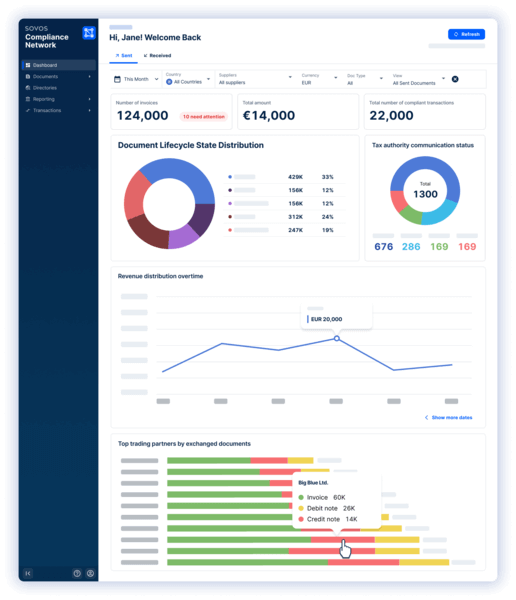
Compliance Network: E-Invoicing, E-Receipts and E-Archiving
Transact worldwide with confidence.
“Compliance is now inside the transaction, elevating its importance and driving businesses to look beyond just meeting a minimum threshold. Now, the goal is a global view of compliance with a single source of data that allows them to generate actionable business intelligence”
Kevin Permenter, Research Director
IDC
Get in touch: find out more about Compliance Network with our team of experts.
Global Compliance for Continuous Transaction Controls
Sovos Compliance Network is complete, continuous and connected. We process over 6 billion compliant invoices per year through our Compliance Network, more than 60 times other industry providers.
A core component of our Indirect Tax Suite, Sovos Compliance Network helps you:
Effortlessly map indirect tax compliance requirements with suppliers, buyers and consumers
Ensure your transactional documents adhere to the latest local regulations
Connect seamlessly with the right government agencies and certified platforms
Distribute invoices to trading partners where required
Build the Sovos Compliance Network into every transaction
The solution provides:
B2B & B2G Transaction Compliance
The world’s first complete solution for e-invoicing compliance, including clearance, CTC and global post-audit models.
Prove integrity and authenticity with universal, compliant archiving, including compliance maps, preservation sets, timestamps and signing and validation services.
40% of CFOs around the world say that they do not trust the accuracy of their financial data, with their biggest issue being able to access and analyze financial data in real time.
SAP S/4HANA migration projects create an opportunity for businesses to mitigate this risk and drive transformative results.
Join us for an insightful webinar featuring Marco van der Veer, Senior Tax Technology Manager at Sovos, as he explores the critical intersection of ERP transformation and tax compliance. This session will provide you with:
How your ERP transformation project converges with your tax compliance obligations
How the global tax landscape is evolving with data visibility at its core
The benefits of enabling ‘always on’ compliance
The risks of getting it wrong with the emergence of transaction-oriented indirect tax enforcement
Position your business for growth—register today to ensure accurate data and unwavering compliance.