This blog was last updated on March 25, 2026
The story of direct-to-consumer beer shipping in 2026 reveals a familiar but contradictory reality: consumer demand and spending intent remain strong, yet regulatory progress continues to lag behind.
Key Takeaways from the 2026 DtC Beer Report
The 2026 Direct-to-Consumer Beer Shipping Report highlights a widening gap between what consumers want and what current regulations allow. For breweries, retailers, and policymakers alike, this gap represents both a major challenge and opportunity.
Consumer demand for DtC beer shipping remains overwhelmingly strong
This year’s report reinforced that demand is certainly not the issue. In fact, 81% of regular craft beer drinkers and 63% of Americans age 21+ support the expansion of DtC beer shipping laws. Just as importantly, demand has proven to be remarkably stable over time.
Over the past several years, roughly four in five regular craft beer drinkers have consistently expressed interest in DtC-shipped beer purchasing. This consistency removes uncertainty for breweries and policymakers alike: the appetite for DtC beer shipping is not a trend, it’s an expectation.
Regulatory limitations remain the biggest barrier for breweries
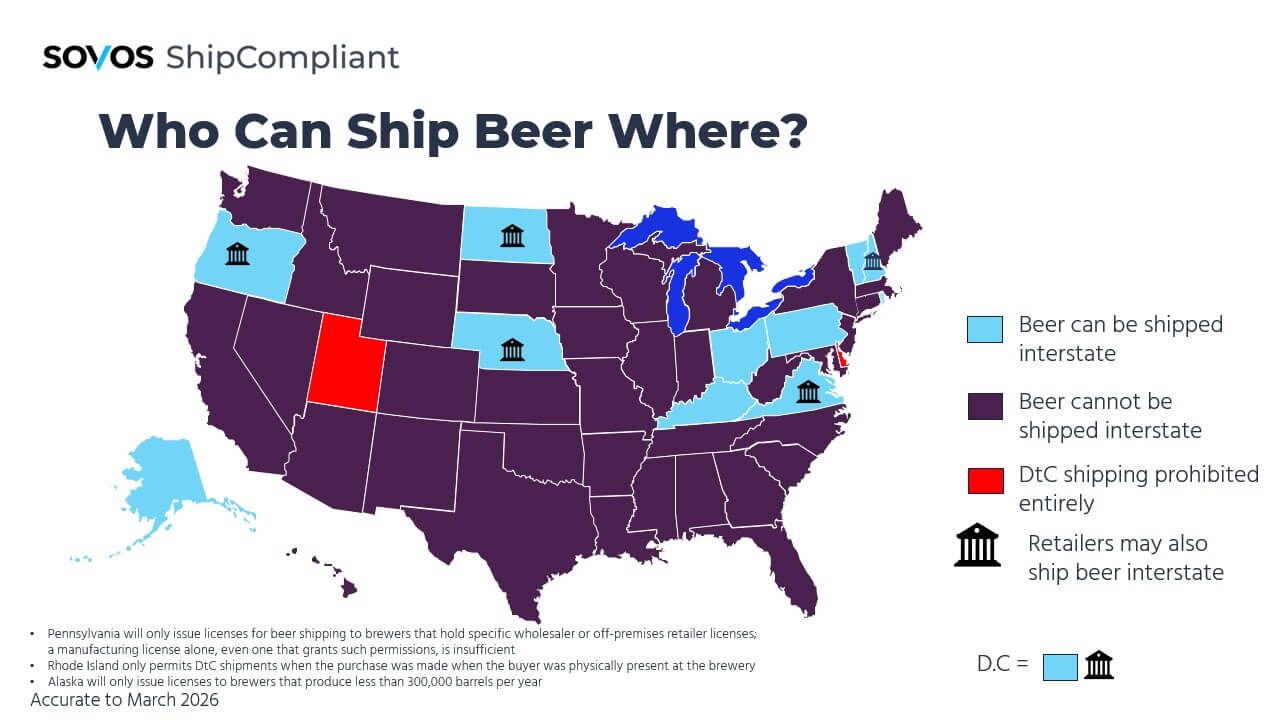
Another constant is that most of the country remains closed off to interstate DtC beer shipping. As of 2026, only 11 states plus Washington, D.C. allow it, compared to 48 states plus D.C. for wine. Even with legislative efforts in states like Texas and Illinois, progress has stalled. The result is a highly fragmented regulatory landscape that limits access, restricts growth, and creates unnecessary complexity for breweries attempting to scale.
The Opportunities for Brewers, Beer Drinkers & the Broader Ecosystem
If the first half of the DtC beer shipping trends are defined by limitations, the second half is defined by opportunity. The data shows that when access expands, the benefits are felt across the entire ecosystem—from breweries unlocking new revenue streams to consumers gaining access to the products they already want to buy.
Craft brewers: Unlocking new revenue and market access
Recurring revenue is one of the most compelling and obvious advantages of DtC, and the potential is clear. Sixty-nine percent of regular craft beer drinkers would subscribe to a DtC beer club. Relatedly, 77% of beer drinkers agree they would purchase more craft beer if direct shipping were available. This mirrors the success seen in the wine industry, where subscription models have driven long-term customer loyalty and predictable revenue streams, to the tune of a $3.7 billion channel.
Just as importantly, DtC offers a critical path to market for small and independent brewers. As noted by the Brewers Association, many breweries struggle to access traditional distribution, especially for niche, seasonal, or limited-release products. In this environment, DtC shipping becomes not just a growth channel, but a lifeline.
Beyond revenue, the brand impact is equally significant. Of the regular beer drinkers surveyed, 86% say they would view a brewery more positively while another 85% would be more likely to recommend to others if DtC were available.
Beer drinkers: Frustrated demand and unmet expectations
Breweries aren’t the only ones feeling the friction. Consumers are encountering it firsthand, as 75% of craft beer drinkers have discovered a beer while traveling that they couldn’t buy back home. Consumers are ready to buy, but the system prevents them from doing so—and it’s a missed opportunity for breweries to convert interest into sales.
The broader beverage alcohol ecosystem
One of the most persistent misconceptions about DtC beer shipping is that it threatens the three-tier system. However, 91% of consumers who are likely to buy beer via DtC shipping say they would look for those brands in retail afterward.
Consumers try new beers through direct shipping, then seek them out in bars, restaurants, and stores. Rather than disrupting the ecosystem, DtC strengthens it, acting as a demand-generation engine that benefits producers, distributors, and retailers alike.
What comes next for DtC beer shipping
The takeaway from the 2026 DtC beer report is clear: the industry is facing an access problem rather than a demand problem. Consumers are ready, breweries are ready, and the broader ecosystem stands to benefit. What’s missing is regulatory alignment.
Until laws evolve, breweries will continue to face constrained growth, and consumers will remain limited in how they discover and purchase craft beer. But the consistency of this data year over year sends a strong signal: change is not a matter of if, but when.
Explore more of the DtC beer shipping trends in 2026
The insights above only scratch the surface. The full report dives deeper into consumer behavior, regulatory trends, and what’s next for breweries navigating this evolving landscape. Download the 2026 Direct-to-Consumer Beer Shipping Report to explore the data, uncover new opportunities, and prepare for what’s ahead.